
We know that Christians should avoid vainglory, conceit, and the tacit expectation of rewards of grace during Lent. However, even the most careful and unceasing self-control does not always lead to the desired results. Protecting oneself from hidden vainglory during Lent is by no means easy. This is where Christian good deeds – when one really takes on human grief – can be of help. After all, when we move away from ourselves by coming into contact with concrete human trouble and misfortune, by sharing in someone’s oppressive grief, our own concerns fade into the background, silent and diminished. One person grieves because of frequent colds, while another dreams of learning to walk without crutches. When we see real grief right in front of us we begin to experience a burning shame not only for our own petty vainglory, but also for our prosperity: just recently we thought it defective and dared complain about our lot.
The Holy Church of Christ insists that we perform good deeds during the time of Great Lent, inasmuch as our acts of mercy not only relieve other people’s plights, making their lives easier and brighter, but they turn the struggler’s attention from himself to others, thereby quietly freeing him from his egotistical self. The wave of love that arises in us when we share in the misfortunes of others fills us with Divine life, animating and inspiring us while driving the passions far away, thereby cleansing us from their harmful and troublesome effects.
Why is the subject of good deeds so tightly interwoven in the Gospel with that of the end of the world and the Second Coming of Christ? After all, it would seem that the call to mercy is not especially inspiring when we are simultaneously being reminded that the earth and all deeds therein shall be consumed.
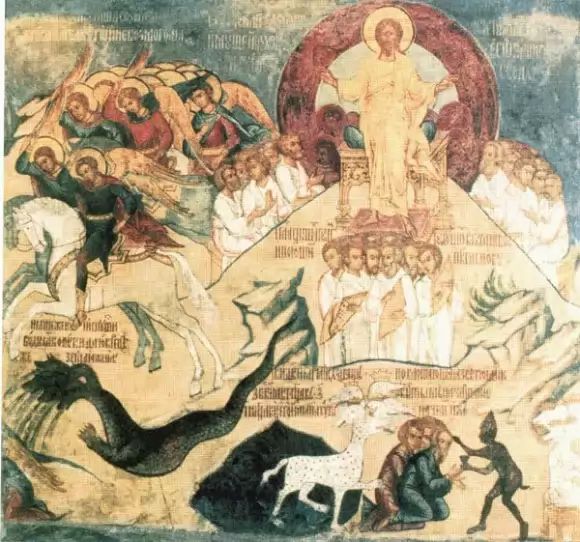
Icon of the Last Judgment. Seventeenth century.
The fact is that even good deeds, as with all other Christian actions, have their dangers. From the example of the Pharisee and the elder son in the parable of the Prodigal Son we have already seen how religious effort can take on an ungodly character that alienates man from God’s love. The same thing can happen with good deeds. If a Christian immerses himself in them to the point of completely forgetting the primary goal of human existence, then it is unlikely he will do himself any good. Good deeds themselves, if one forgets the memory of death, can acquire the character of an activity that is excited, chaotic, and scattered.
When the Jewish woman poured precious myrrh onto the head of Jesus, certain of the disciples said among themselves: Why was this waste of ointment made? For it might have been sold… and have been given to the poor (Mark 14:4-5). The indignant disciples probably expected the Savior to endorse their feelings. Christ, however, comes to the defense of this “squanderer”: why trouble ye her? she hath wrought a good work on Me. For ye have the poor with you always, and whensoever ye will ye may do them good: but Me ye have not always (Mark 14:6-7).
With these words the Savior warns His followers that the work of keeping oneself in the truth of the Gospel is of utmost importance and, moreover, that this does not yield in importance to Christian good deeds; in some cases it even surpasses them. Indeed, Christ tells us that our eternal fate depends entirely and wholly on deeds of mercy. By including this call to mercy in the general discourse on the Second Coming, however, the Gospel establishes the proportionality and consistency of every part of the Christian activity that makes up our salvation. As such, if we will always have in mind the Second Coming and the Dread Judgment, but all the while become so absorbed in the expectation of the end that we lose sight of concrete deeds of mercy, we will most likely not acquire that love without which no one can see God. Yet if we give ourselves over enthusiastically to deeds of love while forgetting about the fleeting and vain nature of all that takes place on earth and the memory of death, then our good deeds will take on an emotional rather than spiritual character and not bring us any closer to God.
In Ecclesiastes we read: To every thing there is a season, and a time to every purpose under the heaven… a time to keep silence… A time to love (3:1-8). A time of silence – a time of solitude and standing noetically before God’s Judgment – is no less essential to Christianity than the active and continuous performance of good deeds. This silence not only returns us from the superficial life around us back to our own depths, but also reminds us of the finite nature of everything that takes place on earth, thereby purifying our love from emotional exaltation.
Therefore, from the publican’s repentance to deeds of love and mercy; from good deeds to the memory of death; and from the memory of death back to repentance and prayer, we must make our journey toward the joyful and bright days of Christ’s Resurrection. The Gospel readings during these preparatory weeks show us the direction we are to follow in our Lenten journey: they are like road signs showing us the way to the Heavenly Jerusalem, to the Lord’s eternal and unceasing Pascha.
 St John’s Adult Education
One thought on “Sunday of the Last Judgment – Homily by Archpriest Symeon Lev”