About

Fifth Sunday Of Lent Adult Education Class

This will be our final class since next Sunday, April 17th, we’ll ask all to join in Palm Sunday Matins Service that will precede Divine Liturgy.

I will print out the following articles that we’ll plan to read and discuss in our class:

You may also find the posts from earlier this week relevant as a supplement and background for review and our discussion:

Preview Next Weekend – Lazarus Saturday and Palm Sunday

By Father Thomas Hopko from Volume II (The Church Year) in the OCA Faith Series

The week following the Sunday of Saint Mary of Egypt is called Palm or Branch Week. At the Tuesday services of this week the Church recalls that Jesus’ friend Lazarus has died and that the Lord is going to raise him from the dead (Jn 11). As the days continue toward Saturday, the Church, in its hymns and verses, continues to follow Christ towards Bethany to the tomb of Lazarus. On Friday evening, the eve of the celebration of the Resurrection of Lazarus, the “great and saving forty days” of Great Lent are formally brought to an end:

Having accomplished the forty days for the benefit of our souls, we pray to Thee, O Lover of Man, that we may see the holy week of Thy passion, that in it we may glorify Thy greatness and Thine unspeakable plan of salvation for our sake

Vespers Hymn
Lazarus

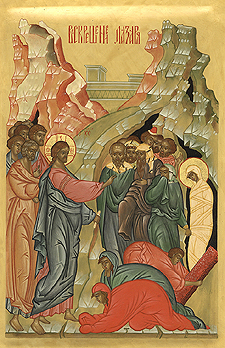
Lazarus Saturday is a paschal celebration. It is the only time in the entire Church Year that the resurrectional service of Sunday is celebrated on another day. At the liturgy of Lazarus Saturday, the Church glorifies Christ as “the Resurrection and the Life” who, by raising Lazarus, has confirmed the universal resurrection of mankind even before His own suffering and death.

By raising Lazarus from the dead before Thy passion, Thou didst confirm the universal resurrection, O Christ God! Like the children with the branches of victory, we cry out to Thee, O Vanquisher of Death: Hosanna in the highest! Blessed is he that comes in the name of the Lord! (Troparion).

Christ —the Joy, the Truth and the Light of All, the Life of the world and its Resurrection—has appeared in his goodness to those on earth. He has become the Image of our Resurrection, granting divine forgiveness to all (Kontakion).

At the Divine Liturgy of Lazarus Saturday the baptismal verse from Galatians: As many as have been baptized into Christ have put on Christ (Gal 3.27) replaces the Thrice-holy Hymn thus indicating the resurrectional character of the celebration, and the fact that Lazarus Saturday was once among the few great baptismal days in the Orthodox Church Year.

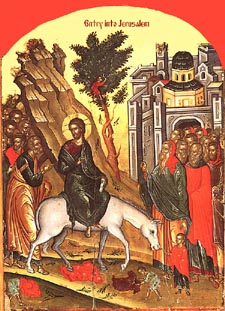
Because of the resurrection of Lazarus from the dead, Christ was hailed by the masses as the long-expected Messiah-King of Israel. Thus, in fulfillment of the prophecies of the Old Testament, He entered Jerusalem, the City of the King, riding on the colt of an ass (Zech 9.9; Jn 12.12). The crowds greeted Him with branches in their hands and called out to Him with shouts of praise: Hosanna! Blessed is He who comes in the name of the Lord! The Son of David! The King of Israel! Because of this glorification by the people, the priests and scribes were finally driven “to destroy Him, to put Him to death” (Lk 19.47; Jn 11.53, 12.10).

Palm Sunday

The feast of Christ’s triumphal Entry into Jerusalem, Palm Sunday, is one of the twelve major feasts of the Church. The services of this Sunday follow directly from those of Lazarus Saturday. The church building continues to be vested in resurrectional splendor, filled with hymns which continually repeat the Hosanna offered to Christ as the Messiah-King who comes in the name of God the Father for the salvation of the world.

The main troparion of Palm Sunday is the same one sung on Lazarus Saturday. It is sung at all of the services, and is used at the Divine Liturgy as the third antiphon which follows the other special psalm verses which are sung as the liturgical antiphons in the place of those normally used. The second troparion of the feast, as well as the kontakion and the other verses and hymns, all continue to glorify Christ’s triumphal manifestation “six days before the Passover” when he will give himself at the Supper and on the Cross for the life of the world.

Today the grace of the Holy Spirit has gathered us together. Let us all take up Thy cross and say: Blessed is he who comes in the name of the Lord. Hosanna in the highest! (First Verse of Vespers).

When we were buried with Thee in baptism, O Christ God, we were made worthy of eternal life by Thy resurrection. Now we praise Thee and sing: Hosanna in the highest! Blessed is he that comes in the name of the Lord! (Second Troparion).

Sitting on Thy throne in heaven, and carried on a foal on earth, O Christ God, accept the praise of angels and the songs of children who sing: BIessed is he who comes to recall Adam! (Kontakion).

At the vigil of the feast of Palm Sunday the prophecies of the Old Testament about the Messiah-King are read together with the Gospel accounts of the entry of Christ into Jerusalem. At Matins branches are blessed which the people carry throughout the celebration as the sign of their own glorification of Jesus as Saviour and King. These branches are usually palms, or, in the Slavic churches, pussy willows which came to be customary because of their availability and their early blossoming in the springtime.

As the people carry their branches and sing their songs to the Lord on Palm Sunday, they are judged together with the Jerusalem crowd. For it was the very same voices which cried Hosanna to Christ, which, a few days later, cried Crucify Him! Thus in the liturgy of the Church the lives of men continue to be judged as they hail Christ with the “branches of victory” and enter together with Him into the days of His “voluntary passion.”

Humble Repentance or Paralyzing Guilt – Homily Fifth Sunday of Lent

By Father Philip LeMasters

            Whenever we experience guilt and shame because of something we have done wrong, we need to ask ourselves a question.  Do we feel that way because we are sorrowful that we have disobeyed God or because we cannot stand being less than perfect in our own eyes or those of others?  The first kind of humiliation is spiritually beneficial and may lead to repentance, but the second kind is simply a form of pride that easily paralyzes us in obsessive despair. At this point in our lives, most of us probably experience some mixture of these two types of shame.  As we grow closer to Christ, the first must increase and the second must decrease.

When we wonder if there is hope for the healing of our souls in this way, we should remember St. Mary of Egypt. She stands as a brilliant icon of how to repent from even the most shameful sins. Mary experienced a healthy form of guilt when her eyes were opened to how depraved she had become through her life of addiction to perverse sexual pleasure.  Through the intercessions and guidance of the Theotokos, she venerated the Holy Cross at the Church of the Holy Sepulcher and received Communion on her way to decades of ascetical struggle in the desert. When the monk Zosima stumbled upon her almost 50 years later, he was amazed at her holiness.  He saw this holy woman walk on water and rise up off the ground in prayer, but like all the saints she knew only her own sins and perpetual need for the Lord’s mercy.

Perhaps what makes St. Mary of Egypt’s story such a beautiful icon of true repentance is that she was genuinely humble before God.  She was not sorrowful for her sin out of a sense of wounded pride, obsessive self-centered guilt, or fear of what others thought of her.  Instead, she said earnestly to the Theotokos “Be my faithful witness before your Son that I will never again defile my body by the impurity of fornication, but as soon as I have seen the Tree of the Cross I will renounce the world and its temptations and will go wherever you will lead me.”  And she did precisely that, abandoning all that she had known for the long and difficult journey that led to the healing of her soul.  Her focus was completely on doing whatever it took to reorient her life toward God, to purify her desires so that she would find true fulfillment in Him.

Today the Orthodox Church calls us all to follow her example of repentance, regardless of the details of how we have sinned in thought, word, and deed. By commemorating a notorious sex addict who became a great saint, we proclaim that no sin is so shameful that we cannot repent of it.  An honest look at our lives, as we should all take during Lent, dredges up shame and regret in various forms.  St. Mary of Egypt reminds us to accept humbly the truth about our failings as we confess our sins, call for the Lord’s mercy, and do what is necessary to find healing.  Her example reminds us not to be paralyzed by prideful obsessions that block us from being freed from slavery to our passions.  Even her depraved way of life did not exclude St. Mary of Egypt from acquiring remarkable holiness.  If she did not let a perverse form of pride deter her from finding salvation, then no one should be ashamed to kneel before Christ in humility. The Savior did not reject her and He will not reject us when we come to Him as she did.

In today’s gospel text, James and John related to Christ in a very different way, for they wanted the best positions of power when He came into His Kingdom.  The Lord challenged their prideful delusions by reminding the disciples that humility, not self-exalation, is the way to life eternal.  He said “For even the Son of Man did not come to be served, but to serve, and to give His life a ransom for many.”  How shocking that today we celebrate honest, humble repentance from a woman with a truly scandalous past while some of the men closest to Christ in His earthly ministry think only of getting worldly power for themselves.

Perhaps the key difference is that St. Mary of Egypt got over obsession with herself.  Instead of assuming that she was “damaged goods” for whom there was no hope, she humbly died to self by taking up her cross.  Indeed, her repentance began in the context of venerating the Holy Cross at the Church of the Holy Sepulcher.  The rest of her journey required profound faith, sacrifice, and courage. To undo with God’s help the harm that she had done to herself through years of debauchery must have been incredibly difficult.  But sustained by the Lord’s mercy and the intercessions of the Theotokos, that is precisely what she did over the remaining decades of her life.

Today, so near the end of Lent and only a week from Palm Sunday, we see that this is the path we must take also.  In order to follow it, we must not be paralyzed in prideful shame about anything we have said, thought, done, or otherwise experienced or participated in at any point in our lives.  Instead, we must have the brutal honesty and deep humility of St. Mary of Egypt, a woman with a revolting past who became a shining beacon of holiness.  That is how she found healing for her soul and it is how we will find healing for ours also. The good news of this season is that the Lord makes such blessedness possible for us all through His Cross, His descent into Hades, and His glorious resurrection on the third day.  But in order to participate in the great mystery of His salvation, we too must get over our pride, accept His mercy, and actually repent.  If St. Mary of Egypt could do that with her personal history, we can too.

Great Lent And The Mystery of the Cross & Resurrection – Short Reflection

By Archimandrite Zacharias from his book ’At The Doors of Holy Lent’

Great Lent is a taste of death in the Name of God, for the sake of our reconciliation with Him, for the sake of His commandment. The little death that that beast, our ego, endures through fasting, through voluntarily bearing shame in the mystery of confession, by shedding streams of wretched tears for our dire poverty and inability to render mighty love unto the Lord; this death places us on the path of Him Who said: ‘I am the first and the last: I am He that liveth, and was dead; and, behold, I am alive for evermore.’(Rev 1:17-18). This begets in the heart the faith that, ‘If we be dead with Christ, we believe that we shall also live with Him: Knowing that Christ being raised from the dead dieth no more; death hath no more dominion over Him.’ (Rom 6:8-9). Then on the night of the Resurrection, we sing with boldness the hymn: ‘Yesterday, O Christ, I was buried with Thee and today I rise again with Thy rising. Yesterday I was crucified with Thee: do Thou Thyself glorify me, O Saviour, in thy kingdom.’ Our minor taste of death leavens in the heart and, upon hearing the good news of the Resurrection of Christ, it becomes an explosion of joy, initiating us into the mystery of His descent into hell and ascension above the Heavens.

The Church is preoccupied with only one matter: the Cross and Resurrection of Christ. Saint Paul was consumed by the desire to set forth before his disciples the image of Jesus Christ, ‘and Him crucified’ (1 Cor 2:2). In other words, his concern was to impart to them the knowledge of the mystery of the Cross and Resurrection of Christ, knowing that whosoever walks the way of the Cross will also enter into the presence of the Risen Lord. The Church institutes as a commandment that we should go through this period with spiritual tension for the renewal of our life. She travails to see her children assimilated through obedience into the mystery of the Cross and Resurrection of Christ.

Putting All of the Fifth Week of Lent Together – Father Thomas Hopko

At the end of the fifth week of Great Lent, and very particularly on the fifth Sunday, the Orthodox Church has all of its members and faithful Christians contemplating a very beloved and well-known person in Christian history for ancient Christians, and that is a woman named Mary of Egypt. On the matins of the Thursday of the fifth week, there is a penitential canon of St. Andrew of Crete that is read. That particular service, which is a long type of penitential vigil, is often called in Orthodox popular piety “the vigil of Mary of Egypt.” It’s kind of an identification with Mary. In Slavonic, it’s called Marii bodrstvovaniye, the standing with Mary in penance before God. Indeed, in that canon, with all the penitential verses, there are verses that ask Mary of Egypt to intercede for us, to pray for us, as part of the penitential canon. St. Andrew of Crete, the author, is also asked, but particularly Mary of Egypt.

On this Sunday, it’s again kind of a paradox in Orthodox worship, because the focus is now all on Christ. You have that great celebration of the Theotokos with the Akathist on Saturday, and then you enter into the Lord’s Day, and you hear the gospel about Christ going up to Jerusalem and entering into his glory through his suffering. Then even on that Sunday also in the epistle reading, we’ll hear again about how Christ enters into the holy of holies in heaven, not of creation, the sanctuary of God, securing for us an eternal redemption, and that he’s led to offer his blood on the cross through the eternal Holy Spirit where he offers himself without blemish to God and we are encouraged to purify our consciences from dead works in order to serve the living God.

So we are focusing on Christ, but then, with that, you have this whole Sunday when on the one hand you have these marvelous hymns about the resurrection and the victory of Christ on that Sunday, and then you hear even more about this Mary of Egypt. And it’s a kind of a juxtaposition. It’s almost as if the Holy Spirit and God Almighty wants us to keep these two things together. As we focus on Christ and his victory and go up with him to Jerusalem, then we know that this is for everyone and that it is for the worst of sinners. Nobody is excluded, and you can never forget that when you think of Mary of Egypt.

Who was this Mary? It’s interesting that on that Thursday matins with that canon the entire Life of Mary of Egypt is read in church.

…Orthodox Christians in this ancient tradition are called to contemplate that Mary, to remember her. And what’s the point? What’s the point? Oh, there are probably so many, and maybe the points are different for every single person who hears that story, but there’s two points that are for sure. One is that, no matter how sinful we are, the Lord God Almighty forgives us. The other point is that repentance is not just an emotion. It’s not just some kind of magical act. When we repent, we have to purge out of ourselves all of the garbage and filth and slime that’s in us. We have to go through a purgation process before we can be illumined and deified. All that is evil in us has to go: it’s got to be scrubbed away; it’s got to be cut out by the word of God that’s a two-edged sword that cuts the bones and marrows, the sinews, as it says in [the] letter to the Hebrews, the heart of people.

Penance is a work. It is a work. It’s made possible by faith and grace, but it is the result of faith and grace. We know God, we believe in him, we accept his grace, and then that grace purifies us, but it’s not automatic. I can’t resist saying—maybe I shouldn’t on the radio—about how one of my friends would say, “We believe in God the Father, Creator of heaven and earth; and the Son, the Lord Jesus Christ; and the Holy Spirit. We don’t believe in the Magician, the Mechanic, and the Fairy Godmother.” God is not a fairy godmother. He’s not a magician. He’s not a mechanic. There has to be a synergia between us and God. We have to accept that grace that cleanses us, that heals us, that power, and it’s got to happen, and it takes time. It takes time, it takes effort, it takes perseverance to the end. How often Jesus said, “Those who persevere to the end will be saved.” He says, “In hypomone, in patient endurance you will win your life,” and that repentance is a process; it’s not a momentary act.

Yes, Mary had her conversion experience. Yes, she knew the grace and the love of God at that moment, at that Holy Sepulcher. Yes, she knew that she was saved when she was allowed to enter and to venerate the tomb of Christ and receive the precious gifts of his broken body and spilled blood for the forgiveness of her sins, for the healing of her soul and her body and her passions and emotions and for the attaining of everlasting life. Yeah, that moment took place, and there are many such moments often in people’s lives. But then there is the result of that moment: the ongoing life in conformity to that moment. That’s what we see also in Mary of Egypt.

When I was the dean of St. Vladimir’s and the pastor of the chapel, and of course I was there for 30-some years, I always loved that fifth week of Lent. We had a practice at the seminary chapel that was, for me, at least, incredibly significant and marvelous. This is what it was: We would have those penitential services: the Presanctified on Wednesday with all those prostrations and those 24 additional penitential hymns—“O Lord, before I perish utterly, before I perish to the end, do thou save me, O Lord.” We would sing that canon of Andrew with Mary and keep that vigil on that Thursday. Honestly, we cut it down a bit. We were not monks and monastics there; we had our schedule to live, but we did it. We did it, yes. And then we sang the entire Akathist Hymn the next day, with all that marvelous celebration and veneration of the Theotokos with everything we could possibly think of put into our mouth to celebration the incarnation of the Son of God through her.

And when we sang that Akathist Hymn, we had a quite large icon of the Theotokos, Mother of God, with the Child, and we had it set in the middle of the church, and it was surrounded by flowers. It was decorated by beautiful flowers, and we would stand in front of that icon of the Theotokos, Mary, Mother of God. The deacons would be incensing and the whole church would be singing this marvelous Akathistos Hymn with all those wonderful words. Then we would celebration the Incarnation and Mary on that Saturday in the morning.

And then, on Saturday evening when we would come for the vespers and the matins and the Divine Liturgy of the fifth Sunday of Lent, in that same frame of flowers, on that same stand, the same analoy, in the middle of our same church, would be another icon: an icon of another Mary. Because we would remove the icon of the Theotokos and Child, and in that very same frame of flowers, on that very same stand, in the middle of our very same chapel, we would see Mary of Egypt. What a contrast that was! What an amazing thing it was, that on Saturday we’re glorifying and venerating the incarnation of the Son of God through the All-pure Virgin, of whom is more holy? The most holiest of mere human beings, Christ’s mother, Mary, holding in her arms the Holy One of God, Jesus Christ, our Savior and Lord, the Messiah of Israel, the Savior of the world. Holiness! Holiness like you cannot imagine! was in that icon in those flowers and in those songs.

And then in the same building, on the same stand, in the same flowers—was Mary of Egypt. And our icon showed her emaciated, sun-burnt, her hair frizzly white, and her face totally beautiful, and even similar to the face of the Theotokos in the iconography. Totally beautiful. And we knew that a nymphomaniac, sexually addicted harlot and even-worse-than-a-harlot human enters the same radiance and the same glory as the Mother of Christ and of all believers. Like Mary, she herself became more honorable than cherubim, more glorious than seraphim, because in Christ everyone who’s saved has that particular glory. We all are enthroned with Christ over all the angels—the twelve apostles sit on twelve thrones, judging the angels, it says in Scripture. We really are deified and enter into the glory of God. That is why Christ was born of a Virgin, and that’s why we venerate his mother so magnificently.

But on this day we know that the worst, the lowliest, the filthiest, the most addicted, the most impassioned, the most possessed, by faith and grace through that same Christ, by the intercessions of his mother and all the saints, can enter into that same glory. And Mary of Egypt tells us that. She shows us that. And then she begins herself to intercede for us poor sinners. Maybe some of us listening are sex-addicted ourselves and nymphos and whatever, controlled and on computers, looking at porno and whatever—but there’s hope for us. There’s hope for us. Mary of Egypt proves there’s hope for us.

But it’s not magic, it’s not mechanical; God is not a fairy godmother. There must be faith, grace accepted and lived out, and that purgation that leads to illumination that leads to glorification, leads to deification—can be ours. If it can be Mary of Egypt’s, then it can be ours. And how wonderful it was to go to church on Saturday of the fifth week and stand in front of that flower-decorated icon of the Theotokos and Child, and to come back again that same night and the next day and to see, in that same place, Mary of Egypt.

Why is the Great Canon done in its entirety in the 5th week of Lent

Remember to check out the Great Canon Resource Page as you prepare

By Fr. Sergei V. Bulgakov

At Matins on this day the Canon of St. Andrew of Crete is read in its entirety once a year, which was read in four parts on the first four days of the first week, and the Life of St. Mary of Egypt is read after the Sessional Hymn (Kathisma). According to this feature of the Thursday Matins it is called either the St. Andrew of Crete or the St. Mary of Egypt Thursday. 

In the Canon are collected and stated, all the exhortations to fasting and repentance, and the Holy Church repeats it now in its fullness to inspire us new strength for the successful end to Lent. “Since”, it is said in the Synaxarion, “the Holy Forty Day Lent is drawing near the end so that men should not become lazy, or more carelessly disposed to the spiritual efforts, or give up their abstinence altogether,” that this Great Canon is offered. It is “so long, and so well-composed, as to be sufficient to soften even the hardest soul, and to rouse it to resumption of the good, if only it is sung with a contrite heart and proper attention”. And the Church Typikon (Ustav) orders the Great Canon to be read and chanted slowly and “with a contrite heart and voice, making three prostrations at each Troparion”. 

For the same purpose of abstinence and strength, and attention to repentance is the reading of the Life of the Venerable Mary of Egypt. According to an explanation of the same Synaxarion, the Life of the Venerable Mary also “manifests infinite compunction and gives much encouragement to the fallen and sinners”, representing itself to us as a paradigm of true repentance, and an example of the unutterable mercy of God. It serves as the continuation of the Canon of St. Andrew of Crete and a transition to the order of the following Sunday. Reading the Canon of St. Andrew and Mary of Egypt on the Thursday of the Fifth Week was established from the time of the Sixth Ecumenical Council.

Kontakion in Plagal of the Second Tone

My soul, my soul, arise. Why are you sleeping? The end is approaching, and you will be confounded. Awake, therefore, that you may be spared by Christ God, Who is everywhere present and fills all things.

St. Symeon the New Theologian – His Lessons on Humility & Joyful Sorrow

This 11th century saint shed many tears in his life, and wrote much about the ’not of this world’ paradox of joyous tears. Below are a few of his quotes on humility and joyful sorrow. A common theme to many of these quotes is his experience of his own spiritual poverty in his journey to the wealth of what lies beyond in the mercy and grace of our Triune God. As Father Thomas Hopko would remind us “genuine humility means to see reality as it actually is in God”. You may also find this talk from our own Archbishop Alexander about the life of St. Symeon very interesting as he raises an awareness of his unique contributions to our faith.

“When the faithful man, who always pays strict attention to the commandments of God, performs all that the divine commandments enjoin and directs his mind toward their sublimity, that is, to a conduct and purity that are above reproach, he will discover his own limitations. He will find that he is weak and lacks the power to attain to the height of the commandments, indeed that he is very poor, that is, unworthy to receive God and give Him thanks and glory, since he has as yet failed to attain any good of his own. One who thus reasons with himself in the perception of his soul will indeed mourn with that sorrow which is truly most blessed, which will receive comfort and make the soul meek (cf. Matt. 5:5).”

He also writes:

“Let us long with all our soul for the things God commands us to embrace, spiritual poverty, which is humility; constant mourning by night and by day, from which there wells forth the joy of the soul and the hourly consolation for those who love God. By this means all who strive in truth succeed in attaining meekness. Those who hunger and thirst for righteousness and seek it at all times will obtain the kingdom of God, which ‘surpasses all human understanding’ (Phil. 4:7). Further, one becomes merciful, pure in heart, full of peace, a peacemaker, courageous in the face of trials (cf. Matt. 5:3-11). All this is the result of mourning day by day. It is also brought to pass that we will hate evil; it kindles in the soul that divine zeal which does not allow it to be ever at ease or to incline to evil deeds with evil men, but fills it with courage and strength to endure to the end against adversities.”

Elsewhere he writes: 

“The first effect of mourning in God is humility; but later it brings unspeakable joy and gladness. And around humility in God grows the hope of salvation. For the more a man feels with his whole soul that he is the most sinful of men, the more strongly hope and humility grow and blossom in his heart, and fill him with the conviction that, through humility, he will surely gain salvation.”

He also writes:

“Mourning has a twofold action: like water tears extinguish all the fire of the passions and wash the soul clean of their foulness; and, again, through the presence of the Holy Spirit, it is like fire bringing life, warming and inflaming the heart, and inciting it to love and desire God.”

Elsewhere he again writes:

“Where there is humility there is also the enlightenment of the Spirit. And where there is the enlightenment of the Spirit there is also the outpouring of the light of God, there is God in the wisdom and knowledge of His mysteries. Where these mysteries are to be found, there is the kingdom of heaven and the experience of the kingdom and the hidden treasures of the knowledge of God, which include the manifestation of the poverty of spirit. Where poverty of spirit is perceived, there also is the sorrow that is full of joy. There are the ever-flowing tears that purify the soul that love these things and cause it to be completely filled with light.”

Also:

“O tears, which flow from divine enlightenment and open heaven itself and assure me of divine consolation! Again and many times over I utter the same words out of delight and longing. Where there is abundance of tears, brethren, accompanied by true knowledge, there also shines the divine light. Where the light shines, there also all good gifts are bestowed and the seal of the Holy Spirit, from whom spring all the fruits of life, is implanted in the heart. Here also the fruit of gentleness is borne for Christ, as well as ‘peace, mercy, compassion, kindness, goodness, faith and self-control’ (Gal. 5:22-23). It is the source of the virtue of loving one’s enemies and praying for them (Matt. 5:44), of rejoicing in trials, of glorying in tribulations (Rom. 5:3), of looking on the faults of others as if they are one’s own and lamenting them, and of laying down one’s life for the brethren with eagerness even unto death.”

4th Sunday of Lent – ‘Lord I Believe; Help My Unbelief’ Adult Education Class

This week we celebrated the mid-point of the Lenten fast. We’ve had the Cross out in the church and heard words that encourage us to enjoin ourselves to the Cross as the not of this world ’refuge of all men’.

The Cross is the haven of the storm-tossed, the guide and support of those that go astray, the glory of Christ, the power of the apostles and the prophets, the strength of God’s athletes, the refuge of all men. We see it set before us in this time of fasting and we venerate it.

Heal my brokenness, O King of all, crucified upon the Cross in thy surpassing love. Thy hands and feet were pierced with nails, Thy side was wounded with the spear, and Thou wast given vinegar and gall to drink, who art the joy of all men, their sweetness, glory and eternal redemption.

The Fast that brings us blessings has now reached its midmost point: it has helped us to receive God’s grace in the days that are past, and it will bring us further benefit in the days still to come. For by continuing in what is right we attain yet greater gifts. We therefore cry to Christ, the Giver of all good: O Thou who for our sakes hast fasted and endured the Cross, make us worthy to share uncondemned in Thy divine Passover. May we spend our lives in peace and rightly glorify Thee with the Father and the Spirit.

Triodion Matins/Vespers Wednesday/Friday 4th Week

This Sunday we venerate St. John Climacus and his great work ’The Ladder of Divine Ascent’. In our Vigil we’ll sing these powerful words that unite him to the Cross and as a guide for our own Lenten journeys.

O holy father John, through faith thou hast lifted up thy mind on wings to God; hating the restless confusion of this world, thou has taken up thy Cross; and following Him who sees all things, though has subjected thy rebellious body to His guidance through ascetic discipline, by the power of the Holy Spirit

O holy father John, truly hast though ever carried on thy lips the praises of the Lord, and with great wisdom has thou studied the words of Holy Scripture that teach us how to practice the ascetic life. So hast thou gained the riches of grace, and thou has become blessed, overthrowing all the purposes of the ungodly.

Triodion Vespers 4th Sunday of Lent

During this week’s class time, I’d like us to focus on the Gospel reading (Mark 9: 17-31) for today and the humility and honesty of the appeal ’Lord I believe, help my unbelief’. I’d also like us to do a deep dive into the Prayer of St. Ephraim and what lessons it has for us as we now enter the second half of our Lenten journey.

I’ll print the following articles for our class Sunday:

During the week, I posted some additional articles that you may find relevant and useful as we prepare for class:

“Lord I Believe ; Help My Unbelief”- Homily for 4th Sunday of Lent

Father Phillip LeMasters

Sometimes we stand before God with more doubt than belief, with more despair than hope. Sometimes our worries and fears increase; the joy of life slips away and we feel rotten. Maybe it’s our health, the problems of our loved ones, stress about a busy schedule, or other matters at home, at work, or with our friends. We are sometimes simply at the end of our rope.

If you feel that way today or ever have in your life, you can begin to sympathize with the father of the demon-possessed young man in today’s gospel reading. Since childhood, his son had had life-threatening seizures and convulsions. With the broken heart of a parent who has little hope for his child’s healing, the man cries out, “Lord, I believe; help my unbelief.” Christ’s disciples had lacked the spiritual strength to cast out the demon, but the Lord Himself healed him. We can only imagine how grateful the man and his son were for this blessing.

And imagine how embarrassed the disciples were. The Lord had referred to them as part of a “faithless generation” and asked how long he would have to put with them. He told them that demons like this “can come out by nothing but prayer and fasting,” spiritual exercises designed to strengthen our faith and to purify our souls. Not only were the disciples unable to cast out the demon, they could not even understand the Savior’s prediction of His own death and resurrection. At this point in the journey, they were not great models of faithfulness.

In fact, the best example of faithfulness in this story is the unnamed father. He wants help for his child, and he tells the truth about himself. His faith was imperfect; he had doubts; his hopes for his son’s healing had been crushed many times before. He said to Christ, “If you can do anything, have compassion on us.” In other words, he wasn’t entirely sure if the Lord could heal his son. All that he could do was to cry out with tears, “Lord, I believe; help my unbelief.”

And in doing so, he showed that he had the spiritual clarity that the disciples lacked, for he knew the weakness of his faith. Still, with every ounce of his being He called to the Lord for mercy. He received it and the young man was set free.

If we have taken Lent seriously at all this year, we will have become at least a bit like this honest father when our struggles with spiritual disciplines have shown us our weakness. When we pray, we often welcome distractions; and it’s so easy not to pray at all. When we set out to fast from food or something else to which we have become too attached, we often become angry and frustrated. When we try to forgive and be reconciled with others, memories of past wrongs and fears about the future often overcome our good intentions. We wrestle with our passions just a bit, and they get the better of us. We so easily do, think, and say things that aren’t holy at all. We put so much else before loving God and our neighbors. Lent is good at breaking down our illusions of holiness, at giving us a clearer picture of our spiritual state. And often we don’t like what we see.

If that’s where you are today, take heart, for Jesus Christ came to show mercy upon people like the father in our gospel lesson. That man knew his weakness, he did not try to hide it, and he honestly threw himself on the mercy of the Lord. He made no excuses; he did not justify himself; he did not complain. He did not hide his doubt and frustration before God. He did not wallow in wounded pride, obsess about his imperfections, or worry about what someone else would think of him. Instead, he simply acknowledged the truth about his situation and called upon Christ with every ounce of his being for help with a problem that had broken his heart.

We don’t know how religious this man appeared to anyone else.   Perhaps his fasting had been his many years of selfless struggle to care for his son; perhaps his prayers had always been focused on the boy’s healing.  But we do know that this man, in humility and honesty, received the mercy of Jesus Christ when he called to Him. 

With whatever level of spiritual clarity we possess, with whatever amount of faith in our souls, with whatever doubts, fears, weaknesses, and sins that beset us, let us all follow his example of opening the wounds of our hearts and lives to the Lord.  Jesus Christ heard this man’s prayer; He brought new life to his son.  And He will do the same for us, when we fall before Him in honest repentance, knowing that our only hope is in the great mercy that He has always shown to sinners like you and me whose faith leaves a lot to be desired.

If we need a reminder of the importance of taking Confession this Lent, this gospel passage should help us. Christ did not reject a father who was brutally honest about his imperfect faith, but instead responded to his confession with abundant grace, healing, and love. He will do the same for each of us who stand before His icon with the humble plea for forgiveness, “Lord, I believe; help my unbelief.” There is no better way to prepare to follow our Savior to the agony of the cross and the joy of the empty tomb.

Finding ‘God With Us’

I love this short article. It’s powerful in waking us up to what Archbishop Kallistos Ware describes as being ’conscious of our dependance on God’. It’s also helpful in relating our cross to His as we venerate the Cross this week. It’s helpful for me to remain clear about what we are doing and why we are doing it as we now now enter the home stretch of our Lenten journey together.

God With Us – By Father Stephen Freeman

Popular New Age thought postulates that everyone has a “god within.” It’s a pleasant way of saying that we’re all special while making “god” to be rather banal. But there is a clear teaching of classical Christianity regarding Christ-within-us, and it is essential to the Orthodox way of life.

We should not understand our relationship with God to be an “external” matter, as if we were one individual and God another. Our union with God, birthed in us at Holy Baptism, is far more profound.

“He who is joined to the Lord is one spirit with Him.” (1Co 6:17)

God does not “help” us in the manner of encouraging us or simply arranging for things to work out. Rather, He is in us, working in union with our work. The mystery of ascesis (the practice of prayer, fasting, self-denial, etc.) only makes true sense in this context. Those who look at Orthodoxy from the outside often accuse us of practicing “works-righteousness,” meaning that we believe we can earn favor with God by doing good works. This is utterly false. God’s good favor is His gift and cannot be earned.

However, the Orthodox life is similar to the life of Christ Himself.

“Truly, I say to you, the Son can do nothing of Himself, but what He sees the Father do; for whatever He does, the Son also does in like manner.  (Joh 5:19)

and

“Truly, I say to you, he who believes in Me, the works that I do he will do also; and greater works than these he will do, because I go to My Father. (Joh 14:12)

The “works” that a Christian does, are properly done in union with Christ, such that the works are not those of an individual, but of our common life with and in Christ. When we fast, it is Christ who fasts in us. When we pray, it is Christ who prays in us. When we give alms it is Christ who gives alms in us.

And we should understand that Christ-in-us longs to fast. Christ-in-us longs to pray. Christ-in-us longs to show mercy. The disciplines of the Church are not a prescription for behaving ourselves or a map of moral perfection. Rather, the commandments of Christ (as manifest in the life of the Church) are themselves a description, an icon of Christ Himself.

 Jesus answered and said to him, “If anyone loves Me, he will keep My word; and My Father will love him, and We will come to him and make Our home with him.” (Joh 14:2)

Dumitru Staniloae notes:

At the beginning Christ is, so to speak, buried in the commandments and in us, in the measure in which we are committed to them, by His power which is in us. By this collaboration we gain the virtues as living traits; they reflect the image of the Lord, and Christ is raised even brighter from under these veils. (Orthodox Spirituality)

This way of “union” is the very heart of Orthodox faith and practice. Sadly, much of Christianity has created an “extrinsic” view of our relationship with God and the path of salvation. In this, God is seen as exterior to our life, our relationship with Him being analogous to the individualized contractual relationships of modern culture. As such the Christian relationship with God is reduced to psychology and morality.

It is reduced to psychology in that the concern is shifted to God’s “attitude” towards us. The psychologized atonement concerns itself with God’s wrath. It is reduced to morality in that our behavior is no more than our private efforts to conform to an external set of rules and norms. We are considered “good” or “bad” based on our performance, but without regard to the nature of that performance. St. Paul says that “whatsoever is not of faith is sin.” Only our lives-lived-in-union-with-Christ have the nature of true salvation, true humanity. This is the proper meaning of being “saved by grace.”

…for it is God who works in you both to will and to do for Hisgood pleasure. (Phi 2:13)

and

You are of God, little children, and have overcome them, because He who is in you is greater than he who is in the world. (1Jo 4:4)

and

To them, God willed to make known what are the riches of the glory of this mystery among the Gentiles: which is Christ in you, the hope of glory. (Col 1:27)

There is a second part of this mystery (Christ in us) that presses its importance upon us. This is the suffering of Christ within us. Fr. Staniloae writes:

Jesus takes part in all our sufferings, making them easier. He helps us with our struggle against temptations and sin; He strives with us in our quest for virtues: He uncovers our true nature from under the leaves of sin. St. Maximus comments: Until the end of the world He always suffers with us, secretly, because of His goodness according to [and in proportion to] the suffering found in each one.

The Cross recapitulates the suffering and sin of humanity, but it extends throughout the life and experience of all people. It is the foundation of Christ’s statement: “Inasmuch as you did it [did it not] unto the least of these my brethren, you did it [did it not] unto me.

The hypostatic union of the person of Christ extends into the life of every person. There is something of a perichoresis or coinherence in our daily relationship with Christ.

And if one member suffers, all the members suffer with it; or if one member is honored, all the members rejoice with it. (1Co 12:26)

This must be given  the strongest possible reading. If any one of us suffers, Christ suffers. There is no specific human suffering to which Christ is alien.

It is the moment-by-moment pressing into this commonality (koinonia) that is the foundation of Christian existence. It is the point of Baptism (buried with Him). It is the point of the Eucharist (“whosoever eats my flesh and drinks my blood abides in me, and I in him”). It is the point of every action and thought.

It is the life of grace.