The Grace Of Our Powerlessness – 2026 Lenten Book Club Reflection

A key theme in Lecture 2 of our 2026 Lenten book ‘The Suffering Of The Soul In Relationships’ is the on-ramp of powerlessness to an authentic dependence on God and communion with Him. Here’s a quote from the book that captures this:

Our most important task is to look at our powerlessness, accept it, and call God and receive Him in this very powerlessness. If we understand that we cannot be good without God, then this will suddenly take the weight off of our shoulders. We don’t have to be different. We are how we are, we are just not ready. This filth within me is the place where God comes to heal me, to sanctify me. As Fr. Nicolae Steinhardt from Rohia used to say: God makes saints with “the customer’s material”. And if I don’t give Him my material, what will He do? He will let me keep my sick mind. He came to lift up the sin of the world, which means all our psychological filth. By giving Him my sin, I give Him myself. I turn myself into “prosphora” and I offer it to Him, I ask Him to make me into the human being He meant me to be. This is the permanent Liturgy where we put our offering on the altar of our heart. In the beginning, this offering is our sin. As monks say, and it is not a metaphor: “I didn’t bring anything to God except my sins”. But I give them to God. And God lifts them up, and heals me. 

Another thing that hampers our growth is that we have a wrong vision of sin. First of all, we look at sin juridically, and not as an illness. Then we are mistaken, considering that our sins are our thoughts, our words, our actions.  We confess that “we sinned by word, deed, or thought” –  which means that the word, the deed, the thought are the “flesh” of the sin, its “raw materials”, its symptoms. When we have a physical illness, we don’t say that we are sick of a headache….Sin is an illness, and this illness is within me, in my heart. If I treat the symptoms, I can die, because the illness remains unhealed. …Now I see clearly that without God, I wouldn’t be able to abandon sin. And so I feel in myself all human powerlessness, and I pray that everyone receives God’s mercy, as I received it. This is how love for enemies starts.’’ 

Saint Sophrony of Essex (†1993) taught that “the way down is the way up” by emphasizing humility and spiritual struggle. He understood and experienced the wisdom of St. Silouan direction “Keep your mind in hell and despair not”. This means that acknowledging our brokenness and descending into humility (going down) leads to finding God’s grace and resurrection (going up), a path patterned after Christ’s own descent.

St. Mary of Egypt described in this post by Father Stephen Freeman also describes accepting our powerlessness as the first step in repentance. The remainder of this article includes some supplemental materials that may be helpful to further explore this important topic.

Powerlessness; We Learn By Doing It Wrong March 23rd 2023 Daily Meditation By Richard Rohr

Richard describes the futility of trying to “fix” ourselves: 

The genius of Twelve Step programs is that they situate powerlessness and surrender right where they belong—at the beginning. They teach how sin or addiction are overcome not through willpower or by control, but much more by recognizing that we are powerless to overcome them.  

For example, we don’t become charitable by willpower, by saying to ourselves, “Be charitable!” Rather, we recognize the moments when we were totally uncharitable, and we weep over them. That doesn’t feel like power at all, does it? No one wants to go there.  

Any talk of growth, achievement, climbing, improving, and progress highly appeals to the ego. But the only way we stay on the path with any authenticity is to constantly experience our incapacity to do it, our failure at doing it. That’s what makes us, to use my language, fall upward. Otherwise, we’re really not climbing; we’re just thinking we’re climbing by saying to ourselves, “Look, I’m better today. Look, I’m holier than I was last week. Look, my prayer is improving.” That really doesn’t teach us anything or lead us anywhere new.  

In contrast, it is recognizing, “Richard, you don’t know how to love at all” that keeps me on the path of love. Constant failure at loving is ironically and paradoxically what keeps us learning how to love. When we think we’re there, there’s nothing to learn.  

This is the genius of what Paul calls “the folly of the cross” (1 Corinthians 1:18), the folly of failure: that it doesn’t give us the satisfaction that our egos want. I don’t know if I am growing. I don’t know if I am “deepening my relationship with God,” as Christians love to say. I hope I am, but any smug satisfaction in that is not going to do me any good. But every day, knowing that I have not yet begun to love? That constant experience of littleness is the Franciscan way.  

It’s also the way of one of my other favorite saints, Thérèse of Lisieux (1873–1897). She called it her “Little Way.” She makes it very clear in small examples how it was failing to love every day that kept her on the path of love. She taught that remaining close to God requires “bearing in peace the trial of not pleasing yourself.” [1] Who would have thought that? That is so counterintuitive! Yet what it reveals is that a lot of us have sought—without knowing it—a certain self-satisfaction, a certain smugness.

..I congratulate Bill Wilson and Twelve-Step spirituality, because just like Thérèse of Lisieux, they named it. They said powerlessness is the beginning of the spiritual journey.  

Regardless of the conditions we find ourselves in, we learn to navigate in the midst of our lack of control.

References: 

[1] Thérèse to Sister Geneviève, December 24, 1896, in Thérèse of Lisieux: General Correspondence, vol. 2, 1890–1897, trans. John Clarke (Washington, DC: ICS Publications, 1988), 1038. 

Adapted from Richard Rohr, Breathing under Water (Albuquerque, NM: Center for Action and Contemplation), online course.  

The Grace of Powerlessness – Richard Rohr Daily Meditation July 15th 2024

I cannot understand my own behavior. I fail to carry out the very things I want to do and find myself doing the very things I hate … for although the will to do what is good is in me, the power to do it is not. —Romans 7:15, 18 

Admitted we were powerless over alcohol—that our lives had become unmanageable. 
—Step 1 of the Twelve Steps 

Richard affirms the essential and difficult task of admitting our own powerlessness: 

As many teachers of the Twelve Steps have said, the first Step is probably the hardest, most denied, and most avoided. Letting go isn’t in anybody’s program for happiness, and yet all mature spirituality is about letting go and unlearning.  

Jesus used the metaphors of a “grain of wheat” (John 12:24) or a “branch cut off from the vine” (John 15:2) to describe the arrogant ego. Paul used the unfortunate word “flesh,” which made most people think he was talking about the body. Yet both Jesus and Paul were pointing to the isolated and protected small self, and both said it has to go. Its concerns are too small and too selfish. An ego response is always an inadequate or even wrong response to the moment. It will not deepen or broaden life, love, or inner peace. Since it has no inner substance, our ego self is always attached to mere externals. The ego defines itself by its attachments and revulsions. The soul does not attach, nor does it hate; it desires and loves and lets go.  

What the ego hates more than anything else is to change—even when the present situation isn’t working or is horrible. Instead, we do more and more of what does not work. The reason we do anything one more time is because the last time did not really satisfy us deeply. As English poet W. H. Auden wrote, “We would rather be ruined than changed, / We would rather die in our dread / Than climb the cross of the moment / And let our illusions die.” [1]  

Rabbi Rami Shapiro names the paradox of powerlessness and surrender to God: 

The fundamental and paradoxical premise of Twelve Step recovery as I experience it is this: The more clearly you realize your lack of control, the more powerless you discover yourself to be… [and] the more natural it is for you to be surrendered to God. The more surrendered to God you become, the less you struggle against the natural flow of life. The less you struggle against the flow of life, the freer you become. Radical powerlessness is radical freedom, liberating you from the need to control the ocean of life and freeing you to learn how best to navigate it.…  

We are all addicted to control, and it is to this greater addiction that I wish to speak. The deepest truth of Step 1 requires us to admit that we are powerless over our lives, and that life itself is unmanageable. [2] 

References:  
[1] Selected from Richard Rohr, Breathing under Water: Spirituality and the Twelve Steps, 10th anniv. ed.(Cincinnati, OH: Franciscan Media, 2011,2021), 5–6; W. H. Auden, The Age of Anxiety: A Baroque Eclogue (Princeton, NJ: Princeton University Press, 2011), 105. 

[2] Rami Shapiro, Recovery, the Sacred Art: The Twelve Steps as Spiritual Practice (Woodstock, VT: Skylight Paths, 2009), 3, 6. 

Stinking Thinking: The Universal Addiction – Daily Meditation December 9th 2019 By Richard Rohr

The addiction and overdose crisis . . . does not so much reflect moral failings of individuals as it does reveal a sickness that has infected the country and our collective consciousness. —Timothy McMahan King [1]

Tim King fairly attributes the United States’ epidemic of addiction to “the failures of religion and of an anemic spirituality.” [2] Thankfully, I believe the Twelve-Step programs are a movement of the Spirit in our time. In creating Alcoholics Anonymous in 1935, Bill Wilson and Dr. Bob Smith, with typical American pragmatism, designed a truly practical program that really worked to change lives. Twelve-Step spirituality rediscovered the real transformative power in the spirituality of imperfection. Transformation has little to do with intelligence, willpower, or perfection. It has everything to do with honest humility, willingness, and surrender.

Here are four assumptions that I am making about addiction:

1. We are all addicts. Human beings are addictive by nature. King writes: “The question for each of us is not whether we are addicted but how we are addicted, and to what.Denial of the existence of addiction in your life is not a mark of moral accomplishment but a sign of blindness.” [3] Addiction is a modern name and honest description for what the biblical tradition called “sin” and medieval Christians called “passions” or “attachments.” They both recognized that serious measures or practices were needed to break us out of these illusions and entrapments.

2. “Stinking thinking” is the universal addiction. Substance addictions like alcohol and drugs are merely the most visible form of addiction, but we are addicted to our own habitual way of thinking and doingThese attachments are at first hidden to us. We cannot heal what we do not first acknowledge. We are all addicted to our own habitual way of doing anything, our own defenses, and, most especially, our patterned way of thinking, or how we process reality. The very fact that we have to say this shows how little we see it. By definition, we can never see or handle what we are addicted to. It is always “hidden” and disguised as something else

3. All societies are addicted to themselves and create deep codependency. There are shared and agreed-upon addictions in every culture and every institution. These are often the hardest to heal because they do not look like addictions—because we have all agreed to be compulsive about the same things and blind to the same problems.

4. Some form of alternative consciousness is the only freedom from this self and from cultural lies. Contemplation teaches us how to observe our own small mind and, frankly, to see how inadequate it is to the task in front of us. As Eckhart Tolle says, 98% of human thought is “repetitive and pointless.” How humiliating is that? When we see how self-serving, how petty, how narcissistic, and how compulsive our thinking is, we realize how trapped and unfree we truly are. We might even call it “possessed.”

In the Desert of the Heart By Paul Kingnorth

For see, you were inside, and I was outside, but I sought you there. Unlovely, I rushed without thinking among the things of beauty you made. You were with me, but I was not with you.’

St Augustine of Hippo

Sometimes it is difficult for me to write anything, because all I want to do is to be quiet. I have wanted this for years, and sometimes I achieve it, but it is fleeting. Maybe less fleeting by the year, though. Maybe the pull is growing, and the will and the ability. Growing slowly, like moss on a stone.

‘If anyone wants to learn the will of God’ said the Russian Orthodox priest Father Alexander Men, in one of his Lenten sermons¹, ‘let him seek silence.’ Christians have known this forever. They have fled to deserts and caves, monasteries and sketes. They have taken up residence on the tops of pillars and in the boles of hollow trees. They knew that the voice of God was both still and small² and could only be heard in silence, would only settle in a peaceful heart. 

Silence – or at least, quiet; peace – is the natural environment of the Spirit of God, it seems, and we live in the world which appears purposefully designed to make this a great struggle. The roar of traffic, the planes crossing the skies, the hum of the electric wires, the black rectangles in our pockets which fragment our attention, stimulate our passions and take us anywhere but the place where we stand. Whatever the world is it makes silence, or even quiet, almost an impossibility. That means we cannot hear God. And when we cannot hear God, we are lost.

Most of us will never get the opportunity to live in the bole of a hollow tree, and probably wouldn’t much like it if we did. But it is possible to be distracted by outward appearances. If you live in the middle of a city, a desert or a forest may seem an attractive haven of peace, but of course it is possible to flee to the wilderness and take your restless, neurotic, world-tangled heart with you. Probably it is quite common. Silence, a peaceful heart, the landing strip of the Holy Spirit, is not achieved simply by fleeing external noise, though this certainly helps. Most of the noise comes from within.

Last Sunday was the second Sunday of Lent in the Orthodox Church. Each Lenten Sunday is built around a different theme, usually around one of the Church Fathers or a story from the Gospels, each designed to take us deeper into what is sometimes called the ‘bright sadness’ of the Lenten descent. The second Sunday is dedicated to the memory of St Gregory Palamas, the fourteenth-century monk who is celebrated in the Orthodox Church for his defence of the spiritual tradition of ‘hesychasm’, which today forms the core of the contemplative spirituality of the Christian East. 

Hesychasm is one of those Greek words often encountered in Christian Orthodoxy which has no direct English translation; it is usually rendered as ‘stillness’. Hesychastic prayer is the pursuit of inner stillness, not for its own sake, but because this is the opening move of the entire purpose of Orthodox Christian spirituality, which is to seek theosis. This is another one of those Greek words, usually translated as ‘union with God.’ Theosis, according to the hesychasts, is achieved in silence, through solitary prayer and living, the aim of which is to offer up a peaceful heart for the Holy Spirit to dwell within. ‘The Holy Spirit is extremely meek,” wrote the Coptic monk Matthew the Poor. ‘He finds no rest in cries and confusion, or in a heart that is cruel, unjust, wrathful, irascible, or proud.’³ Hesychasm seeks to create the conditions for the Spirit to settle in our hearts; something He can only do if our hearts are at peace. 

St Gregory Palamas is celebrated for the intellectual battle he waged in the early 1300s with an Italian Orthodox monk named Barlaam, who had visited Mount Athos, seen the practice of hesychasm at first hand and been scandalised by it. Barlaam, it is said, had been trained in the Western Scholastic tradition, and was horrified by what today he might call the ‘woo’ of Eastern Christian mysticism. He nicknamed the hesychasts omphaloscopoi, our third Greek word of the day, which translates as ‘navel gazers’. Barlaam thought that the hesychasts were deluded and blasphemous; a position I still hear occasionally today from some Protestants. St Gregory took him on, and his defence of hesychasm won the day in the East. In the process, he helped cement its place at the heart of Orthodox spirituality, where it remains today.

The practice most commonly associated with the hesychastic tradition is that of the Jesus Prayer, which all Orthodox Christians – and plenty of non-Orthodox ones for that matter – are familiar with, and which many of us practice daily, either in the boles of trees or in suburban homes before work or after dinner. It is not, of course, necessary to live in a desert or on Mount Athos to pursue inner silence, though again it may help. It is probably not true that it can be found as easily in the midst of a megacity as it can in a forest, at least for most of us: the temptations, and the distractions, are simply greater, which is why people flee in the first place. Still, the principle is clear, and is much enunciated by the Fathers of the Christian Church: the Spirit of God will only settle in a peaceful heart. Outer peace makes it easier to achieve inner peace, but it doesn’t create it. Inner peace is achievable in central London, just as neurotic self-obsession is possible in a desert cave. 


This subject has obsessed me for years: the subject of silence, of stillness. I once wrote a book about the need to pursue it, and the difficulty of pursuing it as a writer. That book, Savage Gods, was a work of neurotic self-obsession if ever there was one, but it worried away at a question that had grown in me for years. It first arose, I think, when I began practicing Chan Buddhism at the age of forty: a practice which turned out to be a gateway drug to Eastern Christianity, just as soon as I was able to ask Christ to open the gate for me. Buddhism, like hesychasm, begins with the search for inner stillness, which it sees as a necessary precursor to understanding the delusions we tend to call ‘reality.’ This is entirely in accordance with Christian teaching, and indeed with modern understandings of human psychology. 

The thing is, once you begin to examine those delusions, you see that one of the most pernicious is the construction of a self-identity. This is necessary to survive in the world, probably, but soon enough it becomes a yoke around the neck. This construction labelled ‘Paul Kingsnorth’, for example, now has a public reputation as a writer with certain opinions and a particular history. His future work, and indeed his income, is in some way reliant on keeping this fiction going. It is not a ‘fiction’ in the sense of it being a deliberate falsehood, but it is a construction, which means it is a story, which means that the actual me has ended up stuck inside it, as well do with our stories in the end. 

Things are particularly bad for this ‘Paul Kingsnorth’ character, because he makes his living writing articles like this one. Not only does he need to do this to eat, but more existentially, he has written for so long that he now sees the world almost entirely through the lens of the written word. Even if he wasn’t getting paid to write things down, he would be writing them down anyway, which would just continue to encrust the artificial world around the artificial self, and make it harder to escape from both.

Whether we are writers or not, we create these personal fictions we call ‘identities’, and the older we get, the harder it is for that simple, primal stillness which is the precursor to true prayer to break back through. Back when I practiced Buddhism, I remember seeing with crystal clarity, at a level far deeper than the intellect, that if I wanted to progress spiritually I had to stop pumping out all these words. This was not because language itself was inherently bad – it is hardly avoidable – but because of something at once fuzzier and clearer, which even now I find it hard to explain. It was that words were part of the fiction of the world. It was so clear then – and it remains clear now – that spiritual progress, that work of theosis, requires us to drop all of our illusions. To smash through the cement of words and concepts and identities and opinions. To see ourselves naked before God. To make ourselves simple again.


Jesus, in more than one of the Gospels, talks about children, and what they have to teach us. In Luke’s Gospel⁴, when the disciples attempt to shoo away groups of parents who want him to bless their babies, Jesus rounds on them. ‘Let the little children come to me, and do not hinder them’, he says, ‘for the kingdom of God belongs to such as these. Truly I tell you, anyone who will not receive the kingdom of God like a little child will never enter it.’

In Matthew’s Gospel, meanwhile, the disciples are jostling amongst themselves to achieve Jesus’s favour – or perhaps they are just anxious for some clear guidance. ‘Who is the greatest in the kingdom of heaven?’ they ask Him.⁵ In response, Jesus calls a child over to them. ‘Truly I tell you,’ he says, ‘unless you change and become like little children, you will never enter the kingdom of heaven. Therefore, whoever takes the lowly position of this child is the greatest in the kingdom of heaven. And whoever welcomes one such child in my name welcomes me.’

The ‘kingdom of heaven’, then, belongs to those who ‘become like little children’. In fact, unless we ‘change’, and learn to ‘receive the kingdom of God like a little child’, we will ‘never enter it.’ Jesus says this twice, and very emphatically. What does it mean?

Simplify, I think. To become childlike means to return again to the state in which God created us. To drop those self-created ‘personalities’. Children do not have strong opinions about the world. They do not – yet – have self-created egos which will trap them. They tend to move through the world wide-eyed, and to accept its magic. To become like a child is also to become like the lilies of the field and the birds of the air, a pair of striking images which Jesus uses elsewhere to urge his followers away from complexity and towards simplicity;⁶ away from words and towards experience; away from noise and towards silence. 

I have been struck repeatedly over the years by the fact that some of my favourite Christian saints were ‘uneducated’ people, in the world’s terms. The holiest of them, those who practiced straightforward Christian love with no frills, so often seem to have barely attended school. Some of them could barely read. I don’t think this is a coincidence. 


In his little book Do You Know Yourself?⁷, a collection of talks on Christianity and psychology, the late Fr Symeon Kragiopoulos, a Greek Bishop with a reputation as a ‘profound anatomist of the soul’, anatomises those of us who have what he calls ‘complications’ within: a description which I would guess applies to most modern people, and perhaps most pre-modern ones as well. ‘Someone who has complications within him, who has been blocked internally … can’t live the spiritual life,’ he writes, starkly. 

‘The harm that has happened to humanity,’ he goes on to say, ‘and particularly to contemporary humanity – that is, to us – it’s so great that in our effort to disentangle the complications that exist inside us we tangle them up even more.’ Humans, he says, begin life with ‘this blue sky in their souls, this clear heaven, this purity and holiness.’ In the beginning we are children, as Jesus tells his disciples to be again. But we complicate everything as we grow, with our stories, with our egotistic scrabbling, with all the stuff of life from which there is no escape. We build necessary shells to protect ourselves, and ‘the heaven of [our] souls is clouded and darkened.’ This is what it means to be ‘Fallen.’ 

What can help us, then? Christianity we say – if we are Christians, that is – but Fr Symeon is not convinced. ‘I’d dare to say that even Christianity is getting tangled up inside us and is itself getting mixed up,’ he says. Those of us who call ourselves ‘Christians’ do not have the simple, childlike souls we are called to embrace. ‘In the final analysis,’ he says, ‘while a person is Christian, while he believes in the Gospel, while he believes in Jesus Christ, while he confesses and receives communion, he is blocked.’ The blockage comes from the fact that so many of us are influenced more by ‘the spirit of western Christianity, which we perhaps call Christian civilisation, than by the Christianity of the Gospel and the Fathers, by that Christianity that really redeems a human being, that cleanses man and releases him from all those parasites and from all those pitfalls and makes it pure and clean.’


All of which, I suppose, takes us back to where we started: the silence. I have just written 2,500 words of noise to try and get at the matter of silence, and of course have not achieved it, because it is not achieved this way. Lent is a strange journey of deepening: I have learned this very slowly over the years. I am far from being any kind of ascetic, and my Lenten discipline regularly disappoints me, but even so, something seems to happen every year. This year, I have not wanted to say much for weeks. Even when I write, I write about silence. Something is calling me away. I am still not sure where to go, or how.

It took me a long time as a Christian to even begin to understand that much of the work, at least for beginners, is simply in shutting up. There is no point in worrying about whether you are silent or childlike or holy enough, or in trying to make yourself some kind of holy ascetic through force of will. Force of will doesn’t get you that far. You can run off to the forest or the desert if you like: some people are called to that life and some people are not. But we are all called to make a desert of our hearts. The Holy Spirit will alight there, we are told, when it finds a peace to welcome it. 

However, we do it, so much of the work, I think now, is struggling to allow silence a place to grow. When we do that, much of our overcomplicated, worldly nonsense just falls away, even if only for a second. The cement cracks, our stories shatter, and we begin to see how to walk away from ourselves. In the silence, perhaps we discover how to be children again.

Father Symeon should have the last word, I think, because I have written too many already:

‘Spiritual work happens secretly in the heart. Externally, let everything else threaten us. Like the sea: The wind blows, waves rise. But deep down it’s all quiet, peaceful, serene.

This is how a man who trusts in God lives. There might be a wild rage out there, but deep down nothing hinders the soul from having a mystical communion with God, a mystical love for God. Quietly and mystically, in a special way that the heart perceives, the Lord is whispering: “Don’t be afraid. I am here. Keep walking this path. Keep loving me, keep believing in me, keep following me”.

It’s not enough to suffer myriad things in life. When, though, you believe in God and accept all these – whatever it is that happens to you – gladly, for the love of God, God will make a saint out of you.’


1

Fr Men’s Lenten homilies are collected in Awake To Life, published in 1996 by Oakwood Publications, California

2

1 Kings 19:12

3

Quoted from Guidelines For Prayer by Matthew the Poor, St Macarius Press, 2021

4

Luke 18:15

5

Matthew 18:1 – 5

6

Matthew 6:26 – 34

7

Published by Divine Ascent Press, California, in 2010.

8

‘Christians of Comfort.’ https://www.orthodoxpath.org/spiritual-life/christians-of-comfort/

u were inside, and I was outside, but I sought you there. Unlovely, I rushed without thinking among the things of beauty you made. You were with me, but I was not with you.’

St Augustine of Hippo

Sometimes it is difficult for me to write anything, because all I want to do is to be quiet. I have wanted this for years, and sometimes I achieve it, but it is fleeting. Maybe less fleeting by the year, though. Maybe the pull is growing, and the will and the ability. Growing slowly, like moss on a stone.

‘If anyone wants to learn the will of God’ said the Russian Orthodox priest Father Alexander Men, in one of his Lenten sermons¹, ‘let him seek silence.’ Christians have known this forever. They have fled to deserts and caves, monasteries and sketes. They have taken up residence on the tops of pillars and in the boles of hollow trees. They knew that the voice of God was both still and small² and could only be heard in silence, would only settle in a peaceful heart. 

Silence – or at least, quiet; peace – is the natural environment of the Spirit of God, it seems, and we live in the world which appears purposefully designed to make this a great struggle. The roar of traffic, the planes crossing the skies, the hum of the electric wires, the black rectangles in our pockets which fragment our attention, stimulate our passions and take us anywhere but the place where we stand. Whatever the world is it makes silence, or even quiet, almost an impossibility. That means we cannot hear God. And when we cannot hear God, we are lost.

Most of us will never get the opportunity to live in the bole of a hollow tree, and probably wouldn’t much like it if we did. But it is possible to be distracted by outward appearances. If you live in the middle of a city, a desert or a forest may seem an attractive haven of peace, but of course it is possible to flee to the wilderness and take your restless, neurotic, world-tangled heart with you. Probably it is quite common. Silence, a peaceful heart, the landing strip of the Holy Spirit, is not achieved simply by fleeing external noise, though this certainly helps. Most of the noise comes from within.

Last Sunday was the second Sunday of Lent in the Orthodox Church. Each Lenten Sunday is built around a different theme, usually around one of the Church Fathers or a story from the Gospels, each designed to take us deeper into what is sometimes called the ‘bright sadness’ of the Lenten descent. The second Sunday is dedicated to the memory of St Gregory Palamas, the fourteenth-century monk who is celebrated in the Orthodox Church for his defence of the spiritual tradition of ‘hesychasm’, which today forms the core of the contemplative spirituality of the Christian East. 

Hesychasm is one of those Greek words often encountered in Christian Orthodoxy which has no direct English translation; it is usually rendered as ‘stillness’. Hesychastic prayer is the pursuit of inner stillness, not for its own sake, but because this is the opening move of the entire purpose of Orthodox Christian spirituality, which is to seek theosis. This is another one of those Greek words, usually translated as ‘union with God.’ Theosis, according to the hesychasts, is achieved in silence, through solitary prayer and living, the aim of which is to offer up a peaceful heart for the Holy Spirit to dwell within. ‘The Holy Spirit is extremely meek,” wrote the Coptic monk Matthew the Poor. ‘He finds no rest in cries and confusion, or in a heart that is cruel, unjust, wrathful, irascible, or proud.’³ Hesychasm seeks to create the conditions for the Spirit to settle in our hearts; something He can only do if our hearts are at peace. 

St Gregory Palamas is celebrated for the intellectual battle he waged in the early 1300s with an Italian Orthodox monk named Barlaam, who had visited Mount Athos, seen the practice of hesychasm at first hand and been scandalised by it. Barlaam, it is said, had been trained in the Western Scholastic tradition, and was horrified by what today he might call the ‘woo’ of Eastern Christian mysticism. He nicknamed the hesychasts omphaloscopoi, our third Greek word of the day, which translates as ‘navel gazers’. Barlaam thought that the hesychasts were deluded and blasphemous; a position I still hear occasionally today from some Protestants. St Gregory took him on, and his defence of hesychasm won the day in the East. In the process, he helped cement its place at the heart of Orthodox spirituality, where it remains today.

The practice most commonly associated with the hesychastic tradition is that of the Jesus Prayer, which all Orthodox Christians – and plenty of non-Orthodox ones for that matter – are familiar with, and which many of us practice daily, either in the boles of trees or in suburban homes before work or after dinner. It is not, of course, necessary to live in a desert or on Mount Athos to pursue inner silence, though again it may help. It is probably not true that it can be found as easily in the midst of a megacity as it can in a forest, at least for most of us: the temptations, and the distractions, are simply greater, which is why people flee in the first place. Still, the principle is clear, and is much enunciated by the Fathers of the Christian Church: the Spirit of God will only settle in a peaceful heart. Outer peace makes it easier to achieve inner peace, but it doesn’t create it. Inner peace is achievable in central London, just as neurotic self-obsession is possible in a desert cave. 


This subject has obsessed me for years: the subject of silence, of stillness. I once wrote a book about the need to pursue it, and the difficulty of pursuing it as a writer. That book, Savage Gods, was a work of neurotic self-obsession if ever there was one, but it worried away at a question that had grown in me for years. It first arose, I think, when I began practicing Chan Buddhism at the age of forty: a practice which turned out to be a gateway drug to Eastern Christianity, just as soon as I was able to ask Christ to open the gate for me. Buddhism, like hesychasm, begins with the search for inner stillness, which it sees as a necessary precursor to understanding the delusions we tend to call ‘reality.’ This is entirely in accordance with Christian teaching, and indeed with modern understandings of human psychology. 

The thing is, once you begin to examine those delusions, you see that one of the most pernicious is the construction of a self-identity. This is necessary to survive in the world, probably, but soon enough it becomes a yoke around the neck. This construction labelled ‘Paul Kingsnorth’, for example, now has a public reputation as a writer with certain opinions and a particular history. His future work, and indeed his income, is in some way reliant on keeping this fiction going. It is not a ‘fiction’ in the sense of it being a deliberate falsehood, but it is a construction, which means it is a story, which means that the actual me has ended up stuck inside it, as well do with our stories in the end. 

Things are particularly bad for this ‘Paul Kingsnorth’ character, because he makes his living writing articles like this one. Not only does he need to do this to eat, but more existentially, he has written for so long that he now sees the world almost entirely through the lens of the written word. Even if he wasn’t getting paid to write things down, he would be writing them down anyway, which would just continue to encrust the artificial world around the artificial self, and make it harder to escape from both.

Whether we are writers or not, we create these personal fictions we call ‘identities’, and the older we get, the harder it is for that simple, primal stillness which is the precursor to true prayer to break back through. Back when I practiced Buddhism, I remember seeing with crystal clarity, at a level far deeper than the intellect, that if I wanted to progress spiritually I had to stop pumping out all these words. This was not because language itself was inherently bad – it is hardly avoidable – but because of something at once fuzzier and clearer, which even now I find it hard to explain. It was that words were part of the fiction of the world. It was so clear then – and it remains clear now – that spiritual progress, that work of theosis, requires us to drop all of our illusions. To smash through the cement of words and concepts and identities and opinions. To see ourselves naked before God. To make ourselves simple again.


Jesus, in more than one of the Gospels, talks about children, and what they have to teach us. In Luke’s Gospel⁴, when the disciples attempt to shoo away groups of parents who want him to bless their babies, Jesus rounds on them. ‘Let the little children come to me, and do not hinder them’, he says, ‘for the kingdom of God belongs to such as these. Truly I tell you, anyone who will not receive the kingdom of God like a little child will never enter it.’

In Matthew’s Gospel, meanwhile, the disciples are jostling amongst themselves to achieve Jesus’s favour – or perhaps they are just anxious for some clear guidance. ‘Who is the greatest in the kingdom of heaven?’ they ask Him.⁵ In response, Jesus calls a child over to them. ‘Truly I tell you,’ he says, ‘unless you change and become like little children, you will never enter the kingdom of heaven. Therefore, whoever takes the lowly position of this child is the greatest in the kingdom of heaven. And whoever welcomes one such child in my name welcomes me.’

The ‘kingdom of heaven’, then, belongs to those who ‘become like little children’. In fact, unless we ‘change’, and learn to ‘receive the kingdom of God like a little child’, we will ‘never enter it.’ Jesus says this twice, and very emphatically. What does it mean?

Simplify, I think. To become childlike means to return again to the state in which God created us. To drop those self-created ‘personalities’. Children do not have strong opinions about the world. They do not – yet – have self-created egos which will trap them. They tend to move through the world wide-eyed, and to accept its magic. To become like a child is also to become like the lilies of the field and the birds of the air, a pair of striking images which Jesus uses elsewhere to urge his followers away from complexity and towards simplicity;⁶ away from words and towards experience; away from noise and towards silence. 

I have been struck repeatedly over the years by the fact that some of my favourite Christian saints were ‘uneducated’ people, in the world’s terms. The holiest of them, those who practiced straightforward Christian love with no frills, so often seem to have barely attended school. Some of them could barely read. I don’t think this is a coincidence. 


In his little book Do You Know Yourself?⁷, a collection of talks on Christianity and psychology, the late Fr Symeon Kragiopoulos, a Greek Bishop with a reputation as a ‘profound anatomist of the soul’, anatomises those of us who have what he calls ‘complications’ within: a description which I would guess applies to most modern people, and perhaps most pre-modern ones as well. ‘Someone who has complications within him, who has been blocked internally … can’t live the spiritual life,’ he writes, starkly. 

‘The harm that has happened to humanity,’ he goes on to say, ‘and particularly to contemporary humanity – that is, to us – it’s so great that in our effort to disentangle the complications that exist inside us we tangle them up even more.’ Humans, he says, begin life with ‘this blue sky in their souls, this clear heaven, this purity and holiness.’ In the beginning we are children, as Jesus tells his disciples to be again. But we complicate everything as we grow, with our stories, with our egotistic scrabbling, with all the stuff of life from which there is no escape. We build necessary shells to protect ourselves, and ‘the heaven of [our] souls is clouded and darkened.’ This is what it means to be ‘Fallen.’ 

What can help us, then? Christianity we say – if we are Christians, that is – but Fr Symeon is not convinced. ‘I’d dare to say that even Christianity is getting tangled up inside us and is itself getting mixed up,’ he says. Those of us who call ourselves ‘Christians’ do not have the simple, childlike souls we are called to embrace. ‘In the final analysis,’ he says, ‘while a person is Christian, while he believes in the Gospel, while he believes in Jesus Christ, while he confesses and receives communion, he is blocked.’ The blockage comes from the fact that so many of us are influenced more by ‘the spirit of western Christianity, which we perhaps call Christian civilisation, than by the Christianity of the Gospel and the Fathers, by that Christianity that really redeems a human being, that cleanses man and releases him from all those parasites and from all those pitfalls and makes it pure and clean.’


All of which, I suppose, takes us back to where we started: the silence. I have just written 2,500 words of noise to try and get at the matter of silence, and of course have not achieved it, because it is not achieved this way. Lent is a strange journey of deepening: I have learned this very slowly over the years. I am far from being any kind of ascetic, and my Lenten discipline regularly disappoints me, but even so, something seems to happen every year. This year, I have not wanted to say much for weeks. Even when I write, I write about silence. Something is calling me away. I am still not sure where to go, or how.

It took me a long time as a Christian to even begin to understand that much of the work, at least for beginners, is simply in shutting up. There is no point in worrying about whether you are silent or childlike or holy enough, or in trying to make yourself some kind of holy ascetic through force of will. Force of will doesn’t get you that far. You can run off to the forest or the desert if you like: some people are called to that life and some people are not. But we are all called to make a desert of our hearts. The Holy Spirit will alight there, we are told, when it finds a peace to welcome it. 

However, we do it, so much of the work, I think now, is struggling to allow silence a place to grow. When we do that, much of our overcomplicated, worldly nonsense just falls away, even if only for a second. The cement cracks, our stories shatter, and we begin to see how to walk away from ourselves. In the silence, perhaps we discover how to be children again.

Father Symeon should have the last word, I think, because I have written too many already:

‘Spiritual work happens secretly in the heart. Externally, let everything else threaten us. Like the sea: The wind blows, waves rise. But deep down it’s all quiet, peaceful, serene.

This is how a man who trusts in God lives. There might be a wild rage out there, but deep down nothing hinders the soul from having a mystical communion with God, a mystical love for God. Quietly and mystically, in a special way that the heart perceives, the Lord is whispering: “Don’t be afraid. I am here. Keep walking this path. Keep loving me, keep believing in me, keep following me”.

It’s not enough to suffer myriad things in life. When, though, you believe in God and accept all these – whatever it is that happens to you – gladly, for the love of God, God will make a saint out of you.’


If you appreciated this piece of writing, please consider a subscription or a one-off donation. It will allow me to keep offering these words for free, and will help those unable to pay. Thank you!

Make a donation

1

Fr Men’s Lenten homilies are collected in Awake To Life, published in 1996 by Oakwood Publications, California

2

1 Kings 19:12

3

Quoted from Guidelines For Prayer by Matthew the Poor, St Macarius Press, 2021

4

Luke 18:15

5

Matthew 18:1 – 5

6

Matthew 6:26 – 34

7

Published by Divine Ascent Press, California, in 2010.

8

‘Christians of Comfort.’ https://www.orthodoxpath.org/spiritual-life/christians-of-comfort/

St. Augustine Quotations

In his homily last Sunday, Father Gabe talked about the importance of St. Augustine of Hippo. I thought this compilation of some of his most well known quotes organized into broad topics might be a good way of helping us more deeply connect to this great saint.

Life and Wisdom

“Habit, if not resisted, soon becomes necessity”.

“Patience is the companion of wisdom”.

“It was pride that changed angels into devils; it is humility that makes men as angels”.

“Become what you are not yet.”

“In doing what we ought we deserve no praise, because it is our duty”. 

“Free curiosity is a greater encouragement to learning than frightened compulsion.” (Conf 1,14)

Love and Character

To fall in love with God is the greatest romance; to seek him the greatest adventure; to find him, the greatest human achievement”.

“It matters not as much how much you know, but how much you love.”

“You can judge how much progress you are making by the degree to which you prefer the common good to your own individual interests”.

“Love has hands to help others”.

“Complete abstinence is easier than perfect moderation”.

“If you are to be filled with what is good, then you must pour out what is evil”.

“The confession of evil works is the first beginning of good works”

Humility

“Do you wish to rise? Begin by descending. You plan a tower that will pierce the clouds? Lay first the foundation of humility.”

“Let us, you and I lay aside all arrogance. Let neither of us pretend to have found the truth. Let us seek it as something unknown to both of us. Then we may seek it with love and sincerity, when neither of us has the rashness or presumption to believe that we already possess it.”

“I watch over you by virtue of my office, but I also wish to be watched over by you. I am a pastor for you, under the Pastor. From that position I address you as one who teaches, but with you I am a disciple in the school of the one Master”.

Interiority

“Return to yourself. Withdraw from all the din. Look inside yourself to find a pleasant, private corner in your consciousness…” (Sermon 52,22)

“Always examine yourselves without self-deception, without flattery, without buttering yourselves up. After all, there is nobody inside you before whom you need feel ashamed, or whom you need to impress. There is someone there, but one who is pleased with humility. Let Him test you. And you, too, test yourself.” (Sermon 169.18)

“Late have I loved you, O Beauty so ancient and so new, late have I loved you. For see, you were within and I was without, and I sought you out there. Unlovely, I rushed heedlessly among the lovely things you have made. You were with me, but I was not with you.” (Confessions 10,27,38)

“When teachers have explained, using words, all those subjects which they profess to teach, even the science of virtue and wisdom, then the ones we call pupils consider within themselves whether what they have heard is true. This they do by gazing attentively at that interior truth, so far as they are able. Then it is that they learn, when within themselves they discover that what has been taught is true…” (The Teacher 14.45

“You are closer to me than I am to myself.”

“Let me know myself that I may know You.” (Soliloquies 2,1,1)

Community

“Honour God in each other.” (Rule 1,8)

“Before all else, beloved, love God and then your neighbour, for these are the chief commandments given to us.” (Rule 1,1)

“God does not demand much of you. He asks back what he gave you, and from him you take what is enough for you. The excesses of the rich are the necessities of the poor. When you possess more than you need, you possess what belongs to others.” (On Psalm 147.12)

“Friendship should not be bounded by narrow limits…. It extends beyond those to whom we owe affection and love, even to enemies, for whom we are commanded to pray. There is no one in the human race to whom we do not owe love, even if not out of mutual love, at least on account of our sharing in a common nature.” (Letter 130.13)

“I admit that when I am wearied by the scandals of the world, I abandon my whole self to the love of friends. I find rest in their love and I can stop worrying, for God is in that person to whom I abandon myself and with whom I feel secure and find rest. Their friendship eases my fear, fear about the incertitude of tomorrow that stems from human fragility…”(Letter 73:10)

‘In an orchestra there are many different instruments. But all are tuned so carefully and played in harmony that the audience only hears one melody. This must be our ideal: to be one orchestra for the Lord.’ (On Psalm 150,8)

Restless Search for Truth

“You have made us for Yourself, O Lord and our hearts are restless until they rest in You.” (Confessions 1,1)

Truth conquers and “the victory of truth is love.” (Sermon 358,1) 

“Let our searching be such that we can be sure of finding and let our finding be such that we may go on searching.” (The Trinity 9.1,1)

We “understand in order to believe; we believe in order to understand.” (Sermon 43.9)

“Every illness of the soul finds its medicine in the Scriptures.”

“Accordingly, dear reader, whenever you are as certain about something as I am go forward with me; whenever you stick equally fast seek with me; whenever you notice that you have gone wrong come back to me; or that I have, call me back to you.” (The Trinity 1,5,1)

Ongoing Conversion

“It is necessary for a person to let themselves be seized by the Word and change their life.” 

“You can judge how much progress you are making by the degree to which you prefer the common good to your own individual interests.” (Rule 5,2) 

“Hope has two beautiful daughters: their names are anger and courage. Anger that things are the way they are. Courage to make them the way they ought to be.” 

“When the truth is eagerly sought, finding it produces greater enjoyment. Found, it is sought again with renewed desire.” (The Trinity 15,2,2) 

“As pilgrims on the way, sing in hope, but keep on marching. Are we making progress in good works, in true faith, in right living? 

‘‘Bad time, troubled times’, these people say. Let our lives be good, and the times will be good. We make our times; as we are, so are the times.” (Sermon 80,8) 

Teaching and Education

“Teach that students may become their own teacher. Let us feed our pupils with the right food so that time will come when they will be able to provide their own food.” (Serm.155,3,3)

“The first subject students learn is the teacher. Teachers offer themselves for imitation. This is the essence of what people call teaching.” (De musica 1,6)

“Let our searching be such that we can be sure of finding, and let our finding be such that we may go on searching.” (De Trin.9.1,1)

“Take care of your body as if you were going to live forever; and take care of your soul as if you were going to die tomorrow.”

“Pray as though everything depended on God. Work as though everything depended on you.”

“God provides the wind, Man must raise the sail.”

“A thing is not necessarily true because badly uttered, nor false because spoken magnificently.”

“God is always trying to give good things to us, but our hands are too full to receive them.”

“God loves each of us as if there were only one of us.”

“If you believe what you like in the Gospel, and reject what you don’t like, it is not the Gospel you believe, but yourself.”

“Let us leave a little room for reflection and room too, for silence.”

A Modern Lent By Father Stephen Freeman

Few things are as difficult in the modern world as fasting. It is not simply the action of changing our eating habits that we find problematic – it’s the whole concept of fasting and what it truly entails. It comes from another world.

We understand dieting – changing how we eat in order to improve how we look or how we feel. But changing how we eat in order to know God or to rightly keep a feast of the Church – this is foreign. Our first question is often, “How does that work?” For we live in a culture of utility – we want to know the use of things. Underneath the question of utility is the demand that something make sense to me, and that I be able to ultimately take charge of it, use it as I see fit and shape it according to my own desires. Perhaps the fast could be improved?

Our modern self-understanding sees people primarily as individual centers of choice and decision. A person is seen as the product of their choices and decisions – our lives are self-authenticated. As such, we are managers.

Of course there are many problems with this world-view from the perspective of Classical Christianity. Though we are free to make choices and decisions, our freedom is not unlimited. The largest part of our lives is not self-determined. Much of the rhetoric of modernity is aimed towards those with wealth and power. It privileges their stories and mocks the weakness of those without power with promises that are rarely, if ever, fulfilled.

Our lives are a gift from God and not of our own making. The Classical Christian spiritual life is not marked by choice and self-determination: it is characterized by self-emptying and the way of the Cross.

When a modern Christian confronts the season of Lent – the question often becomes: “What do I want to give up for Lent?” The intention is good, but the question is wrong. Lent quickly becomes yet another life-choice, a consumer’s fast.

The practice of the traditional fast has been greatly diminished over the past few centuries. The Catholic Church has modified its requirements and streamlined Lenten fasting (today it includes only abstaining from meat on the Fridays of Lent – which makes them similar to all the other Fridays of the year). The Protestant Churches that observe the season of Lent offer no formal guidelines for Lenten practice. The individual is left on their own.

Orthodoxy continues to have in place the full traditional fast, which is frequently modified in its application (the “rules” themselves are generally recognized as written for monastics). It is essentially a vegan diet (no meat, fish, wine, dairy). Some limit the number of meals and their manner of cooking. Of course, having the fast in place and “keeping the fast” are two very different things. I know of no study on how Orthodox in the modern world actually fast. My pastoral experience tells me that people generally make a good effort.

Does any of this matter? Why should Christians in the modern world concern themselves with a traditional practice?

What is at stake in the modern world is our humanity. The notion that we are self-authenticating individuals is simply false. We obviously do not bring ourselves into existence – it is a gift. And the larger part of what constitutes our lives is simply a given – a gift. It is not always a gift that someone is happy with – we would like ourselves to be other than we are. But the myth of the modern world is that we, in fact, do create ourselves and our lives – our identities are imagined to be of our own making. We are only who we choose to be. It is a myth that is extremely well-suited for undergirding a culture built on consumption. Identity can be had at a price. The wealthy have a far greater range of identities available to them – the poor are largely stuck with being who they really are.

But the only truly authentic human life is the one we receive as a gift from God. The spirituality of choice and consumption under the guise of freedom is an emptiness. The identity we create is an ephemera, a product of imagination and the market. The habits of the marketplace serve to enslave us – Lent is a call to freedom.

 A Modern Lent

Thus, a beginning for a modern Lent is to repent from the modern world itself. By this, I mean renouncing the notion that you are a self-generated, self-authenticating individual. You are not defined by your choices and decisions, much less by your career and your shopping. You begin by acknowledging that God alone is Lord (and you are not). Your life has meaning and purpose only in relation to God. The most fundamental practice of such God-centered living is the giving of thanks.

  • Renounce trying to improve yourself and become something. You are not a work in progress. If you are a work – then you are God’s work. “For we are His workmanship, created in Christ Jesus for good works, which God prepared beforehand that we should walk in” (Eph 2:10).
  • Do not plan to have a “good Lent” or imagine what a “good Lent” would be. Give up judging – especially judging yourself. Get out of the center of your world. Lent is not about you. It is about Christ and His Pascha.
  • Fast according to the Tradition instead of according to your own ideas and designs.This might be hard for some if they are not part of the traditional Church and thus have no fasting tradition. Most Catholics have differing rules for fasting than the Orthodox. If you’re Catholic, fast like a Catholic. Don’t admire other people’s fasting.

If you’re Protestant but would like to live more traditionally, think about becoming Orthodox. Short of that, covenant with others (family, friends) to keep the traditional fast. Don’t be too strict or too lenient, and if possible keep the fast in a manner that is mutually agreed rather than privately designed. Be accountable but not guilty.

  • Pray. Fasting without praying is called “the Fast of Demons,” because demons never eat, but they never pray. We fast as a means of drawing closer to God. Your fasting and your prayer should be balanced as much as possible. If you fast in a strict manner, then you should pray for extended periods. If you fast lightly, then your prayers may be lighter as well. The point is to be single – for prayer and fasting to be a single thing.
  • To our prayer and fasting should be added mercy (giving stuff away, especially money). You cannot be too generous. Your mercy should be as invisible as possible to others, except in your kindness to all. Spend less, give away more.

Eating, drinking, praying and generosity are very natural activities. Look at your life. How natural is your eating? Is your diet driven by manufactured, processed foods (especially as served in restaurants and fast food places)? These can be very inhuman ways of eating. Eating should take time. It is not a waste of time to spend as much as six hours in twenty-four preparing, sharing, eating and cleaning up. Even animals take time to eat.

  • Go to Church a lot more (if your Church has additional Lenten services, go to them). This can be problematic for Protestants, in that most Protestant worship is quite modern, i.e. focused on the individual rather than directed to God, well-meant but antithetical to worship. If your Church isn’t boring, it’s probably modern. This is not to say that Classical Christianity is inherently boring – it’s just experienced as such by people trained to be consumers. Classical Christianity worships according to Tradition and focuses its attention on God. It is not there for you to “get something out of it.”
  • Entertain yourself less. In traditional Orthodox lands, amusements are often given up during the Lenten period. This can be very difficult for modern people in that we live to consume and are thus caught in a cycle of pain and pleasure. Normal pleasures such as exercise or walking are not what I have in mind – although it strikes me as altogether modern that there should be businesses dedicated to helping us do something normal (like walking or exercising), such that even our normal activities become a commodity to consume.
  • Fast from watching/reading the news and having/expressing opinions. The news is not presented in order to keep you informed. It is often inaccurate and serves the primary purpose of political propaganda and consumer frenzy. Neither are good for the soul. Opinions can be deeply destructive to the soul’s health. Most opinions are not properly considered, necessary beliefs. They are passions that pass themselves off as thoughts or beliefs. The need to express them reveals their passionate nature. Though opinions are a necessary part of life – they easily come to dominate us. Reducing the need to express how we feel about everything that comes our way (as opposed to silently weighing and considering and patiently speaking what we know to be true) is an important part of ascesis and self-control.

I could well imagine that a modern person, reading through such a list, might feel overwhelmed and wonder what is left. What is left is being human. That so much in our lives is not particularly human but an ephemeral distraction goes far to explain much of our exhaustion and anxiety. There is no food  for us in what is not human.

And so the words of Isaiah come to mind:

Ho! Everyone who thirsts, Come to the waters; And you who have no money, Come, buy and eat. Yes, come, buy wine and milk Without money and without price. Why do you spend money for what is not bread, And your wages for what does not satisfy? Listen carefully to Me, and eat what is good, And let your soul delight itself in fatness (Isa 55:1-2).

“Let your soul delight itself in fatness…” the irony of Lent.

The Suffering Of The Soul In Relationships – God, Where Is The Wound? Healing Remedies For Today’s World By Schemanun Siluana Vlad

As many of you know from our very recent annual parish meeting, we are reading this book ‘God, Where Is The Wound’ in various small groups during Lent,2026. I’ve chosen one of her three lectures to share with you. I was especially inspired by this talk which is referred to as Lecture II in the book. My hope is that sharing this will encourage more of us to participate in these book discussions during Lent.

You can get the full Kindle version of this book by clicking here. Below is the text for this talk which is entitled ‘The Suffering Of The Soul In Relationships”.


Eparchial Assembly – Nuremberg, Germany, 2012

His Eminence Serafim, Metropolitan for the Romanian Orthodox Archdiocese of Germany and Central and Northern Europe:

We welcome Mother Siluana, it is a great honor and a great help to have her with us today. God, bless her and give her words full of power! Please pay attention, Mother Siluana’s speech is quite rapid and dense, as it was last night, so it’s not easy to follow and understand it – but if we make an effort to focus our attention, we will understand and benefit greatly from it. And most of all, we will understand Mother Siluana’s spirit.

Mother Siluana: I prayed so I could speak more slowly and more clearly.

His Eminence Serafim: Good, very good.

Mother Siluana:

Last night my thought was to focus more on the effects of our ill relationships on the body. Today I would like to talk about the suffering of the soul in relationships. If our soul is ill, our relationships will also be ill. Therefore, if we take care of the health of our souls, we will have healthy relationships.

Many people believe they will be happy if the government will change, or the president, or the world, or the people close to them. And they believe this very sincerely. Yes, something can indeed change to good if something bad gets annihilated, but I can be just as unhappy in this new situation. Why? Because the source of joy, the source of health is within me, within us. It is never outside of me.

We all want to be happy, we ask others to make us happy, to do something for us, to help us become happy. And we are even convinced that they must take care of our happiness. But because not everybody wants to do this, or they do something else than what we want, this gives us cause to complain that we are not happy. This is something we learn in our families, when, as children, we are dependent on our parents.

Yes, children are dependent on their parents, their joy and their health are dependent on the parents. But gradually, as they grow up and become more mature, they become their own masters and realize that they want a different “happiness” than the one offered to them by their parents. This is the process through which they become independent. It is a troubled and tormenting stage called adolescence. It is a stage necessary for becoming mature, during which the children “abandon their parents” – but, when they do it without God, this abandonment will be chaotic, driven by impulses suggested by the models of this world, centered on seeking pleasure, power, and money.

If adolescents stay or enter into a living relationship with God and have living models in their families and Church, only then will they attain the autonomy in which they will learn and want to give themselves freely to God as the source of their joy, and not as an external authority which commands them what to do and what not to do.

It is very important for adolescents not to project the authority of their parents on God. God is not a parent who tells you: “If you don’t behave, I won’t love you anymore!” He is not an external authority, He is Someone perceived by our spirit as an internal loving power. He is Someone who loves us deep within us and gives us all the joy and health we need. With one condition: we need to go into those depths.

Yes, the condition is for us to go within ourselves, to that place where God is in us. But how many of us have learned this in our family or our parish? Or at the Theological Seminary? We know and we believe that by uniting the mind with the heart, by going deep within ourselves, we find that joy that cannot be taken away from us – but we don’t know how to go there, deep within. Because of this, our heart remains sick and many times opposes our rational decision of becoming good Christians.

Yes, unfortunately not only relationships in the world are ill, but also relationships in the Church. They are and they will be ill as long as we are and will remain ill.

I don’t want to talk now about passions as illnesses of the soul and of the havoc they cause in our relationships. You know these things very well and you struggle with them internally and externally. I will only try to point out some aspects of our day-to-day world that generate and maintain a great number of psychological illnesses.

– First of all, I would like us to understand that much of our unhappiness stems from conflicts caused by the orientation of our interests. Relationship experts say that people come into conflict in their relationships because they are centered differently: some are centered on goals, some on persons. What’s more, people can be egoistic or altruistic. What is certain is that these orientations dictate our behavior which will then generate conflicts when we live or work with people who are centered differently from us. The Lord teaches us about this aspect when He says that where our treasure is, our heart will be also. That is, where my treasure is, that’s where my interest will be – and my heart is and always will be bonded with my interests.

Let’s start from what I mentioned before: some people are focused on a goal or a task, and others are focused on a person. We have a task to do: some people consider that we must accomplish that task no matter what – whether we think we can do it or not, we keep our focus on the task. Some other people are centered on the person: “Look, that man over there is tired, maybe he’s sick, he needs a little attention – we need to think of people too!” Then the people who are centered on the task, on “let’s do this!”, get into a conflict with those centered on the person, on “look at him, he can’t work anymore, he needs some rest!”

Also, the one who wants to get the job done may be selfish – he does it for money, for a reward, or praise. Or maybe he is altruistic – he wants to do it for the benefit of somebody else. The one centered on the person may be selfish, wishing to seem like a good person, or to “look good” to the one he is defending…Or he may be altruistic – he truly cares about the other’s suffering. But again selfish, because he is not thinking about the people who need that task to be done. You see how difficult it is to harmonize such a team…

Now, starting from this model, let’s look a little at “our backyard”, at our parish. The Church is the only place and way of life in which all activity is meant to be centered on the person: on God and our neighbor. Any word, thought, or deed which is not centered on loving God or our neighbor – and thus on the person – is a sin. And we forget this in the whirlwind of our life. We build churches, we establish missions, we serve just for the sake of meeting some goals. We forget about God and our neighbor.

And what is even sadder is that we forget about the people closest to us. I was very happy when I found out about a priest who built a church together with his whole family – and at the same time, his family was a small church in itself. Unfortunately, I have met many priests who built churches, created missions, while at the same time they had serious problems in their families, with their wives, but especially with their children.

I will give you an example out of my own heart – my first spiritual Father, my dear Fr. Galeriu. I was once at his house for his birthday – there were several of us there, spiritual sons and daughters of his, together with his four sons. And at some point, one of his sons starts yelling at us as Fr. Galeriu’s spiritual children: “I hate you! I hate all of you! All of you debauched, thieves – and my father loves you so much, he falls on his knees, cries and prays for you, and he never once held me on his knees!” We all knew how much Fr. Galeriu loved his children. I think they knew too. But this child needed his time with his father, needed that love which is transmitted by holding someone in your arms, on your knees…

Many parents say today: “I don’t know what is going on with my child! I don’t recognize him anymore!” And I ask them: have you really known him, or have you just imagined him the way you wanted him to be? A very good priest came to me once (he was also doing counseling work in the areas of education and mission work) and told me that his daughter, who was in second grade, “is very naughty: she leaves her socks in the silverware drawer, she leaves her underwear on my desk, she is behaving very strangely. I brought her to a psychologist, then to a psychiatrist, and they said there is nothing wrong with her. And I don’t know what to do with her. I brought her to you, maybe you can find a solution…”

I listened to the priest, then I listened to the little girl, then I asked her: “What would you like your dad to do so you make peace with him? Or what would you do if you were the boss of the family so that it would be good for your child?” To our surprise, she said: “A meeting!” And I asked her: “What do you mean, a meeting?” She replied: “Yes, a meeting, so I can get a chance to talk too. So I can talk and so I can be heard too!” I turned to the father and said: “Father, do you listen to her?” He said: “Mother Siluana, I don’t listen to her too much, because she is talking nonsense! I ask her about what they did in Science in school and she tells me what little Johnny or little Billy said! I am not interested and I don’t have time to listen to what Johnny or Billy said!” I told him: “Well, her life is full of Billy! Her life is full of lego games, of the teddy bear who broke his paw…”

If parents have their interests in mind when looking after their children, the children will not be seen as living human beings. If a parent goes into a child’s room and starts yelling: “What is this mess? You’ll never amount to anything! What are all these toys doing all over the place?” and then the parent starts “lovingly” putting everything in good order for “this child who never wants to learn good from bad”, then the child will experience a real tragedy. There, in that mess, was that child’s life: there were traffic accidents there, there was a sick person there waiting for the ambulance, the teddy bear was looking for a honey pot that could only be found in that room…and mom comes and throws all these things around without understanding seeing or understanding anything!

Children need to be sought and found right where they are – in their reality. Parents trample over their children with their own adult minds and feelings. If a child says: “I’m afraid!”, a loving parent can say: “there is nothing to be afraid about!” and if the parent is more attentive, he can ask: “What are you afraid of?”. And the child can say: “There is a crocodile under my bed!” Then, if the parent is task-oriented (“my child needs to go to sleep”), he can tell the child: “Are you crazy? What can a crocodile do under your bed! Go to sleep now!”. This way, the child can form the impression that he is crazy.

Another way – centered on the task of teaching the child – would be to tell the child: “No, darling, let mom show you there is no crocodile under the bed. Look, we have a flashlight here and we can look together under the bed – see, there is no crocodile!” In this case, the child can start thinking he is not normal, since he is afraid, but there is nothing to be afraid of – because there is no crocodile under his bed.

But if the mother can focus on the child’s person, on the child’s feelings and experience, she can go to the child’s level and ask: “Well, if there was a crocodile under your bed, what could it do to you?” “It could bite me!” “And if it bit you, what would happen?” “I will go to the hospital!” “And if you went to the hospital, what could happen there?” “I could die!” “And if you would die, what would happen?” “I would go in the hole like grandpa!”

In fact, the child’s grandfather had passed away not too long before, and the child, who faced death for the first time, was unsettled, needed to process and integrate in his mind this situation…But in the mind of a five- or six-year-old child, this integration happens through scenarios, through stories, and not through logical explanations and ideas.

Another source of unhappiness in our relationships is love. Yes, yes – love! We all want to be loved and to love. Many people believe they are focused on love, meaning on the person of the other. “I do this thing for you!” or “Mother Siluana, I have three jobs so that my wife and kids don’t lack anything!” And I ask the children and the wife when they come to me for counseling: “What do you lack in this situation?” “Our dad, my husband…He is never with us, and when he comes home, he is very tired. And when he is not tired, he watches TV. He is never with us.”

Why do you think that man has three jobs? Don’t you think he wants to “run away” from his family? Even if his choice is unconscious, that is the reason. He runs away from them – from them as living human beings. He runs away from himself. He doesn’t know what to do with his children, he doesn’t know what to do with his wife, he thinks that “if I give them money they will be happy”. And so his relationship with them is ill. Maybe, as a child, he wanted to have money and he imagined that money brings happiness…

But these are pretexts that we invent with our conscious minds, because deep within, in our unhealed soul, we are afraid. We are afraid of relationships because we don’t know how to love. Nobody taught us how to love. We need to pray so that the Holy Spirit can teach us true love. And a first step is being aware of our powerlessness, assuming it, and wanting to learn about our deep fears and defeat them.

Another type of ill love is one founded on “positive” feelings. We need to understand that love is not a feeling or a complex of feelings. Yes, we have feelings set afire, activated by love, but they don’t represent love. They only “color” it. Even though things here are much more profound, I would only like to mention now that the organ which we use to love God and our neighbor, as the Lord commanded, is an organ of the deep part of our mind, the deep part of our heart – what is called nous.

When people become aware of the action of this organ, their whole lives change. But to start with, for the spiritual level we reached, it’s sufficient to believe that the Holy Spirit works in this deep part of us when we participate actively in the divine services, when we confess and receive Communion, when we observe the commandments according to our strength, and when we pray at all times, in everything we do.

If we choose to get off to a good start in this sense, the first step would be to learn to use our attention, this wonderful but often so diseased power of our nous. Attention is a power of our mind (nous) to which we have access through our willpower. It is with attention that we embrace others and we love – and not with our affective powers which were reduced to feelings and emotions after the Fall. Feelings are like the weather, they come and go. Storms come and go, the atmospheric pressure rises and falls…These are powers that serve us during certain moments, they color our experiences, they involve our whole nature – but they don’t represent the deep part of love.

And so, to have a healthy relationship with our neighbor, we need to pay attention to him as a person, and not to his attributes which could be either useful or harmful to us. We embrace him and we pay attention to him as he stands before us in his reality. This is a difficult thing to do even for those “spiritually advanced” people who focus on the good of the other, as they perceive it.

I will give you an example from my own life. Before starting the monastery where I am now, I had reached a “very high spiritual level”. I was doing many prostrations each day, I was saying hundreds of “Lord, Jesus Christ…”, I loved the poor, the imprisoned, the ones who strayed…I was “perfect” in other words! But I didn’t have any direct relationship, in my day-to-day life, with anyone. I was the one who strayed, thinking I was a missionary – which, in a way, I was. Yes, I was helping the ones I worked with, but I wasn’t helping myself, I wasn’t growing…

God  arranged things so that I became an abbess – that is, for a few nuns to gather around me, and for me to receive the grace to “shepherd” them. I started to work with a lot of zeal, and I was convinced that in a short time they will also be “perfect” like me! Oh God, great are Your wonders! What do you think happened? Well, the “holy” one became, forgive my expression, the devil incarnate! I couldn’t believe it! So much anger, so much impatience, so much disbelief: “How can you set the glass down here? Aren’t you thinking when you do that? You never do that!” And the wet glass was indeed set down on some piece of furniture, leaving a mark which couldn’t be removed – and this would arouse in me great indignation. I wasn’t even focusing on the person – I was focusing on the furniture! And I wanted to “set things right”.

I was noticing with astonishment how all those “methods of education” used by my mother and father were now awakened in me – even though I had left my parents telling myself that I will never do what they did! And I was doing exactly what they did. I was telling myself: “My blessed father had his method, and my blessed mother her method, and here I am now with both methods!”

I had to go through a sort of death to be able to escape from this way of loving and living. With the help of my spiritual Father, I stopped, I chose to die to that life and I started all over. I said: “Lord, heal me, create me anew, make me new, I don’t want to live this way anymore! Yes, this is who I am, but You can change me! Help me!” This was after I wanted to give up, after I told the Metropolitan that I am not meant to be a good abbess. And he said: “Do you think anyone is good? God makes people good! Ask God to make you good, and you just hate the bad that is in you!” And I started to do this. It’s not easy, and it would be impossible if it were only up to us.

Our most important task is to look at our powerlessness, accept it, and call God and receive Him in this very powerlessness.

We need to enter into a living relationship with God’s Saints who healed themselves and who help us on our path both with their prayers and with their teachings. The Holy Fathers from Philokalia give us teachings that help us even if we read them only to get healed. The Holy Spirit, Who acted in them, lives and acts in us too. We don’t read their teachings to copy them exactly, but to enter into their spirit. This way, we can do what is in our power to do in our lives, but with their spirit.

We will thus discover within ourselves a war between the powers of our soul, which fight amongst themselves for different objectives. The first battle is between mind and heart. My mind wants to love and my heart says: “No, I don’t like him!” My mind wants patience – which is a virtue, isn’t it? – while my heart says: “How long will I endure this! That’s it, I can’t bear it anymore!” This is how I discover that my heart is driven from its depths (“For it is from within, out of a person’s heart, that evil thoughts come” – Mark 7:21) by desires which contradict themselves, and also contradict my rational ideals. We have in those depths convictions that dictate our behavior, and which contradict our conscious, ideological convictions (ideological because they are made out of ideas).

Nobody changes by listening to preaching that is based only on ideology. People are influenced only by the energies of the heart, by thoughts that come out of the heart. Scientists from Cardiology Institutes in the USA and Canada performed experiments that showed that the energy of the thought covers a much smaller distance (5 feet) compared to the energy of the heart (from 20 to 200 miles)…We Orthodox Christians believe that these energies of our hearts cover the whole of Creation and influence it towards good or evil, depending on whether they are good (which means they are united with God’s grace) or evil (that is, parasitized by demonic energies).

When my heart emits something evil, experiences something evil, these energies go out from me as vibrations with a specific frequency, and they will attract waves of similar quality. And I will meet evil people like me – even though I might believe that I am unlucky, or that someone put a curse on me, because I am not aware of the evil in me. Some people are astonished and ask themselves if the evil people they have met at different times have talked to each other because they have all acted the same way. No, those people haven’t talked to each other, they’ve talked to me. I tell everyone what to do, how to behave – through the energies hidden in my heart.

So what can we do?

There is only one solution: to heal our hearts with God’s grace. For example, when I choose to say: “Lord, have mercy on my neighbor!”, my heart is filled with uncreated energy, with God’s grace, and it annihilates the evil stored in its depths. All curses are loosened through blessings. The Lord says: “Bless those who curse you” and His word is a power that heals and creates. But we “don’t feel like” blessing those who curse us, because we think it’s not right. And so, looking for righteousness, we suffer evil and we react with evil, thus doubling the evil (because I am evil and you are evil). This is the secret of our ill relationships.

And let’s also pay attention to this: the quality of our relationships can only be tested by our relationship with God, with ourselves, and with the ones closest to us (family, community). We will behave in the world the same way we behave in these relationships.

Let’s say I start doing missionary work. If I left my room (cell) with tension, if I went out into the community with tension, then my community got on the same wavelength with me and is now tense. If I am upset and I don’t solve my problems through prayer, blessings, forgiveness, and love, everything I do in my missionary work – talks, conferences, seminaries – will have no effect. Absolutely no effect. If my heart is not pure, I can’t touch another heart. I can’t bring light anywhere if there is darkness in my heart. Don’t imagine that you can bring – forgive me, that we can bring Orthodox faithful into the church if we don’t love our wife and children. And not sentimentally, but in Christ. If we don’t bring our light there first, we will live in darkness and we will preach darkness.

Let’s not imagine that we can do something – spiritually speaking – outside our monastery, or when someone comes into the monastery, if we don’t love one another. Elder Sophrony of Essex insists: if you learn how to love the person next to you, in that intimacy, then you learn how to love any type of person. Let’s not deceive ourselves: it’s easy to love (in reality, to imagine that we love) someone far away from us or someone we rarely meet. It’s easy because we each show only our good parts to the other. We show only our valuable parts to each other. But when we live together, life becomes more complex and our hidden parts come to the surface.

And so, only when I cleanse my heart and when I have inner harmony will I also have harmonious relationships. The way I resolve conflicts within me, between my mind and my heart, is the same way I will resolve conflicts with my fellow human beings. If I learn how to love an “impossible” person, then, as Elder Sophrony says, I will love 10,000 people of this same type. And they are all impossible from my point of view.

To do this, we need first of all to heal all the psychological illnesses we received from our childhood, from memories, from wounds that entered our cells as toxic memories, as I was telling you last night. We need to heal the illnesses nested in what I was referring to last night as “cellular memory”, or genetic memory (epigenetic, as modern science calls it).

Our ancestors embodied both the good and the bad – things that they were not able, or were not willing to offer to God for healing. We received these things from their bodies, from the seed of life which comes from them. These things are written in our DNA, in this “Book of Life”, from where they can get activated or not, they can become conscious or not. We also need to heal the memories we received involuntarily, in our mother’s womb and the first years of our life, when we didn’t have the mental capacity to process rationally the data from the world, we just received it and “downloaded” it (even though we understood certain things and we had a certain willpower). We need to heal the memories we formed by storing and embodying experiences that we participated in freely and responsibly when we were more than seven years old.

If we don’t heal these three layers of memories, we will remain enslaved to impulses that they dictate to us. In actuality, we are never free because we are thrust, propelled by these drives that come from somewhere deep within us and that we are not able to control. I want to add an important clarification here, which has been proven scientifically: indeed, we are not free to stop these impulses from assaulting us. It has been proven that the impulsive act gets triggered before we are aware of it. But we are free to choose not to do what the impulse asks us to do. We never lose this freedom, but we need power so we can make that choice. And the only power that makes us truly free is God’s grace, God’s uncreated energy.

I very much pity all people who seek healing without God, because they will be overwhelmed by the complexity of their illnesses…Humanly speaking, this healing is not possible, this liberation is not possible. This is why the Son of God became human. This is why we have the Holy Church, against which the gates of hell will not prevail. If we pay attention and participate in the work of the Holy Spirit in the Church, we will be healed from all these illnesses – assuming we become aware of them and we want to be healed.

Another cause of our psychological illnesses is not knowing our soul and its relationship with God. We believe in the work of grace, we believe in the uncreated energies, but we are not aware and we don’t take advantage of the fullness of God’s work in Church, in us, and through us.

Some of the more daring scientists, from universities in the USA and the UK, have discovered that at the root of our illnesses are issues related to energy – and they are now looking for forms of energy that will annihilate the negative energy which manipulates our lives. We can already see progress related to energy – surgeries with laser beams, seeing inside the body with energy – so we should be able to treat our illnesses more efficiently and more consciously through the work of energy. Now would be the appropriate time for the Church to meet these scientists and show them the truth about the true healing energy, which is the energy of grace, and about the capacity of human energy to unite with the divine energy.

You also, Reverend Fathers, could be more aware and more daring in using this healing energy of grace which you received through the Sacrament of Ordination into Priesthood, and which you have grown accustomed to using generally only in the Holy Sacraments. I noticed that many priests are not aware of the energy they transmit through their hands when they bless someone.

A priest was telling me that one night, when he returned home after an event where he had consumed some alcohol, a young gypsy woman with a baby in her arms knocked on his door and told him: “Say a prayer, Father, my baby is dying!”. The priest said: “I am not in a state right now to say a prayer, I can’t put my vestments on right now, come back tomorrow.” The woman yelled at him: “At least put your hand on the baby, otherwise I’ll slam the baby over your head!” The priest got scared, put his hand on the baby and said: “God have mercy on him, heal him, so she can leave me alone!” The next day the woman came back to thank him for healing her baby. Her faith healed the baby, but by the priest’s hand through which grace comes to us…

We need to learn how to use the grace that God gives us through His Holy Church. And we need to learn more about our illnesses, their causes, and our healing powers which become divine-human through our connection to God’s grace.

For example, we need to know that human beings have an extraordinary capacity (as a gift from their creation) to live, grow, be happy, be creative, enjoy life, and heal if they get sick. We all want to be healthy or to be healed if we get sick. But few of us know the “organ” which maintains or restores our health. And even fewer of us know that this organ needs to be cared for, needs to have its health maintained. And that our lifestyle, centered on comfort and pleasure, destroys this very organ. This organ is our immune system, the only instrument we have for healing ourselves. If we want to heal someone, we need to restore his immune system. But we also need to identify the enemies and the killers of this system.

I will mention only one of these enemies (even though there are many of them): stress. We all know the havoc that stress brings into our lives.

The state of stress arises when our organism is threatened by danger. In those moments, the brain commands the ceasing of the functions of maintenance, growth, waste elimination, creativity – so that all our vital energy can be targeted towards survival, through a physiological mechanism called “fight or flight”. All our strength is focused on our legs (so we can run away/take flight) and in our arms (so we can fight). When the danger passes, the organism is brought back into its normal state of functioning, into a “good” state. But if the danger lasts too long, or is greater than our capacities of defense, then the organism will enter into a state of crisis and will get sick – because its vital functions are working insufficiently.

This survival mechanism has developed in us from the time when our lives were much more threatened by natural dangers. Humans were constantly threatened by death. This physiological mechanism works in our days as well, even though our conditions of living have changed and we have built many “shelters” and protections for our lives. Modern man doesn’t fight wolves anymore – he fights instead with bank X or boss Y or task Z.

We get sick today because of unjustified, many times unreal cares and fears. Many of us live in a permanent state of stress caused by thoughts that we “chew on” as if they were chewing gum: “she doesn’t love me!”, “he is not listening to me!”, “they will mess it up!”, “they won’t be saved!”, “we won’t be able to build the monastery!”, “we won’t be able to finish the renovation of the church!”, “we have no money!”… All these are alarms that cause us to live in a state of siege and so we are not able to take care of our hygiene, of elimination of toxins, we are not able to take care of our health – and then we wonder why we are sick, or why we can’t sleep at night.

I want you to know that the sign of your faith in God is a good night’s sleep. When you fall asleep, you know that you are in God’s arms, and there is nowhere in the world that is safer or more comfortable. You lie there and you rest, because you know that He gives you rest and He wakes you up. And also your Guardian Angel, if you pray to him and you have learned how to listen to him. Instead of setting your alarm clock to wake you up and hitting Snooze all the time, you could say: “Holy Guardian Angel, when you think I got enough rest, give me a little shove so I can wake up and so I can say “Lord, Have mercy” a few times!” – and the Angel knows your level of stress and rest, so he will wake you up.

It is painful to realize that we do not put to use God’s grace, His holy teaching, and we choose to suffer instead. It is astonishing how skilled we are at creating our sorrows which could be avoided so easily. As if our hidden goal was to suffer! What are we focusing on when we choose risky behaviors or behaviors that proved to be dangerous? It seems we are addicted to a state of stress! We love our enemies, in a perverted sense. But if we wake up and we want to be free, we discover that we have a remedy against these enemies – if only we want to use it! We have the Lord, Who gives us His mercy, His care, His grace! Let’s use this remedy so we can uncover our hidden motives for these destructive choices represented by our passions: pride, vanity, gluttony, envy, rivalry…Let us uncover them and offer them to the Lord so He can heal them.

Let’s say someone comes to you and complains that he is in a lot of debt and can’t cope anymore. What can you do, since you don’t have money to give him, nor a job to offer him so he can earn more money? You can help him, through the Holy Sacrament of Repentance, to bring to light the passions which cast him into this situation. You can help him accept these passions, and accept the healing action of the Lord. And if he does that, he will be amazed at the change that will happen!

Another grave illness of our soul and a great enemy of our happiness is the remembering of evil, with all its “relatives”: hate, envy, resentments, lack of forgiveness, rivalry, etc. 

Many illnesses of the body are actually symptoms of this terrible illness of the soul. Almost all of us are filled with resentments, especially those we are not aware of anymore, which we don’t feel anymore, but which determine our psychological states, and, through them, our behavior. Many people say: “I had a happy childhood!” But for a child, it can be traumatic if his mother praises his brother for getting an A, while telling him that he is stupid and he won’t achieve anything in life…For the mother, those heavy words can be just words, or they can be a way for her to relieve some frustrations that have nothing to do with that situation. But for the child, this statement can become a belief, a conviction accompanied by all the feelings he felt at that moment. In the same way, the “traditional” expressions used by our parents, such as “why did you have to be born!” or “go to…”, are not empty words, but words that penetrate our memory and act upon us as internal commandments.

In these situations, our souls are poisoned because of a blind and sick “faithfulness” to these words, which we turned into beliefs when we were children. We can see in ourselves or people around us how such convictions can manipulate us. For example, people who, so that they don’t upset anyone, make compromises and always focus on others, but in a perverted way, wanting to appease the others. They neglect their own needs until they become exhausted, just so they appease the others. They are people that everybody uses, but that nobody thanks, nobody looks at them and their needs…They are people who finish their tasks last because there is always somebody asking them to do something more.

These people “embodied” in them the belief that they will not be loved unless they appease everybody. This is a perverted way of having “good relationships”. These relationships are not good, they are bad. These people will end up suffering from exhaustion, victimization. depression…And when they become depressed this way, it will be very hard for them to find healing. The people around them are not happier either: they will become more and more selfish, unfeeling, they will have bad relationships themselves because they will always look for people who appease them.

For us to free ourselves from this enslavement to the beliefs stored in the depths of our hearts, we have the remedies of our Holy Church: we can cleanse our minds through forgiveness and through renouncing the comfort of conformism; we can receive God’s grace through the Holy Sacraments and we can use this grace consciously and responsibly. And we have the prayer! Praying with the name of the Lord is a wonderful remedy. And also the Psalms. Sometimes, repeating a verse from a Psalm can work miracles in our hearts. For example, we can say often, with a burning desire: “Bring my soul out of prison, that I may praise Your name” (Psalm 141/142). Or anything that moves our hearts when we read the Psalter.

The only condition is to pay attention to ourselves, to our thoughts and our words, and to choose to give up the remembrance of evil in our minds. We have to realize that we need to awaken and keep alive in us this special type of attention which is taking heed to ourselves.

Forgive me for always repeating this! I know from my own heart that we all wish to be happy and healthy, to have good, happy relationships. And I also know how much suffering we generate despite this wish – and especially despite this ocean of grace that overflows from God into the Church and into ourselves.

I said earlier that there are scientists who are looking for energies that counteract the destructive energies from our cellular memories and our negative beliefs – similar to how, using special headphones, external noise is counteracted by sounds with the same wavelength (Forgive me, my scientific language is only approximate or even inexact. But I hope you understand what I mean.)

And so, these scientists are looking for energy adequate for the energy in my body, in my heart, and they offer it to me as a treatment. In this way, if I suffer from pain or sorrow, I go to them, I lie down on the treatment chair or bed, and I get healed through this counteracting energy! Forgive me, I don’t mean to be ironic, and I am convinced that you’ll see devices like these and you’ll benefit from them. But what kind of benefit is it? What is my heart focused on when it wants this benefit? What is my “treasure” and where is it? It is a state of well-being through pleasure and comfort, isn’t it? And we all have enough experience to realize that this will not help us have good relationships, living relationships, relationships that will make us happy with God, with ourselves, and with our neighbor.  

It is time for us to realize that we need to use God’s gift: His grace, His uncreated energy through which we not only receive healing, we not only learn how to love and have good relationships – but we also obtain deification! Because this is the purpose of our lives, isn’t it? Let’s focus on this purpose, let’s move our treasure There, and our hearts will be healed. We will not be able to live like the great Saints, but we will live with their spirit.

I am astonished at the lack of feeling that we have, especially those of us who are “church-goers”, when facing the infinite mercy of God! I am astonished how, when the Lord comes to us at every Divine Liturgy and calls us to draw near with “fear of God, faith, and love”, offering us the Remedy for immortality – how hundreds and maybe thousands of Orthodox Christians remain indifferent in their places…And the Lord leaves, goes back into the Holy Altar, and is consumed by the priest who goes back home full, while those people go back home empty…And then they wonder that nothing changes…

What can we do? Again: take heed to ourselves. Discover that inner hunger that torments all of us. It is the hunger for God, for Life. When we pay attention to it consciously, this hunger grows in us until it demolishes the “walls of separation” between us and the Holy Chalice. The important thing is for our desire to be lively – both the desire of the priest who celebrates the service and the desire of the people who co-celebrate.

Do we think that we don’t have this desire? It just seems like we don’t! We do, but it is perverted, it is broken up into desire for health, money, power, pleasure, etc. Let’s start with what we possess. Let’s take every thread of desire within us and offer it to the Lord so He can transform it into His desire. Our need to be happy, to rid ourselves of pain and sorrow, is the “raw material”, so to speak, for the desire to partake of the uncreated energy and of the presence of He Who gives it to us.

He, God Himself, comes down to our level and calibrates His infinite energy to our pain, our desire, our illness…And He makes all of these His and transforms them into a place of holy joyfulness! Do we believe this?

As His Eminence was saying today, our mission and your mission is to serve the mystical, healing, sanctifying dimension of our Church. To do this, we need to set our hearts on fire. We need to ask the Lord to set our hearts alight. Think about it: the Apostles set the hearts of the first Christians on fire, and then those people did the same to others. Faith catches on fire from one heart to another. Motovilov saw the grace, the uncreated light, in relation to St. Seraphim of Sarov. We all have the uncreated light, we all see it with the eyes of our hearts. It is only our minds that are not there, or not there all the time.

Father Romanides (who turns to the Holy Fathers) states resolutely that “we will not be saved if we have not seen the uncreated light”. But we shouldn’t despair, thinking that we need to see this light like St. Silouan or St. Seraphim of Sarov. This light is revealed to us gradually and in many forms. The first is faith – not the faith we confess in the Creed. That is only the expression of faith, the formulation of faith. It is the astonishing power of our reason-mind to confess what the depth of our heart-mind feels and sees and knows (this depth is the “nous” I was telling you about).

When the reason-mind is centered on the heart-mind, and when the heart-mind is united with God, then that person will confess and express the truth of the faith without learning it in school. As St. Silouan says: if the Bible and all the books of the Church were to disappear, the Orthodox faithful would be able to write them again. Why? Because it is the Holy Spirit Who writes them. Man’s rational mind expresses what the Holy Spirit says in the depths of his heart. But since we haven’t reached this measure of faith, we confess our faith by receiving the confessions of the Saints and living their faith.

Another form of seeing the uncreated light is to see our sins. Without this light, without God’s loving presence in us, we can’t see our sins. We can’t see our powerlessness. And we will go on living by projecting them on others, by judging, by remembering evil, by doing other similar things.

This is why a spiritual father is so happy when someone confesses grave sins. He sees and feels the work of the Holy Spirit and he rejoices for that soul, together with the angels. This is why it is important for our Orthodox faithful, adults and children, to learn these things from us so that they can want them and practice them. If we don’t preach the faith this way, in this dimension, people will come to Church to seek miracles and signs and magical solutions to their problems. And many of them will be disappointed, and will not understand what we are doing there in Church…But if they ask us, it’s good for us to have clear answers in our minds and hearts.

Forgive me for giving you another example from my own life: an officer of the Secret Police (“Securitate” in Romanian) asked me once why I am going to Church since I am so educated, and I don’t have any health problems…He asked me, marveling: “Why do you go there with all the old grannies? I don’t understand…You must have a reason…”. And I told him: “Yes, you’re right! I do have a reason”. And he said: “I knew it! Are you going to tell me the reason?” And I replied: “I want to receive the power to love you! Because otherwise, I am not able to…Since you’re ugly, bad, an officer of the Secret Police…it’s impossible for me to love you. So I go to Church because that’s where I can receive the power which allows me to love you!”

Yes! That’s what we are looking for in Church! And coming to Church and staying in it, that’s what I found! I found true faith! There is no doubt in this faith because it is vision, it is knowledge. Doubts come through our reason, through thoughts that are suggestions from the enemy. But as soon as we go deep into that vein of faith, we suddenly become confessors of that internal vision which is our faith.

Unfortunately, many Orthodox faithful run away from the first sparkles of the light in which we see our own spiritual misery. We run away because we are beset by a great sense of despair, a strong feeling of self-disgust…Before receiving the uncreated light from our Merciful God, we deceive ourselves, thinking: “my father did this to me, or the Communist Party, or the Secret Police, or my husband, my wife, my children, the weather, the cold…” These beliefs give comfort to our soul, offer us the illusion that we know where all our sorrows come from – or, if we don’t know, then we find comfort in the belief that we are innocent victims of occult forces…

Now, in this light, all of these beliefs have disappeared, and I see that everything happens because of me, everything is in me. My pride tells me to rebel, to excuse myself, to accuse everybody else, but the loving presence of the Savior (which my ration-mind doesn’t even feel) doesn’t allow me to do it – and I choose to accept and to offer myself wholly to the mercy of God. It is up to me to accept it, to assume it. I believe it was St. Cyril of Alexandria who said: “What is not assumed cannot be saved.” If I don’t assume my misery, then I can’t give it to God so He can free me up from its burden – and so I am not saved, that is to say, I am not freed up.

I would like to emphasize here something very important: we need to accept our life, accept the fact that we have this life, that we are alive. We confuse life with its events – but life is what is alive in us, it is this astounding capacity to be, to feel, to think, to act…When our attention will focus on our life in this sense, then we will be free when facing any event: we will be capable of saying “Yes” to life and experiencing fully everything that our circumstances offer us. And everything will be different – not dictated by events, but depending on whether we are connected or not to the Divine Life.

The first “Yes” we are called to say is when we enter life at the moment of our conception. The quality of our life will depend on how faithful we will be to this first “Yes”. To whom do we say “Yes” at that time? To God. Because we indeed come from our parents as far as our nature, but as a person, as “hypostasis”, as “someone” unique, we come from God. He brings us into existence then. We see Him then with our minds deep within us, we see Him and we feel His love. Then we forget, but we never forget that love which is not only infinitely great and powerful – but is also personal. I feel His love for me, personally.

We never forget that love, and we search for it everywhere, all the time. We can’t be satisfied with any other love, and that is why we keep searching for it. It is healing and soothing to always remember this search so that we don’t get lost in an ephemeral love that we consider absolute. The love that we feel amongst ourselves will then also have another dimension, another essence. It will become love from Love.

Then, so we can continue on the path of light, we need to say “Yes” to life again and again. But to do this, we need to free ourselves, to be freed up from the hell within us, and from the fear of death.

The path to freedom, the way to holiness is a descent – it is a descent into hell. As the Holy Fathers say, human beings lost God in Heaven and found Him in hell. God is waiting for us in hell – but not in the hell on the other side, but in the hell right here; not in the external hell, but our internal hell. This is, after all, the only hell: the hell in the heart separated by God. The Lord has descended and continues to descend into this hell to give us His power so that we can also become sons of God. This is an ontological reality that can be verified by anybody. We only need to descend with Him in the hell within us. It is a descent with multiple stages, because it requires our free will – and the liberation of our will from the slavery of sin takes a long time.

The first stage of this descent into our internal hell is our new birth through Holy Baptism. We see the uncreated light at that time, we feel the loving presence of the resurrected Lord and we receive Him with much joy into our hearts. This is why the Sacrament of Holy Baptism must be done and lived as the Holy Church teaches us, with no changes. As His Eminence said, let’s make sure that the water immersion is done three times. All the prayers that are ordained need to be offered not only by the priest who serves the Sacrament but also by the people present. Some people activated their deep memories and recalled their Baptism (and you all can also experience this in certain situations).

The Baptism is death and resurrection with and in the Lord. We believe this and we confess it. But we need to be more aware so that we can assume and benefit from another aspect of God’s work with us in our Baptism: our liberation from the fear of death, from this chain that the enemy used to enslave us. When we are immersed three times in the water of Baptism, we live death as the fear of death. We live the fear of death to such a degree that it surpasses our strength – to a point of dismemberment. The cells in our bodies are dismembered by this fear and stop communicating with each other, so to speak, those messages of protection against death that result in life as survival.

Everything we inherited from our parents, all our cellular memories, even though they are toxic, help us survive, teach us what to do so we don’t die physically, so that we survive until we meet Christ the Savior. That’s why God ordained for the body not to die – as the soul died when it separated from God by disobeying the commandment. He gave us this life for survival, for us to want Him, our true Life, again. And so in the Holy Baptism we don’t die of fear, but we die to the fear of death by dying and getting resurrected with the Lord. This might be hard to understand, but prayer will illuminate us if we will pay more attention to ourselves.

And still. After Baptism, many of us live and behave as if all these things never happened to us. Why? Because we don’t know how to live, which is to say we don’t know how to use the powers that were gifted to us. We don’t have, as animals do, an innate “instruction manual for living life”. We need to learn how to live. And even though, in the Sacrament of Holy Unction, we received the Holy Spirit Who “teaches us everything”, we continue to learn from our parents and our teachers who are still spiritual infants, carnal beings who didn’t honor being “born again” in the Spirit, who didn’t activate the power of God’s grace in their lives. Therefore, the fear of death still rules over us. That is why we need to make a new beginning, again and again.

For example, I feel fear – I am afraid of illness, of death, of being destitute. As I said before, I can’t choose freely and willingly to feel this fear. How do I make a new beginning? Simply by refusing to act and to think in the way the fear imposes on me, and by offering this fear to God. I call God into my fear. I accept it, I live it, I feel it with all my being and I turn this feeling into a vessel, a chalice in which I call to the Lord: “Come, Lord, and heal my soul of this fear!”

We have here a new step towards the vision of the uncreated light. It is the step of turning all our powerlessness, all our experiences (“our whole life” as we say in the Divine Liturgy) into a vessel of uncreated energies, a door through which the Good Shepherd can enter. Our relationships will cease being ill from the moment we will focus on knowing and healing our powerlessness. Knowing and assuming this powerlessness, and feeling the mercy of God, will open our spiritual eyes toward the one in front of us. Knowing that God loves us as we are (of course, so that we can become, through His mercy, what we are not yet), our attention will be united with His mercy so that we learn how to do His will.

The enemy keeps telling us that God cannot love us in our miserable condition – and that, if we want God to love us, we need to be “good kids”. And the enemy does this very often through those who raise us: “If you are a good kid, God will love you. If not, He will be angry with you! He will punish you!” And this is how we learn to either run away from God or to “negotiate” with Him, to buy His goodwill. This is a very incorrect way of relating to God and it comes from serious ignorance: we don’t know that sin is first of all illness. We don’t believe that God came to us, in us, to heal us, to forgive us, to free us from this illness. He lifts up our sins – if we give them to Him!

We are ill. Our relationships are ill. Lord, you have a lot of work to do with us! Come, Lord!

As for me, the first task I have is to look at my illness, to want to be healed, and to learn divine therapy. God gives us healing in our lives little by little, because this healing is also part of our becoming. If I look at myself, at my own life, I am amazed how God worked (and He still does, always different) for my healing, a long time before I asked Him consciously to heal me. He worked, and He also made me into my own therapist.

As I was saying before, a certain school of psychotherapy says that we are the victims of unconscious scripts “written” in our childhood, which we blindly obey. When I was suffering without God, I looked at my life and said: “What is this? This is a play with a bad script, written for an actor of genius. I am not going to perform from this script anymore, I will write another script for myself!” And for years and years, I wrote my own scripts…Not too good, but at least they were mine. Until I found the Screenwriter Who gave me His script, written especially for my genius! And I heal myself of myself time and time again, following the “rules of the divine play” which are always new and which constantly renew me as well. My iniquity and my stupidity seem to be (and maybe they are) bottomless, but His mercy and His goodwill are limitless!

Now, all that I read in psychotherapy books I know somewhat from my experience. They are valuable because they show the human soul which searches for healing, searches for some joyfulness. Before understanding that the Lord is the Path, and that joy comes through the cross, man runs frantically around, looking for a way out of suffering. I sometimes think that God allowed me to walk on paths of darkness just so I can understand human suffering and the human yearning for happiness. In a way, each of us covers the history of the entire human race so that we can be ready to receive Him not only for ourselves. And so that we learn to be respectful towards these human efforts which are not in vain, and which is also God’s gift to us.

Most of all, these efforts are useful to us because they prove that human science can’t save us. By becoming aware of the powerlessness of science, many people who are hurting will decide to choose the true Path. May we be the ones who give courage to the newcomers on this Path.

And so, we accept our powerlessness, we enter the hell within us. And then? We will first judge ourselves, so that “we will not be judged”, as the Lord teaches us. But to do this, we need to correct the way we understand this judgment – because we usually take the place of God the Judge. That is, we not only accuse ourselves (when we don’t excuse ourselves by accusing others or even God), but we also punish ourselves. The Holy Spirit teaches us through His Saints how healing it is for our souls when we accuse ourselves – when we assume responsibility, when we assume our actions, thoughts, words, lack of knowledge, powerlessness…when we accept that each of us is responsible for being far away from Him, and thus we suffer.

Let us not sink into neurotic guilt. And let us ask for His mercy, for His healing. Yes, we deserve the punishment which consists exactly of the suffering we endure. But we judge ourselves precisely so that we are freed from suffering – that is, freed from being dependent on the causes of this suffering, which are exactly our attitudes and our choices. Let us stop asking for our suffering to cease while we keep doing the same old things, we keep eating the wrong food, etc. But the most important thing, I repeat, is to not punish ourselves, but to accept God’s love and forgiveness.

This first step is hard to take because we were told all the time that we need to be good, we need to be different than what we were…”You shouldn’t be like this!” or “How can you behave so badly? Shame on you!” as a mother was yelling to her one-and-a-half-year-old daughter who wanted to stand up and grabbed the table cloth, thus spreading the fancy food from the table all over the floor. And then the little girl started to paint on the floor with all that yummy food…When her mother came into the room, both the little girl and the room were painted in bright colors. And the little girl was very excited and happy. But can you imagine the effect that the mother’s shouts and accusations had on this creative child? Was she able to feel shame? She was able to feel only fear and despair…and to form the belief that she is not good, and that she needs to be good.

This is how we learn that we should be good, instead of learning that we cannot be good without other people and God teaching us how to be good. This mentality is hard to change. I was helped by St. Nicodemus the Hagiorite when I read “The Unseen Warfare”. I learned from the Saint how to confess as well. I had received the book from Fr. Galeriu, who had told me that it would “build up my soul”. Usually, he would lend me books that would warm my heart, would strengthen my piety. And so I took this book home with me, thinking it would bring me to the peaks of ecstasy! But, alas, it brought me down directly into the hell within me! When I saw how many sins there are, and that, in one way or another, they were in me too, I said: “This can’t be true!” But I had already seen that it was true, that they were in me as well, not only in the book. I had a hard time accepting this, looking at my sins, shedding tears for them, asking for mercy and forgiveness.

But the most difficult thing was to confess: how was I supposed to tell Fr. Galeriu  – who was telling other people what a cultivated person I was, and full of repentance – how was I supposed to tell him that I did all those trivialities? And I prayed to St. Nicodemus: “Holy Father, help me, I can’t say those things!” And the Saint replied to me with words out of his book: “Never say ‘How could I do such a thing?’ but say ‘Lord, thank you for allowing me not to do worse things!’”. This brought peace into my heart and turned my natural shame into courage. Yes, as a human being I can do much worse, I can commit every sin. And only God’s mercy protected me from the things I didn’t do, and only His love will teach me how to be good and pure.

If we understand that we cannot be good without God, then this will suddenly take the weight off of our shoulders. We don’t have to be different. We are how we are, we are just not ready. This filth within me is the place where God comes to heal me, to sanctify me. As Fr. Nicolae Steinhardt from Rohia used to say: God makes saints with “the customer’s material”. And if I don’t give Him my material, what will He do? He will let me keep my sick mind. He came to lift up the sin of the world, which means all our psychological filth. By giving Him my sin, I give Him myself. I turn myself into “prosphora” and I offer it to Him, I ask Him to make me into the human being He meant me to be. This is the permanent Liturgy where we put our offering on the altar of our heart. In the beginning, this offering is our sin. As monks say, and it is not a metaphor: “I didn’t bring anything to God except my sins”. But I give them to God. And God lifts them up, and heals me.

Another thing that hampers our growth is that we have a wrong vision of sin. First of all, we look at sin juridically, and not as an illness. Then we are mistaken, considering that our sins are our thoughts, our words, our actions.  We confess that “we sinned by word, deed, or thought” –  which means that the word, the deed, the thought are the “flesh” of the sin, its “raw materials”, its symptoms. When we have a physical illness, we don’t say that we are sick of a headache….Sin is an illness, and this illness is within me, in my heart. If I treat the symptoms, I can die, because the illness remains unhealed.

For example, when someone confesses, saying “I stole this and that”, and stops stealing, that person is not healed – because the problem is not in the things he stole, but in the perverted attitude of his soul when looking to satisfy his needs without consideration and mercy for the victim of the theft. Most often, people who steal do it for pleasure, not for riches. I knew thieves in prisons who were saying: “I was earning 20 million lei per day when I was stealing, and my salary was just 1 million!” And I asked them: “So why didn’t you stop after you stole the first 20 million?” And they said: “Well, I used to spend all the money in one day! I knew I could always steal more money, and I felt great pleasure in stealing and in the danger of being caught!”. So this was it, the pleasure! In other cases, the fuel could be fear or shame. These energies of our souls are ill and push us to commit sins. And God heals precisely these energies, by offering us His uncreated energy as the remedy.

When we confess our sins, when we repent, let us look carefully underneath our actions, our thoughts, and our words. We slandered someone…What is underneath that? The wish to make that person small in someone’s eyes, and make myself big. Which is to say – pride. Lord, heal my soul! And so on…

Only when we live our repentance in the Holy Spirit will we understand what great sinners we are, and how great is God’s mercy. And when we truly taste God’s mercy, there will be such mercy in our souls that we couldn’t imagine is humanly possible. An internal discernment will grow from this tasting, between me as a sinner and me as being powerless against sin.

Now I see clearly that without God, I wouldn’t be able to abandon sin. And so I feel in myself all human powerlessness, and I pray that everyone receives God’s mercy, as I received it. This is how love for enemies starts. But we’ll talk about this another time…

I will finish by synthesizing:

We are all ill, the powers of our soul are ill, our energies are ill and parasitized by demonic energies. But we have a Remedy! It is close to us. It is in your Reverend Fathers’ hands! It is in our mouths! We have God and His grace. And grace works according to the divine ordinance, and we receive it according to the divine ordinance, through the Holy Sacraments – we receive the fire which we keep alive through prayer, which we affix to our lives and our habits through the observance of the commandments. From here on you know better than me how to proceed, Reverend Fathers. Bless! Thank you!

His Eminence Serafim: I confess that I am simply fascinated, as I believe you all are, and I think we can all say that we have never heard in our whole lives the things we heard tonight, through Mother Siluana’s mouth. And yet Mother Siluana doesn’t talk about things foreign to our faith, to our Orthodoxy – she tells us about the specifics, about what is our Orthodox faith, but unfortunately, we are not familiar with those things. And I dare say that even if we are not familiar with them, we still experience them, each of us at our level. And even if we are not able to express them as well as Mother Siluana, we heard them as our normality, as something that we felt is true. Our conscience, our hearts tell us that they are true, even though we can’t express these things. And so, it seems to me that the synthesis of what Mother Siluana told us is that we, Orthodox faithful, especially here in the West, need to be more aware of the value of our Orthodoxy, of its depth, of its profound truth, of the fact that Orthodoxy is not intellectualistic or moralistic, it does not want to regiment us in one way or another. Orthodoxy is a profound opening toward God’s work, so that grace comes to us, so that we receive grace.

And so that we know ourselves, because, as Mother Siluana said, we can only know ourselves truly with help from God’s grace. And if we know ourselves, we need not despair. If you see yourself as a sinner, if you see yourself dirty, it doesn’t mean you get discouraged or you pity yourself, since I don’t think this would be of any use.

Mother Siluana: On the contrary, we are happy – we are happy that we can offer ourselves to God so that He can heal us.

His Eminence Serafim: Yes, on the contrary, you give God all your filth, you place yourself in front of Him. We are God’s creatures, in any case, we are His sons, and we are the way we are, as God knows us in any case – but God wants us to be aware that we are His creation, that He is our Father, that He loves us the way we are, and that He will take us out of our filth, little by little, and will heal us.

And so I think that our Orthodoxy has a very positive, very optimistic spirituality – the spirituality of the Resurrection, of course. Why else did St. Seraphim of Sarov greet everyone on any day of the year with: “Christ is Risen, my joy!”? “My joy.” Everyone was his joy. May God help us to feel that way too! We thank Mother Siluana, all of us who are here in Nuremberg, and enjoyed her presence!

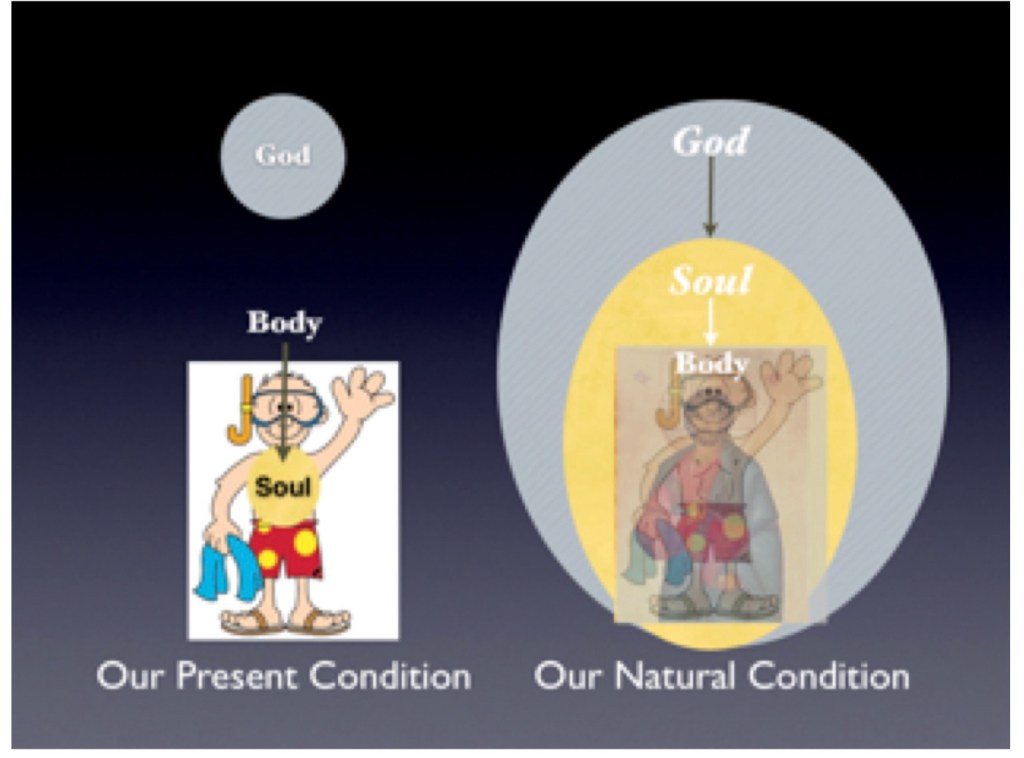
Nativity Class #6 – The Cross Of Righteous Suffering – Victory Of The Cross By St. Dumitru Stăniloae

In our final Nativity class as we draw close to the birth of Christ, it is good for us to remember how even Christ’s birth reflects this cross of the righteous suffering. Perhaps you, like me, might be tempted to believe that if I’m trying to do the right thing with God … why is this so hard … why wasn’t there room at the inn … why did even finding a place to lay His head become a struggle? So often my life in Christ is complicated by the doubts of my expectations and desires. And, if I’m honest, placing myself on His throne … playing God by imposing my will … instead of accepting His and trusting that as I participate in His will I deepen an experience of God He desires that unites me to Him and reflects His Goodness. Perhaps in the final class, we need to be reminded of the question of the condition of my heart and St. Dumitru’s explanation of God’s purpose for us:

The fathers emphasized the goodness of God as the motive behind creation … God created all things in order that they might share in his Love, that is, full communion with God … the Good, as scripture testifies, produced everything and is the ultimately perfect Cause… God created the world for the sake of humanity, that the world be led towards the purpose of full communion with Him … only humans in a conscious way can rejoice more and more in the love of God and become God’s partners … The world serves this movement of raising ourselves to our ultimate meaning of achieving our fullness in communion with the personal God. All things impose on us a responsibility before God and before the world itself, and it is by the exercise of this responsibility that we increase in our communion with God and with our fellow human beings.

The Experience of God – Vol 2: The World: Creation & Deification (p.17-18) By Dumitru Staniloae

There is a transcendent mystery to our life in Christ .. one that forces us out of the comfort zone of our own understanding. And our life in Christ will reflect this cross if we live it with the daily willingness he is very clear will be presented to us:

If anyone desires to come after Me, let him deny himself, and take up his cross daily, and follow me 

Luke 9:23

Let’s have St. Dumitru use the life of Job to help us more deeply understand this cross of righteous suffering from his booklet ‘Victory of the Cross’ we’ve studied through Nativity.


In the end it is God alone who can explain the sufferings of the righteous, and he does it through the many questions which he asks Job, all of which draw Job’s attention to the Giver of gifts. God in effect says to Job, ‘All my gifts are wonderful, but the intention of their wonder is to reveal the infinite wisdom and greatness of the one who gives them all’.

Then Job answered the Lord and said: I know that thou canst do everything, and that no thought can be withheld from thee … I have uttered that I understood not; things too wonderful for me, which I knew not … I have heard of thee by the hearing of the ear; but now mine eye seeth thee. Wherefore I abhor myself, and repent in dust and ashes.

Job 42: 1-3; 5-6

This means to say that up until this moment Job had always thought of God in much the same terms in which others had spoken of him; now he begins to understand God himself, beyond all his gifts, the Giver of everything. In order to gain this supreme treasure he had for a while to lose all his possessions. He lost the respect of others, he lost his health, his wealth—all things—in order to see God in all his greatness and wisdom and marvellous nature. In losing all things he did not doubt God and thus he came to see the apophatic, inexpressible character of God who is beyond all human understanding. He saw God in a higher way than is possible merely through his gifts. He saw him immediately through his suffering.

The believer continually needs to make abstraction of the things of this world, needs to put the things of this world into brackets of forgetfulness, in order to think of God who is above all human understanding. But sometimes it is necessary that God himself should intervene in order to throw into relief the little value of the things of this world in comparison with God, their transitory, passing nature in contrast to the eternity of God, in order to show us more clearly God’s infinite transcendence of his gifts and his ineffable presence with us. In such cases it seems to us that God himself abandons us. This is because sometimes we become so attached to things that we can no longer see God. Sometimes we make so close a link between God and the things which he gives, that we identify God with these things and totally forget God in himself, and then if God no longer shows his interest in us by giving us gifts it seems to us that he has abandoned us. For this reason the cross often seems to us a sign of our being abandoned by God. But it can also happen that God does really withdraw himself from our vision in order to prove and strengthen the tenacity of our love for him. Even our Lord Jesus Christ on the cross had this feeling of complete abandonment by God. But even the Lord Jesus never weakened in his love for God.

In reality, God never abandons us in whatever situation we find ourselves. It is possible that he may disappear for a time, for a moment, from our horizon, from our understanding. But the God whom we habitually think of in terms of creation will then appear to us in the true greatness of his glory which is indefinable and inexpressible in human thoughts and words. This is why in the Song of Songs it is said that sometimes God hides himself, and then again reveals himself in a higher and more glorious way:

By night on my bed I sought him whom my soul loveth; I sought him, but I found him not. I will rise now, and go about the city in the streets, and in the broad ways I will seek him whom my soul loveth; I sought him, but I found him not. The watchmen that go about the city found me, to whom I said: Saw ye him whom my soul loveth? It was but a little that I passed from them, but I found him whom my soul loveth. I held him, and would not let him go, until I had brought him into my mother’s house and into the chamber of her who conceived me. (Song of Songs 3: 1- 4)

It is only then that we enter into a relationship with God which is truly personal, a relationship which is above all created things. This relationship with God is one no longer dominated by material images. Our ideas about things and about the gifts which God gives altogether disappear in the light of God himself. Thus purified we give ourselves wholly to God; and we are raised into the dialogue of love exclusively with him. Then we feel that God is infinitely greater than all his gifts and all his creatures, and that in this relationship with him we are raised to a different spiritual level at which we regain in him all that we had lost.

The Christian who has the love of God in him and who thus has love for every person—that love which is an imperishable and inexhaustible reality—feels a greater joy than all the joys which the things of this world can procure, a greater joy than his own existence lived as an isolated individual could ever give him. This is the fact which the righteous discover in their suffering. This cross is given to a man in order that he himself may come to discover God at another level, at an apophatic depth, but also in order to show to other men that there are those who can be attached to God in this way even when all their possessions are taken from them, and even when God himself seems to disappear from their view.

The Cross as the Mystery of Love

The mystery of the cross of the just is the mystery of love between men as eternal persons, the mystery of love for God, and also of the love which above all things must be affirmed amongst men. Truly to love a person means to love them for themselves even when they no longer give us anything, when they no longer seem to have goodwill towards us, even when they seem to show us an incomprehensible coldness or hostility which is altogether contrary to the goodness which they showed to us earlier, even when it seems that the other person has abandoned us even to death. For if we remain firm in our love towards others despite their incomprehensible hardness towards us, we make a true proof of love, of the love which we have for them. This is the love which God himself forms in us and which does indeed raise us from death. When love confronts even death, then it conquers death itself.

He who accepts the death which God gives, with the declaration of love on his lips, gives a supreme proof of a love which will never fail, a love which is given to the person himself and not to his gifts. It is in this supreme love for God that we find the mystery of the cross which is carried by the just, of whom God has given the perfect example in the person of Jesus Christ, and in the earthly suffering which he underwent for the love of God. The Son of God in becoming man accepted the cross first of all to show his love for men, despite their hatred and incomprehension of him which were to be the cause of his death in this world. But then by his death on the cross he has given us the example of a man in whom love for God has resisted to the end, even to being given up to death.

…The world has value only in so far as through it we see and receive the revelations and the energies of the person of God who in himself, in his essence, cannot be described, but whose energies are already at work in all creation and will be fully revealed in the transfigured world of the age to come. Until the last day God is at work in this world, leading it towards its resurrection, above all by means of the cross.

Thus the cross is the sign and the means of the salvation of the world. All the world is a gift of God, and by the cross all the world has to be transcended in God. Only in Christ is this meaning of the cross fully revealed. In the cross of Christ the salvation of the world is founded, and the salvation of the whole cosmos, because by the cross the tendency of the whole cosmos to transcend itself in God is accomplished. One cannot conceive of a world which is not saved, a world which would always remain in suffering, enclosed in itself, a world in which the cross would not fully fulfil the destiny of the world. Suffering would have no meaning at all unless it was leading the world towards its salvation in God. The hell of an eternal suffering is no longer ‘a world’, properly speaking, but simply fragments detached from the world without meaning and without solidarity amongst themselves, shadowy, phantasmagoric fragments of the world. In hell suffering is eternal and would finally swallow up the gift. In the kingdom of God the world has been transfigured by the cross through which God himself is finally revealed and glorified.

The Cross Of Forgiveness – Homily 37 By St. Marcarius

We began our first class with the quote from St Marcarius about the condition of the heart … of its capacity to contain both good and evil. Also in the first class, we gained St. Dimitri’s perspective on God’s purpose for us to “share in his Love, that is, full communion with God … the Good…God created the world for the sake of humanity, that the world be led towards the purpose of full communion with Him.” St Dumitru also has been teaching us how our crosses help us see where we have become attached to the gifts of God not the Gift Giver … or as Father Gabe says “what is the X I’m placing above God”. All of these gifts of God have this ultimate purpose of teaching us to love as He loves us as we unite to Him. The cross of our relationships is the topic of today’s class 5. Perhaps, there is no better teacher about God’s love than his mercy and forgiveness. How do we become vessels and instruments that participate more fully in His love in the reality of our relationships? This 4th century homily from St Macarius seems, to me, incredibly relevant as we explore how to answer this crucial question.


For the Lord, in giving many commandments concerning love enjoined us to seek the “righteousness of God” (Mt 6:11). For He knows that it is the mother of Love. There is no other way to be saved but through our neighbour; according as He commanded: “Forgive, and it shall be forgiven you”(Lk 6:37). This is the spiritual law, written in faithful hearts, the “fulfillment of the first law”(Rom 13:10). For he says “I came not to destroy the law, but to fulfill it (Mt 5:17). How is it to be fulfilled? Teach me the first Law by seizing occasion to bless the one who sinned rather than condemn his injustice. For it says “In whatever you judge another , you condemn yourself, for you who judge practice the same things.” (Rom 2:1). For the Law thus says, “In the midst of judgment, judgment, and in the midst of forgiveness, forgiveness” (Dt 17:8).

The fullness, therefore, of the Law consists in forgiveness. We have called it the “first law”; not that God has set two laws but one law, which is spiritual by its nature, but in regard to retribution, it gives to each person the retribution which is just, forgiving him that forgives, and contending with him that contends. For it says, “With the clean thou shalt be clean, and with the perverse thou shalt wrestle” (Ps. 18:26). Therefore, those who spiritually fulfilled the Law and in proportion as they participated in Grace loved with a spiritual love not only those who did good to them, but also those who reproached and persecuted them, looking forward to receive the gift of good things. Of good things, I say, not because they forgave the wrongs done to them, but because they also did good to the persons who did wrong to them. For they offered them to God as the means whereby they fulfilled the beatitude, as it says: “Blessed are you when they shall revile you and persecute you” (Mt 5:11).

They were taught to think so by means of a spiritual law. For while they patiently endured and maintained an attitude of meekness, the Lord, seeing the patience of the heart engaged in warfare and the love that lessened none of its ardor, broke through “the middle wall of separation” (Eph 2:14). And they got rid of so great a hatred with the result that their love was no longer forced but served as a help. In a word, the Lord took control over “the sword that turned every way” (Gn3:24) which excited the thoughts. And they “entered into the inner sanctuary of the veil where the forerunner on our behalf had entered” (Heb 6:19), namely the Lord. And they enjoyed the fruits of the Spirit. Having seen the things to come in the certainty of the heart, no longer as the Apostle says,”in a mirror dimly” (1 Cor 13:12), they spoke of “what eye has not seen nor ear heard nor the things that have entered the heart of man, what things God has prepared for them that love Him” (1 Cor 2:9).

The Spiritual Illness of Distraction – Ancient Christian Wisdom by Bishop Alexis Trader (OCA Bishop of Alaska)

Perhaps nothing in contemporary culture is more revelatory of our perpetually distracted state than our attachment to electronic devices such as iPhones, iPods, iPads, cell phones, and laptops.  It seems as if we are not able to function without the distraction of technology.  Now, technology properly used is a wonderful thing.  However, when technology becomes an end in itself to distract us from who we are and our ultimate destiny as well as from human communication with others, it becomes a problem. And distraction is a problem, for Abba Poimen living far from our world of technology in the simple and barren desert went so far as to say, “distraction is the beginning of evils” (PG 65.332). What would he say today?

Technology and its distractions, like idols in ancient times, refashion human beings into something far different from what they were intended to be. The ego, as mentioned in the last blog post, can become so dominant that people under its sway becomes lost in its seeking and desiring forms of entertainment and distraction. We becomes slaves to our own ego, constantly seeking instant gratification and solutions to mundane problems all the while distracted from the source of our existential problem, which is alienation from God. Our higher self becomes enslaved to our lower self and our lower self to the myriad of distractions that technology sets before our eyes. We lose our ability to be still and focus on the “one good part that should not be taken from us.” We multitask to accomplish more, even though psychological studies have shown that in so doing, we ultimately accomplish less. We’ve sold our royal birthright unknowingly. As the illumined Elder Aimilianos wrote before the age of the internet and cell phones, “In the industrial era, people became consumers and slaves to things produced. In post-industrial society, they are also becoming consumers and slaves to images and information, which fill their lives.

When technology becomes the vehicle through which we disconnect from nature and those around us, we become further alienated from our true selves.  Technology usurps the primary role in human life: seeking communion and restoration in God.  The problem can become so acute that we begin to view our relationship with God and prayer as a distraction rather than the source of our salvation and healing.  At this point, our world has been turned completely upside down. Elder Aimilianos has written presciently about this subject, “The most dreadful enemy created by post-industrial culture, the culture of information technology and the image, is cunning distraction. Swamped by millions of images and a host of different situations on television and in the media in general, people lose their peace of mind, their self-control, their powers of contemplation and reflection and turn outwards, becoming strangers to themselves, in a word mindless, impervious to the dictates of their intelligence. If people, especially children, watch television for 35 hours a week, as they do according to statistics, then are not their minds and hearts threatened by Scylla and Charabdis, are they not between the devil and the deep blue sea? (Homer, Odyssey, XII, 85).

The antidote is the constant and abiding remembrance of God in our daily lives, but such remembrance is itself only possible through stillness.  This is no doubt why Saint Ephraim the Syrian wrote that we must “love stillness in order to be delivered from distraction.” Since we have become so accustomed to our technological attachments, it will take discipline to accomplish this.  If we are serious about combating distraction as a spiritual illness, we must be willing to lay aside these sources of distraction during times of prayer and the Services. We must discipline ourselves to turn off those devices, so that we can allow our hearts and mind to function in the way they were ultimately meant to function in keeping with the commandment: “Thou shalt love the Lord thy God with all thy heart, and with all thy soul, and with all thy strength, and with all thy mind; and thy neighbour as thyself” (Luke 10:27).

Nativity Class #5 – The Cross Of Our Relationships

In this week’s class, we focus on a single question. We will be using the short booklet ‘The Victory of the Cross’ by St. Dumitru Staniloae as our key resource as we examine this question:

  • What do the crosses we experience in our relationships have to teach us

We will also review our results from how we dealt with the cross of technology and distraction this past week. As you might remember from our last class, William suggested this as a somewhat universal cross that all of us must face in this tension we live in of ‘being in the world’ but ‘not of the world’. The Orthodox practice of nepsis or watchfulness comes to mind as something that can be helpful here. OCA Bishop Alexis Trader (Bishop of Alaska) has written a book about ‘Ancient Christian Wisdom’ that I find has a helpful quote about some of the specific tools we can use to promote this watchfulness:

For the ancient ascetics, watchfulness can be likened to Jacob’s ladder extending up into the heavens and to a pathway leading to the kingdom within where the believer encounters a “spiritual world of God, splendid and vast”. The fathers refer to watchfulness as “stillness of heart, attentiveness, guarding the heart.” Saint Hesychius the Presbyter describes four approaches to watchfulness: calling out to Christ for help, remaining silent and still in prayer, remembrance of death (i.e. keeping things in perspective), scrutinizing our thoughts (i.e. honest appraisal of what’s happening).

Ancient Christian Wisdom p. 197

I believe this cartoon we’ve used in previous classes is an appropriate way of thinking about the movement we’re attempting as we face this cross of technology and distraction that seems so deeply woven into each of our lives.

What do the crosses we experience in our relationships have to teach us?

Our responsibility towards those who are near to us forms the weight of a particularly heavy and painful cross on account of the fragility of their life which is exposed to a multitude of ills, a multitude of difficulties which arise from the conditions of this world in its present state. Parents suffer intensely and very frequently because of the ills and difficulties of their children; they fear for their life, for their failure, for their sufferings. Therefore the life of parents becomes a life of continual concern, and the cross of the children is their cross. Our cross becomes heavier with the weight of the cross of those with whom we come in contact, for we share responsibility for the life of our children, our relatives, our friends, and even of all men with whom, in one way and another, we are in touch. We bear responsibility for all that can threaten the life of those for whom we have care, and we have the obligation, so far as we can, of smoothing their difficulties and helping their lives. Thus we can reveal and strengthen our love for them and their love for us; thus we can develop the seeds of a future life in strengthening our and their spiritual existence. In this responsibility towards our neighbour we live more intensely our responsibility towards God. Christ has shown this meaning of his cross, he who had pity on those who were suffering, and wept for those who were dead. 

A second sense of the cross in relationships is this: the fallen world is often lived and felt as a cross to be carried until death through the fact that people sometimes act towards us in a hostile way, even though we have done them no wrong. They suspect us of having evil intentions towards them. They think of us as obstacles in the path of their life. Often they become our enemies even on account of the noble and high convictions to which we remain faithful. Our attachment to these convictions brings their evil designs into the light and their bad intentions to view even though we do not intend this. And this happens all the more because by the beliefs which we hold, and which we cannot renounce, we show our responsibility towards them, since we seek the security of their physical and material life and the true development of their spiritual being. This is a responsibility which we reveal in our words, our writings and our actions which become, as it were, an exhortation to them. 

We also feel as a heavy cross the erring ways of our children, of our brethren, and of many of our neighbours and contemporaries. We carry their incomprehension of our good intentions and of our good works as a cross. Almost every one of our efforts to spread goodness is accompanied by suffering and by a cross which we carry on account of the incomprehension of others. To wish to avoid this suffering, this cross, would mean in general to renounce the struggle and the effort to do what is good.

Thus without the cross there can be no true growth and no true strengthening of the spiritual life. To avoid the weight of this cross is to avoid our responsibility towards our brethren and our neighbours before God. Only by the cross can we remain in submission to God and in true love towards our neighbours. We cannot purify or develop our own spiritual life nor that of others, nor that of the world in general, by seeking to avoid the cross. Consequently, we do not discover either the depth or the greatness of the potential forces and powers of this world as a gift of God if we try to live without the cross. The way of the cross is the only way which leads us upwards, the only way which carries creation towards the true heights for which it was made. This is the signification which we understand of the cross of Christ.

Victory of the Cross p.3-5

How Do We Face The Cross Of Suffering Of Our Neighbors & Ourselves

I believe this poem offers us a way to see our sufferings as both a way to unite us to God as well as those who suffer. There is a transcendence available in suffering with Christ who loves us and suffers with us … a cross that leads to resurrection …. but are we willing to accept it? Can there be a gift from God hidden in our suffering … a joy in all who sorrow?


You, Too, Must Weep

Let me not live a life that’s free
From the things that draw me close to You—
For how can I ever hope to heal
The wounds of others I do not feel—
If my eyes are dry and I never weep,
How do I know when the hurt is deep—
If my heart is cold and it never bleeds,
How can I tell what my brother needs—
For when ears are deaf to the beggar’s plea
And we close our eyes and refuse to see,
And we steel our hearts and harden our mind,
And we count it a weakness whenever we’re kind,
We are no longer following The Father’s Way
Or seeking His guidance from day to day…
For, without “crosses to carry” and “burdens to bear,”
We dance through a life that is frothy and fair,
And “chasing the rainbow” we have no desire
For “roads that are rough” and “realms that are higher”—
So spare me no heartache or sorrow, dear Lord,
For the heart that is hurt reaps the richest reward,
And God enters the heart that is broken with sorrow
As he opens the door to a Brighter Tomorrow,
For only through tears can we recognize 
The suffering that lies in another’s eyes.

– Author Unknown