Nativity Fast Class #1 – Preparing Ourselves For The Birth Of Christ

In our Nativity Fast preparation, we will be using a lot of materials from a 20th century Romanian saint recently canonized … St. Dumitru Staniloae. 

Let’s begin by examining an Orthodox perspective on the condition of our hearts. 

What Is The Condition Of My Heart?

And the heart itself is but a small vessel, yet there also are dragons and there are lions; there are poisonous beasts and all the treasures of evil. And there are rough and uneven roads; there are precipices. But there is also God, also the angels, the life and the kingdom, the light and the Apostles, the treasures of grace—there are all things

St Macarius ‘50 Spiritual Homilies and Great Letter’ (Homily 43)

The line separating good and evil passes not through states, nor between classes, nor between political parties either — but right through every human heart — and through all human hearts. This line shifts. Inside us, it oscillates with the years. And even within hearts overwhelmed by evil, one small bridgehead of good is retained

Alexander Solzhenitsyn ‘The Gulag Archipelago’

What Is God’s Purpose For For Us?

St. Dumitru has a very useful way of helping us understand God’s purpose for us? He says:

The fathers emphasized the goodness of God as the motive behind creation … God created all things in order that they might share in his Love, that is, full communion with God … the Good, as scripture testifies, produced everything and is the ultimately perfect Cause… God created the world for the sake of humanity, that the world be led towards the purpose of full communion with Him … only humans in a conscious way can rejoice more and more in the love of God and become God’s partners … The world serves this movement of raising ourselves to our ultimate meaning of achieving our fullness in communion with the personal God. All things impose on us a responsibility before God and before the world itself, and it is by the exercise of this responsibility that we increase in our communion with God and with our fellow human beings.

The Experience of God – Vol 2: The World: Creation & Deification (p.17-18) By Dumitru Staniloae

Can Thirst For The Infinite Be Satisfied By The Finite ?

The human being has a spiritual basis and therefore a tendency toward the infinite which also is manifested in the passions, but in these passions the tendency is turned from the authentic infinite which is of a spiritual order, toward the world, which only gives the illusion of the infinite.  Man without being himself infinite, not only is fit, but is also thirsty for the infinite and precisely for this reason is also capable of, and longs for, God, the true and only infinite (homo capaz divini – man capable of the divine).  He has a capacity and thirst for the infinite not in the sense that he is in a state to win it, to absorb  it in his nature – because then human nature itself would become infinite – but in the sense that he can and must be nourished spiritually from the infinite, and infinitely.  He seeks and is able to live in a continued communication with it,  in a sharing with it.  But man didn’t want to be satisfied with sharing in the infinite, or he believed that he is such a center, he let himself be tricked by his nature’s thirst for the infinite.  

So, the human being, instead of being satisfied to remain in communication with the true infinite, and to progress in it, wanted to become himself the infinite.  He tried to absorb in himself or to subordinate to himself everything that lent itself to this relation of subordination:  dead objects, finite things.  Instead of quenching his thirst for the infinite, he sought to gather everything around himself, as around a center.  But because man isn’t a true center in himself, this nature of his took revenge; it made him in reality run after things, even enslaving him to them.  So passion, as a tireless chase after the world, instead of being an expression of the central sovereignty of our nature, is rather a force which carries us along against our will; it’s a sign of the fall of our nature into an accentuated state of passivity. Our nature, whether it wants to or not, still has to express its tendency for a center outside of itself.  By the passions, this center was moved from God to the world.  Thus the passions are the product of a tortuous impulse of our nature, or of a nature which has lots its simplicity and tendency to move straight ahead. 

The spirit of man has no exact limits and is capable of being filled with the infinite and thirsts to receive it; yet instead of looking for the relationship with the infinite Spirit, it seeks to fill itself with the finite and passing objects.  So it is left with nothing and its thirst is never quenched.  

…By their irrationality, by their deceptive character, by turning man away from his true goal, the passions keep man in the darkness of ignorance.  By the struggle against the passions, the human being escapes ignorance; he returns to the true infinity of God, as a goal of his life and as a liberation of his spirit from the slavery of the world and from the tyranny which the passions represent.  This is the meaning of dispassion.

Orthodox Spirituality – The Essence Of The Passions p.77 -79 By Dimitri Staniloae 

Are We Attached To The Gifts Of God Or The Gift Giver ?

We are going to use a small booklet written by St. Dumitru for a lot of our initial class work as we prepare ourselves for Christ’s birth. The booklet is entitled ‘The Victory Of The Cross’. Let’s begin with a short Gospel verse:

If anyone desires to come after Me, let him deny himself, and take up his cross daily, and follow me 

Luke 9:23

It’s pretty universal for us to think about gifts as we enter this time of year. St. Dumitru gives us a very different perspective on this relationship between His purpose for us … full communion with God .. and the cross of the reality we experience in the gifts of the world.

The world is a gift of God, but the destiny of this gift is to unite us with God, who has given it. The intention of the gift is that in itself it should be continually transcended. When we receive a gift from somebody we should look primarily towards the person who has given it and not keep our eyes fixed on the gift. But often those who receive a gift become so attached to the gift that they forget who has given it to them. But God demands an unconditional love from us, for God is infinitely greater than any gifts given to us; just as at the human level the person who gives us something is incomparably more important than what is given, and should be loved for himself or herself, not only on account of the gift. In this way every gift requires a certain cross, and this cross is meant to show us that they are not the last and final reality. This cross consists in an alteration in the gift, and sometimes even in its entire loss.

Victory Of The Cross p.1

You can find this booklet in more of its entirety in the following links:

Part 1 Victory of Cross

Part 2 – The Cross and God’s Revelation of Its Meaning 


Why What Is Natural Doesn’t Seem Natural

The Cross and God’s Revelation of Its Meaning – Victory Of The Cross By Father Dumitru Stăniloae

This is a 2nd extract from a powerful booklet entitled ‘The Victory Of The Cross’ written by the well known 20th century Romanian Orthodox priest and scholar Father Dumitru Stăniloae. You can find the 1st extract from his booklet here.


In the end it is God alone who can explain the sufferings of the righteous, and he does it through the many questions which he asks Job, all of which draw Job’s attention to the Giver of gifts. God in effect says to Job, ‘All my gifts are wonderful, but the intention of their wonder is to reveal the infinite wisdom and greatness of the one who gives them all’.

Then Job answered the Lord and said: I know that thou canst do everything, and that no thought can be withheld from thee … I have uttered that I understood not; things too wonderful for me, which I knew not … I have heard of thee by the hearing of the ear; but now mine eye seeth thee. Wherefore I abhor myself, and repent in dust and ashes.

Job 42: 1-3; 5-6

This means to say that up until this moment Job had always thought of God in much the same terms in which others had spoken of him; now he begins to understand God himself, beyond all his gifts, the Giver of everything. In order to gain this supreme treasure he had for a while to lose all his possessions. He lost the respect of others, he lost his health, his wealth—all things—in order to see God in all his greatness and wisdom and marvellous nature. In losing all things he did not doubt God and thus he came to see the apophatic, inexpressible character of God who is beyond all human understanding. He saw God in a higher way than is possible merely through his gifts. He saw him immediately through his suffering.

The believer continually needs to make abstraction of the things of this world, needs to put the things of this world into brackets of forgetfulness, in order to think of God who is above all human understanding. But sometimes it is necessary that God himself should intervene in order to throw into relief the little value of the things of this world in comparison with God, their transitory, passing nature in contrast to the eternity of God, in order to show us more clearly God’s infinite transcendence of his gifts and his ineffable presence with us. In such cases it seems to us that God himself abandons us. This is because sometimes we become so attached to things that we can no longer see God. Sometimes we make so close a link between God and the things which he gives, that we identify God with these things and totally forget God in himself, and then if God no longer shows his interest in us by giving us gifts it seems to us that he has abandoned us. For this reason the cross often seems to us a sign of our being abandoned by God. But it can also happen that God does really withdraw himself from our vision in order to prove and strengthen the tenacity of our love for him. Even our Lord Jesus Christ on the cross had this feeling of complete abandonment by God. But even the Lord Jesus never weakened in his love for God.

In reality, God never abandons us in whatever situation we find ourselves. It is possible that he may disappear for a time, for a moment, from our horizon, from our understanding. But the God whom we habitually think of in terms of creation will then appear to us in the true greatness of his glory which is indefinable and inexpressible in human thoughts and words. This is why in the Song of Songs it is said that sometimes God hides himself, and then again reveals himself in a higher and more glorious way:

By night on my bed I sought him whom my soul loveth; I sought him, but I found him not. I will rise now, and go about the city in the streets, and in the broad ways I will seek him whom my soul loveth; I sought him, but I found him not. The watchmen that go about the city found me, to whom I said: Saw ye him whom my soul loveth? It was but a little that I passed from them, but I found him whom my soul loveth. I held him, and would not let him go, until I had brought him into my mother’s house and into the chamber of her who conceived me. (Song of Songs 3: 1- 4)

It is only then that we enter into a relationship with God which is truly personal, a relationship which is above all created things. This relationship with God is one no longer dominated by material images. Our ideas about things and about the gifts which God gives altogether disappear in the light of God himself. Thus purified we give ourselves wholly to God; and we are raised into the dialogue of love exclusively with him. Then we feel that God is infinitely greater than all his gifts and all his creatures, and that in this relationship with him we are raised to a different spiritual level at which we regain in him all that we had lost.

The Christian who has the love of God in him and who thus has love for every person—that love which is an imperishable and inexhaustible reality—feels a greater joy than all the joys which the things of this world can procure, a greater joy than his own existence lived as an isolated individual could ever give him. This is the fact which the righteous discover in their suffering. This cross is given to a man in order that he himself may come to discover God at another level, at an apophatic depth, but also in order to show to other men that there are those who can be attached to God in this way even when all their possessions are taken from them, and even when God himself seems to disappear from their view.

The Cross as the Mystery of Love

The mystery of the cross of the just is the mystery of love between men as eternal persons, the mystery of love for God, and also of the love which above all things must be affirmed amongst men. Truly to love a person means to love them for themselves even when they no longer give us anything, when they no longer seem to have goodwill towards us, even when they seem to show us an incomprehensible coldness or hostility which is altogether contrary to the goodness which they showed to us earlier, even when it seems that the other person has abandoned us even to death. For if we remain firm in our love towards others despite their incomprehensible hardness towards us, we make a true proof of love, of the love which we have for them. This is the love which God himself forms in us and which does indeed raise us from death. When love confronts even death, then it conquers death itself.

He who accepts the death which God gives, with the declaration of love on his lips, gives a supreme proof of a love which will never fail, a love which is given to the person himself and not to his gifts. It is in this supreme love for God that we find the mystery of the cross which is carried by the just, of whom God has given the perfect example in the person of Jesus Christ, and in the earthly suffering which he underwent for the love of God. The Son of God in becoming man accepted the cross first of all to show his love for men, despite their hatred and incomprehension of him which were to be the cause of his death in this world. But then by his death on the cross he has given us the example of a man in whom love for God has resisted to the end, even to being given up to death.

In the case of Job we do not have this picture of a love for God which continues even to death, but we feel that this love could have been there unalterable to the end in Job. All the same, in the beginning Job did not understand the reason for his sufferings which in the end were to be a proof of his love for God. It is Christ who first saw the supreme and absolute value of the cross as a proof of love both of God and of men, love of a worth beyond all else. None the less, Job is the type of Christ, and his second and greater fortune is a type or symbol of the resurrection which the just man who accepts death from God will receive in the end.

Love which does not go so far as the love of Job went or, more clearly, as far as the love of Jesus Christ, is not true love but only conditional, a love conditional on things, that is to say a love of oneself and not a true love of others. It does not reveal the true, infinitely greater worth of persons than of any other created things or the eternal basis of their worth in the personal reality of God. In true love a man should transcend himself, go beyond himself, and the supreme act of this transcendence is fulfilled in love for God, who is the Transcendent One.

It is is doubtless true and right that persons reveal their love for one another by their gifts, and this is also true in God’s relationship with men. In this sense we cannot think of the cross without the world as God’s gift. But on the other side we cannot think of the world without the cross. The cross makes this world transparent for God. The cross shows that the world is God’s gift, and as such is a lower and lesser reality than God himself. The cross is the sign of God as a person who is above all his gifts. But it is also the sign of a perfect relationship between God and man. In this sense the cross is specially the sign of the Son of Man in whom this relationship has been perfectly realised. The cross is the sign of the Son of God become man, the sign which he prints on the world by his solidarity with the world.

Without the cross man would be in danger of considering this world as the ultimate reality. Without the cross he would no longer see the world as God’s gift. Without the cross the Son of God incarnate would have simply confirmed the image of the world as it is now as the final reality, and strictly speaking he could have been neither God nor God incarnate. The cross completes the fragmentary meaning of this world which has meaning when it is seen as a gift which has its value, but only a relative and not an absolute value. The cross reveals the destiny of the world as it is drawn towards its transfiguration in God by Christ. For this reason at the end of this stage of the world this sign, ‘the sign of the Son of Man’, will be revealed in the heavens above all the world, as a light, as a meaning, as a destiny which illumines the whole history of man (Matt. 24: 30).

In this way the cross prophetically points to the eschatological, the final destiny of the world. For this reason we associate the sign of the cross with the Holy Trinity, with the Kingdom of God. This is the reason why in the Orthodox Liturgy the cross is printed on the loaf which is used in the Eucharist, bread being at once the sign of God’s gift and of man’s work, the existential expression of the whole of man’s life in this world offered to God. With this sign of the cross the Church blesses, and before all their actions Christians make the sign of the cross in order to dedicate them to God. With this sign the priest blesses the water of Baptism, and also the holy water with which he sprinkles the house, the fields and the whole world in which the Christian lives and works—all is covered with the sign of the cross.

The world has value only in so far as through it we see and receive the revelations and the energies of the person of God who in himself, in his essence, cannot be described, but whose energies are already at work in all creation and will be fully revealed in the transfigured world of the age to come. Until the last day God is at work in this world, leading it towards its resurrection, above all by means of the cross.

Thus the cross is the sign and the means of the salvation of the world. All the world is a gift of God, and by the cross all the world has to be transcended in God. Only in Christ is this meaning of the cross fully revealed. In the cross of Christ the salvation of the world is founded, and the salvation of the whole cosmos, because by the cross the tendency of the whole cosmos to transcend itself in God is accomplished. One cannot conceive of a world which is not saved, a world which would always remain in suffering, enclosed in itself, a world in which the cross would not fully fulfil the destiny of the world. Suffering would have no meaning at all unless it was leading the world towards its salvation in God. The hell of an eternal suffering is no longer ‘a world’, properly speaking, but simply fragments detached from the world without meaning and without solidarity amongst themselves, shadowy, phantasmagoric fragments of the world. In hell suffering is eternal and would finally swallow up the gift. In the kingdom of God the world has been transfigured by the cross through which God himself is finally revealed and glorified.

Born To Set Us Free From Our Infirmities

December 4, 2021 · Fr. Philip LeMasters

Galatians 5:22-6:2; Luke 13:10-17

When Jesus Christ was teaching in a synagogue on the Sabbath, he saw a woman who was bent over and could not straighten up. She had been that way for eighteen years. Imagine how her life had changed due to her disability, how frustrating that chronic illness had to be, especially in a time before modern medicine and physical therapy. The Lord said to her, “Woman, you are loosed from your infirmity.” When He laid hands on her, she was healed. When the woman stood up straight again, she glorified God.

As was often the case when the Savior healed on the Sabbath day, there were those standing around just waiting to criticize Him for working on the day of rest.  He responded to them by noting that people do what is necessary to take care of their animals on the Sabbath.  “So ought not this woman, being a daughter of Abraham, whom Satan has bound for eighteen years, be loosed from this bond on the Sabbath?”  The force of His point was so clear that those self-righteous hypocrites were put to shame and the people rejoiced.

In these weeks of the Nativity Fast, we pray, fast, give to the needy, and confess and turn away from our sins as we prepare to celebrate the wonderful news of the Incarnation of the Son of God, of our Lord’s birth at Christmas for the salvation of the world. Today’s gospel text provides a beautiful image of what Jesus Christ has done for us by becoming a human being by uniting divinity and humanity in His own Person.  These weeks of preparation give us all the opportunity to gain the spiritual clarity to see ourselves in that poor woman bent over and bound with chronic, debilitating infirmity.

Though we often do our best to hide it, we are all too well acquainted with illness, pain, and death.  We face chronic challenges of various kinds from which we cannot deliver ourselves or our loved ones. We have diseases of soul, of personality, of behavior, and of relationships that cripple us, that keep us from acting, thinking, and speaking with the joyful freedom of the children of God.  We are all bent over and crippled in profound ways in relation to the Lord, our neighbors, and even ourselves.  We have all fallen short of fulfilling God’s gracious purposes for us, as has every generation since Adam and Eve.

Joachim and Anna knew all about long-term frustration and pain, for like Abraham and Sarah they were childless into their old age.  God heard their prayers, however, and gave them Mary, who would in turn give birth to the Savior Who came to liberate us all from sin and death.  We celebrate in the coming week the feast of St. Anna’s conception of the Theotokos, which foreshadows the coming of the Lord to loose us from the infirmities that hinder our participation even now in the joyful life of the Kingdom.

The story of the Old Testament unfolded through the family of Abraham, who was told by God that he would be the father of a large, blessed family.   Some think of life after death as being accomplished through ongoing generations of children and grandchildren, not by victory over death itself.  If God’s blessings extended no further than the grave, however, then no one would ever be loosed from bondage to the wages of sin, which is death itself. Only a Savior Who is truly divine and human could enter fully into the fatal consequences of our corruption and then rise victorious over them, making it possible for us to participate in the eternal life of the heavenly kingdom.

The history of the Hebrews was preparatory for the coming of the Christ, the Messiah in Whom God’s promises are fulfilled and extended to all who have faith in the Savior, regardless of their ethnic or national heritage.  Christ did not come to promote one nation over another or to set up an earthly kingdom of any kind, but to fulfill our original calling as those created in the image and likeness of God.  He unites divinity and humanity in Himself and makes it possible for us to share in the eternal life of the Holy Trinity as distinct, unique persons who become radiant with the divine glory by grace. God breaks the laws of nature, at least as we know them in our world of corruption, in order to save us, enabling elderly women like Sarah and Anna to conceive and bear children and a young virgin named Mary to become the mother of His Son, Who Himself rose from the dead after three days in the tomb.  He is born at Christmas to work our liberation, to break the bonds of death, and to heal the brokenness of our life in this world of corruption.

The Lord did not treat the woman in today’s reading according to her physical condition as simply an impersonal bundle of disease, even as St. Anna’s fate was not defined by barrenness.  Instead, He revealed her true identity as a beloved person, a daughter of Abraham, by enabling her to stand up straight for the first time in years.   On that particular Sabbath day, Jesus Christ treated her as a unique, cherished child of God who was not created for slavery to a wretched existence of pain, disease, and despair, but for blessing, health, and joy.  She glorified God for this deliverance from bondage, for this restoration of freedom, as did those who saw the miracle.

The good news of Christmas is that the Savior is born to do the same for us all, to set us free from captivity to the decay, corruption, and weakness that have taken root in our souls. He comes to deliver us from being defined by our infirmities so that we can leave behind our bondage and enter into the joyous freedom of the children of God.  He comes to restore us as living icons who manifest His glory and salvation as the unique persons He created us to be.

Our salvation is a process of becoming more fully our true ourselves by embracing Christ’s healing of the human person.  There is no limit to the unique beauty of our souls other than those we impose by our own refusal to unite ourselves to Him in holiness.  The more we share by grace in the life of the Holy Trinity, the more we will see that the process of our fulfillment in God is eternal.  Since our fundamental calling is to become like God in holiness, we become more truly ourselves whenever we turn away from slavery to sin and corruption in order to embrace more fully the new life that Christ has brought to the world.

Most people today probably do not think of Advent and Christmas in relation to liberation from our bondage to sin and death.  More typically, we distort them into opportunities to strengthen our addiction to the love of money and possessions and to excess in food and drink.  Such self-centered indulgence is really nothing but bondage to ourselves, which can easily leave us so weak spiritually that we will never be able to straighten ourselves up.  That is not surprising because, as God’s children, we were not created to find our fulfillment in the passing things of creation or in satisfying self-centered desires for bodily pleasure.  That is why we must resist the cultural temptation to become so busy with shopping, planning, and partying this time of year that we end up ignoring the profound spiritual gravity of our Lord’s Incarnation.  He is born to restore us to the full dignity of His sons and daughters, to make us personal participants in the blessing and joy of the heavenly kingdom.  He comes to loose us all from slavery to sin and death.

In the remaining weeks of the Nativity Fast, let us follow St. Paul’s advice to acquire “the fruit of the Spirit…love, joy, peace, longsuffering, kindness, goodness, faith, meekness, [and] self-control.” Let us use this season to crucify “the flesh with the passions and the lusts” as we are loosed from the debilitating corruptions of sin by the mercy of the God-Man born for our salvation. As we pray, fast, give to the needy, and confess and repent of our sins this Advent, let us do so with the joyful hope of the woman who could finally stand up straight after eighteen years. For the Savior is born to deliver us from bondage in all its forms. It is time to rise up with Him into the blessed life of holiness He comes to share with us, for we have already had more than enough of pain and infirmity. As daughters and sons of Abraham by faith, let us embrace the healing that is ours in Jesus Christ.

Akathist Hymn of Thanksgiving : Glory to God for All Things

It is a great joy to gather together Thanksgiving morning and to pray, contemplate and sing this beautiful Akathist. Father Stephen gives us some short , powerful guidance on what to do in that space between stimulus and response today … and how prayer and thanksgiving can become a new means of coping with what , without God, may invoke our distress and anxiety. The Akathist powerfully reminds us of how much can be added to our perception and our lives when we accept God’s unceasing invitation for us to join ourselves to Him

August 8, 2007 · Fr. Stephen Freeman

gulag.jpg

I have seen several translations of this hymn. This one comes from the site of St. John the Baptist Cathedral (ROCOR) in Washington, D.C. I have edited it only typographically. It was composed by Metropolitan Tryphon (Prince Boris Petrovich Turkestanov) +1934 – but frequently attributed to Father Gregory Petrov, who died in a Soviet prison camp. It continues to grow in its popularity within the Orthodox Church. In my parish’s usage, we sing it to the Alaskan Akathist Melody, a simple, two-line, tune that can easily be adapted to the unpredictable number of lines in the hymn. With each day, some news of one thing or another reaches me that is cause either for distress or anxiety – but is met far better with prayer and thanksgiving. Either there is a God whom we trust or “we are of most men to be pitied.” I prefer to give thanks.

ODE 1

Everlasting King, Your will for our salvation is full of power. Your right arm controls the whole course of human life. We give You thanks for all Your mercies, seen and unseen: For eternal life, for the heavenly joys of the Kingdom which is to be. Grant mercy to us who sing Your praises, both now and in the time to come. Glory to You, O God, from age to age.

IKOS 1

I was born a weak, defenseless child, but Your angel spread his wings over my cradle to defend me. From birth until now, Your love hasillumined my path, and has wondrously guided me towards the light of eternity. From birth until now the generous gifts of Your Providencehave been marvelously showered upon me. I give You thanks, with all who have come to know You, who call upon Your Name:

Glory to You for calling me into being.
Glory to You, showing me the beauty of the universe.
Glory to You, spreading out before me heaven and earth, like the pages in a book of eternal wisdom.
Glory to You for Your eternity in this fleeting world.
Glory to You for Your mercies, seen and unseen.
Glory to You, through every sigh of my sorrow.
Glory to You for every step of my life’s journey,for every moment of glory.
Glory to You, O God, from age to age.

ODE 2

O Lord, how lovely it is to be Your guest. Breeze full of scents — mountains reaching to the skies — waters like a boundless mirror, reflecting the sun’s golden rays and the scudding clouds. All nature murmurs mysteriously, breathing depths of Your tenderness. Birds and beasts of the forest bear the imprint of Your love. Blessed are you, mother earth, in your fleeting loveliness, which wakens our yearning for happiness that will last forever in the land where, amid beauty that grows not old, rings out the cry: Alleluia!

IKOS 2

You have brought me into life as if into an enchanted paradise. We have seen the sky like a chalice of deepest blue, where in the azure heights the birds are singing. We have listened to the soothing murmur of the forest and the melodious music of the streams. We have tasted fruit of fine flavor and the sweet-scented honey. We can live very well on your earth. It is a pleasure to be your guest.
Glory to You for the feast-day of life.
Glory to You for the perfume of lilies and roses.
Glory to You for each different taste of berry and fruit.
Glory to You for the sparkling silver of early morning dew.
Glory to You for the joy of dawn’s awakening.
Glory to You for the new life each day brings.
Glory to You, O God, from age to age.

ODE 3

It is the Holy Spirit Who makes us find joy in each flower–the exquisite scent, the delicate color — the beauty of the Most High in the tiniest of things. Glory and honor to the Spirit, the Giver of Life, Who covers the fields with their carpet of flowers, crowns the harvest with gold, and gives to us the joy of gazing at it with our eyes. O be joyful and sing to Him: Alleluia!

IKOS 3

How glorious You are in the springtime, when every creature awakens to new life and joyfully sings Your praises with a thousand tongues! You are the source of life, the destroyer of death. By the light of the moon, nightingales sing, and the valleys and hills lie like wedding-garments, white as snow. All the earth is Your promised bride awaiting her spotless Husband. If the grass of the field is like this, how gloriously shall we be transfigured in the Second Coming, after the Resurrection! How splendid our bodies, how spotless our souls!

Glory to You for the warmth and tenderness of the world of nature.
Glory to You for the numberless creatures around us.
Glory to you for the depths of Your wisdom–the whole world a living sign of it.
Glory to You: On my knees, I kiss the traces of Your unseen hand.
Glory to You, enlightening us with the clarity of eternal life.
Glory to You for the hope of the unutterable, imperishable beauty of immortality.
Glory to You, O God, from age to age.

ODE 4

How filled with sweetness are those whose thoughts dwell on You: how life-giving Your holy Word. To speak with You is more soothing than anointing with oil, sweeter than the honeycomb. To pray to You lifts the spirit, refreshes the soul. Where You are not, there is only emptiness; hearts are smitten with sadness; nature, and life itself, becomes sorrowful. Where You are, the soul is filled with abundance, and its song resounds like a torrent of life: Alleluia!

IKOS 4

When the sun is setting, when quietness falls, like the peace of eternal sleep, and the silence of the spent day reigns, then in the splendor of its declining rays, filtering through the clouds, I see Your dwelling-place. Firey and purple, gold and blue, they speak prophet-like of the ineffable beauty of Your presence, and call to us in their majesty. We turn to the Father:

Glory to You at the hushed hour of nightfall.
Glory to You, covering the earth with peace.
Glory to You for the last ray of the sun as it sets.
Glory to You for sleep’s repose that restores us.
Glory to You for Your goodness, even in time of darkness, when all the world is hidden from our eyes.
Glory to You for the prayers offered by a trembling soul.
Glory to You for the pledge of our reawakening on the glorious last day, that day which has no evening.
Glory to You, O God, from age to age.

ODE 5

The dark storm-clouds of life bring no terror to those in whose hearts Your fire is burning brightly. Outside is the darkness of the whirlwind, the terror and howling of the storm, but in the heart, in the presence of Christ, there is light and peace, silence. The heart sings: Alleluia!

IKOS 5

I see Your heavens resplendent with stars. How glorious You are, radiant with light! Eternity watches me by the rays of the distant stars. I am small, insignificant, but the Lord is at my side: Your right arm guides me wherever I go.

Glory to You, ceaselessly watching over me.
Glory to You for the encounters You arrange for me.
Glory to You for the love of parents, for the faithfulness of friends.
Glory to You for the humbleness of animals which serve me.
Glory to You for the unforgettable moments of life.
Glory to You for the heart’s innocent joy.
Glory to You for the joy of living, moving, and being able to return Your love.
Glory to You, O God, from age to age.

ODE 6

How great and how close You are in the powerful track of the storm! How mighty Your right arm in the blinding flash of the lightning! How awesome Your majesty! The voice of the Lord fills the fields, It speaks in the rustling of the trees. The voice of the Lord is in the thunder and the downpour. The voice of the Lord is heard above the waters. Praise be to You in the roar of mountains ablaze. You shake the earth like a garment; You pile up to the sky the waves of the sea. Praise be to You, bringing low the pride of man. You bring from his heart a cry of penitence: Alleluia!

IKOS 6

When the lightning flash has lit up the camp dining hall, how feeble seems the light from the lamp. Thus do You, like the lightning, unexpectedly light up my heart with flashes of intense joy. After Your blinding light, how drab, how colorless, how illusory all else seems.

Glory to You, the highest peak of men’s dreaming.
Glory to You for our unquenchable thirst for communion with God.
Glory to You, making us dissatisfied with earthly things.
Glory to You, turning on us Your healing rays.
Glory to You, subduing the power of the spirits of darkness and dooming to death every evil.
Glory to You for the signs of Your presence, for the joy of hearing Your voice and living in Your love.
Glory to You, O God, from age to age.

ODE 7

In the wondrous blending of sounds, it is Your call we hear. In the harmony of many voices, in the sublime beauty of music, in the glory of the works of great composers, You lead us to the threshold of paradise to come, and to the choirs of angels. All true beauty has the power to draw the soul towards You and make it sing in ecstasy: Alleluia!

IKOS 7

The breath of Your Holy Spirit inspires artists, poets, scientists. The power of Your supreme knowledge makes them prophets and interpreters of Your laws, who reveal the depths of Your creative wisdom. Their works speak unwittingly of You. How great are You in Your creation! How great are You in man!

Glory to You, showing Your unsurpassable power in the laws of the universe.
Glory to You, for all nature is filled with Your laws.
Glory to You for what You have revealed to us in Your mercy.
Glory to You for what you have hidden from us in Your wisdom.
Glory to You for the inventiveness of the human mind.
Glory to You for the dignity of man’s labor.
Glory to You for the tongues of fire that bring inspiration.
Glory to You, O God, from age to age.

ODE 8

How near You are in the day of sickness. You Yourself visit the sick. You Yourself bend over the sufferer’s bed; his heart speaks to You. In the throes of sorrow and suffering, You bring peace; You bring unexpected consolation. You are the Comforter. You are the Love which watches over and heals us. To You we sing the song: Alleluia!

IKOS 8

When in my childhood I called upon You consciously for the first time, You heard my prayer; You filled my heart with the blessing of peace. At that moment I knew Your goodness, knew how blessed are those who turn to You. I started to call upon You, night and day, and even now, I call upon Your Name:

Glory to You, satisfying my desires with good things.
Glory to You, watching over me day and night.
Glory to You, curing affliction and emptiness with the healing flow of time.
Glory to You; no loss is irreparable in You, giver of eternal life to all.
Glory to You, making immortal all that is lofty and good.
Glory to You, promising us the longed-for meeting with our loved ones who have died.
Glory to You, O God, from age to age.

ODE 9

Why is it that on a feast-day the whole of nature mysteriously smiles? Why is it that then a heavenly gladness fills our hearts, a gladness far beyond that of earth, and the very air in church and in the altar becomes luminous? It is the breath of Your gracious love; it is the reflection of the glory of Mount Tabor. Then do heaven and earth sing Your praise: Alleluia!

IKOS 9

When You called me to serve my brothers and filed my soul with humility, one of Your deep-piercing rays shone into my heart; it became luminous, full of light, like iron glowing in the furnace. I have seen Your face, face of mystery and of unapproachable glory.

Glory to You, transfiguring our lives with deeds of love.
Glory to You, making wonderfully sweet the keeping of Your commandments.
Glory to You, making Yourself known where man shows mercy on his neighbor.
Glory to You, sending us failure and misfortune, that we may understand the sorrows of others.
Glory to You, rewarding us so well for the good we do.
Glory to You, welcoming the impulse of our heart’s love.
Glory to You, raising to the heights of heaven every act of love in earth and sky.
Glory to You, O God, from age to age.

ODE 10

No one can put together what has crumbled into dust, but You can restore a conscience turned to ashes; You can restore to its former beauty a soul lost and without hope. With You, there is nothing that cannot be redeemed. You are Love; You are Creator and Redeemer. We praise You, singing: Alleluia!

IKOS 10

Remember, my God, the fall of Lucifer, full of pride; keep me safe with the power of Your grace. Save me from falling away from You; save me from doubt. Incline my heart to call upon You, present in everything.

Glory to You for every happening, every condition Your Providence has put me in.
Glory to You for what you speak to me in my heart.
Glory to You for what you reveal to me, asleep or awake.
Glory to You for scattering our vain imaginations.
Glory to You for raising us from the slough of our passions through suffering.
Glory to You for curing our pride of heart by humiliation.
Glory to You, O God, from age to age.

ODE 11

Across the cold chains of the centuries, I feel the warmth of Your breath; I feel Your blood pulsing in my veins. Part of time has already gone, but now You are the present. I stand by Your cross; I was the cause of it. I cast myself down in the dust before it. Here is the triumph of love, the victory of salvation. Here the centuries themselves cannot remain silent, singing Your praises: Alleluia!

IKOS 11

Blessed are they that will share in the King’s banquet; but already on earth You give me a foretaste of this blessedness. How many times with Your own hand have You held out to me Your Body and Your Blood, and I, though a miserable sinner, have received this Sacrament, and have tasted Your love, so ineffable, so heavenly!

Glory to You for the unquenchable fire of Your grace.
Glory to You, building Your Church, a haven of peace in a tortured world.
Glory to You for the life-giving water of baptism in which we find new birth.
Glory to You, restoring to the penitent purity white as the lily.
Glory to you for the Cup of Salvation and the Bread of eternal joy.
Glory to You for exalting us to the highest heaven.
Glory to You, O God, from age to age.

ODE 12

How oft have I seen the reflection of Your glory in the faces of the dead. How resplendent they were, with beauty and heavenly joy; how ethereal, how translucent their faces; how triumphant over suffering and death, their felicity and peace. Even in the silence they were calling upon You. In the hour of my death, enlighten my soul, too, that it may cry out to You: Alleluia!

IKOS 12

What sort of praise can I give You? I have never heard the song of the cherubim, a joy reserved for the spirits above. But I know the praises that nature sings to You. In winter, I have beheld how silently in the moonlight the whole earth offers You prayer, clad in its white mantle of snow, sparkling like diamonds. I have seen how the rising sun rejoices in You, how the song of the birds is a chorus of praise to You. I have heard the mysterious murmurings of the forests about You, and the winds singing Your praise as they stir the waters. I ahve understood how the choirs of stars proclaim Your glory as they move forever in the depths of infinite space. What is my poor worship? All nature obeys You, I do not. Yet while I live, I see Your love, I long to thank You, pray to You, and call upon Your Name:

Glory to You, giving us light.
Glory to You, loving us with love so deep, divine, and infinite.
Glory to You, blessing us with light, and with the host of angels and saints.
Glory to You, Father All-Holy, promising us a share in Your Kingdom.
Glory to You, Holy Spirit, Life-giving Sun of the world to come.
Glory to You for all things, holy and most merciful Trinity.
Glory to You, O God, from age to age.

ODE 13

Life-giving and merciful Trinity, receive my thanksgiving for all Your goodness. Make us worthy of Your blessings, so that, when we have brought to fruit the talents You have entrusted to us, we may enter into the joy of our Lord, forever exulting in the shout of victory: Alleluia!

(Repeat Ikos 1, Ode 1.)

Entry Of The Holy Theotokos Into The Temple

By Archpriest Alexander Shargunov

The feast of the Entry of the Holy Theotokos into the temple is a marvelous model of our entry into the Heavenly Kingdom. The church itself symbolizes the Kingdom of God on earth. In church we see the altar table, which is like a throne on which the Lord God sits, just as He does on His heavenly throne. In church, through the partaking of holy communion, we become united with the Lord Himself. In church, as in heaven, we are surrounded by hosts of angels and saints. In church, by means of the divine services we glorify God, as do the angels and saints in heaven.

When the righteous Joachim and Anna brought the Holy Virgin to the temple, they offered to the Lord a gift that was most pure.

So should we, in order to enter the Heavenly Realm, be absolutely pure, because the Lord Himself said that nothing unclean can enter the Kingdom of God. But we can cleanse ourselves of our sins and all manner of spiritual impurity only through the sacrament of penitence, through confession and communion.

As the righteous parents of the Holy Virgin prepared to take Her to the temple, they first dressed Her in royal garments, adorned Her, and provided Her with an escort of maidens carrying lighted candles. So should we, in order to enter the Heavenly Realm, first clothe our souls in the garment of obedience to the Lord’s commandments, adorn our souls with virtues, and accompany them with the lighted candles of prayer and charity.   

Upon arriving at the temple, the 3-year-old Infant Mary had to make an effort to ascend 15 high steps in order to enter the temple. So should we, in order to enter the Heavenly Realm, make the effort to ascend the ladder of virtues, to labor at fasting and prayer. The Holy Virgin went up the steps by Herself, without any help from others, but with the miraculous help of God. So should we, in our attempt to attain the Heavenly Realm, make the effort ourselves, but constantly asking God for help along the way.

Such is the lesson we receive from this wondrous holiday! The Holy Mother of God, by entering the temple, clearly shows us the Way, and through the earthly temple lies the way into the heavenly temple, the Kingdom of God. Let us follow the Holy Theotokos into the temple, into the church. Now is the time of the Nativity fast, a time for preparing oneself to greet the Saviour on earth, a time for purifying oneself through fasting, prayer and repentance, a time of increased church attendance. Let us not pass by this important period of time, for from this holiday, and throughout the entire Nativity fast, we will hear in church the joyous tidings of our coming salvation, we will hear the joyous appeal: “Christ is born – glorify Him!”

***

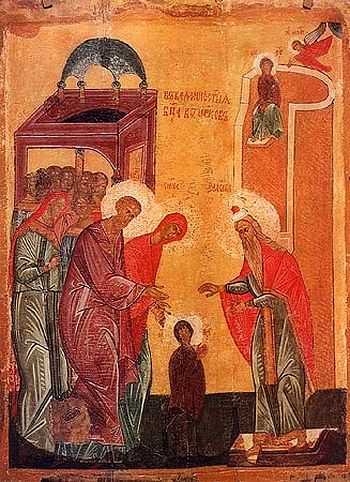
The Entry of the Holy Theotokos into the Temple is one of the twelve major church feasts and is numbered among those that affect our salvation. What takes place on this day? The three-year-old Child, the Most-holy Virgin Mary, is brought by Her parents to the temple of Jerusalem. She is placed on the temple steps and, moved by Divine revelation, the high priest Zacharias comes out to Her and leads Her into the Holy of Holies – the place where God Himself was mysteriously present, the place which no man could ever enter except the high priest, who, moreover, went in only once a year and not without sacrificial blood. And it is precisely this place, the Holy of Holies, which the Virgin Mary enters, invisibly carrying within Herself a new, living sacrifice – the forthcoming Christ, Saviour of the world, Who will sacrifice Himself in order to deliver all men from sin and death.

This holiday is “wondrous,” as sings the Church, not finding words to express the inexpressible joy, hope and expectation which commence with today’s event.

From a mysterious and grace-filled seed there will grow up a new covenant between God and man. The Saviour’s most-pure, animate temple – the Most-holy Maiden, precious bridal chamber, sacred treasure of God’s glory – is led into the Lord’s temple. And She brings with Her the foreshadowing of God’s goodwill to all of mankind, the beginning of a new covenant between God and man, the end of the many centuries of man’s alienation from God, and the end of our bondage to sin. Only a brief time remains, only several more years, for the fulfillment of that which the entire humanity awaits – the appearance of God Himself in the flesh, by way of the Most-holy Virgin.

She will be brought up in God’s temple – a place of holiness, purity and the power of God. She will be nourished by Divine grace, in order to become capable of containing Divinity Itself, so that the mystery of God’s incarnation could take place through Her. She must become used to conversing with the angels, in order to harken to the Archangel Gabriel’s glad tidings. She must encompass God within Her heart, in order to truly become a new temple of God.

We are all familiar with the words of the Apostle Paul: “Know ye not that ye are the temple of God, and that the Spirit of God dwelleth in you? If any man defile the temple of God, him shall God destroy; for the temple of God is holy, which temple ye are.” This mystery is revealed to us because we are called upon to become the temples of God, and this is the reason for today’s celebration.   

Today’s feast reminds us of the unique significance of man-made temples (i.e. churches). Let us ponder today: what is a church of God? When we come here today to celebrate the feast, we not only participate in wondrous hymn-singing, but we touch upon eternity, which is always present in a church of God. And nothing else in life makes sense except in the light of eternity. We should ponder this and repent of how often we remain deaf and blind to these great mysteries, and reject God’s gifts.

The Church cannot save us by itself. For our salvation we must actively participate in church life. The Lord calls upon us today to think of this, and to see the sinful condition in which each one of us lives. The Lord continues to await our repentance. He continues to patiently tolerate our detrimental lack of faith, and continuously wishes to enfold us within His grace, in order that we may be saved from the terrible misfortunes that are coming upon the world.

And we know that the Most-holy Virgin Mary, Mother of the suffering mankind that is being destroyed by its sins, will surely intercede for all those who appeal to Her with faith and love, and who offer their lives unto Her.

Let us thank God that our churches are still standing, and that the Lord and the Mother of God are present in them along with us. We magnify Thee, O Most-holy Virgin, God-chosen Maiden, and we honor Thine Entry into the Temple of the Lord.

The feast of the Entry of the Holy Virgin Mary, the Mother of God, into the temple is a feast of the Church itself. It is also a feast of all of us, because the Holy Virgin, ascending the steps of the temple of Jerusalem, presages not only Her future life, Her ascension into the Holy of Holies, but also presages the affiliation of mankind with Christ’s way of the cross and with His Resurrection. This feast tells us that the Mother of God, Who now enters the Holy of Holies, is even greater than the Holy of Holies. By the grace of God She is more honorable than the cherubim and beyond compare more glorious than the seraphim. She is above all creation. And not only by the grace of God, but by the hope of all of mankind, which has rushed towards this light, towards this holy of holies, towards this focal point of life and the source of life itself – the Lord – through the darkness of ages, through all sorrows, through all the sins and horrors of history.

The entry of the Most-holy Mother of God into the Holy of Holies is revealed to us as the path each one of us must take. It has been said: “The virgins that follow Her shall be brought unto the king, Her companions shall be brought unto Thee” (Psalm 45:14). This has been said about every person and primarily about children. For this reason children participate in a special way in today’s feast along with us. This is always very joyful, because if everyone were to participate in what the Lord gives us, our entire being would be transformed. The salvation which the Lord grants us depends on our offering of our children and on our own lives. It also depends primarily on how we lead our children through life, for what we prepare them and to what we actually dedicate them. What Joachim and Anna did was a great labor of love. Having been barren their entire life, they gave up their sole daughter. They gave Her to God, dedicated Her to the Lord, as though they separated Her from themselves, in order that She belong entirely to God alone.

What Joachim and Anna have done, offering to God the fruit of their prayers, far exceeds any spiritual labors that we could set up as an example. But let us ponder the following: often we find ourselves in a situation similar to these people – Joachim and Anna, – when misfortune befalls us, when we are in need, when we are ready to promise the Lord everything, say all kinds of words of love, just so He would help us, would deliver us from such a state. And then sorrow passes, need passes. But when the time comes to fulfill our promise, we begin to vacillate. We begin to delay the fulfillment of our own words: “I will definitely do this, Lord, only I pray Thee, do such-and-such for me, what I ask of Thee…”. And for this reason our life turns out to be barren. It is barren not in terms of childlessness (although that may also be possible), but in a deeper and more significant sense.

Thinking about this, we should pray today to the Lord and the Mother of God that we may be granted the grace of understanding that we have a true life, that we may be aware that the event which the Church celebrates today is the entry of the holy 3-year-old maiden into the Holy of Holies and Her sanctification by the grace of God for Her future encompassing of God the Word. And all of this for the fulfillment of the sacrament of God’s incarnation and for our salvation, which is already coming to pass. For it is not in vain that we sing: “Christ is born – glorify Him, Christ descends from heaven – meet ye Him.”

Remember that our salvation has actually come to pass already, and it is not only a remembrance. Over and over again we are given the Lent and the approach to the Nativity of Christ in order for our life to become truly more profound, truly deepen with the knowledge of the one unique mystery – that God has become man, that He is present in the life and destiny of each one of us. He always hears our every prayer, because there is no longer that curse which used to hang over every person, there is no longer that inescapable and ineffaceable stamp of evil which tainted mankind before Christ’s incarnation. The way to heaven is open to every person. We must only desire and want genuine truth, genuine beauty, and the light which had once shone for us, the light which the Lord sometimes gives back to us, and without which everything becomes extinguished.   

What can we bring to the Lord on this feast day? The parents of the Most-holy maiden Mary – Joachim and Anna – brought Him their own child, but what shall we give the Lord? Does the One to Whom belongs the entire earth and before Whom all the stars in heaven shine need the candles and the vigil lights which we offer to God? They are needed only to testify to the meaningfulness of our prayers and our standing before God. There are no other sacrifices which we can offer Him except one, of which He says: “Son, give Me thy heart,” because our heart is the only thing which does not yet fully belong to Him. He has given us His own heart and wishes us to give Him ours. He, Who loves us and gives all of Himself for us, is waiting for our love in return.

Let us pray to God that we may learn this love. Every person understands what reciprocal love is, and how terrible is unrequited love. It is precisely love which each person needs, every human soul needs. And the Lord Himself needs us to love Him with all our heart, all our thoughts, all our strength, our entire life. And to love God means to keep His commandments, as He Himself has said. Only when we keep His commandments can we learn what this all means and of what kind of love Christ is speaking. Only then can we learn this love and be worthy of the Lord, be able to stand up for Christ’s honor in this world where childhood, purity, and sanctity are being defiled. And this we can accomplish only when we go to church and receive God’s grace there, which is always given as long as we are turned towards the Lord.

Let us entreat the Lord for this incorruptible wealth, which He bountifully grants to all of us by the prayers and intercession of the Holy Theotokos. Let us also entreat Him for the ability to respond to His immeasurable gifts with our love, our entire life, the offering of our children to Him. And most precious of all – the unity which we achieve through Him. Amen.

What Does The Entrance Into The Temple Of The Mother Of God Mean For Us & Our Salvation

By Father Panagiotes Carras

The oikonomia of our salvation began with the very creation of the world. It is not by chance that the fourth Gospel does not commence with a genealogy of our Lord but takes us back to the very beginning.  All things from the beginning to the end, from the alpha to the omega are part of God’soikonomia for our salvation, God’s providential ordering of our salvation. Man was created that he may participate in the Divinity of his Creator by first participat­ing in his own perfection.  We are taught by the Fathers that man was created for perfection. Adam was offered perfection but fell victim to the guile of the serpent.  God’s plan could not be frustrated and the Lord prepared the world for another Adam who would rescue the offspring of the first Adam.

St. Paul tells us that Adam is a type of the future Adam (Romans 5: 14). All Christians are des­cendants of both the first Adam and the last Adam. From the first we inherited death, from the last we inherited life. (1 Corinthians 15: 45-50). It is this Apostolic teaching of the two Adams which was developed by the Fathers and formed the nucleus of the Church’s teaching on the salvation of mankind.

Mankind, which had its beginning in the first Adam, had to be given a new beginning. A new Adam was needed to become the Head of the New Humanity, the Head of the body, the Church, which is His body (Ephesians 1:22-23). However, just as in the creation of the Old Humanity, mankind was given the freedom to choose sonship; similarly in the creation of the New Humanity, mankind was granted the opportunity to choose. The first Adam was from the earth, a man of dust, the second is from Heaven (1 Corinthians 15: 47). The first could choose sin because he was not yet perfect, the second Adam, our Lord Jesus Christ, being God by nature, was totally alien to sin. It is because God’s oikonomia required a member of the human race who was able to prove himself free from every sin that the time had fully come (Galatians 4:4) for God to send forth His Son, since mankind was able to bring forth the All-Holy Virgin.

This is precisely why Theotokos is the key-word of the Christological teaching of the fourth Ecumen­ical Council or as St. John of Damascus says, This name contains the whole mystery of the Oikonomia(On the Orthodox Faith, 3, 12). It is for this reason that the traditional Orthodox icon of the Mother of God is an icon of the Incarnation, the Virgin is always with the Child.

The Church’s teaching of the Theotokos is an ex­tension of what is believed concerning the person of Christ. The Son of God was born of a woman and in this case the Mother is not just a mere physical instrument but an active participant who has found favour with God (Luke 1, 30). The faith of the Church is aptly expressed in the words of Nicholas Cabasilas in his Homily on the Annunciation: The incarnation was not only the work of the Father and of His Power and His Spirit, it was also the work of the will and the faith of the Virgin (On the Annunciation, 4).

It is the teaching of the Church, attested to from the earliest date, that the Virgin Mother of the In­carnate Lord had found favour with God (Luke 1:30) and that she was chosen and ordained to particip­ate in the Mystery of the Incarnation, in the Oikonomia of Salvation. The ancient Church understood the typo­logical relationship between the first Adam and the last Adam, and by extension it was able to see that the first Eve prefigured the second Eve. We find that as early as the Second Century St. Justin and St. Irenaeus had a developed teaching of the Theotokos as the second Eve who through her obedience re­medied the disobedience of the first Eve. And so the knot of Eve’s disobedience received its unloosing through the obedience of Mary; for what Eve, a virgin, bound by unbelief, that, Mary, a Virgin, unloosed by faith (Against Heresies, III, 22, 4.) Mary… by yield­ing obedience, became the cause of salvation, both to herself and the whole human race. (Against Heresies, III, 22, 4). Mary alone cooperating with the economy (Against Heresies, III, 21, 7).

The Church has proclaimed this great Mystery of our salvation not only through the teaching of the Fathers but also through the festal celebration of the acts which worked our salvation, chief of which is the Holy Resurrection of our Lord. On the 21st of Novem­ber the Church celebrates the Feast of the Entry of the Theotokos into the Temple. It is at this time that the faithful chant Today is the prelude of God’s Good-Will and the heralding of the salvation of mankind. (Dismissal Hymn).

Throughout the whole service the hymns proclaim the exalted place which the Entry has in the history of Salvation. The Entry marks the closing of the Old Covenant, whereas the Annunciation marks the beginn­ing of the New. With the Entry the most Holy Virgin is passing from the Old Covenant to the New, and this transition in the person of the Mother of God shows us how the New Covenant is the fulfillment of the Old.

Like other human beings the Holy Virgin was born under the law of original sin but the sinful heritage of the fall had no mastery over her. She was without sin under the universal sovereignty of sin, pure from every seduction and yet part of a humanity enslaved by the devil. This is the victory which the Feast of the Entry joyfully celebrates. St. Photius praises the Holy Virgin as the great and God-carved ornament of human kind” who ” made her whole soul a holy shrine of meekness… never allowing any of her wares as much as to touch for a moment the brine of evil. (On the Annunciation, 4). This theme con­stantly appears in the hymns of the Feast of the EntryThy Miracle, 0 Pure Theotokos, transcends the power of words; for I comprehend that thine is a body transcending description, not receptive to the flow of sin. (Third Magnification of the ninth Ode). Ni­cholas Cabasilas expanded this teaching and dealt with it extensively in his Homily on the Birth of the Theo­tokos where we read: The Virgin remained from the beginning to the end free from every evil because of her vigilant attention, firm will, and magnitude of wisdom. (Chapter 15).

The sinlessness and purity of the Theotokos along with the fact that the Lord was preparing Her to be­come His chamber overshadowed the sanctity of the Old Testament temple. The All-Pure Virgin is allowed to enter the Holy of Holies precisely because she is to become the living temple of God. St. Tarasios in his Homily of the Entry has Saint Anne exclaiming:Re­ceive Zacharias, the pure tabernacle; receive 0 priest, the immaculate chamber of the Word … have her dwell in the temple made by hands, she who has be­come a living temple of the Word (Migne, 98:1489). Zacharias in turn speaks to the Virgin, You are the loosing of the curse of Adam, you are the payment of the debt of Eveand he continues to recall all the types and prophecies of the Old Testament which refer to the Theotokos. (Migne, 98:1492-93).

In the Minea of St. Dimitry of Rostov we read, Thus with the honor and glory not only of men, but also of angels, the most Immaculate Maiden was led into the temple of the Lord. And it was meet: for if the ark of the Old Testament, bearing manna in itself, which served only as a prototype of the Most Holy Virgin, was carried into the temple with great honor, with the assembling of all Israel, then with how much greater honor, with the assembling of angels and men, had to take place the entry into the temple of that same living ark, which had manna — Christ — in it, the Most Blessed Virgin, fore-ordained to be the Mother of God.

The Feast of the Entry celebrates the sanctity of the All-Holy Virgin and glorifies the Lord who placed her in the inaccessible Holies like some treasure of God’s, to be used in due time (even as came to pass) for the enrichment of, and as an ornament transcend­ing, as well as common to, all the world.(St. Gregory Palamas, Homily on the Entry, IX).

Teachings From the Service of the Feast

In the Orthodox Church services we participate in the saving events of the Oikonomia of Salvation. This is why, during these services we hear the word Today quite often. This is why in the first Sticheron of the  Lord I have Cried  begins, Come let us faithful dance for joy on this day. The second Sticheron begins with In the temple of the Law today is the living temple.  During Vespers, Matins and the Divine Liturgy we enter into the Mystery of the Entry of the Theotokos. When we enter into the Mystery we are not simple witnesses as the maidens who accompanied theTheotokos but rather participants in the eternal mystery.  

The first two Old Testament readings of Vespers speak of the Divine establishment of the Tabernacle and the Temple (Exodus 40:1-5, 9-10, 34-35 and IIIKings 8:1, 3-4, 6-7, 9, 10-11). The third reading, taken from the Prophecy to Prophet Ezekiel ( Ezekiel 43:27-44:4) speaks of the Theotokos as the living Temple of God.  

During the Divine Liturgy, in the reading of the Epistle of Saint Paul to the Hebrews (9:1-7), we are taught that all things which were done in the Temple of the Old Testament were a Prophecy of what would be fulfilled by our Saviour. In the Gospel of Saint Luke (10:38-42, 11:27-28), which is read at every Feast of the Mother of God, we hear: Blessed is the womb that bare thee, and the paps which thou hast sucked. We are reminded to glorify our Lord and bless His mother, who brought us our salvation.

Icon of the Feast

The Orthodox teaching on the The Entry of the Theotokos into the Temple as the heralding of the salvation of mankind is seen in the Icon of the Feast. The central theme of the icon is the Holy of Holies (1) in the Temple which is about to receive a blessing far superior to any of its former blessings. The priest Zacharias, the father of St. John the Baptist, receives Panagia at the gates of the Temple (3) and in this way prophesies that the Virgin Mary is the New Ark of the Covenant. Saints Joachim and Anna (4), accompanied by virgins of Jerusalem, carrying torches in procession, bring Panagia as a well-pleasing sacrifice. The Theotokos is brought to the gates and ascends to the Holy of Holies where she is cared for by angels (2). Notice that the young virgins do not have their heads covered but that the Theotokos has her head covered. Also the garments of the Mother of God resemble those of Saint Anna and not of the young virgins. The Theotokos, although a child, is already a perfected woman that has reached full spiritual maturity.  She who in body is but three years old, and yet in the spirit is full of years (Ode three of the Second Canon).

Temple Of The Foolish Rich Man – Homily by Father Phillip LeMasters

Have you ever thought about the similarities and differences between barns and temples? Usually when we think of barns, we think simply of places to house farm animals or to store crops.  We normally do not think of them as having much spiritual significance. The rich man in today’s gospel lesson thought of his barns only in terms of his business, which was so successful that he looked forward simply to relaxing, eating, drinking, and enjoying himself.  Unfortunately, he did so to the point of making his possessions an idol.  He was rich in things of the world, but poor towards God.  He was ultimately a fool, for he based his life on what was temporary and lost his own soul.  His barn became a temple only to himself. 

We live in a culture that constantly tempts us to follow this man’s bad example. More so than any previous generation, we are bombarded with advertising and other messages telling us that the good life is found in what we can buy. Whether it is cell phones, clothing, cars, houses, entertainment, food, or medicines, the message is the same: Happiness comes from buying the latest new product. During the weeks leading up to Christmas, this message is particularly strong. We do not have to become Scrooges, however. It is one thing to give reasonable gifts to our loved ones in celebration of the Savior’s birth, but it is quite another to turn this holy time of year into an idolatrous orgy of materialism that obscures the very reason for the season.

We are not really near Christmas yet, as Advent just began on November 15. Today, as we continue to celebrate the ForeFeast of the Entrance of the Theotokos into the Temple, we are reminded of the importance of preparing to receive Christ at His birth. Instead of looking for fulfillment in barns and the money they produce, we should follow her into the temple. Sts. Joachim and Anna took their young daughter to the temple in Jerusalem, where she grew up in prayer and purity in preparation to become the living temple of God when she consented to the message of the Archangel Gabriel to become the mother of the God-Man Jesus Christ. The Theotokos was not prepared for her uniquely glorious role by a life focused on making as much money as possible, acquiring the most fashionable and expensive products, or simply pleasing herself. No, she became unbelievably rich toward God by focusing on the one thing needful, by a life focused on hearing the word of God and keeping it.

In ways appropriate to our own life circumstances, God calls each of us to do the same thing. And before we start making excuses, we need to recognize that what St. Paul wrote to the Ephesians applies to us also: “[Y]ou are no longer strangers and sojourners, but…fellow citizens with the saints and members of the household of God, built upon the foundation of the apostles and prophets, Christ Jesus Himself being the cornerstone, in Whom the whole structure is joined together and grows into a holy temple in the Lord; in Whom you also are built into it for a dwelling place of God in the Spirit.” In other words, to be a Christian is to be a temple, for the Holy Spirit dwells in us both personally and collectively. The only way to become a better temple is to follow the example of the Theotokos in deliberate, intentional practices that make us rich toward God, that open ourselves to the healing and transformation of our souls that Christ has brought to the world. We must participate personally in His holiness if we want to welcome Him anew into our lives at Christmas.

The rich fool became wealthy by investing himself entirely in his business to the neglect of everything else. In contrast, the Theotokos invested herself so fully in the Lord that she was able to fulfill the most exalted, blessed, and difficult calling of all time as the Virgin Mother of the Savior. In order for us to follow her example by becoming better temples of Christ, we also have to invest ourselves in holiness. The hard truth is that holiness does not happen by accident, especially in a culture that worships at the altar of pleasure, power, and possessions. So much in our world shapes us every day a bit more like the rich fool in our gospel lesson, regardless of how much or how little money we have. Many of us are addicted to electronic screens on phones, computers, and televisions. What we see and hear through virtually all forms of entertainment encourages us to think and act as though our horizons extend no further than a barn. In other words, the measure of our lives becomes what we possess, what we can buy, and whatever pleasure or distraction we can find on our own terms with food, drink, sex, or anything else. We think of ourselves as isolated individuals free to seek happiness however it suits us. No wonder that there is so much divorce, abortion, sexual immorality, and disregard for the poor, sick, and aged in our society. Investing our lives in these ways is a form of idolatry, of offering ourselves to false gods that can neither save nor satisfy us. The barn of the rich fool was also a temple, a pagan temple in which he basically worshiped himself. If we are not careful, we will become just like him by laying up treasures for ourselves according to the dominant standards of our culture and shut ourselves out of the new life that Christ has brought to the world.

We cannot control the larger trends of our society, but we can control what we do each day. During this Nativity Fast, no matter the circumstances of our lives, we can all take steps to live more faithfully as members of God’s household, built on the foundation of the apostles and prophets, with Jesus Christ as the cornerstone. In other words, we can intentionally reject corrupting influences and live in ways that serve our calling to become better living temples of the Lord. Yes, we can stop obsessing about our barns and enter into the temple of the one true God.

The first step is to set aside time for prayer. If we do not pray every day, we should not be surprised that it is hard to pray in Church or that we find only frustration in trying to resist temptation or to know God’s peace in our lives.  We also need to read the Bible.  If we fill our minds with everything but the Holy Scriptures and the lives of the Saints, we should not be surprised that worry, fear, and unholy thoughts dominate us.  Fasting is also crucial.  If we do not fast or otherwise practice self-denial, we should not be surprised when self-centered desires for pleasure routinely get the better of us and make us their slaves.  We should also share with the poor.  If we do not give generously of our time and resources to others in need, we should not be surprised when selfishness alienates us from God, our neighbors, and even our loved ones. This is also a time for humble confession and repentance.   If we refuse to acknowledge and turn from our  sins, we should not be surprised when we are overcome by guilt and fall into despair about leading a faithful life.  No, the Theotokos did not wander into the temple by accident and we will not follow her into a life of holiness unless we intentionally reorient ourselves toward Him.

None of us will do that perfectly, but we must all take the steps we are capable of taking in order to turn our barns into temples. Remember that the infant Christ was born in a barn, which by virtue of His presence became a temple. The same will be true of our distracted, broken lives when—with the fear of God and faith and love—we open ourselves to the One Who comes to save us at Christmas. The Theotokos prepared to receive the Savior by attending to the one thing needful, to hearing and keeping His word. In the world as we know it, that takes deliberate effort, but it remains the only way to be rich toward God. And that is why Christ is born at Christmas, to bring us into His blessed, holy, and divine life which is more marvelous than anything we can possibly imagine. As the Lord said, “He who has ears to hear, let him hear.”

The Foolish Rich Man – Homily by Father Anthony Hughes November 2005

Planted in our hearts are possibilities, good and bad. It is possible for us to become unwholesome people filled with greed, pride, hatred, selfishness, insensitivity, intolerance, judgment, and cruelty. Or we can become people filled with love, peace, tolerance, compassion, joy. It is our decision which seeds take root and grow in us. What shall I nurture in my life? What shall I do with the time and talents that have been given me? The rich man in today’s Gospel, though evidently gifted, talented and intelligent chose unwisely.

The rich man transgressed in a number of different ways. Let’s examine three of them.

First, he ignored one of life’s greatest teachers: death. He seems to have forgotten death entirely. He was so busy worrying about accumulating more wealth that he did not envision an end to his life. He may not have thought of death, but he sure did fear it! The parable ends with God saying to him, “Fool! This night your soul will be required of you, then whose will those things be which you have provided?”

The saints of the Church often teach that we should keep death in our minds daily. People often call us crazy when we say that, but think about it for a moment. If we remember that we are going to die, it helps us to prioritize what we do with the time we have left. Thinking on our own mortality need not be morbid or depressing; instead it can help us appreciate life even more and live fuller and richer lives. It certainly causes us to think of God and the after-life. The remembrance of death encourages us to nurture good things in ourselves.

Here is a pithy saying, “All of us will surely die, but will any of us ever really live?” In order to really live we must not run from the remembrance of death.

Secondly, the rich man did not care for the poor. He had more than he needed and kept collecting even more, so much that he needed to build bigger barns. He forgot three important truths: every treasure in this life withers and fades, God gives in abundance so that we can share in abundance and, since all human beings are interconnected, the suffering of one equals the suffering of all.

Jesus tells us to “lay up treasures in heaven” that do not fade and can’t be stolen away. This we do by nurturing goodness in ourselves and sharing it with others. The truly rich are people who are rich in compassion even though they may have nothing in the bank. If we are well-off it is not for our benefit alone that God has blessed us. It is so that we can share even more with others and lay up treasure in heaven. Attachment to wealth, selfish hoarding during our short lives on this earth will impoverish us during our eternal life in the age to come.

Humanity is unity in diversity, one in essence just as we say about the Holy Trinity. Funny! We are indeed made in the image of God are we not? In fact, the truth of the essential unity of humanity is one reason why we Orthodox should be extremely concerned about social justice. Every hungry child is my child, every tortured prisoner is my brother, every mother dying of HIV/Aids in Africa is my mother, every wounded solider is my father, everyone suffering from injustice is my neighbor. Yes, it is our job to see to the needs of our neighbors and to do all we can to alleviate suffering. Like their Savior all true Christian disciples have “bleeding hearts”. After Cain killed his brother he asked God, “Am I my brother’s keeper.” The answer is yes.

St. Basil the Great has a famous quote for this foolish rich man and for us, “The bread which you do not use is the bread of the hungry, the garment hanging in your wardrobe is the garment of him who is naked, the shoes that you do not wear are the shoes of the one who is barefoot, the money that you keep locked away is the money of the poor, the acts of charity that you do not perform are so many injustices that you commit.” Sisters and brothers, we do not own anything. What we have belongs to God and to those who are in need. If we do not share, then we are no better than thieves.

God gives abundantly so that we can share abundantly. To those who give, God gives even more so that they can share even more. That is the truth of it.

Remember this wise saying, “All the happiness there is in the world comes from thinking about others, and all the suffering in the world comes from preoccupation with yourself.”

Lastly, the foolish rich man, by not remembering death and by hoarding his wealth and robbing the poor, failed to “lay up riches in heaven where neither rust nor moth destroys, where man cannot break in and steal.” Thus, he ignored God whose treasures are eternal. “Seek first the kingdom of God,” Jesus taught, but to do that we must stop trying to establish our own kingdoms here. Far from trying to ignore and escape death, Jesus teaches that we must embrace it, “Take up your cross and follow me.”

To save our lives we must lose them. To preserve our lives we must give them up. To become great we must become small. All that God teaches is contrary to conventional wisdom. As Christians we are therefore called to be compassionate revolutionaries, to subvert the normal order of things with the radical leaven of the kingdom of heaven.

The foolish rich man ran away from death and discovered himself racing into its arms. He stole from the poor by hoarding his wealth and found himself impoverished in eternity. He ignored God who alone had the power to give him what his heart truly desired – peace, security, eternal life – and ended up empty handed.

While we are able, while the light of day remains, let us learn from the foolish rich man, turn away from our own foolish ways and begin laying up treasures in heaven.

What Is The Nativity Fast

The Nativity Fast sanctifies the last part of the year and is established so that by the day of the Nativity of Christ we will purify ourselves by repentance, prayer and abstinence. As a result, we could piously meet the Son of God who came to this world and, in addition to the usual gifts and sacrifices, bring Him a pure soul and a passionate intention to follow His commandments and teachings.

Saint Simeon of Thessalonica described this autumn fast this way, “The fast of the Nativity depicts the fast of Moses, who, after fasting for forty days and nights, received the inscription of the words of God on stone tablets. We, fasting for forty days, contemplate and accept the living word from the Virgin, inscribed not on stone, but incarnate and born, and partake of His Divine Body and Blood”.

St. Leo the Great says about fasting that “the very keeping of abstinence is sealed by four times, so that during the year we know that we constantly need purification and that when life is scattered, we should always try to destroy sin by fasting and alms.” He calls this time of fasting “a sacrifice to God for the fruits gathered… As the Lord has given us the fruits of the earth, so we should be generous to the poor during the fast.”

The establishment of the Nativity Fast has a long history and begins in early Christian times. Like the feast of the Nativity of Christ, it appeared earlier in the West, and then was adopted by the Eastern Churches. Initially, in the II-III centuries, there was one syncretic holiday – Epiphany, which at that time was understood as “a whole series of events related to the Incarnation of God, including the birth of Jesus from a Virgin and His Baptism in the waters of the Jordan.” In the IV century. there is a separation of two holidays – Nativity and Epiphany. In the West, the separation period can be set “with perfect accuracy – 354 years. To the East it penetrates slowly and probably not without a struggle. In the East , the first homilies at Nativity belong to the Cappadocian fathers . In Antioch, Chrysostom introduces the celebration of Nativity separately from Epiphany, and it is on December 25 in 386 or 387.”

The fact is that the date of the Nativity of Christ is not exactly known. Different churches defined it differently. In the Church of Alexandria it was April 18, the African tradition adhered to March 28, the Eastern one – January 6, and Rome – December 25. As we can see, the Roman tradition prevailed everywhere. The exception is the Armenian Church, where Nativity is celebrated in accordance with the ancient Eastern tradition on January 6/19. In the Church of Constantinople, the feast of Nativity was established in the late 370s. This is evidenced by the separate words pronounced by Gregory the Theologian, Archbishop of Constantinople, “two words: December 25, 380 – for Nativity and January 6, 381 – for Epiphany.” In the Church of Antioch, this happened, as already mentioned, in 386-387, and possibly earlier – around 370, then “in the Churches of Asia Minor and later – in Alexandria (in the early 430s).”

The Jerusalem Church has long resisted the separation of Nativity and Epiphany. Festive syncretism persisted until Emperor Justinian wrote around 560/561 a message “On holidays: Annunciation and Nativity, Candlemas and Baptism” addressed to the Church of Jerusalem under Patriarch Eustochius (552-563/564). The Emperor complained, “that the dates of the holidays of the Annunciation (March 25) and Candlemas (February 2) are violated there. Referring to the Gospel of Luke (Luke 1, 26-56), Justinian also cited a number of authoritative opinions of the fathers: Saints Gregory the Theologian, Gregory of Nyssa and John Chrysostom, as well as a text under the name of Blessed Augustine of Hippo, trying to convince his addressees to accept a separate holiday of Nativity.” These recommendations were implemented, but after the death of Justinian (565).

The first reference of the Nativity Fast is in the writings of the holy fathers of the IV century: Ambrose of Milan, Blessed Augustine and Philastrius. In the IV-V centuries, “fasts of the four seasons” appeared in the West. Pope Leo I (440-461) mentions them: “Fasts are distributed throughout the year, so that the law of abstinence is prescribed for all seasons: it is the spring fast that is performed on Lent, summer on Pentecost, autumn in the 7th month, winter in the 10th.” As the basis for these fasts, St. Leo indicates gratitude to God for the fruits gathered. In parallel with these western fasts, there must be annual fasts in the East brought up to the number of four.”

Nativity Fast – Why Are Humility & Joy Our Focus Now?

Entrance to the Grotto at the Church of the Nativity, Bethlehem.
Entrance to the Grotto at the Church of the Nativity, Bethlehem

By Father Rostislav Sheniloff

As we enter the Nativity Fast, my dear friends, this fast, beginning on November 15th, lasts for six weeks – almost as long as the Great Lent. However, the Nativity Fast has a different and entirely unique character. Lent in our minds is usually associated with penitence, sorrow, weeping over one’s sins, cleansing the soul in preparation for the forthcoming great event or sacrament. In the Nativity Fast, all concepts concerning lent – except for the last one, that is, purification of the soul, – are eclipsed by two dominant characteristics. These are – humbleness and internal joy.

Why does the Church urge us to use this period to bring our souls into a state of complete humility? Because the coming holiday, although so joyous and so great, is completely enveloped in the spirit of humility. The Apostle Paul explains to us that in this holiday “God on high descended upon earth, in order to elevate us into heaven.” But in order to achieve this, the Lord “diminished Himself, taking on the image of a servant, and was likened to man.” We are all servants of God, that is, we have all been created, and in order to become like man, the Lord had to diminish, lessen, exhaust, in other words – humble His Divinity. And all of this the Lord did for us, in order to save us from death and the power of the devil, so that man – the crown of God’s creation – would not perish. In like manner we, too, should honor and thank our Creator and Saviour. We should diminish our pride, lessen our self-extolment, exhaust our selfishness, and only then – through total humility – will we find that ascending road into heaven, into the Heavenly Realm, which the Lord has opened for us in His descent to earth.

In the Holy Land, in the town of Bethlehem, where the Lord was born in a humble manger 2,000 years ago, a majestic church now stands over the site of His birth. This church is distinguished by its entrance doors, which were made so low, that an average adult has to stoop in order to go in. This was done deliberately, to constantly remind us of the need for spiritual humility before the greatness of the event that took place here.

At the same time, Christmas is also a time for joy. During Great Lent, for example, the Church so gives itself over to penitence, that with the exception of two major feasts – the Annunciation of the Holy Virgin and the Entrance of our Lord into Jerusalem – which are both directly linked to paschal events, there is hardly any commemoration of the feasts of major saints, since a holiday spirit would interfere with the purpose of this lent. The entire Nativity Fast, on the other hand, is studded with the feasts of major saints like glittering jewels: holy great-martyr Catherine, Saint Apostle Andrew, holy great-martyr Barbara, the great Saint Nicholas, Saint Herman of Alaska, and many others, as though indicating to us that the presence of all these saints and all this rejoicing has become possible only because the Lord has come down to earth and has opened the way to heaven. Thus throughout this entire period the Church strongly urges us to prepare for the coming joy with the words of the Christmas canon: “Christ is born – glorify Him! Christ cometh from heaven – meet ye Him! Christ is on earth – be ye exalted!” Amen.