Triodion – Why do we fast? – Archbishop Kallistos Ware

The primary aim of fasting is to make us conscious of our dependence upon God. If practiced seriously, the Lenten abstinence from food – particularly in the opening days – involves a considerable measure of real hunger, and also a feeling of tiredness and physical exhaustion. The purpose of this is to lead us in turn to a sense of inward brokenness and contrition; to bring us, that is, to the point where we appreciate the full force of Christ’s statement, ‘Without Me you can do nothing’ (John 15: 5). If we always take our fill of food and drink, we easily grow over-confident in our own abilities, acquiring a false sense of autonomy and self-sufficiency. The observance of a physical fast undermines this sinful complacency. Stripping from us the specious assurance of the Pharisee – who fasted, it is true, but not in the right spirit – Lenten abstinence gives us the saving self dissatisfaction of the Publican (Luke I 8: 10-1 3). Such is the function of the hunger and the tiredness: to make us ‘poor in spirit’, aware of our helplessness and of our dependence on God’s aid.

Yet it would be misleading to speak only of this element of weariness and hunger. Abstinence leads, not merely-to this, but also to a sense of lightness, wakefulness, freedom and joy. Even if the fast proves debilitating at first, afterwards we find that it enables us to sleep less, to think more clearly, and to work more decisively. As many doctors acknowledge, periodical fasts contribute to bodily hygiene. While involving genuine self-denial, fasting does not seek to do violence to our body but rather to restore it to health and equilibrium. Most of us in the Western world habitually eat more than we need. Fasting liberates our body from the burden of excessive weight and makes it a willing partner in the task of prayer, alert and responsive to the voice of the Spirit.

It will be noted that in common Orthodox usage the words ‘fasting’ and ‘abstinence’ are employed interchangeably. Prior to the Second Vatican Council, the Roman Catholic Church made a clear distinction between the two terms: abstinence concerned the types of food eaten, irrespective of quantity, whereas fasting signified a limitation on the number of meals or on the amount of food that could be taken. Thus on certain days both abstinence and fasting were required; alternatively, the one might be prescribed but not the other. In the Orthodox Church a clear-cut distinction is not made between the two words. During Lent there is frequently a limitation on the number of meals eaten each day, 5 but when a meal is permitted there is no restriction on the amount of food allowed. The Fathers simply state, as a guiding principle, that we should never eat to satiety but always rise from the table feeling that we could have taken more and that we are now ready for prayer.

If it is important not to overlook the physical requirements of fasting, it is even more important not to overlook its inward significance. Fasting is not a mere matter of diet. It is moral as well as physical. True fasting is to be converted in heart and will; it is to return to God, to come home like the Prodigal to our Father’s house. In the words of St. John Chrysostom, it means ‘abstinence not only from food but from sins’. ‘The fast’, he insists, ‘should be kept not by the mouth alone but also by the eye, the ear, the feet, the hands and all the members of the body’: the eye must abstain from impure sights, the ear from malicious gossip, the hands from acts of injustice. 6 It is useless to fast from food, protests St. Basil, and yet to indulge in cruel criticism and slander: ‘You do not eat meat, but you devour your brother’ . 7 The same point is made in the Triodion, especially during the first week of Lent:

As we fast from food, let us abstain also from every passion. . .

Let us observe a fast acceptable and pleasing to the Lord.
True fasting is to put away all evil,
To control the tongue, to forbear from anger,
To abstain from lust, slander, falsehood and perjury.
If we renounce these things, then is our fasting true and acceptable to God.
Let us keep the Fast not only by refraining from food,
But by becoming strangers to all the bodily passions. 8

The inner significance of fasting is best summed up in the triad: prayer, fasting, almsgiving. Divorced from prayer and from the reception of the holy sacraments, unaccompanied by acts of compassion, our fasting becomes pharisaical or even demonic. It leads, not to contrition and joyfulness, but to pride, inward tension and irritability. The link between prayer and fasting is rightly indicated by Father Alexander Elchaninov. A critic of fasting says to him: ‘Our work suffers and we become irritable. . . . I have never seen servants [in pre-revolutionary Russia] so bad tempered as during the last days of Holy Week. Clearly, fasting has a very bad effect on the nerves.’ To this Father Alexander replies: ‘You are quite right. . . . If it is not accompanied by prayer and an increased spiritual life, it merely leads to a heightened state of irritability. It is natural that servants who took their fasting seriously and who were forced to work hard during Lent, while not being allowed to go to church, were angry and irritable.’ 9

Fasting, then, is valueless or even harmful when not combined with prayer. In the Gospels the devil is cast out, not by fasting alone, but by ‘prayer and fasting’ (Matt. 17: 21 ; Mark 9: 29); and of the early Christians it is said, not simply that they fasted, but that they ‘fasted and prayed’ (Acts 13: 3; compare 14: 23). In both the Old and the New Testament fasting is seen, not as an end in itself, but as an aid to more intense and living prayer, as a preparation for decisive action or for direct encounter with God. Thus our Lord’s forty-day fast in the wilderness was the immediate preparation for His public ministry (Matt. 4: 1-11). When Moses fasted on Mount Sinai (Exod. 34: 28) and Elijah on Mount Horeb (3 [1] Kgs. 19: 8-12), the fast was in both cases linked with a theophany. The same connection between fasting and the vision of God is evident in the case of St. Peter (Acts 10: 9-17). He ‘went up on the housetop to pray about the sixth hour, and he became very hungry and wanted to eat; and it was in this state that he fell into a trance and heard the divine voice. Such is always the purpose of ascetic fasting – to enable us, as the Triodion puts it, to ‘draw near to the mountain of prayer’. 10

Prayer and fasting should in their turn be accompanied by almsgiving – by love for others expressed in practical form, by works of compassion and forgiveness. Eight days before the opening of the Lenten fast, on the Sunday of the Last Judgment, the appointed Gospel is the Parable of the Sheep and the Goats (Matt. 25′: 31-46), reminding us that the criterion in the coming judgment will not be the strictness of our fasting but the amount of help that we have given to those in need. In the words of the Triodion:


Knowing the commandments of the Lord, let this be our way of life:
Let us feed the hungry, let us give the thirsty drink,
Let us clothe the naked, let us welcome strangers,
Let us visit those in prison and the sick.
Then the Judge of all the earth will say even to us:
‘Come, ye blessed of My Father, inherit the Kingdom prepared for you.’ 11

This stanza, it may be noted in passing, is a typical instance of the ‘evangelical’ character of the Orthodox service-books. In common with so many other texts in the Triodion, it is simply a paraphrase of the words of Holy Scripture. 12

It is no coincidence that on the very threshold of the Great Fast, at Vespers on the Sunday of Forgiveness, there is a special ceremony of mutual reconciliation: 13  for without love towards others there can be no genuine fast. And this love for others should not be limited to formal gestures or to sentimental feelings, but should issue in specific acts of almsgiving. Such was the firm conviction of the early Church. The second-century Shepherd of Hermas insists that the money saved through fasting is to be given to the widow, the orphan and the poor. 14 But almsgiving means more than this. It is to give not only our money but our time, not only what we have but what we are; it is to give a part of ourselves. When we hear the Triodion speak of almsgiving, the word should almost always be taken in this deeper sense. For the mere giving of money can often be a substitute and an evasion, a way of protecting ourselves from closer personal involvement with those in distress. On the other hand, to do nothing more than offer reassuring words of advice to someone crushed by urgent material anxieties is equally an evasion of our responsibilities (see Jas. 2: 16). Bearing in mind the unity already emphasized between man’s body and his soul, we seek to offer help on both the material and the spiritual levels at once.

‘When thou seest the naked, cover him; and hide not thyself from thine own flesh.’ The Eastern liturgical tradition, in common with that of the West, treats Isaiah 58: 3-8 as a basic Lenten text.


So we read in the Triodion:

While fasting with the body, brethren, let us also fast in spirit.
Let us loose every bond of iniquity;
Let us undo the knots of every contract made by violence;
Let us tear up all unjust agreements;
Let us give bread to the hungry
And welcome to our house the poor who have no roof to cover them,
That we may receive great mercy from Christ our God. 15

Always in our acts of abstinence we should keep in mind St. Paul’s admonition not to condemn others who fast less strictly: ‘Let not him who abstains pass judgment on him who eats’ (Rom. 14: 3). Equally, we remember Christ’s condemnation of outward display in prayer, fasting or almsgiving (Matt. 6: 1-18). Both these Scriptural passages are often recalled in the Triodion:

Consider well, my soul: dost thou fast? Then despise not thy neighbor.
Dost thou abstain from food? Condemn not thy brother.

Come, let us cleanse ourselves by almsgiving and acts of mercy to the poor,
Not sounding a trumpet or making a show of our charity.
Let not our left hand know what our right hand is doing;
Let not vainglory scatter the fruit of our almsgiving;
But in secret let us call on Him that knows all secrets:
Father, forgive us our trespasses, for Thou lovest mankind. 16

If we are to understand correctly the text of the Triodion and the spirituality that underlies it, there are five misconceptions about the Lenten fast against which we should guard. In the first place, the Lenten fast is not intended only for monks and nuns, but is enjoined on the whole Christian people. Nowhere do the Canons of the Ecumenical or Local Councils suggest that fasting is only for monks and not for the laity. By virtue of their Baptism, all Christians – whether married or under monastic vows – are Cross-bearers, following the same spiritual path. The exterior conditions in which they live out their Christianity display a wide variety, but in its inward essence the life is one. Just as the monk by his voluntary self-denial is seeking to affirm the intrinsic goodness and beauty of God’s creation, so also is each married Christian required to be in some measure an ascetic. The way of negation and the way of affirmation are interdependent, and every Christian is called to follow both ways at once.

In the second place, the Triodion should not be misconstrued in a Pelagian sense.If the Lenten texts are continually urging us to greater personal efforts, this should not be taken as implying that our progress depends solely upon the exertion of our own will. On the contrary, whatever we achieve in the Lenten fast is to be regarded as a free gift of grace from God. The Great Canon of St. Andrew of Crete leaves no doubt at all on this point:

I have no tears, no repentance, no compunction;
But as God do Thou Thyself, O Saviour, bestow them on me. 17

In the third place, our fasting should not be self-willed but obedient. When we fast, we should not try to invent special rules for ourselves, but we should follow as faithfully as possible the accepted pattern set before us by Holy Tradition. This accepted pattern, expressing as it does the collective conscience of the People of God, possesses a hidden wisdom and balance not to be found in ingenious austerities devised by our own fantasy. Where it seems that the traditional regulations are not applicable to our personal situation, we should seek the counsel of our spiritual father – not in order legalistically to secure a ‘dispensation’ from him, but in order humbly with his help to discover what is the will of God for us. Above all, if we desire for ourselves not some relaxation but some piece of additional strictness, we should not embark upon it without our spiritual father’s blessing. Such has been the practice since the early centuries of the Church’s life:

Abba Antony said: ‘I know of monks who fell after much labor and lapsed into madness, because they trusted in their own work and neglected the commandment that says: “Ask your father, and he will tell you.'” (Deut. 32: 7)


Again he said: ‘So far as possible, for every step that a monk takes, for every drop of water that he drinks in his cell, he should consult the gerontes, in case he makes some mistake in this.’ 18

These words apply not only to monks but also to lay people living in the ‘world’, even though the latter may be bound by a less strict obedience to their spiritual father. If proud and willful, our fasting assumes a diabolical character, bringing us closer not to God but to Satan. Because fasting renders us sensitive to the realities of the spiritual world, it can be dangerously ambivalent: for there are evil spirits as well as good.


In the fourth place, paradoxical though it may seem, the period of Lent is a time not of gloom but of joyfulness. It is true that fasting brings us to repentance and to grief for sin, but this penitent grief, in the vivid phrase of St. John Climacus, is a ‘joy-creating sorrow’ . 19 The Triodion deliberately mentions both tears and gladness in a single sentence:

Grant me tears falling as the rain from heaven,O Christ,
As I keep this joyful day of the Fast. 20

It is remarkable how frequently the themes of joy and light recur in the texts for the first day of Lent:


With joy let us enter upon the beginning of the Fast.
Let us not be of sad countenance. . . .
Let us joyfully begin the all-hallowed season of abstinence;
And let us shine with the bright radiance of the holy commandments. . . 
All mortal life is but one day, so it is said,
To those who labor with love.
There are forty days in the Fast;
Let us keep them all with joy. 21

The season of Lent, it should be noted, falls not in midwinter when the countryside is frozen and dead, but in spring when all things are returning to life. The English word ‘Lent’ originally had the meaning ‘springtime’; and in a text of fundamental importance the Triodion likewise describes the Great Fast as ‘springtime’:


The springtime of the Fast has dawned,
The flower of repentance has begun to open.
O brethren, let us cleanse ourselves from all impurity
And sing to the Giver of Light:
Glory be to Thee, who alone lovest mankind. 22

Lent signifies not winter but spring, not darkness but light, not death but renewed vitality. Certainly it has its somber aspect, with the repeated prostrations at the weekday services, with the dark vestments of the priest, with the hymns sung to a subdued chant, full of compunction. In the Christian Empire of Byzantium theatres were closed and public spectacles forbidden during Lent; 23 and even today weddings are forbidden in the seven weeks of the fast. 24 Yet these elements of austerity should not blind us to the fact that the fast is not a burden, not a punishment, but a gift of God’s grace:

Come,O ye people, and today let us accept
The grace of the Fast as a gift from God. 25

Fifthly and finally, our Lenten abstinence does not imply a rejection of God’s creation. As St. Paul insists, ‘Nothing is unclean in itself’ (Rom. 14: 14). All that God has made is ‘very good’ (Gen. I: 31): to fast is not to deny this intrinsic goodness but to reaffirm it. ‘To the pure all things are pure’ (Titus I: I S), and so at the Messianic banquet in the Kingdom of heaven there will be no need for fasting and ascetic self-denial. But, living as we do in a fallen world, and suffering as we do from the consequences of sin, both original and personal, we are not pure; and so we have need of fasting. Evil resides not in created things as such but in our attitude towards them, that is, in our will. The purpose of fasting, then, is not to repudiate the divine creation but to cleanse our will. During the fast we deny our bodily impulses – for example, our spontaneous appetite for food and drink – not because these impulses are in themselves evil, but because they have been disordered by sin and require to be purified through self-discipline. In this way, asceticism is a fight not against but for the body; the aim of fasting is to purge the body from alien defilement and to render it spiritual. By rejecting what is sinful in our will, we do not destroy the God-created body but restore it to its true balance and freedom. In Father Sergei Bulgakov’s phrase, we kill the flesh in order to acquire a body.

But in rendering the body spiritual, we do not thereby dematerialize it, depriving it of its character as a physical entity. The ‘spiritual’ is not to be equated with the non-material, neither is the ‘fleshly’ or carnal to be equated with the bodily. In St. Paul’s usage, ‘flesh’ denotes the totality of man, soul and body together, in so far as he is fallen and separated from God; and in the same way ‘spirit’ denotes the totality of man, soul and body together, in so far as he is redeemed and divinized by grace. 26 Thus the soul as well as the body can become carnal and fleshly, and the body as well as the soul can become spiritual. When St. Paul enumerates the ‘works of the flesh’ (Gal. 5: 19-21), he includes such things as sedition, heresy and envy, which involve the soul much more than the body. In making our body spiritual, then, the Lenten fast does not suppress the physical aspect of our human nature, but makes our materiality once more as God intended it to be.

This has been extracted from the full article that replicates what is in the Triodion.

Triodion – CheeseFare Week – Themes Preparing Us For Great Lent

Up to this point, the Triodion has only had messages for us on Sundays. This week it begins to expand itself into daily Matins and Vespers services. These Triodion daily services continue throughout Lent and Holy Week.

So, what are the key messages for this first day of daily Triodion services?

Monday’s Triodion messages fit into themes that look backwards at our Pre-Lenten preparation as well as forward to the upcoming Sunday of the Expulsion of Adam from Paradise and of course the Lenten Fast itself which begins a week from today on March 7th. Below are the key themes along with some quotes from Monday’s Daily Matins and Vespers Services.

1. Desire/Eagerness (Zacchaus)

The entranceway to divine repentance * hath been opened: * let us eagerly enter therein, * purified in body and observing abstinence * from food and the passions, * as obedient servants of Christ * who hath called the world into the heavenly Kingdom. * Let us offer unto the King of all * a tenth part of the whole year, ** that with love we may behold His Resurrection.

The bright forefeast of the time of abstinence, the bright threshold of the Fast hath appeared today, wherefore brethren, let us run the race with hope and great eagerness.

2. Humility/ God’s Mercy (Publican)

My way of life is shameful and bitter, but Thy mercy and compassion are immeasurable O Lover of mankind, wherefore I beseech Thee O Savior, grant unto me who doth sing Thy praises with love, time for repentance.

3. Repentance (Prodigal)

Having wasted my whole life living prodigally, I have been hired by bitter and wicked citizens; but O Christ who desireth that I turn back to Thy compassion, reject me not.

The beginning of compunction and repentance is to make a stranger of sin and abstain from passions. Therefore, let us hasten to cut off our wicked deeds.

Behold, the door of repentance hath already opened, O friends of God: come, let us make haste to enter therein, that Christ not close it and we be shut out as unworthy

4. Being Merciful & God’s Judgement (Last Judgement)

Behold, now is the season of repentance, the forefeast that prepareth us to enter the Fast. Awake, O my soul, and with a fervent heart be reconciled to thy God and Benefactor, and thus escape His just and truly fearful judgment

The time for repentance hath begun; be not heedless, O my soul. Give bread to the hungry, and pray unto the Lord every day and night and each hour, that He may save thee.

5. Expulsion of Adam from Paradise (Coming This Sunday)

By transgressing I have emulated our forefather Adam, and wretched as I am, I have been cast out from sweet joy. Therefore I fall down before Thee in repentance weeping: O Lord save me.

6. Lenten Fast & Fasting ( Our fast begins slowly this week and in high gear next)

At all times the Fast is profitable for those * who choose to observe it, * for the temptations of devils are rendered ineffective * against those who fast, * rather the protectors of our lives, the angels, * abide with us who with fortitude, ** cleanse ourselves by fasting.

With fasting let us hasten to wash away * the filth of our transgressions, * and by means of mercy and compassion to the poor, * let us enter the bridal chamber of the Bridegroom Christ, ** who hath bestowed upon us great mercy.

7. Preparation and Purifying Ourselves ( General throughout Pre-Lent and Lent)

Announcing that spring is upon us, the week of cleansing which prepareth us for the holy Fast, let us all now illumine our souls and bodies thereby

Standing before the entrance and gateway of the Fast, let us not begin it with reckless abandon and drunkenness, rather, let us eagerly enter with purity of thought, that we may worthily receive crowns of immortality and the fruit of our labors.

Sunday of Last Judgement Adult Education Class

Many themes come together this week in the Sunday of Last Judgment. 

Perhaps, the one that stands out the most to me personally is the difference between my judgment and God’s mercy and judgement.  From our prior weeks together, I see in the example of both the Pharisee and the elder son the separation (and sin) that occurs when I impose my judgment on God and elevate my judgement over His.  I also see in the examples of the Publican and younger son; God’s ceaseless merciful desire for a communion of Love with those of us who can accept the reality of our desperate need for Him as we release our judgement(s) and experience His mercy.  

“Do not judge, and you will not be judged. Do not condemn, and you will not be condemned. Forgive, and you will be forgiven.”

Luke 6:37

How can I be ‘right-sized’ as the creature and He as the Creator if I lose this perspective on judgment?  And in this desire I have for self-reliance and self-sufficiency, am I not separating myself from the life that is only available in Him.  

Is there any ceiling to this repentant possibility of releasing what is truly false in me (from distorting the reality of myself as wholly dependent on Him) and discovering what is true in Him?

Trust in the Lord with all thine heart and lean not unto thine own understanding. In all thy way acknowledge Him, and He shall direct they paths

Proverbs 3:5 – 7

And what more poignant message than this parable of the Last Judgment to make clear the danger of elevating my judgement above God’s.    

Perhaps, from this theme of judgement we are lead with new resolve into humility and mercy.  Father Thomas Hopko describes humility as ‘seeing reality as it is in God’.  What does my response to the message of the Last Judgement tell me about where I stand in humility and being right-sized in the way I relate myself to God?   Am I willing to accept God’s mercy as essential in this daily practice of repentance? Is my preparation for Lent teaching me to open my heart to God‘s mercy and the needs of those I encounter each day?

Perhaps , we can hear the many chants of ‘Lord have mercy’ differently this Sunday.  Perhaps , my chants can be a bit more of an intense expression of my heart yearning for what only He can do in my life. 

This week I’ve chosen just two of our readings for the class to focus on. I’ve intentionally reduced our focus to hopefully allow us to deepen the time we spend on discussion and reflection:

Great Lent & Last Judgment – Father Alexander Schmemann

Our Heart Condition & Last Judgement – Father Symeon Lev

Here were the other postings this week that are useful background for the class but I will (in an effort to save trees) not print these out for the class.

Orthodox Saints on Repentance

Bearing Shame in Confession

Danger of Judging Others

A Sensitive & Loving Heart

Sunday of the Last Judgment – Homily by Archpriest Symeon Lev

We know that Christians should avoid vainglory, conceit, and the tacit expectation of rewards of grace during Lent. However, even the most careful and unceasing self-control does not always lead to the desired results. Protecting oneself from hidden vainglory during Lent is by no means easy. This is where Christian good deeds – when one really takes on human grief – can be of help. After all, when we move away from ourselves by coming into contact with concrete human trouble and misfortune, by sharing in someone’s oppressive grief, our own concerns fade into the background, silent and diminished. One person grieves because of frequent colds, while another dreams of learning to walk without crutches. When we see real grief right in front of us we begin to experience a burning shame not only for our own petty vainglory, but also for our prosperity: just recently we thought it defective and dared complain about our lot. 

The Holy Church of Christ insists that we perform good deeds during the time of Great Lent, inasmuch as our acts of mercy not only relieve other people’s plights, making their lives easier and brighter, but they turn the struggler’s attention from himself to others, thereby quietly freeing him from his egotistical self. The wave of love that arises in us when we share in the misfortunes of others fills us with Divine life, animating and inspiring us while driving the passions far away, thereby cleansing us from their harmful and troublesome effects. 

Why is the subject of good deeds so tightly interwoven in the Gospel with that of the end of the world and the Second Coming of Christ? After all, it would seem that the call to mercy is not especially inspiring when we are simultaneously being reminded that the earth and all deeds therein shall be consumed.

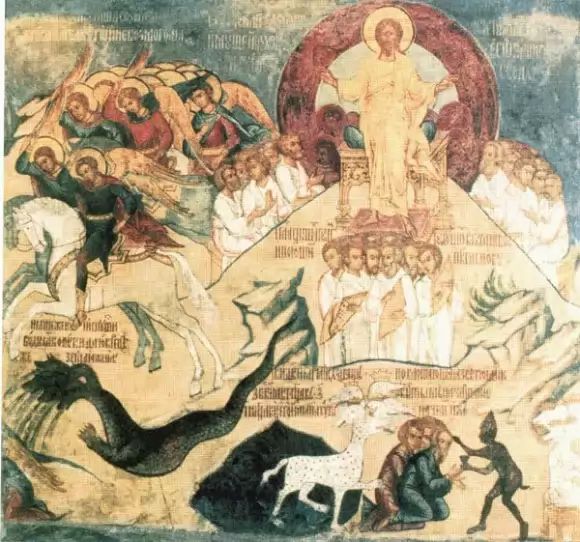
Icon of the Last Judgment. Seventeenth century. 

The fact is that even good deeds, as with all other Christian actions, have their dangers. From the example of the Pharisee and the elder son in the parable of the Prodigal Son we have already seen how religious effort can take on an ungodly character that alienates man from God’s love. The same thing can happen with good deeds. If a Christian immerses himself in them to the point of completely forgetting the primary goal of human existence, then it is unlikely he will do himself any good. Good deeds themselves, if one forgets the memory of death, can acquire the character of an activity that is excited, chaotic, and scattered. 

When the Jewish woman poured precious myrrh onto the head of Jesus, certain of the disciples said among themselves: Why was this waste of ointment made? For it might have been sold… and have been given to the poor (Mark 14:4-5). The indignant disciples probably expected the Savior to endorse their feelings. Christ, however, comes to the defense of this “squanderer”: why trouble ye her? she hath wrought a good work on Me. For ye have the poor with you always, and whensoever ye will ye may do them good: but Me ye have not always (Mark 14:6-7). 

With these words the Savior warns His followers that the work of keeping oneself in the truth of the Gospel is of utmost importance and, moreover, that this does not yield in importance to Christian good deeds; in some cases it even surpasses them. Indeed, Christ tells us that our eternal fate depends entirely and wholly on deeds of mercy. By including this call to mercy in the general discourse on the Second Coming, however, the Gospel establishes the proportionality and consistency of every part of the Christian activity that makes up our salvation. As such, if we will always have in mind the Second Coming and the Dread Judgment, but all the while become so absorbed in the expectation of the end that we lose sight of concrete deeds of mercy, we will most likely not acquire that love without which no one can see God. Yet if we give ourselves over enthusiastically to deeds of love while forgetting about the fleeting and vain nature of all that takes place on earth and the memory of death, then our good deeds will take on an emotional rather than spiritual character and not bring us any closer to God.

In Ecclesiastes we read: To every thing there is a season, and a time to every purpose under the heaven… a time to keep silence… A time to love (3:1-8). A time of silence – a time of solitude and standing noetically before God’s Judgment – is no less essential to Christianity than the active and continuous performance of good deeds. This silence not only returns us from the superficial life around us back to our own depths, but also reminds us of the finite nature of everything that takes place on earth, thereby purifying our love from emotional exaltation.

Therefore, from the publican’s repentance to deeds of love and mercy; from good deeds to the memory of death; and from the memory of death back to repentance and prayer, we must make our journey toward the joyful and bright days of Christ’s Resurrection. The Gospel readings during these preparatory weeks show us the direction we are to follow in our Lenten journey: they are like road signs showing us the way to the Heavenly Jerusalem, to the Lord’s eternal and unceasing Pascha.

What does it mean to repent?

Father Stephen Freeman published an article entitled ’The Instinct of Repentance’. I’ve excerpted some of this article that focuses on repentance as something very straight forward and tangible that we do and therefore experience.

Here are some highlights from this article:

The Instinct Of Repentance – Father Stephen Freeman

In the original language of the New Testament repentance is metanoia, a change in the mind (nous). The word nous, in Eastern Christian tradition, is often used interchangeably with the word heart. Repentance is an inner change of heart. Repentance is not concerned with clearing our legal record but with being changed – ultimately into the likeness of Christ.

Create in me a clean heart, O God, and renew a right spirit within me

Psalm 50:10

The fathers of the Church – particularly those who strove the most deeply for repentance (found predominantly in the desert tradition of the ascetics) – borrowed the language of their own day, as well as that of Scripture… The result is the language of the canons and the patristic writings. Most of the “road map” that is attached to these words is an experiential map. It is a reflection on how the heart changes in practice that dominates the teaching of the desert fathers and the tradition that flows from their labors. Theory is not driven by a priori assumptions about the constructs of man’s inner life. Thus there is no particular account of the mechanics of the inner life, other than a description given from experience – what works. The coherence of this patristic language is found in its common assumption that the human heart (nous) – the core of our being – is capable of change and can indeed be conformed to the image of Christ. Thus the goal of repentance is this very metanoia – a change of heart. There is nothing within modern psychology that reflects this particular concern.

Modern man is not predisposed to think about a change of heart. We think of psychological wholeness or well-being, but we do not have a language of conformity to Christ. We do speak of “hardness of heart,” but we know very little about how such a heart is changed.

This creates difficulties for us. Our temptation is to translate the language of the Church into concepts with which we are more familiar. Those coming to confession often give evidence of our psychologized world. We not only confess our sins, but we often want to give a small psychological analysis of where our sins came from and a progress report on how we are doing. (I have often thought that this makes a confession sound much like a monologue from Woody Allen, the comedian).

So, how do we repent?

The Scriptures give one of the clearest examples of how we should think about repentance. The encounter of John the Baptist with the crowds who came to and heard his message of repentance contain an interesting exchange:

Then he [John the Baptist] said to the multitudes that came out to be baptized by him, “Brood of vipers! Who warned you to flee from the wrath to come? Therefore bear fruits worthy of repentance, and do not begin to say to yourselves, ‘We have Abraham as our father.’ For I say to you that God is able to raise up children to Abraham from these stones. And even now the ax is laid to the root of the trees. Therefore every tree which does not bear good fruit is cut down and thrown into the fire.”

So the people asked him, saying, “What shall we do then?”

He answered and said to them, “He who has two tunics, let him give to him who has none; and he who has food, let him do likewise.”

Then tax collectors also came to be baptized, and said to him, “Teacher, what shall we do?”

And he said to them, “Collect no more than what is appointed for you.”

Likewise the soldiers asked him, saying, “And what shall we do?”

So he said to them, “Do not intimidate anyone or accuse falsely, and be content with your wages.” (Luke 3:7-14).

John’s response to the people who came was not to launch them into a world of introspection. The heart changes in the crucible of our actions. Generosity and kindness are begotten of generosity and kindness. If you have enough to share – then share.


I have always been bemused by the great lengths that modern interpreters of Scripture go when trying to account for sayings such as, “Sell what you have, give to the poor and come and follow me.” Or “How hardly shall a rich man enter the kingdom of God.” We are often told that such passages are really about how we feel about our wealth – that our wealth should not be the center of our lives. But if we have and do not share, then “feeling good” about our wealth is just delusion.

The commandments of Christ are not difficult because they are so complex or mystical – they are difficult because they are so clear and we do not want to keep them.

The disciplines traditionally practiced during the season of Great Lent, prayer, fasting, almsgiving, are given to us not in order to generate a season of introspection. They are given to us as a call to a season of action. Prayer is something we do. It is a struggle, but it is an action (Orthodox prayer is particularly marked by action – even physical action). Fasting is an action as well. In our psychologized culture, it is hard for many to understand fasting as having anything to do with repentance. But it is the experience of Scripture and generations of the Church, that the discipline of fasting (abstaining from certain foods and eating less) has a clear effect on the heart – our inner disposition – particularly when that fasting is coupled with prayer and almsgiving. Almsgiving is an action that is all too often ignored in our thoughts about repentance.

Giving is an action. Give money away. Give sacrificially of your time. Give mercy and kindness to others. Forgive the sins of others as if your own forgiveness depended on it (it does). If we would see our hearts change in the direction of the image of Christ – the “roadmap” is not hidden. Pray, fast, be merciful and give.

This is the instinct of repentance. With practice it becomes the habit of the heart. Kindness, practiced consistently over a period of time, by the grace of God results in our becoming kind. To be kind is to be like God (Luke 6:35). Repentance is the path to the kingdom of God. The actions of repentance (under grace) – given to us in the Tradition of the Church – are the means by which such a changed heart will be formed within us.

Taking the Lenten Journey – Ancient Faith – Father Ted Paraskevopoulos

Audio Link

Many people have the—I guess you could say—common assumption that Lent begins with Clean Monday, which this year falls on February 23, and that that is the beginning of the Fast which leads to the Great Feast, the center of our faith, which is Holy Resurrection—Pascha, Easter. But really, if we look at the ecclesiastical year, and we look at the cycle of services and the themes that are being introduced to us, that journey towards the resurrection of Christ begins today, with the beginning of the cycle called the Triodion. The Triodion, it’s named after a book that we use—the psaltis use and the priests use inside the altar—which is called The Triodion, and it begins today and ends right before the resurrection of Christ.

The themes of the Triodion are of repentance, of self-examination, of self-discovery, and we see that the Triodion starts four weeks before the actual Fast begins. We start today with the Sunday of the Publican and the Pharisee, the theme of true repentance and pseudo-repentance, two different characters, and how we approach actual repentance and how we approach humility and whether we have true humility or not. Next week we will have the Sunday of the Prodigal Son, another beautiful story of repentance and coming back to the Father. The Sunday after that we have the Sunday of the Last Judgment. And the Sunday after that, which is the last Sunday before the beginning of the Fast, is the Sunday of Forgiveness, another beautifully themed Sunday.

All these themes that we have are done intentionally to prepare us for this journey, which we call in Greek the journey towards the resurrection, which is Great Lent. Even if we pay attention to the whole cycle of the year, we see that Pascha, the Resurrection, takes up a third of the year, if we take into account starting to today, leading to Pascha, and even the afterfeasts: the Ascension all the way up to Pentecost, which is fifty days after Easter. That whole block of time takes up a third of our year, which means that this Feast of Pascha is the most important. Most important not only for teaching, but most important for our own personal spirituality, that we dedicate such a long period of time to focus on one event.

Many people ask me, “Father, I really don’t feel that I can actually do the things that the Church asks me to do,” which is to fast, to pray, to confess, to go to more services. It seems a bit overwhelming, and it can be very overwhelming, especially when we’ve never done it before. Many people tell me, “Father, I’ve just become accustomed to fasting on the last week, Holy Week, and then I’ll just go into Easter and experience it.” Other people say, “Well, Father, I don’t even do that. I just show up for the Anastasi.” And as we can see with the thousands of people that show up on Anastasi night, that is usually the case, that many of our brothers and sisters simply show up for the light, as if the light saved them.

I always respond to people like this and friends of mine whom I grew up with that doing the journey, actually struggling through it and actually following the different traditions and the Fast, leading up to Easter and not doing it and simply just showing up at the end are two very different experiences. I used to have a professor in seminary who said it really beautifully to us. He said that the Lenten journey, and indeed the whole Triodion, is like climbing a mountain. The top, of course, is the goal. It is the union with God. It is the witnessing of the holy Resurrection. It is the beautiful view that you get from the top. So we begin from the bottom, and we struggle to climb this mountain. We have many difficulties: we fall, we get back up again. Some of us climb faster than others. Some of us turn around and help those who have fallen behind us; others help from behind. We all try to climb this mountain. For those who struggle and work hard and finally make it to the top, which is the end of Lent, beginning the actual Resurrection—for those the experience at the top is very, very different from [that of] those who simply hopped on the helicopter and flew to the top and got dropped off. Both will experience the view. Both will experience the light of the Resurrection. But those who struggled to reach the top, for them the experience will be completely different. They will appreciate it more, they will have a sense of accomplishment, and it will be much more of a profound experience than [that of] those who didn’t work for it but simply showed up.

I can attest to that even as a young man, growing up in Toronto. When I was a young man growing up, there were some years where I did the Fast, and there were some years where I did not, unfortunately. And I can attest to the difference in experience, of struggling and growing through the actual spiritual exercises and reaching that night of the Resurrection after having fasted for 47 days, and not only fasted but examining my conscience and going to confession and helping others and doing more volunteer work—the whole thing—and reaching that point of the Resurrection, it is a point that is quite moving, because we have opened up our souls, have cleansed our souls, and we have allowed for the light of the Resurrection to have entered into us. The years in which I did nothing—my heart was closed, so when I attempted to experience that light, it was not the same thing. It didn’t have the same spiritual potency as it did the years that I tried.

So I say all this not because I’m trying to force or trying to persuade everybody to go to church every Sunday, but rather so that we understand what the cycles of the Church are, why they are set up the way they are for the last 2,000 years, and why they work and why all these things are put in place to prepare us for what the Fathers say is the three-fold method of achieving salvation or achieving holiness.

For the Fathers, the three stages are katharsis, which basically means purification; photisis, which means illumination; and theosis, which means divinization, becoming like God, becoming holy. We have to understand that one cannot come before the other. First we have to purify ourselves before we can be enlightened. And after we are enlightened, we can actually become divine.

So if we don’t do these things, we will never be able to understand what the Church is talking about. We will never be able to see the reality which Christ reveals to us in the Resurrection. It will just simply be another night, another night of going to the church and lighting a candle and taking it back home, devoid of anything spiritual, devoid of anything that is truly profound in our lives. But for those who take the chance… And I hope that all of you take the chance this year, beginning with today, not to do everything perfectly—you can’t; that’s okay—but to try, to maybe take a few steps further, to do a little more than what you did the year before. And maybe next year you do a little more than that, but to try, a little bit.

And together we can climb the mountain, and together we can truly enjoy the light of the Resurrection as it’s supposed to be enjoyed, as it’s supposed to be perceived. It all begins with today, and it ends with the Resurrection of our Lord and Savior Jesus Christ on the evening of Pascha. Amen.

Lent and the Shaping Of Desire – Public Orthodoxy by John Monaco

Christianity is a religion of desire. At first glance, this statement may seem counterintuitive and contradictory. After all, Christians are told to deny themselves, to take up their cross and follow Christ (Mt 16:24). Several prayers, especially in the Divine Liturgy, also seem to downplay desire. In the Divine Liturgy of St. John Chrysostom, prior to the reading of the Holy Gospel, the priest prays for the revering of the Lord’s commandments so that, “having trampled down all carnal desires,” the Christian may do that which is pleasing to God. Similarly, the the prayer during the Cherubic Hymn, the priest prays that “No one bound by carnal desires and pleasures is worthy to approach, draw near, or minister to You, the King of Glory.” Church history is filled with numerous examples of ascetics and saints who renounced their desires, whether that includes St. Benedict throwing himself into the thorn bush to chasten his sexual desire, or Eudocia the Samaritan (whom the Orthodox Church commemorated on Forgiveness Sunday) who abandoned her earthly riches and physical beauty to the disdain of her former lovers. Countless entries within the Church’s illustrious hagiography follow a similar trajectory: a person with worldly fame and material pleasures experiences a conversion, and then sells her belongings, and embraces a life of poverty and self-denial. It would then seem that “desire” has an awfully negative place within Christian discourse. In other words, if you desire something, it is probably bad and sinful, and the way to holiness is thus avoiding what we desire and instead pursue those things we do not like.

In theory, one could pursue the Christian life this way. In fact, many have. Assuming desire is evil (particularly bodily desire), one trods the path of famous historical figures: Mani, whose ideas produced the dualistic philosophy of Manichaeism which tormented Augustine of Hippo; Marcion, the Gnostic heretic who repudiated the idea that Christ could have assumed human flesh; Severus, who led an extreme sect of ascetics (the Encratites) and believed marriage, as well as women, were inherently sinful. Orthodox Christian theologians were quick to denounce these figures among others, as such ideas were seen as dangerous and heretical. In affirming the goodness of creation, Orthodox Christianity rejects any notion that matter is evil or that, in order to achieve union with God, one must renounce one’s humanity. At the same time, Orthodoxy is hardly a religion of comfort: the fasting rules (which, of course, can be modified and determined by one’s spiritual father) and extolling of the ascetical life dismisses any idea that Orthodoxy places no demands on its adherents.

Christianity is a religion of desire, precisely because it is concerned with a God who desires to save the human race and who loves mankind. Christians are those who desire to respond to God’s free invitation to love and serve Him here on earth and worship Him forever in eternity. A desire-less Christian is an oxymoron; our intellects are oriented to seek truth and the knowledge of God, and our wills are directed towards loving that which is good and making good use of temporal goods for the sake of loving the Eternal Good. The Christian is the one who desires to follow Christ and orders her desires to pursue those things which lead her closer to Him.

However, as we all know, we do not desire things in a vacuum. Here on earth, human desire is always staged within the context of a fallen world. Our passions move us to desire things outside of their proper place. Desiring sex is good, but the desire to view pornography is not, as it is the selfish inversion and objectification of the sexual act. Desiring to support one’s family and have daily sustenance is good, but the ravenous desire for wealth is not, as it seduces a person to seek pleasure solely earthly things at the expense of finding joy in God. Desiring justice for victims of assault is good, but the desire for revenge is not, as it prevents us from loving our enemies.

Lent is the perfect opportunity for Christians to examine and train their desires—not to eschew them. What is the purpose of asceticism, if not for being the exercise by which we shape our desires to be pure and ordered to their proper ends? Food is good, but an inordinate love for food can result in health problems as well as social ones. Can our time of fasting from meat and dairy help us examine the way in which those popular industries contribute to environmental degradation? Games, movies, and other forms of entertainment are good, but an obsession with the virtual can distract us from the real— including those who are right in front of us. Can our time of fasting from unnecessary purchases and Netflix-binging help us be better stewards of our God-given time, money, and energy? As Philip Kariatlis wrote, “Fasting finds its true meaning when the outward abstinence of food is connected with the inward struggle to intensify our longing for God through the dynamic of purity and repentance.” Renunciation is not an end in itself, but only as a means of ongoing union with God.

Fasting, prayer, and almsgiving are activities by which our desires are purified, our wills healed, our intellects open to the glory of divine truth. Far from being a distraction to Christian life, desire is the very vehicle by which we move closer or farther from Christ. Returning to the liturgy, the lex orandi by which Christians are to base their lives, we come across an anonymous prayer to be recited following the reception of Holy Communion. In this prayer, we see the end (that is, the telos) of our desire: “For You are, indeed, the true object of our desire and the inexpressible gladness of those who love You, O Christ our God, and all creation praises You unto the ages. Amen.”

Full Article