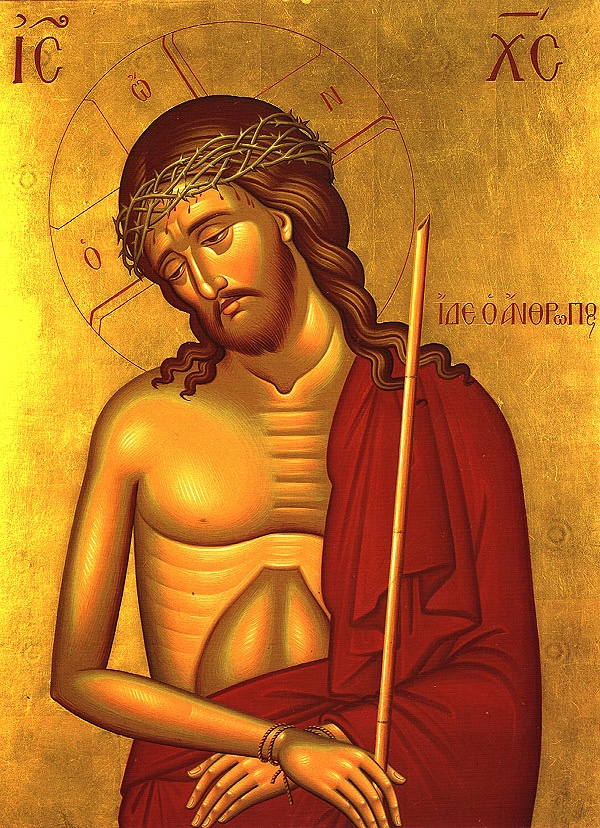
3rd Sunday Of Lent Adult Education Class – Annunciation with the Cross

The icon above is specific to this unique week when we celebrate both the Feast of the Annunciation Friday and the Veneration of the Cross on Sunday. As you know, Pascha is a variable feast but the Annunciation is always on March 25th … 9 months before Nativity. So, this feast falls in a wide variety of places in our Lenten journey. Below is an extract from a homily entitled ’The Annunciation with the Cross’ that was delivered in the 1930’s by Father Sergius Bulgakov. I think he has some great insights for us to discuss in today’s class that capture the unique picture we have of both the Annunciation and the Cross this week.

The Annunciation is a direct testimony about God’s love for the world. Love is sacrificial by its very nature; the power of love is the measure of the sacrifice. God’s love is immeasurable and inexplicable in its sacrificial character, which partakes of the way of the cross. God who is in the Trinity renounces Himself from all eternity in the reciprocal love of the Three Hypostases; for ”God is love,” and ”the unfathomable divine power of the holy and glorious Cross” is the power of God’s life – of all conquering , immeasurable love in the depths of Holy Trinity itself. God-Love … the pre-eternal Love of the cross – raises a new cross for the sake of His love for creation. He gives the world a place of being alongside Himself; He renounces Himself for the sake of the world, voluntarily limiting Himself to allow creation in its limitedness to find itself in its slow and arduous development.

The world is created by the cross of God’s love. It is also saved by the cross, for, in its creaturely infirmity, the self-sufficient world contains the possibility of sin and of falling away from God, which is unrestrainable. Once it occurs, this falling away leads to the fatal disintegration of the world. In response to this possibility, God in His pre-eternal counsel already raises the cross of sacrificial love in the divine incarnation for the sake of the world: ”God so loved the world, that he gave his only begotten Son (John 3:16). The Son is sent into the world in order to take away the sin of the world (John 1:29), in order to suffer out this sin unto the death on the Cross. And this pre-eternal counsel is accomplished by God’s love, by the power of the Cross. That which manifests the power of the Cross in the heavens is , on earth among the sons of me, the joy of the Annunciation; for there is no true joy without the Cross.

The Annunciation itself contains news of the Cross; and with a heavy cross upon the Most Pure Virgin, who now renounces all things that pertain to selfhood and entrusts herself to the power of the Lord. She accepts the sword that will pierce her heart. Her Son’s way of the cross is also her own. The joy of the Annunciation is accomplished through the cross and finds it foundation in the cross.

This week I’d like us to review two articles in some detail. I’ll print these articles out:

Here are the other articles posted this week that may be very relevant to our discussions and our Lenten journey:

How to Say Yes to God: Homily for the Feast of the Annunciation

By Father Phillip LeMasters

Today we celebrate the very best example of how to live faithfully as a human being before God with the feast of the Annunciation.  When the Archangel Gabriel announced to the Virgin Mary that she was to become the Theotokos, she freely accepted this extraordinary calling when she said, “Behold, I am the handmaid of the Lord; let it be to me according to your word.”  When she offered herself to become the Living Temple of God, she played a crucial role in how the Savior would “deliver all those who through fear of death were subject to lifelong bondage.”  In opening her life without reservation to Christ, she made it possible for Him to “share in flesh and blood” and participate in our humanity so “that through death He might destroy him who has the power of death, that is, the devil.”

By conventional human standards, this teenage girl had no power or prominence at all.  No one in first-century Palestine would have been inclined to look to her as having a role in delivering them from anything.  But through her courage in accepting a calling that would impact every dimension of her life in ways that she could not possibly have fully understood, the Theotokos became a fierce warrior against evil because she broke the cycle of disobedience that went back to the rebellion of our first parents.  They chose satisfying their own self-centered desires over obeying the Lord and becoming more like Him in holiness.  She chose, instead, to say “yes” without reservation to the point of sharing her own flesh and blood with the Son of God, and of loving and serving Him throughout His earthly life, even as He hung on the Cross.   She is the New Eve through whom the Second Adam became one of us for our salvation.

In order for the Savior to be fully divine and fully human, He had to be born of a woman.  In order for Him to be the Great High Priest Who offered Himself fully on the Cross to conquer the power of death, the Messiah “had to be made like His brethren in every respect.”  The Theotokos’ offering of herself in free obedience made it possible for Him to do that.  Here we encounter the great mystery of divine-human cooperation or synergy, for God always respects our freedom as unique persons in responding to His will. God did not choose the Virgin Mary randomly, but prepared for her across the generations of the Hebrew people, culminating in the aged, barren couple of Joachim and Anna.  Like Abraham and Sarah before them, they did not conceive simply by their own youthful physical abilities, but after painful decades of childlessness due to the miraculous blessing of the Lord.  John the Baptist was born to Zechariah and Elizabeth in the same way.

These elderly parents of newborns bear witness that something very different from birth into a world dominated by the fear of death has arrived.  Now a new age of the fulfillment of God’s promises has dawned. It is fulfilled through a young girl’s amazing obedience, as the Savior becomes an unborn Child in her womb.  She conceived and gave birth without passion, without a husband, and in a way that preserved her virginity. In the Theotokos’ astounding offering of herself to the Lord, the brokenness and corruption of our humanity is unwound and undone.  This New Eve does not choose the satisfaction of her own desires over obedience to God, but opens every dimension of her being to share in His life.  Through her, the New Adam is born Who heals all the corruption of the first.

Remember, however, that neither our Savior nor the Theotokos is a conventional hero.  Instead of destroying His enemies through brute force, the Lord submitted to the ultimate humiliation of crucifixion, death, burial in a tomb, and descent to Hades in order to deliver us from captivity to fear of the grave and to bring us into the joy of eternal life.  He does not inflict suffering upon others, but takes it upon Himself purely for our sake.  The Theotokos was a young virgin, unmarried and of no particular importance in her society.  Her unwed pregnancy was scandalous and certainly not a path to a conventional life.   Eventually, she saw her Son and God condemned as a blasphemer and a traitor, and then nailed to the Cross.  Her purity and blessedness were surely hidden from the world and known only to those who had the eyes to see her Son as the Savior, not in spite of His Passion, but because of it.

We must use the spiritual disciplines of Lent to become more like the Theotokos in her complete obedience and receptivity to the Lord.  The Archangel announced her unique calling to which she said “yes.”  Through her, the Son of God united Himself with humanity.  Our calling, then, is to become like her in hearing and responding to God’s calling as we unite ourselves personally with Him.

If we believe the good news of this feast, then we may shut off no part of our lives from communion with Christ in holiness. His becoming the God-Man calls us to follow the example of the Theotokos in receiving Him in a fashion that transforms every dimension of our life into a sign of His salvation.  That is a tall order that we probably cannot image we would ever fulfill.  We likely cannot even begin to understand how that could be possible for people like us who are gravely weakened by our sins and the slaves of our self-centered desires.

By this point in Lent, we may have a clearer sense of how hard it is to open our lives to Christ through prayer, fasting, generosity, forgiveness, and repentance.  We undertake these practices so poorly and feebly, often gaining a stronger sense of our weakness than of peace, blessedness, and joy.  If we have embraced the season with integrity so far, Lent will have opened our eyes a bit to the true state of our souls; and if we are honest, there is much there that we do not like to see.  Though that may seem like bad news, it is actually exactly what we need.  For if we are to grow in personal union with the Lord, we have to get over any self-righteous illusions that would drown out the message we need to hear.  If we are to learn to say “Behold the handmaid of the Lord; let it be to me according to your word,” we must do so as the particular people we truly are.  If we try to relate to God with some kind of imaginary holiness or religiosity, we will do more harm than good to our souls. We may be able to fool ourselves, but we can never fool God.

Through the Theotokos’s response to the message of the Archangel, the Savior became one of us, uniting divinity and humanity in His own Person.  By His grace, He calls and enables each of us to find the healing of our souls by sharing in His blessed life.  As the Lenten journey continues with all its struggles, we have the opportunity to gain the spiritual strength to receive Him more fully as we grow into the unique persons He created us to be in His image and likeness.  Let us look to the Theotokos as our hero, our great example, of what happens when a humble, obedient person says “yes” to God from the depths of her soul.  There is no way other than becoming more like her to open ourselves to the victory over the fear of death that her Son accomplished through His Cross and glorious resurrection on the third day.

Surrender Ourselves To God’s Grace – Archimandrite Aimilianos

In our class Sunday we discussed distractions and how difficult it can be to remain focused during these longer, more intense services we experience during Lent. I thought this article was full of wisdom and pragmatic guidance that might be useful to us as we approach the mid-point of the Fast which occurs next Wednesday. The focus of the article is on the Divine Liturgy. It’s an excerpt from the outstanding book ’The Way of the Spirit’ by Archimandrite Aimilianos. It’s a useful next step as we get in touch with our sense of exile that he described in this earlier article . It’s also a good followup to the article we read about ’finding our true selves in Christ’.

Chapter 2 – On The State That Jesus Confers

My beloved children, how marvelous was today’s Gospel lesson! It’s one we’ve heard many times and experience continuously, especially during the celebration of the Divine Liturgy. As we journey through the desert of life, it is only natural that our thirst should draw us to the Liturgy, because the Divine Liturgy is a sumptuous table set in the open air, such as that which the Lord has spread before us today.

What did we hear in the Gospel? Jesus gathered the people together. Why? Because the Apostles told Him they have nothing to eat (cf. Mk 6.36; Mt 14.15). Thousands of people, who had come from every town to see Jesus (Mk 6.33), would have gone hungry, and so the Lord had them sit down in groups on the ground (Mk 6.40), in order to satisfy their souls. They had gone forth into the wilderness to see Jesus, and He gathered them all together (cf. Mk 6.35; Mt 14.15).

The Divine Liturgy, my beloved, is precisely this going forth; it is a movement from one place to another, which we enact continuously. It is also a sitting down in the open in order to eat. It is, first of all, a kind of exodus. But from where? The people mentioned in the Gospel went forth from their towns and villages (Mk 6.33; Mt 14.13), but we come forth from ourselves, as well as from the places in which we live. We leave one kind of place, and come to another, which is different from the one we left. And who among us, upon entering a church, does not sense that there is something special here? Who does not know that to come here means to leave all else behind? And this can be seen by the fact that, if an inappropriate thought enters our mind while we’re here, we immediately want to dismiss it. And even if we’re unable to, we recognize it as something foreign, something that has intruded into the space of our soul, something that has slipped past our guard and entered into us.

We enter the church, then, when we go forth from ourselves in power, in substance, and in truth, leaving behind all our sins, our inclinations, and our aspirations. To enter the church means to leave outside all those things that make up our life in the world. That which exists is God (cf. Ex 3.14), but that which is ours, and which alone belongs to us, is our sin, our self will, and our desire. Apart from God, the self is something non-existent, even though it is, and remains, the creation of His hands, the breath of His first blessing (cf. Gen 2.7).

When we enter the church, we leave behind, not simply the things we see, but even the things for which we hope, because the latter in particular occupy a central place in our lives. Even though the things we hope for are not currently in our hands, we live as if they already were, feeling them intensely, as if we could run our fingers through them, lay hold of them, and possess them. In general, the intensity of our feelings about such things assumes the character of an actual experience, and we must leave that behind, along with all that we see. 2

And what we “see” is everything we encounter in the course of the day: things seen by the eyes of the body as well as those of the soul—which are much more perceptive. The things we “see” are all the things we experience, which stir us up, unsettle us, occupy our minds, give us pleasure, and lift our spirits. When our eyes fall upon them, they elevate us, but only to a place within the visible world: never beyond it.

In leaving behind everything we see, we come forth from that which constitutes our place of exile. This is the new exodus undertaken by the children of God every time they assemble and unite themselves to Christ in the sacred space of the church.

Having left everything behind, where do we find ourselves? In the open air, as befits people close to God (Wis 16.9; cf. Lk 21.31). 3

Why do I say in the open air? Because, looking around the church, we feel that we’re standing in heaven, and heaven cannot be considered a closed space. 4 And this is why Christ chose the desert as a place for prayer: precisely because its endless expanses and tremendous openness symbolize heaven itself. The desert, moreover, stands in contrast to the world: it contains no worldly pleasure, it gives you no earthly delight, and it offers you no fleshly repose. Heaven is something like that.

It follows, then, that no one can live in the desert if he’s still seeking to satisfy his own desires, if he is still anxious to realize his own hopes. You ask God to satisfy your desires, and, when He doesn’t, you think He’s turning a deaf ear. You ask God to realize your hopes, and to your dismay they remain elusive. You ask God to deepen your religious feelings, only to discover that He keeps Himself at a distance. Why? Because in reality those things are only about you, and not God, and thus they constitute the closed space in which you are confined; they are the place out of which God wants to lead you. Now, however, we find ourselves in the open air like that crowd of thousands, people close to God, close to the Lord. As for me, I’m blind, but I’m here too. I’m paralyzed, but nevertheless I’m here. I have no wings, I’m confined to the earth, but I’m here too, close to God.

What does it mean to be close to God? Think for a moment: can you be close to an icon and not be moved to venerate it? Can you be close to a fire and not be warmed? Can you be close to the light and not be illumined? Of course not. How, then, can you be close to God and not become godlike? How can you stretch out on God’s open spaces and not be raised up to the heights of His grandeur?

It follows, then, that after our exit from the world, we find ourselves close to God. We do not, however, find ourselves before the face of God (cf. Ex 33.11). Why? Because, for the most part, the eyes of our soul and body (which are both earthly) do not see God: they only seek Him. In the darkness broken by the brazen lamps, we seek Him, but we do not see Him. And that is the tragedy of human existence: we see everything except that which truly exists. All creation, which had a beginning and which will come to an end, falls under our gaze, which means we see things that, in reality, have no independent existence. 5 The tragic figure of man does not see that which alone truly exists: the One Who Is (cf. Ex 3.14), and Who is always with us.

That is what it means to be close to God. And when we enter into the open spaces of the church, we immediately experience a particular feeling, a feeling which confirms for us that here, in this place, our Helper is at hand. He is invisible, but you feel Him, as if He were rushing toward you, as if you could hear the sound of His breathing. He is your Helper, the One Who can deliver you, Who can redeem you, Who alone can satisfy your insatiable soul, which is forever being gnawed by hunger. You are close to God, and God is invisibly present. But, you may ask, where is He? Who can see Him?

If you wish to see God, my beloved children, there’s only one thing to do: go to church filled with longing to see His face, filled with divine and heavenly desire to be able, somehow, to feel the presence of your Helper and Defender. When you do this, your soul will experience an initially strange feeling: it is God touching your heart. And what will the heart do in response? Will it laugh and rejoice? No. It will be filled with a blessed, godly grief, and begin to weep and lament. In the presence of the Lord, you’ll feel your heart—which is like a useless sack—filling to the brim with the sense of its own emptiness and thereby overflowing with tears. And these tears will be its secret cry, saying:

“Where are You, Lord? Have mercy on me.” “Where are You, Lord?” That is the heart’s first cry. But it immediately realizes that it’s not able to see God, and that, if it did, it would lose its life (cf. Ex 33.20). Correcting its mistake, it continues: “Grant me Your mercy, You are my mercy, Yours is mercy, I am Yours, and You alone can have mercy upon me; You alone can bring me up from the pit of tribulation, from the depths of Your absence and my absence—Your absence from me, and mine from Your own spiritual life.”

When the soul begins to cry—and it cries to God, my beloved, very easily indeed, because God, in a sense, is the soul’s only surviving relative, and what could be more natural than that it should seek Him, and that it should cry when it realizes that it cannot see Him? When you allow your soul to cry, when you reject everything that cuts off the flow of your tears, then you’ll have a feeling of much greater intimacy with God. You’ll understand that now someone else governs your life. You’ll sense that now someone else has grasped the tiller, someone else has taken hold of the wheel (indeed of your own hands) and is now directly guiding you Himself. You become someone guided by the grace of God.

We are guided by God’s grace, to which you can surrender yourself in all confidence. Indeed, it is impossible for you to do the slightest thing without it. Consider the glory of the stars, the magnificence of the heavens, and the wonders of the earth: none of these can give you anything at all. The only thing that can fashion a new heart within you (cf. Ezek 11.19), rendering the old one utterly useless, is the power of God’s grace.

3rd Sunday Of Lent Veneration of the Cross

By Father Sergius Bulgakov; extracted from ‘Churchly Joy: Orthodox Devotions For the Church Year’

There are two worlds for the Christian and two lives in them: one of these lives belongs to this world of sorrow and suffering, while the other is lived in a hidden manner in the Kingdom of God, in the joyful city of heaven. All of the events, both of the Gospel and of the Church, which are celebrated at different times of the Church Year are not only remembered but are also accomplished in us, insofar as our souls touch this heavenly world. These events become for us a higher reality, a source of unceasing celebration, of perfect joy.

The bliss of divine love is the sacrificial bliss of the Cross, and its power is a sacrificial power. If the world is created by love, it is created by no other power than the power of the Cross. God who is love creates it by taking up the Cross in order to reveal His love for the creature. The Almighty Creator leaves room in the world for the creature’s freedom, thus as it were humbling Himself, limiting His almightiness, emptying Himself for the benefit of the creature.

God seeks in the creature a friend, another self, with whom He can share the bliss of love, to whom He can impart the divine life, and in His boundless love for the creature He does not stop at sacrifice, but sacrifices Himself for the sake of the creature. The boundlessness of the divine sacrifice for the sake of the world and its salvation passes all understanding.

The Son humbles Himself to become man, taking upon Him the form of a servant and becoming obedient unto death, even the death of the Cross. The Father does not spare His beloved, His only-begotten Son, but gives Him to be crucified; the Holy Spirit accepts descent into the fallen and hardened world and rests upon the Anointed, Christ dwells in His Mother, and sanctifies the Church. It is the sacrifice not of the Son alone, but of the consubstantial and indivisible Trinity as a whole. The Son alone was incarnate and suffered on the Cross, but in Him was manifested the sacrificial love of the Holy Trinity–of the Father who sends Him, and of the Holy Spirit who rests upon Him and upon His sorrowing Mother.

A Christian lives in God, and, in so far as he enters into the love of Christ, shares both in the burden and in the sweetness of His Cross. To worship the Cross and to glory in it is for him not an external commandment, but an inner behest: ‘Whosoever will come after Me, let him deny himself, and take up his Cross, and follow Me.’

We can only worship the Cross to the extent to which we share in it. He who is afraid of the Cross and in his inmost heart rejects it worships it falsely and deceives his own conscience.

The original Adam, when he was still in sinless ignorance of good and evil, was given to know the sweetness of the cross through obedience to God’s commandment forbidding him to eat the fruits of the tree of the knowledge of good and evil. The tree of life and the tree of the knowledge of good and evil grew in Eden (Gen. 2:9). That was the Edenic sign of the tree of the cross: in renouncing his own will, in doing the will of the Heavenly Father, man was crucified on the tree; and it became for him the tree of life, full of eternal bliss. But because of the whispered wiles of the sly and malicious serpent our progenitors rejected the cross; they descended from the cross, which meant that they had become willful and disobedient. And the tree became deadly for them, giving knowledge of good and evil and leading to their expulsion from Eden.

But this tree of the cross from which the original Adam descended, it was this tree of the cross that the New Adam, the Lord, the Son of Man, the Only Begotten Son of God, ascended. He ascended the cross in order to draw all men unto Himself (John 12:32), for there is no path to the Eden of sweetness except the path of the cross. And the ancient serpent, speaking to the Crucified One with the lips of His disciples, tried to tempt Him: Come down from the cross! But the new temptation was rejected, and the tree of the knowledge of good and evil once again became the tree of life, a life-bearing garden; and those eating its fruits partake of immortality.

And in every man, for as long as life is given to him, there lives the seed of the old Adam. Every man hears in himself the serpent’s incessant whisper, which is echoed by man’s natural infirmity and weakness: Come down from the cross. Do not suffer. The world is hostile to the cross, is made furious by the word of the cross. Love for the world is hatred for the cross. But love for God is also love for the Lord’s cross.

The cross shines in the sinful darkness of our heart, illumining it and at the same time exposing it. Our sinful, self-loving nature fears it and resists it. Why deceive ourselves? The natural man is afraid of the Cross. And yet we must overcome this fear; we must bring forth the tree of the Cross in our hearts, lift it up, and worship it.

Sweet are Thy wounds in my heart, O sweetest Jesus, and no sweetness is greater for my heart than their sweetness!

2nd Sunday of Lent Adult Education Class

This week the Church honors St. Gregory Palamas and his many important contributions to our faith. The theme I’d like us to focus on this week in the context of St. Gregory’s teaching is healing. Here is a quote from him that describes this process:

St. Gregory writes,

This bodily renewal is seen now through faith and hope rather than with our eyes, not being reality yet. The soul’s renewal, on the other hand, begins… with holy baptism through the remission of sins and is nourished and grows through righteousness in faith. The soul is continually renewed in the knowledge of God and the virtues associated with this knowledge, and will reach perfection in the future contemplation of God face to face. Now, however, it sees through a glass darkly.

An important aspect of ‘our part’ in this healing is in the keeping of the Lord’s commandments as we learn to rely and depend upon the gift of the Holy Spirit. St. Gregory continues:

For the Lord has promised to manifest Himself to the man who keeps [His commandments], a manifestation He calls His indwelling and that of the Father, saying, “If anyone loves Me, he will keep My word, and My Father will love him, and We will come to him and will make our abode wth him, and “I will manifest Myself to him.”

I’d like us to begin class this week with your observations on this second week of Lent. Next, I’d like us to read and reflect on the short homily from Father Phillip LeMaster entitled ’St. Gregory Palamas and the Healing of our Paralysis’. I’d then like us to read a short, very powerful reflection from C.S. Lewis that fits very nicely into this healing current of St. Gregory with an article entitled ‘Finding our True Selves in Christ’. I’d also like us to spend some time on prayer and use Archbishop Kallistos Ware’s very short article ’How Essential Is Prayer’.

I will print out the following articles for our class tomorrow:

Below are the other posts from this week that may also have value and relevance to our class and your Lenten journey:

Triodion Reflections – Tuesday in the Second Week

In thine idleness my soul, why art though become a slave of sin? And in thy sickness, why dost thou not run to the Physician? Behold, now is the accepted time; behold, now is the true day of salvation. Rise up and wash thy face with tears of repentance, and make thy lamp burn brightly with the oil of good deeds, so that Christ our God may grant thee cleansing and great mercy.

Matins Aposticha Tuesday in Second Week

O Christ, Thou hast stretched out Thy sinless hands upon the Cross, gathering together the ends of the earth. Therefore I cry unto Thee: Gather together my scattered mind, taken captive by the passions; cleanse me in every part through abstinence, and make me a sharer in Thy sufferings.

The season of the Fast is one of gladness. In shining purity and unfeigned love, filled with the light of prayer and every virtue, with rejoicing let us cry aloud: Most Holy Cross of Christ, that has brought us life and joy, count us all worthy to venerate thee with pure hearts, and grant us forgiveness and great mercy.

Vespers Lord I have Cried Stichera Tuesday of Second Week

When Thou was crucified in the flesh, O Lord, Thou has crucified our fallen nature with Thyself; when Thy side was pierced by the spear, Thou has pierced the serpent that destroyed mankind. Nail my flesh with the fear of Thee and wound my soul with Thy love, that, gazing on Thy Passion, in abstinence I may pass through the appointed time of the Fast, governing not my stomach only, but all the other entrances of sin. Repenting over my past sins, may I offer Thee in sacrifice a humble spirit and a contrite heart. O deliver me from my offenses in Thy love for mankind.

Vespers Aposticha

What is a Presanctified Liturgy

By Father Thomas Hopko

Because of its paschal character, the normal Divine Liturgy is not served on weekdays of Great Lent in the Orthodox Church. In its place, so that the faithful would not be left without Holy Communion, the Liturgy of the Presanctified Gifts is served.

The practice of serving the Presanctified Liturgy during Great Lent is an ancient practice witnessed to by the following canon of the church, which certainly bears witness to a piety of a much earlier date.

On all days of the holy fast of Great Lent, except on the Sabbath (i.e., Saturday), and the Lord’s Day (i.e., Sunday), and the holy day of the Annunciation, the Liturgy of the Presanctified Gifts is to be served. (Canon 52, Quinisext Council, 692 A.D.)

At present, the Liturgy of the Presanctified Gifts is prescribed for Wednesday and Friday evenings during Great Lent. This liturgy is the solemn Lenten Vespers with Holy Communion added to it. The Communion is received from the Sacramental Gifts of bread and wine offered and sanctified at the Divine Liturgy of the previous Lord’s Day, hence its name of the Liturgy of the Presanctified Gifts.

PREPARATION OF THE GIFTS

At the Lord’s Day Liturgy, the priest prepares a “lamb” (the bread which becomes Christ’s Body at the Divine Liturgy), which is then consecrated together with the wine and is kept for the Presanctified Liturgy. On the evening when this liturgy will be served, the Lenten Vespers begins in the usual way. During the chanting of the psalms (kathisma), after the Great Litany, with prayer and incensing, the priest places the Presanctified Gifts on the diskos. He carries them in solemn procession around the back of the altar table to the table of oblation.

HYMNS AND READINGS

After the singing of the evening psalm, Lord I call upon Thee, with the special hymns for the given day, the evening entrance is made and the hymn Gladsome Light is chanted. There then follow the two readings proper to Lenten Vespers, from Genesis and from Proverbs. Between these two readings, with their prescribed prokeimenon verses, the celebrant blesses the faithful with the censer and a lighted candle proclaiming: The Light of Christ illumines all! This blessing symbolizes the light of Christ’s resurrection, which illumines the Old Testament scriptures, and the entire life of man, the very Light with which Christians are illumined the life of the Church through holy baptism.

After the singing once more of the evening psalm, Let my prayer arise in Thy sight as incense, the prayer of Saint Ephraim is read and the augmented litany is chanted. Then the Presanctified Gifts are brought in solemn, silent entrance to the altar table with singing of the special entrance hymn:

Now invisibly the heavenly powers do minister with us.

For behold, the King of Glory enters. For behold, the Mystical Sacrifice, all fulfilled, is ushered in.

Let us with faith and love draw near that we may be partakers of life everlasting. Alleluia.

The prayer of St. Ephraim is read once again, with the proper litany and the special prayer before Holy Communion. The Our Father is sung and the faithful receive Holy Communion from the Presanctified Gifts to the singing of the psalm verse: O taste and see how good is the Lord. Alleluia.

After Holy Communion, the people “depart in peace” with thanksgiving to God for His Coming. The special dismissal prayer asks God for a successful fulfillment of Lent and for the ability to reach a worthy celebration of the Great Feast of Pascha  the Resurrection of the Lord.

O Almighty Lord . . . Who hast brought us to these all-holy days for the purification of soul and body, for the controlling of carnal passions . . . and the hope of the resurrection … enable us to fight the good fight, to accomplish the course of the Fast, to preserve inviolate the Faith … to be accounted victors over sin … and uncondemned, to attain unto and to adore Thy Holy Resurrection. . . .

The evening reception of Communion at the Liturgy of the Presanctified Gifts is fulfilled after a day of prayer and fasting, with the total abstinence from food and drink at least from the early morning hours of the day. Some consider the taking of even light, lenten food on the morning of the Presanctified Liturgy as a “lessening” of discipline. Those who have fasted a whole working day in preparation for the evening participation in the Holy Sacraments, however, know the great difficulty of the effort, as well as the very special spiritual fruits which it brings from God.

The Liturgy of the Presanctified Gifts is one of the great masterpieces of Orthodox piety and liturgical creativity. It reveals in its form and content the central Christian doctrine and experience, namely that our entire life must be spent in prayer and fasting in order that we might enter into communion with Christ who comes at the end, as “a thief in the night.” It tells us that all of our life, and not only the time of Great Lent, or one day of the Fast, is completed with the Presence of the Victorious Christ who is risen from the dead. It witnesses to the fact that Christ will come at the end of the ages to judge the living and the dead and to establish God’s Kingdom “of which there will be no end.” It tells us that we must be ready at His coming, found watching and serving, in order to be worthy to “enter into the joy of the Lord.”

The Liturgy of the Presanctified Gifts is one of the most beautiful and most meaningful liturgical services in the Orthodox Christian Church.

Can reflecting on an individual ode (of the Great Canon) be useful?

Last night we had our first encounter of Lent with the Great Canon of St. Andrew. Let’s examine just one of the nine odes we heard in more depth. Specifically, let’s add the Biblical verses (both Old and New Testament) that support the troparia written by St. Andrew. We’ll just examine and reflect on the 2nd ode.

My hope is that this may strengthen the connection between what we’ve heard and its scriptural support in a way that deepens our acceptance and response to his continual call for repentance while also reminding us of God’s acceptance of us … when we approach Him with the truth of how dependent we are upon His mercy and Grace.

Clean Monday Night 2nd Canon – Great Canon of St. Andrew

He is my Helper and Protector, and has become my salvation. This is my God and I will glorify Him. My father’s God and I will exalt Him. For gloriously has He been glorified. (Exodus 15:2,1; Psalm 117:14)

The Lord is my strength and song, and he is become my salvation: he is my God, and I will prepare him an habitation; my father’s God, and I will exalt him

Exodus 15:2 , 1

The Lord is my strength and my song , and He is become my salvation

Psalm 117:14

Attend, O heaven, and I will speak; O earth, give ear to a voice repenting to God and singing praises to Him.


Attend to me, O God my Savior, with Thy merciful eye, and accept my fervent confession. (Proverbs 15:3; Psalm 33:15)

The eyes of the Lord are in every place, beholding the evil and the good.

Proverbs 15:3

The eyes of the Lord are upon the righteous, and His ears are opened unto their supplication.

Psalm 33:15


I have sinned above all men, I alone have sinned against Thee. But as God have compassion, O Savior, on Thy creature. (1 Tim. 1:15)

This is a faithful saying, and worthy of all acceptation, that Christ Jesus came into the world to save sinners; of whom I am chief.

1 Timothy 1:15


Having formed by my pleasure-loving desires the deformity of my passions, I have marred the beauty of my mind.


A storm of passions besets me, O compassionate Lord. But stretch out Thy hand to me too, as to Peter. (Matthew 14:31)

And immediately Jesus stretched forth his hand, and caught him, and said unto him, O thou of little faith, wherefore didst thou doubt?

Matthew 14:31


I have stained the coat of my flesh, and soiled what is in Thy image and likeness, O Savior.


I have darkened the beauty of my soul with passionate pleasures, and my whole mind I have reduced wholly to mud.


I have torn my first garment which the Creator wove for me in the beginning, and therefore I am lying naked. (Genesis 3:21)

Unto Adam also and to his wife did the LordGod make coats of skins, and clothed them

Genesis 3:21

I have put on a torn coat, which the serpent wove for me by argument, and I am ashamed. (Genesis 3:4-5)

And the serpent said unto the woman, Ye shall not surely die. For God doth know that in the day ye eat thereof, then your eyes shall be opened, and ye shall be as gods, knowing good and evil.

Genesis 3:4 – 5


The tears of the harlot, O merciful Lord, I too offer to Thee. Be merciful to me, O Savior, in Thy compassion. (Luke 7:38; 18:13)

She stood at his feet behind him weeping, and began to wash his feet with tears, and did wipe them with the hairs of her head, and kissed his feet, and anointed them with the ointment.

And the publican, standing afar off, would not lift up so much as his eyes unto heaven, but smote upon his breast, saying, God be merciful to me a sinner.

Luke 7:38 and Luke 18:13


I looked at the beauty of the tree, and my mind was seduced; and now I lie naked, and I am ashamed. (Genesis 3:7)

And the eyes of them both were opened, and they knew that they were naked; and they sewed fig leaves together, and made themselves aprons.

Genesis 3:7


All the demon-chiefs of the passions have plowed on my back, and long has their tyranny over me lasted. (Psalm 128:3)

The sinners wrought upon my back, they lengthened out their iniquity

Psalm 128:3


Beginning of Great Lent 2022

Archpastoral Message of
His Beatitude Metropolitan Tikhon

March 7, 2022

To the Clergy, Monastics, and Faithful of the Orthodox Church in America,

Dear Beloved Children in the Lord,

As we stand at this moment, the threshold of Great Lent, with all turmoil and violence unfolding in the world, the Lenten fast comes like a spring breeze to refresh our souls. It is a time during which we take stock of our hearts, discard the unnecessary things of this world, refocus our spiritual vision, and bring our pains and griefs before God’s healing presence.

Even in the midst of everything we endure; a pandemic, social unrest, economic uncertainty, and now war in Ukraine, we must remember to always attend to doing good and becoming ever-brighter beacons of Christ’s light in this darkening world.

We hear this through the Prophet Isaiah, where the Lord tells us what distinguishes our true fast: 

“Is not this the fast that I choose:
to loose the bonds of wickedness,
to undo the cords of the yoke,
to let the oppressed go free,
and to break every yoke?” (Is 58:6)

In this turbulent moment, the Fast is a call to freedom as children of God through our spiritual discipline. In our time, there are many “bonds of wickedness” and “cords of the yoke” which Lent urges us to loose—but above all, the sins which bind our souls.

We also remember that Lent calls us to control not just our stomachs but our eyes, hands, feet, and mind. We avoid gluttony of food, but likewise we ought to avoid gluttony of all sorts: in recreation, media, or conversation with others. As the Scriptures tell us, “Every athlete exercises self-control in all things” (1 Cor 9:25).

This Lent, be especially on guard with social media, which too easily inflames our passions, devours our time, and devolves into the “foolish controversies” which Saint Paul warns us to avoid, “for they are unprofitable and futile” and only disturb our brothers and sisters in Christ (cf. Titus 3:9). 

We are assured in the Letter to the Galatians that “For freedom Christ has set us free; stand fast therefore, and do not submit again to a yoke of slavery” (Gal 5:1). With these words we fast with cheerful hearts, because it is in our self-denial that we find freedom in the Resurrection.

So as we take up the spiritual disciplines given to us by our Lord, I pray that it is with a spirit of renewed commitment and not with a spirit of gloominess. Nor should we, as Christ warns, “look dismal, like the hypocrites, for they disfigure their faces that their fasting may be seen by men” (Mt 6:16). Great Lent is our much needed time of refreshment of the heart and cleansing of the soul, so that we may more clearly perceive the light of Christ on Great and Holy Pascha.

When we each ask God to “open to me the gates of repentance” this Lent, remember that we do not fast to earn God’s love or to impress others around us. Over the next forty days we break the chains of sin and evil by controlling the things which control us—and so become free people. Let us run towards this freedom in the coming weeks.

Beloved children in the Lord, I conclude by directing you to keep in prayer those suffering in the calamity of war: the wounded, the grieving, and the displaced. Please also be of service to them in your charity and almsgiving this Lent. Remember also those who have been killed in this war. May God keep their memory eternal.

I humbly ask your forgiveness. May you have all the blessings of our Lord, God, and Savior Jesus Christ in your Lenten journey.

I remain sincerely yours in Christ,

+TIKHON
Archbishop of Washington
Metropolitan of All America and Canada

What is the meaning of Forgiveness Sunday?

By Father Alexander Schmemann

In the Orthodox Church, the last Sunday before Great Lent – the day on which, at Vespers, Lent is liturgically announced and inaugurated – is called Forgiveness Sunday.

On the morning of that Sunday, at the Divine Liturgy, we hear the words of Christ: 

“If you forgive men their trespasses, your heavenly Father will also forgive you, but if you forgive not men their trespasses, neither will your Father forgive your trespasses…”

Mark 6: 14-15

Then, after Vespers – after hearing the announcement of Lent in the Great Prokeimenon: “Turn not away Thy face from Thy child for I am afflicted! Hear me speedily! Draw near unto my soul and deliver it!” [and] after making our entrance into Lenten worship, with its special memories, with the prayer of St. Ephraim the Syrian, with its prostrations – we ask forgiveness from each other, we perform the rite of forgiveness and reconciliation. And as we approach each other with words of reconciliation, the choir intones the Paschal hymns, filling the church with the anticipation of Paschal joy.

What is the meaning of this rite? Why is it that the Church wants us to begin Lenten season with forgiveness and reconciliation? These questions are in order because for too many people, Lent means primarily, and almost exclusively, a change of diet, the compliance with ecclesiastical regulations concerning fasting. They understand fasting as an end in itself, as a “good deed” required by God and carrying in itself its merit and its reward. But, the Church spares no effort in revealing to us that fasting is but a means, one among many, towards a higher goal: the spiritual renewal of man, his return to God, true repentance and, therefore, true reconciliation. The Church spares no effort in warning us against a hypocritical and pharisaic fasting, against the reduction of religion to mere external obligations. As a Lenten hymn says: “In vain do you rejoice in no eating, O soul!  For you abstain from food, but from passions you are not purified.  If you persevere in sin, you will perform a useless fast.”

Now, forgiveness stands at the very center of Christian faith and of Christian life because Christianity itself is, above all, the religion of forgiveness. God forgives us, and His forgiveness is in Christ, His Son, Whom He sends to us, so that by sharing in His humanity we may share in His love and be truly reconciled with God. Indeed, Christianity has no other content but love. And it is primarily the renewal of that love, a return to it, a growth in it, that we seek in Great Lent, in fasting and prayer, in the entire spirit and the entire effort of that season. Thus, truly forgiveness is both the beginning of, and the proper condition for the Lenten season.

One may ask, however: Why should I perform this rite when I have no “enemies”? Why should I ask forgiveness from people who have done nothing to me, and whom I hardly know? To ask these questions is to misunderstand the Orthodox teaching concerning forgiveness. It is true, that open enmity, personal hatred, real animosity may be absent from our life, though if we experience them, it may be easier for us to repent, for these feelings openly contradict Divine commandments. But, the Church reveals to us that there are much subtler ways of offending Divine Love. These are indifference, selfishness, lack of interest in other people, of any real concern for them—in short, that wall which we usually erect around ourselves, thinking that by being “polite” and “friendly” we fulfill God’s commandments. The rite of forgiveness is so important precisely because it makes us realize – be it only for one minute – that our entire relationship to other men is wrong, makes us experience that encounter of one child of God with another, of one person created by God with another, makes us feel that mutual “recognition” which is so terribly lacking in our cold and dehumanized world.

On that unique day, listening to the joyful Paschal hymns, we are called to make a spiritual discovery: to taste of another mode of life and relationship with people, of life whose essence is love. We can discover that always and everywhere Christ, the Divine Love Himself, stands in the midst of us, transforming our mutual alienation into brotherhood. As l advance towards the other, as the other comes to me – we begin to realize that it is Christ Who brings us together by His love for both of us.

And because we make this discovery – and because this discovery is that of the Kingdom of God itself: the Kingdom of Peace and Love, of reconciliation with God and, in Him, with all that exists – we hear the hymns of that Feast, which once a year, “opens to us the doors of Paradise.”

We know why we shall fast and pray, what we shall seek during the long Lenten pilgrimage. Forgiveness Sunday: the day on which we acquire the power to make our fasting – true fasting; our effort – true effort; our reconciliation with God – true reconciliation.