Fifth Sunday Of Lent Adult Education Class

This will be our final class since next Sunday, April 17th, we’ll ask all to join in Palm Sunday Matins Service that will precede Divine Liturgy.

I will print out the following articles that we’ll plan to read and discuss in our class:

You may also find the posts from earlier this week relevant as a supplement and background for review and our discussion:

Preview Next Weekend – Lazarus Saturday and Palm Sunday

By Father Thomas Hopko from Volume II (The Church Year) in the OCA Faith Series

The week following the Sunday of Saint Mary of Egypt is called Palm or Branch Week. At the Tuesday services of this week the Church recalls that Jesus’ friend Lazarus has died and that the Lord is going to raise him from the dead (Jn 11). As the days continue toward Saturday, the Church, in its hymns and verses, continues to follow Christ towards Bethany to the tomb of Lazarus. On Friday evening, the eve of the celebration of the Resurrection of Lazarus, the “great and saving forty days” of Great Lent are formally brought to an end:

Having accomplished the forty days for the benefit of our souls, we pray to Thee, O Lover of Man, that we may see the holy week of Thy passion, that in it we may glorify Thy greatness and Thine unspeakable plan of salvation for our sake

Vespers Hymn
Lazarus

Lazarus Saturday is a paschal celebration. It is the only time in the entire Church Year that the resurrectional service of Sunday is celebrated on another day. At the liturgy of Lazarus Saturday, the Church glorifies Christ as “the Resurrection and the Life” who, by raising Lazarus, has confirmed the universal resurrection of mankind even before His own suffering and death.

By raising Lazarus from the dead before Thy passion, Thou didst confirm the universal resurrection, O Christ God! Like the children with the branches of victory, we cry out to Thee, O Vanquisher of Death: Hosanna in the highest! Blessed is he that comes in the name of the Lord! (Troparion).

Christ —the Joy, the Truth and the Light of All, the Life of the world and its Resurrection—has appeared in his goodness to those on earth. He has become the Image of our Resurrection, granting divine forgiveness to all (Kontakion).

At the Divine Liturgy of Lazarus Saturday the baptismal verse from Galatians: As many as have been baptized into Christ have put on Christ (Gal 3.27) replaces the Thrice-holy Hymn thus indicating the resurrectional character of the celebration, and the fact that Lazarus Saturday was once among the few great baptismal days in the Orthodox Church Year.

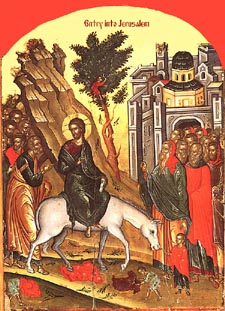
Because of the resurrection of Lazarus from the dead, Christ was hailed by the masses as the long-expected Messiah-King of Israel. Thus, in fulfillment of the prophecies of the Old Testament, He entered Jerusalem, the City of the King, riding on the colt of an ass (Zech 9.9; Jn 12.12). The crowds greeted Him with branches in their hands and called out to Him with shouts of praise: Hosanna! Blessed is He who comes in the name of the Lord! The Son of David! The King of Israel! Because of this glorification by the people, the priests and scribes were finally driven “to destroy Him, to put Him to death” (Lk 19.47; Jn 11.53, 12.10).

Palm Sunday

The feast of Christ’s triumphal Entry into Jerusalem, Palm Sunday, is one of the twelve major feasts of the Church. The services of this Sunday follow directly from those of Lazarus Saturday. The church building continues to be vested in resurrectional splendor, filled with hymns which continually repeat the Hosanna offered to Christ as the Messiah-King who comes in the name of God the Father for the salvation of the world.

The main troparion of Palm Sunday is the same one sung on Lazarus Saturday. It is sung at all of the services, and is used at the Divine Liturgy as the third antiphon which follows the other special psalm verses which are sung as the liturgical antiphons in the place of those normally used. The second troparion of the feast, as well as the kontakion and the other verses and hymns, all continue to glorify Christ’s triumphal manifestation “six days before the Passover” when he will give himself at the Supper and on the Cross for the life of the world.

Today the grace of the Holy Spirit has gathered us together. Let us all take up Thy cross and say: Blessed is he who comes in the name of the Lord. Hosanna in the highest! (First Verse of Vespers).

When we were buried with Thee in baptism, O Christ God, we were made worthy of eternal life by Thy resurrection. Now we praise Thee and sing: Hosanna in the highest! Blessed is he that comes in the name of the Lord! (Second Troparion).

Sitting on Thy throne in heaven, and carried on a foal on earth, O Christ God, accept the praise of angels and the songs of children who sing: BIessed is he who comes to recall Adam! (Kontakion).

At the vigil of the feast of Palm Sunday the prophecies of the Old Testament about the Messiah-King are read together with the Gospel accounts of the entry of Christ into Jerusalem. At Matins branches are blessed which the people carry throughout the celebration as the sign of their own glorification of Jesus as Saviour and King. These branches are usually palms, or, in the Slavic churches, pussy willows which came to be customary because of their availability and their early blossoming in the springtime.

As the people carry their branches and sing their songs to the Lord on Palm Sunday, they are judged together with the Jerusalem crowd. For it was the very same voices which cried Hosanna to Christ, which, a few days later, cried Crucify Him! Thus in the liturgy of the Church the lives of men continue to be judged as they hail Christ with the “branches of victory” and enter together with Him into the days of His “voluntary passion.”

Putting All of the Fifth Week of Lent Together – Father Thomas Hopko

At the end of the fifth week of Great Lent, and very particularly on the fifth Sunday, the Orthodox Church has all of its members and faithful Christians contemplating a very beloved and well-known person in Christian history for ancient Christians, and that is a woman named Mary of Egypt. On the matins of the Thursday of the fifth week, there is a penitential canon of St. Andrew of Crete that is read. That particular service, which is a long type of penitential vigil, is often called in Orthodox popular piety “the vigil of Mary of Egypt.” It’s kind of an identification with Mary. In Slavonic, it’s called Marii bodrstvovaniye, the standing with Mary in penance before God. Indeed, in that canon, with all the penitential verses, there are verses that ask Mary of Egypt to intercede for us, to pray for us, as part of the penitential canon. St. Andrew of Crete, the author, is also asked, but particularly Mary of Egypt.

On this Sunday, it’s again kind of a paradox in Orthodox worship, because the focus is now all on Christ. You have that great celebration of the Theotokos with the Akathist on Saturday, and then you enter into the Lord’s Day, and you hear the gospel about Christ going up to Jerusalem and entering into his glory through his suffering. Then even on that Sunday also in the epistle reading, we’ll hear again about how Christ enters into the holy of holies in heaven, not of creation, the sanctuary of God, securing for us an eternal redemption, and that he’s led to offer his blood on the cross through the eternal Holy Spirit where he offers himself without blemish to God and we are encouraged to purify our consciences from dead works in order to serve the living God.

So we are focusing on Christ, but then, with that, you have this whole Sunday when on the one hand you have these marvelous hymns about the resurrection and the victory of Christ on that Sunday, and then you hear even more about this Mary of Egypt. And it’s a kind of a juxtaposition. It’s almost as if the Holy Spirit and God Almighty wants us to keep these two things together. As we focus on Christ and his victory and go up with him to Jerusalem, then we know that this is for everyone and that it is for the worst of sinners. Nobody is excluded, and you can never forget that when you think of Mary of Egypt.

Who was this Mary? It’s interesting that on that Thursday matins with that canon the entire Life of Mary of Egypt is read in church.

…Orthodox Christians in this ancient tradition are called to contemplate that Mary, to remember her. And what’s the point? What’s the point? Oh, there are probably so many, and maybe the points are different for every single person who hears that story, but there’s two points that are for sure. One is that, no matter how sinful we are, the Lord God Almighty forgives us. The other point is that repentance is not just an emotion. It’s not just some kind of magical act. When we repent, we have to purge out of ourselves all of the garbage and filth and slime that’s in us. We have to go through a purgation process before we can be illumined and deified. All that is evil in us has to go: it’s got to be scrubbed away; it’s got to be cut out by the word of God that’s a two-edged sword that cuts the bones and marrows, the sinews, as it says in [the] letter to the Hebrews, the heart of people.

Penance is a work. It is a work. It’s made possible by faith and grace, but it is the result of faith and grace. We know God, we believe in him, we accept his grace, and then that grace purifies us, but it’s not automatic. I can’t resist saying—maybe I shouldn’t on the radio—about how one of my friends would say, “We believe in God the Father, Creator of heaven and earth; and the Son, the Lord Jesus Christ; and the Holy Spirit. We don’t believe in the Magician, the Mechanic, and the Fairy Godmother.” God is not a fairy godmother. He’s not a magician. He’s not a mechanic. There has to be a synergia between us and God. We have to accept that grace that cleanses us, that heals us, that power, and it’s got to happen, and it takes time. It takes time, it takes effort, it takes perseverance to the end. How often Jesus said, “Those who persevere to the end will be saved.” He says, “In hypomone, in patient endurance you will win your life,” and that repentance is a process; it’s not a momentary act.

Yes, Mary had her conversion experience. Yes, she knew the grace and the love of God at that moment, at that Holy Sepulcher. Yes, she knew that she was saved when she was allowed to enter and to venerate the tomb of Christ and receive the precious gifts of his broken body and spilled blood for the forgiveness of her sins, for the healing of her soul and her body and her passions and emotions and for the attaining of everlasting life. Yeah, that moment took place, and there are many such moments often in people’s lives. But then there is the result of that moment: the ongoing life in conformity to that moment. That’s what we see also in Mary of Egypt.

When I was the dean of St. Vladimir’s and the pastor of the chapel, and of course I was there for 30-some years, I always loved that fifth week of Lent. We had a practice at the seminary chapel that was, for me, at least, incredibly significant and marvelous. This is what it was: We would have those penitential services: the Presanctified on Wednesday with all those prostrations and those 24 additional penitential hymns—“O Lord, before I perish utterly, before I perish to the end, do thou save me, O Lord.” We would sing that canon of Andrew with Mary and keep that vigil on that Thursday. Honestly, we cut it down a bit. We were not monks and monastics there; we had our schedule to live, but we did it. We did it, yes. And then we sang the entire Akathist Hymn the next day, with all that marvelous celebration and veneration of the Theotokos with everything we could possibly think of put into our mouth to celebration the incarnation of the Son of God through her.

And when we sang that Akathist Hymn, we had a quite large icon of the Theotokos, Mother of God, with the Child, and we had it set in the middle of the church, and it was surrounded by flowers. It was decorated by beautiful flowers, and we would stand in front of that icon of the Theotokos, Mary, Mother of God. The deacons would be incensing and the whole church would be singing this marvelous Akathistos Hymn with all those wonderful words. Then we would celebration the Incarnation and Mary on that Saturday in the morning.

And then, on Saturday evening when we would come for the vespers and the matins and the Divine Liturgy of the fifth Sunday of Lent, in that same frame of flowers, on that same stand, the same analoy, in the middle of our same church, would be another icon: an icon of another Mary. Because we would remove the icon of the Theotokos and Child, and in that very same frame of flowers, on that very same stand, in the middle of our very same chapel, we would see Mary of Egypt. What a contrast that was! What an amazing thing it was, that on Saturday we’re glorifying and venerating the incarnation of the Son of God through the All-pure Virgin, of whom is more holy? The most holiest of mere human beings, Christ’s mother, Mary, holding in her arms the Holy One of God, Jesus Christ, our Savior and Lord, the Messiah of Israel, the Savior of the world. Holiness! Holiness like you cannot imagine! was in that icon in those flowers and in those songs.

And then in the same building, on the same stand, in the same flowers—was Mary of Egypt. And our icon showed her emaciated, sun-burnt, her hair frizzly white, and her face totally beautiful, and even similar to the face of the Theotokos in the iconography. Totally beautiful. And we knew that a nymphomaniac, sexually addicted harlot and even-worse-than-a-harlot human enters the same radiance and the same glory as the Mother of Christ and of all believers. Like Mary, she herself became more honorable than cherubim, more glorious than seraphim, because in Christ everyone who’s saved has that particular glory. We all are enthroned with Christ over all the angels—the twelve apostles sit on twelve thrones, judging the angels, it says in Scripture. We really are deified and enter into the glory of God. That is why Christ was born of a Virgin, and that’s why we venerate his mother so magnificently.

But on this day we know that the worst, the lowliest, the filthiest, the most addicted, the most impassioned, the most possessed, by faith and grace through that same Christ, by the intercessions of his mother and all the saints, can enter into that same glory. And Mary of Egypt tells us that. She shows us that. And then she begins herself to intercede for us poor sinners. Maybe some of us listening are sex-addicted ourselves and nymphos and whatever, controlled and on computers, looking at porno and whatever—but there’s hope for us. There’s hope for us. Mary of Egypt proves there’s hope for us.

But it’s not magic, it’s not mechanical; God is not a fairy godmother. There must be faith, grace accepted and lived out, and that purgation that leads to illumination that leads to glorification, leads to deification—can be ours. If it can be Mary of Egypt’s, then it can be ours. And how wonderful it was to go to church on Saturday of the fifth week and stand in front of that flower-decorated icon of the Theotokos and Child, and to come back again that same night and the next day and to see, in that same place, Mary of Egypt.

What is a Presanctified Liturgy

By Father Thomas Hopko

Because of its paschal character, the normal Divine Liturgy is not served on weekdays of Great Lent in the Orthodox Church. In its place, so that the faithful would not be left without Holy Communion, the Liturgy of the Presanctified Gifts is served.

The practice of serving the Presanctified Liturgy during Great Lent is an ancient practice witnessed to by the following canon of the church, which certainly bears witness to a piety of a much earlier date.

On all days of the holy fast of Great Lent, except on the Sabbath (i.e., Saturday), and the Lord’s Day (i.e., Sunday), and the holy day of the Annunciation, the Liturgy of the Presanctified Gifts is to be served. (Canon 52, Quinisext Council, 692 A.D.)

At present, the Liturgy of the Presanctified Gifts is prescribed for Wednesday and Friday evenings during Great Lent. This liturgy is the solemn Lenten Vespers with Holy Communion added to it. The Communion is received from the Sacramental Gifts of bread and wine offered and sanctified at the Divine Liturgy of the previous Lord’s Day, hence its name of the Liturgy of the Presanctified Gifts.

PREPARATION OF THE GIFTS

At the Lord’s Day Liturgy, the priest prepares a “lamb” (the bread which becomes Christ’s Body at the Divine Liturgy), which is then consecrated together with the wine and is kept for the Presanctified Liturgy. On the evening when this liturgy will be served, the Lenten Vespers begins in the usual way. During the chanting of the psalms (kathisma), after the Great Litany, with prayer and incensing, the priest places the Presanctified Gifts on the diskos. He carries them in solemn procession around the back of the altar table to the table of oblation.

HYMNS AND READINGS

After the singing of the evening psalm, Lord I call upon Thee, with the special hymns for the given day, the evening entrance is made and the hymn Gladsome Light is chanted. There then follow the two readings proper to Lenten Vespers, from Genesis and from Proverbs. Between these two readings, with their prescribed prokeimenon verses, the celebrant blesses the faithful with the censer and a lighted candle proclaiming: The Light of Christ illumines all! This blessing symbolizes the light of Christ’s resurrection, which illumines the Old Testament scriptures, and the entire life of man, the very Light with which Christians are illumined the life of the Church through holy baptism.

After the singing once more of the evening psalm, Let my prayer arise in Thy sight as incense, the prayer of Saint Ephraim is read and the augmented litany is chanted. Then the Presanctified Gifts are brought in solemn, silent entrance to the altar table with singing of the special entrance hymn:

Now invisibly the heavenly powers do minister with us.

For behold, the King of Glory enters. For behold, the Mystical Sacrifice, all fulfilled, is ushered in.

Let us with faith and love draw near that we may be partakers of life everlasting. Alleluia.

The prayer of St. Ephraim is read once again, with the proper litany and the special prayer before Holy Communion. The Our Father is sung and the faithful receive Holy Communion from the Presanctified Gifts to the singing of the psalm verse: O taste and see how good is the Lord. Alleluia.

After Holy Communion, the people “depart in peace” with thanksgiving to God for His Coming. The special dismissal prayer asks God for a successful fulfillment of Lent and for the ability to reach a worthy celebration of the Great Feast of Pascha  the Resurrection of the Lord.

O Almighty Lord . . . Who hast brought us to these all-holy days for the purification of soul and body, for the controlling of carnal passions . . . and the hope of the resurrection … enable us to fight the good fight, to accomplish the course of the Fast, to preserve inviolate the Faith … to be accounted victors over sin … and uncondemned, to attain unto and to adore Thy Holy Resurrection. . . .

The evening reception of Communion at the Liturgy of the Presanctified Gifts is fulfilled after a day of prayer and fasting, with the total abstinence from food and drink at least from the early morning hours of the day. Some consider the taking of even light, lenten food on the morning of the Presanctified Liturgy as a “lessening” of discipline. Those who have fasted a whole working day in preparation for the evening participation in the Holy Sacraments, however, know the great difficulty of the effort, as well as the very special spiritual fruits which it brings from God.

The Liturgy of the Presanctified Gifts is one of the great masterpieces of Orthodox piety and liturgical creativity. It reveals in its form and content the central Christian doctrine and experience, namely that our entire life must be spent in prayer and fasting in order that we might enter into communion with Christ who comes at the end, as “a thief in the night.” It tells us that all of our life, and not only the time of Great Lent, or one day of the Fast, is completed with the Presence of the Victorious Christ who is risen from the dead. It witnesses to the fact that Christ will come at the end of the ages to judge the living and the dead and to establish God’s Kingdom “of which there will be no end.” It tells us that we must be ready at His coming, found watching and serving, in order to be worthy to “enter into the joy of the Lord.”

The Liturgy of the Presanctified Gifts is one of the most beautiful and most meaningful liturgical services in the Orthodox Christian Church.

Prodigal Son Adult Education Class – February 20th 2022

In our class this week, our major theme will be the experience of ’exile’ as it relates to the parable of Prodigal Son. We’ll explore this experience through Orthodox homilies and reflections that link exile as essential to repentance. These readings contain very useful insights about not just the younger son but also the older one.

We’ll also review some begin key quotes/messages from Triodion.

Additionally, our Church Fathers have added Psalm 137 (By the Rivers of Babylon) to the Matins service beginning this week. It continues through the remaining Sundays before Lent. This psalm is a further powerful exploration of this theme of exile quite poignant to the ear. We’ll discuss the significance of this psalm and also listen to it during our class time together.

Below is an outline of the class tomorrow with links for you to explore and review if you have an opportunity before the class.

I.Reading,Group & self reflections on this week’s key themes of exile (30 minutes)

Exile Of Both Sons

What lessons can we gain from the elder son?

Why is exile so essential to an authentic experience of repentance?

II. Key Quotes/Messages From Triodion (10 minutes)

Sunday of Prodigal Son Triodion Quotes

Matins Change – Singing of ‘By the Rivers of Bablyon’ Psalm 137 (10 minutes)

YouTube Recording

Father Thomas Hopko Commentary on Psalm 137

Why is humility the ’mother of all virtues’ ?

“Humility is the root, mother, nurse, foundation, and bond of all virtue”

St. John Chrysostom

We begin our Triodion journey with the powerful and timeless example of the Publican’s humility and the Pharisee’s pride. We cannot manifest any of the virtues authentically without God. Without humility, we find ourselves isolated and alone without what we most need. With humility , we open the door of our hearts to the Triune God and our thirst for the true sustainability of the living water of His mercy and grace.

I love Father Thomas Hopko’s description of humility as “seeing reality as it is in God”. And in this reality , we can see each of our breaths as an unceasing reminder of our dependence and reliance on Him. In this deepening awareness and vision of His moment by moment grace that enlivens us ; we have a chance to see more clearly our ‘right size’ and become more open to the majesty of His.

We cannot authentically produce any virtue without this foundation of humility that allows this flow from God to us. The distortion of what we believe we are producing autonomously in good without Him is simply not real ; it is the vanity and ignorance of what we imagine. Our vanity and ignorance separate us from His Holy Spirit as the ‘giver of life’ who is ‘everywhere present and filling all things’. With this distortion of what we see as a reality without God, we ease God out (EGO) of our daily consciousness as well as the vision and experience of how we live our lives. We place ourselves in the center of our lives instead of God.

We can now see in our Church Fathers the ’inner coherence’ and great wisdom in placing the Publican and Pharisee as our first encounter in the Triodion. Whatever good we may experience in Lent will rely and depend upon its birth from this ‘mother’ of humility and our openness to be ’with God’ in the whatever of our lives.

The short extract below from Father Thomas Hopko also reminds us that Christ in his Triune relationship is our perfect model and demonstration of humility.

Volume IV – Spirituality … The Virtues … Humility by Father Thomas Hopko

In the Orthodox tradition, humility has often been called the “mother of all virtues,” and pride has been named “the cause of all sin.” The wise and honest person is the one who is humble.

Pride goes before destruction, and a haughty spirit before a fall.

It is better to be of a lowly spirit with the poor, than to divide the spoils with the proud.

A man’s pride will bring him low, but he who is lowly in spirit will retain honor 

Proverbs 16.18, 16.19, 29.23

According to the Gospel, in the Song of the Virgin, the Lord scatters the proud in the imagination of their hearts and exalts those who are humble and meek (cf. Lk 1.51–52). This is the exact teaching of Jesus.

For everyone who exalts himself will be humbled, and he who humbles himself will be exalted (Lk 14.11, 18.14, Prov 3.34).

Humility does not mean degradation or remorse. It does not mean effecting some sort of demeaning external behavior. It does not mean considering oneself as the most vile and loathsome of creatures. Christ Himself was humble and He did not do this. God Himself, according to the spiritual tradition of the Church, has perfect humility, and He certainly does not act in this way.

Genuine humility means to see reality as it actually is in God. It means to know oneself and others as known by God—a power, according to Saint Isaac, greater than that of raising the dead! The humble lay aside all vanity and conceit in the service of the least of God’s creatures, and consider no good act as beneath one’s dignity and honor. Humility is to know oneself, without the grace of God, as dust, sinful and dead.

God is humble because He cares about the least: the birds in the air, the grass in the fields, the worst of sinners (cf. Mt 6.25–30). Christ is humble because He associates with the lowly, becoming the slave of all in taking on Himself the sins of the world.

If I then, your Lord and Master have washed your feet, you also ought to wash one another’s feet. For I have given you an example, that you also should do as I have done to you (Jn 13.14–15).

You know that the rulers of the pagans lord it over them, and their great men exercise authority over them. It shall not be so among you; but whoever would be great among you must be your servant, and whoever would be first among you must be your slave; even as the Son of Man came not to be served, but to serve, and to give His life as a ransom for many (Mt 20.25–28).

All Christians are to follow the example of Christ in His divine humility. Saint Paul teaches:

Do nothing from selfishness or conceit, but in humility count others better than yourselves. Let each of you look not to his own interests, but also to the interests of others. Have this mind among yourselves, which you have in Christ Jesus, who though He was in the form of God, did not count equality with God a thing to be grasped, but emptied Himself, taking the form of a servant, being born in the likeness of men. And being found in human form He humbled Himself and became obedient unto death, even death on a cross. Therefore God has highly exalted Him and bestowed on Him the name which is above every name, that at the name of Jesus every knee should bow, in heaven and on earth and under the earth, and every tongue confess that Jesus is Lord, to the glory of God the Father (Phil 2.3–11).

The exaltation of Jesus as a man depended entirely on His self-emptying humility. True greatness, divine greatness, is the ability to be the least and do the least with the absolute certitude that it is externally and divinely important, that it is an imitation of God Himself.

True humility for the sinful man is to know that indeed, according to one’s own possibilities and gifts, each one is truly the first and greatest of sinners (cf. 1 Tim 1.15), for each one has sinned in his own way “like no other man” (Saint Andrew of Crete, 7th c., Penitential Canon). The truly humble person is the one who, confessing his sins, is “faithful over little,” and doing so, is exalted by the Lord and is “set over much.” Only such a person will “enter into the joy of his Master” (Mt 25.14–23, Lk 19.17).

Psalm 137 – Ancient Faith – Father Thomas Hopko

Audio Link To Ancient Faith

On the three Sundays before the beginning of Great Lent in the Orthodox Church, at the Matins service, a special psalm is added. It is sung only in the church on these three Sundays in this solemn manner. This psalm is chanted in the church with all the other psalms in the continuous chanting of the psalms during the services, but it is brought forward, it’s highlighted, it’s solemnly chanted on these three Sundays.

It’s done at Matins. Matins on Sunday is always a service celebrating the resurrection of Christ. Every Sunday morning, sometimes late Saturday evening in some churches at a vigil service, the Gospel of the resurrection of Christ from the dead is read. Actually, the resurrection accounts from the four gospels are divided into eleven readings which are read cyclically at the Sunday Matins. Each Sunday you have a different reading about the appearing of the risen Lord after he was crucified.

At this Matins service there are hymns about the resurrection of Christ, there’s a canon about the resurrection of Christ. There’s a great song about the many mercies in the Old Covenant. “For his mercy endures forever” is often sung. There are special verses connected to Psalm 118 about the fact that those who keep the commandments of God cannot die. “Blessed are you, O Lord, teach me your statutes; teach me your commandments, for in them is life.” Christ himself is the only one who kept all the commandments, and therefore could not stay dead, was vindicated by God and raised from the dead.

So you have this marvelous celebration of the resurrection of Christ every Sunday. This is done even during the Great Lenten period. Although Orthodox Christians fast ascetically on Sundays, they still celebrate the Holy Eucharist and celebrate the resurrection of Christ on the Sundays of Great Lent. 

Now, on the three Sundays before Lent begins, this special psalm, 137, is chanted in the most solemn manner. This psalm, 137, is known by its first line: “By the waters of Babylon,” or sometimes translated, “On the waters of Babylon.” That’s how it’s mostly translated in Greek and in Latin. For example, St. John of the Cross, a great Spanish mystic, has a beautiful poem about this psalm, called “Super Flumina—Upon the Waters of Babylon.”

The psalm goes like this:

By the waters of Babylon, there we sat down and wept when we remembered Zion. On the willows there we hung up our lyres, for there our captors required of us songs and our tormenters mirth, saying, “Sing us one of the songs of Zion.”

This shows the people of God in exile. They’re not in Judea any more, not in Zion, not in Jerusalem; they’re in Babylon. Babylon in the Bible stands for exile. It’s the Babylonian exile. In the New Testament, this world will be identified with Babylon. Rome, the city of Rome, the pagan Rome, in the book of Revelation, will be identified with Babylon. Babylon is the antithesis of Jerusalem. Babylon is this world as opposed to God’s kingdom. Babylon is the condition of sin and rebellion against God as opposed to the city of peace where God is adored and worshiped and obeyed. You have the tower of Babel in the Bible, the presumption on the part of people that they will build their own city, over and against the city of God.

So Babylon, it can even be identified with the pig pen in the Parable of the Prodigal Son, the far country, Jerusalem being the house of the father, or Bethlehem, the house of God; Babylon being that far country, the pig pen, the place of swine, the place of corruption and prodigality, carnality, this age. Sometimes even we speak in America about “the good life,” having “the good life.” Well, in biblical terms, that would be Babylon: simply carnal pleasures, hedonism, opposition to God, self-centeredness. That’s Babylon.

During the weeks before Great Lent begins, the people of God meditate that we are in Babylon. In this world as it is in its fallen, corrupted state is Babylon, opposed to God, opposed to his reign, opposed to his kingdom, opposed to his city. There we are, sitting in Babylon, weeping. We are weeping when we remember Zion. It would be like the prodigal son weeping in the pig pen when he remembered the house of the father. We’re far away from God, and we’re thinking about God, thinking about his city, about his house. We’re remembering it, and therefore we are weeping.

Weeping is an essential element in the Christian life. Jesus said, “Blessed are they, how happy are they who mourn, for they will be comforted.” St. Paul speaks in the letter to the Corinthians about godly grief and ungodly grief. There’s a grief according to God where we weep over our sin, over our exile, over our prodigality. But then there’s an ungodly weeping where we’re simply angry and sad and morose because we’re not getting what we want on our own terms. But there is this godly grief, and the holy Fathers say—even the Liturgy of this time of year in the Church, we have hymns that say, “Those who cannot weep cannot be saved.” There is no salvation without tears.

St. Gregory the Theologian, one great Orthodox saint of [the] fourth century, said there are many things that many different people cannot do. One person, for example, may not be able to help the poor, because he has no money and is poor himself. Another person may not be able to worship God in the Christian community in the Church, because he’s far from a Christian gathering or is ill at home. Another person, he said, may want to offer God a life of purity, but it’s too late; he’s already been corrupted and defiled.

But St. Gregory—and this was said by others: St. Seraphim of Sarov repeated it in the 19th century in Russia—he said there are certain things that everyone can do, no matter what, and two of them are these: Everyone, no matter what, can pray, can remember God. You don’t have to be learned. You don’t have to be healthy. You don’t have to be in a church. You don’t have to have anything, except to be conscious. In fact, some saints say you don’t even have to be conscious, because if you are asleep or comatose, your heart can be awake, remembering God. So one of the things that everyone is called to do is to remember God, never to forget Zion, never to forget Jerusalem.

The other thing is we all can weep. Again, you don’t need to be learned. You don’t need to be rich. You don’t need to be in a church. You don’t need to be healthy. All you need is to be alive, and weeping is possible. St. Gregory said, “Ē dakria pantes,” in Greek: “Tears are for everybody.” St. John Climacus, in The Ladder of Divine Ascent, the book that he wrote—and St. John will be particularly celebrated in Lent; on the fourth Sunday he will be remembered specifically—he said in his book: when the Lord comes in glory to judge us, and we stand before him, or when our life departs from our flesh when we die, we will stand before God, and the Lord will not ask us why we were not theologians. He will not ask us why we were not miracle-workers. He will not ask us why we were not prophets and teachers. He will not ask us why we were not mystics. But he will ask us why we have not ceaselessly wept, why we have not mourned over our sin and the sin of the world, why we have not lamented our exile.

So here we have this psalm, and that’s to remind us of all of this. On the waters of Babylon, there we sat down, and we wept when we remembered God, when we remembered Zion, and on the willows there we hung up our lyres, our harps, for our captors, our enslavers in exile, wanted us to sing. They wanted us to sing mirthful, joyful Babylonian hymns. They wanted us to sing bawdy songs and the kind of stuff you see on television every day. They wanted us to sing, and then they taunted us and said, “Sing us a song of Zion,” in a kind of ridicule.

But then the psalm continues:

How shall we sing the Lord’s song in exile, in an alien country, in a foreign land? How can we sing the songs of Zion in this land of exile?

Then the psalmist cries out:

If I forget you, O Jerusalem, let my right hand wither. Let my tongue cleave to the roof of my mouth if I do not remember you, if I do not set Jerusalem above my highest joy.

So the exile is singing that Jerusalem has to be above his highest joy, and he cannot ever forget it, and woe to him if he forgets it. Then he even brings a kind of curse upon himself: If I forget it, if I forget you, O God, you, O Jerusalem, let my right hand wither; let my tongue cleave to the roof of my mouth if I do not remember you. Let me not be able to say a word. By the way, in the Scripture, when a person is struck by sin, they are dumb; they cannot open their mouth. They cannot say anything; they cannot use the greatest gift of God, which is the gift of speech. And the right hand is a sign of power, of cleverness, of [ability] to work. So he says if I forget you, let me be able to say nothing, let me be able to do nothing.

Then the psalmist continues:

Remember, O Lord, against the Edomites, the day of Jerusalem, how they said, “Raze it; raze it! Down to its foundation!”

And God did allow those Babylonians to raze Jerusalem to its foundation. The prophet Jeremiah called Nebuchadnezzar the most wicked king who ever lived; he called him “my servant”; “my anointed,” even. “My servant” because, as the prophet Amos said, “ ‘Can God destroy the city, and it is not I who have not done it?’ says the Lord.” The most unbelievable thing in holy Scripture is that the Lord God Almighty razes Jerusalem himself. He razes it to the ground through the Babylonians, whom providentially he sends against it, for the chastisement and the purification and the repentance of his people.

So the exiled person says to God:

Daughter of Babylon, you devastator, you destructive one, blessed, happy shall he be who requites you for what you have done to us.

So the exile says to those who have destroyed his city, the city of God: Blessed is he who will requite you for what you have done. Then the psalm ends with these terrifying words:

Happy shall he be, blessed shall he be, who takes your little ones and dashes them against the rock, against the stone.

Now that strophe, that line of the psalm has really scandalized a lot of people. It scandalized a lot of believers, even. In fact, I can tell you, I know some churches where they don’t sing that line. They won’t sing it; they’ll say, “Ah, that’s Old Testamental. We can’t sing that: ‘Blessed is he who smashes your little ones against the rock. Alleluia.’ ” because with the psalm in church, an Alleluia is sung; an Alleluia, a “Praise the Lord” is sung.

But what can that mean? The holy Fathers tell us very clearly. They say this psalm, like all of the psalms, has to be sung and heard in the light of Christ. It is Christ who will destroy all the enemies of God. It is Christ who will himself be crucified out of Jerusalem itself, and in the book of Revelation, the very earthly city of Jerusalem is called Sodom in Egypt, where the Lord was crucified. Tragically, Jerusalem itself, geographically, has become Babylon, according to the Scriptures, because God has been rejected there, and Babylon is the symbol of the rejection of God.

So there is a New Jerusalem, and in the Orthodox Church on the Holy Pascha, on the celebration of the Resurrection of Christ, one of the main hymns will be “Shine, shine, O New Jerusalem,” quoting Isaiah the Prophet. There is a New Jerusalem, a Jerusalem from on high. St. Paul said that Jerusalem is our Mother. It’s the only time “mother” is used in Scripture for anything as a name. The metaphor is there plenty of times, but it says the New Jerusalem from above is our Mother. The kingdom of God is the New Jerusalem, the real Zion.

In order to be with God, to be in the Jerusalem on high, to be in God’s city, in God’s kingdom, Babylon has to be destroyed. God has to be victorious. The very word “gospel, evangelion,” it means the good news of a victory in battle. The word “gospel” doesn’t mean good news in general; it means the good news that our king has destroyed his enemies and ours, and we are now safe and secure. We are now belonging in the protection and the glory of his kingdom.

So Babylon must be destroyed. The enemies must be destroyed. What this psalm tells us, and we find it all through the holy Scripture, [is] that every one of those enemies have to be destroyed. It’s interesting that Moses himself was not allowed to cross into the promised land, across Jordan, because he did not obey God when God said, “Kill all the women and the children. Kill them all, because if you don’t kill them, they will rise up, and they will kill you. This is the allegorical, spiritual interpretation of Scripture. This is what the Scripture is all about. It’s all about God destroying the idols, God destroying the enemies of God, God destroying the destructive ones. It’s all about God being victorious over everything that is not God, that is not divine, that is symbolized in that one word: Babylon.

The holy Fathers say to us that in our spiritual warfare, if we don’t defeat our sins and our passions when they’re small, when they’re infants, when they’re babies, when they’re children, they will grow up and destroy us. You have to kill the sin when it’s little. You have to be faithful in little, and let not the littlest evil live, because if it does, it will grow big and strong, and it will kill you.

So when the psalmist cries out, “How happy is he who takes your little ones and dashes them against the rock,” it means that the enemies of God must be killed when they’re little. Every sin, every evil passion, every crime, every ungodliness, every impiety has to be smashed when it is little.

Then the psalm says it has to be smashed and dashed against the rock. And here the Bible reader, the one who knows the holy Scripture, knows what that rock is. It’s the rock of Christ. It’s the rock that God himself is. How many times in the psalms themselves is God called “my rock”? When the people were saved out of Egypt and needed water from that rock, the Apostle Paul says that rock was Christ.

In his rule for monks, St. Benedict of Nursia, the greatest of monastic fathers in the Western Church, who learned from Cassian and from the Desert Fathers and brought monasticism into Western Europe, he wrote this beautiful rule for monks, and he began the rule with a meditation on Psalm 15, not Psalm 137, but it’s interesting that in that rule he refers to this psalm, Psalm 137, “On the waters of Babylon,” because he said that we are in this Babylonian world, and the monastery should be the New Jerusalem. It should be the city of God. It should be the place where God is adored and glorified. Then he told all of his novices and postulants: When you come into this monastery, when you come to be a servant of Christ and of God, what you must do is smash every enemy against God on the rock. Then he says in his introduction to his rule: the rock is Christ.

The rock is Christ. He is the stone that the builders rejected. He is the cornerstone of the temple of the new city. He is the rock. He is the truth. It’s interesting that in [the] Hebrew language, truth is not an abstract, theoretical agreement of our intellect with reality. The word “truth” comes from the same word as the word “rock.” Truth is what you can depend on, what is real, what doesn’t betray you, which is always faithfully there. God is our rock. Christ is our rock. So blessed are they who smash every Babylonian evil against the rock of Christ.

So the psalm has to be sung in its entirety. It can’t leave out that most perfect ending of the psalm. Generally in the Bible, all the enemies that are mentioned in the Bible are the enemies of God. It’s allegorical. It’s spiritual. The king is always Christ. The lord is always Christ God, and God the Father, but the poor, the needy, the lowly, the exiled, the imprisoned are also Christ, when he becomes man and enters into this. And Christ entered our Babylonian exile, in order to take us back to the Father’s house of Jerusalem.

In the Orthodox Church, in this Lenten season and pre-Lenten season, the words of Psalm 137 are put into our mouth. As St. Benedict himself said, “When we go to church, we don’t put our mind where our mouth is. We put our mouth where our mind is.” As St. Anthony, the teacher of Benedict, said, “We glorify God with the words that he has given to us, and only then may we go to our own words, once his word is firmly established in our heart.”

So when we come to church in this penitential season in preparation for penitence, we sing Psalm 137, “By the waters of Babylon.” These words are put into our mouth so that our mind would be in harmony with our mouth. And when we sing this song in the church, what do we know? We know that we are on the waters of Babylon; we are in exile. We are far from Jerusalem and far from God. We are sitting and weeping. Babylon is ridiculing us, wanting us to sing its Babylonian songs. We cannot sing the Lord’s song in a foreign land, but we’ll never forget Jerusalem. Never, above our highest joy. And then we pray that God would destroy the destroyers, that God would be victorious. He would be victorious in Christ, the Victor, the King, the Rock, and that every enemy of God would be dashed against this Rock, and this Rock is Christ.

Pre-Lent – OCA Faith Series – Volume II Worship – The Church Year

The paschal season of the Church is preceded by the season of Great Lent, which is itself preceded by its own liturgical preparation. The first sign of the approach of Great Lent comes five Sundays before its beginning. On this Sunday the Gospel reading is about Zacchaeus the tax-collector. It tells how Christ brought salvation to the sinful man and how his life was greatly changed simply because he “sought to see who Jesus was” (Lk 19.3). The desire and effort to see Jesus begins the entire movement through lent towards Easter. It is the first movement of salvation.

The following Sunday is that of the Publican and the Pharisee. The focus here is on the two men who went to the Temple to pray—one a pharisee who was a very decent and righteous man of religion, the other a publican who was a truly sinful tax-collector who was cheating the people. The first, although genuinely righteous, boasted before God and was condemned, according to Christ. The second, although genuinely sinful, begged for mercy, received it, and was justified by God (Lk 18.9). The meditation here is that we have neither the religious piety of the pharisee nor the repentance of the publican by which alone we can be saved. We are called to see ourselves as we really are in the light of Christ’s teaching, and to beg for mercy.

The next Sunday in the preparation for Great Lent is the Sunday of the Prodigal Son. Hearing the parable of Christ about God’s loving forgiveness, we are called to “come to ourselves” as did the prodigal son, to see ourselves as being “in a far country” far from the Father’s house, and to make the movement of return to God. We are given every assurance by the Master that the Father will receive us with joy and gladness. We must only “arise and go,” confessing our selfinflicted and sinful separation from that “home” where we truly belong (Lk 15.11–24).

The next Sunday is called Meatfare Sunday since it is officially the last day before Easter for eating meat. It commemorates Christ’s parable of the Last Judgment (Mt 25.31–46). We are reminded this day that it is not enough for us to see Jesus, to see ourselves as we are, and to come home to God as his prodigal sons. We must also be his sons by following Christ, his only-begotten divine Son, and by seeing Christ in every man and by serving Christ through them. Our salvation and final judgment will depend upon our deeds, not merely on our intentions or even on the mercies of God devoid of our own personal cooperation and obedience.

. . . for I was hungry and you gave Me food, I was thirsty and you gave Me drink, I was a stranger and you took Me in, I was naked and you clothed Me, I was sick and in prison and you visited Me. For truly I say to you, if you did it to one of the least of these my brothers, you did it to Me (Mt 25).

We are saved not merely by prayer and fasting, not by “religious exercises” alone. We are saved by serving Christ through his people, the goal toward which all piety and prayer is ultimately directed.

Finally, on the eve of Great Lent, the day called Cheesefare Sunday and Forgiveness Sunday, we sing of Adam’s exile from paradise. We identify ourselves with Adam, lamenting our loss of the beauty, dignity and delight of our original creation, mourning our corruption in sin. We also hear on this day the Lord’s teaching about fasting and forgiveness, and we enter the season of the fast forgiving one another so that God will forgive us.

If you forgive men their trespasses, your heavenly Father will forgive you; but if you do not forgive men their trespasses, neither will your heavenly Father forgive you your trespasses (Mt 6.14–18).

Full Article