
Entry Of The Holy Theotokos Into The Temple

By Archpriest Alexander Shargunov

The feast of the Entry of the Holy Theotokos into the temple is a marvelous model of our entry into the Heavenly Kingdom. The church itself symbolizes the Kingdom of God on earth. In church we see the altar table, which is like a throne on which the Lord God sits, just as He does on His heavenly throne. In church, through the partaking of holy communion, we become united with the Lord Himself. In church, as in heaven, we are surrounded by hosts of angels and saints. In church, by means of the divine services we glorify God, as do the angels and saints in heaven.

When the righteous Joachim and Anna brought the Holy Virgin to the temple, they offered to the Lord a gift that was most pure.

So should we, in order to enter the Heavenly Realm, be absolutely pure, because the Lord Himself said that nothing unclean can enter the Kingdom of God. But we can cleanse ourselves of our sins and all manner of spiritual impurity only through the sacrament of penitence, through confession and communion.

As the righteous parents of the Holy Virgin prepared to take Her to the temple, they first dressed Her in royal garments, adorned Her, and provided Her with an escort of maidens carrying lighted candles. So should we, in order to enter the Heavenly Realm, first clothe our souls in the garment of obedience to the Lord’s commandments, adorn our souls with virtues, and accompany them with the lighted candles of prayer and charity.   

Upon arriving at the temple, the 3-year-old Infant Mary had to make an effort to ascend 15 high steps in order to enter the temple. So should we, in order to enter the Heavenly Realm, make the effort to ascend the ladder of virtues, to labor at fasting and prayer. The Holy Virgin went up the steps by Herself, without any help from others, but with the miraculous help of God. So should we, in our attempt to attain the Heavenly Realm, make the effort ourselves, but constantly asking God for help along the way.

Such is the lesson we receive from this wondrous holiday! The Holy Mother of God, by entering the temple, clearly shows us the Way, and through the earthly temple lies the way into the heavenly temple, the Kingdom of God. Let us follow the Holy Theotokos into the temple, into the church. Now is the time of the Nativity fast, a time for preparing oneself to greet the Saviour on earth, a time for purifying oneself through fasting, prayer and repentance, a time of increased church attendance. Let us not pass by this important period of time, for from this holiday, and throughout the entire Nativity fast, we will hear in church the joyous tidings of our coming salvation, we will hear the joyous appeal: “Christ is born – glorify Him!”

***

The Entry of the Holy Theotokos into the Temple is one of the twelve major church feasts and is numbered among those that affect our salvation. What takes place on this day? The three-year-old Child, the Most-holy Virgin Mary, is brought by Her parents to the temple of Jerusalem. She is placed on the temple steps and, moved by Divine revelation, the high priest Zacharias comes out to Her and leads Her into the Holy of Holies – the place where God Himself was mysteriously present, the place which no man could ever enter except the high priest, who, moreover, went in only once a year and not without sacrificial blood. And it is precisely this place, the Holy of Holies, which the Virgin Mary enters, invisibly carrying within Herself a new, living sacrifice – the forthcoming Christ, Saviour of the world, Who will sacrifice Himself in order to deliver all men from sin and death.

This holiday is “wondrous,” as sings the Church, not finding words to express the inexpressible joy, hope and expectation which commence with today’s event.

From a mysterious and grace-filled seed there will grow up a new covenant between God and man. The Saviour’s most-pure, animate temple – the Most-holy Maiden, precious bridal chamber, sacred treasure of God’s glory – is led into the Lord’s temple. And She brings with Her the foreshadowing of God’s goodwill to all of mankind, the beginning of a new covenant between God and man, the end of the many centuries of man’s alienation from God, and the end of our bondage to sin. Only a brief time remains, only several more years, for the fulfillment of that which the entire humanity awaits – the appearance of God Himself in the flesh, by way of the Most-holy Virgin.

She will be brought up in God’s temple – a place of holiness, purity and the power of God. She will be nourished by Divine grace, in order to become capable of containing Divinity Itself, so that the mystery of God’s incarnation could take place through Her. She must become used to conversing with the angels, in order to harken to the Archangel Gabriel’s glad tidings. She must encompass God within Her heart, in order to truly become a new temple of God.

We are all familiar with the words of the Apostle Paul: “Know ye not that ye are the temple of God, and that the Spirit of God dwelleth in you? If any man defile the temple of God, him shall God destroy; for the temple of God is holy, which temple ye are.” This mystery is revealed to us because we are called upon to become the temples of God, and this is the reason for today’s celebration.   

Today’s feast reminds us of the unique significance of man-made temples (i.e. churches). Let us ponder today: what is a church of God? When we come here today to celebrate the feast, we not only participate in wondrous hymn-singing, but we touch upon eternity, which is always present in a church of God. And nothing else in life makes sense except in the light of eternity. We should ponder this and repent of how often we remain deaf and blind to these great mysteries, and reject God’s gifts.

The Church cannot save us by itself. For our salvation we must actively participate in church life. The Lord calls upon us today to think of this, and to see the sinful condition in which each one of us lives. The Lord continues to await our repentance. He continues to patiently tolerate our detrimental lack of faith, and continuously wishes to enfold us within His grace, in order that we may be saved from the terrible misfortunes that are coming upon the world.

And we know that the Most-holy Virgin Mary, Mother of the suffering mankind that is being destroyed by its sins, will surely intercede for all those who appeal to Her with faith and love, and who offer their lives unto Her.

Let us thank God that our churches are still standing, and that the Lord and the Mother of God are present in them along with us. We magnify Thee, O Most-holy Virgin, God-chosen Maiden, and we honor Thine Entry into the Temple of the Lord.

The feast of the Entry of the Holy Virgin Mary, the Mother of God, into the temple is a feast of the Church itself. It is also a feast of all of us, because the Holy Virgin, ascending the steps of the temple of Jerusalem, presages not only Her future life, Her ascension into the Holy of Holies, but also presages the affiliation of mankind with Christ’s way of the cross and with His Resurrection. This feast tells us that the Mother of God, Who now enters the Holy of Holies, is even greater than the Holy of Holies. By the grace of God She is more honorable than the cherubim and beyond compare more glorious than the seraphim. She is above all creation. And not only by the grace of God, but by the hope of all of mankind, which has rushed towards this light, towards this holy of holies, towards this focal point of life and the source of life itself – the Lord – through the darkness of ages, through all sorrows, through all the sins and horrors of history.

The entry of the Most-holy Mother of God into the Holy of Holies is revealed to us as the path each one of us must take. It has been said: “The virgins that follow Her shall be brought unto the king, Her companions shall be brought unto Thee” (Psalm 45:14). This has been said about every person and primarily about children. For this reason children participate in a special way in today’s feast along with us. This is always very joyful, because if everyone were to participate in what the Lord gives us, our entire being would be transformed. The salvation which the Lord grants us depends on our offering of our children and on our own lives. It also depends primarily on how we lead our children through life, for what we prepare them and to what we actually dedicate them. What Joachim and Anna did was a great labor of love. Having been barren their entire life, they gave up their sole daughter. They gave Her to God, dedicated Her to the Lord, as though they separated Her from themselves, in order that She belong entirely to God alone.

What Joachim and Anna have done, offering to God the fruit of their prayers, far exceeds any spiritual labors that we could set up as an example. But let us ponder the following: often we find ourselves in a situation similar to these people – Joachim and Anna, – when misfortune befalls us, when we are in need, when we are ready to promise the Lord everything, say all kinds of words of love, just so He would help us, would deliver us from such a state. And then sorrow passes, need passes. But when the time comes to fulfill our promise, we begin to vacillate. We begin to delay the fulfillment of our own words: “I will definitely do this, Lord, only I pray Thee, do such-and-such for me, what I ask of Thee…”. And for this reason our life turns out to be barren. It is barren not in terms of childlessness (although that may also be possible), but in a deeper and more significant sense.

Thinking about this, we should pray today to the Lord and the Mother of God that we may be granted the grace of understanding that we have a true life, that we may be aware that the event which the Church celebrates today is the entry of the holy 3-year-old maiden into the Holy of Holies and Her sanctification by the grace of God for Her future encompassing of God the Word. And all of this for the fulfillment of the sacrament of God’s incarnation and for our salvation, which is already coming to pass. For it is not in vain that we sing: “Christ is born – glorify Him, Christ descends from heaven – meet ye Him.”

Remember that our salvation has actually come to pass already, and it is not only a remembrance. Over and over again we are given the Lent and the approach to the Nativity of Christ in order for our life to become truly more profound, truly deepen with the knowledge of the one unique mystery – that God has become man, that He is present in the life and destiny of each one of us. He always hears our every prayer, because there is no longer that curse which used to hang over every person, there is no longer that inescapable and ineffaceable stamp of evil which tainted mankind before Christ’s incarnation. The way to heaven is open to every person. We must only desire and want genuine truth, genuine beauty, and the light which had once shone for us, the light which the Lord sometimes gives back to us, and without which everything becomes extinguished.   

What can we bring to the Lord on this feast day? The parents of the Most-holy maiden Mary – Joachim and Anna – brought Him their own child, but what shall we give the Lord? Does the One to Whom belongs the entire earth and before Whom all the stars in heaven shine need the candles and the vigil lights which we offer to God? They are needed only to testify to the meaningfulness of our prayers and our standing before God. There are no other sacrifices which we can offer Him except one, of which He says: “Son, give Me thy heart,” because our heart is the only thing which does not yet fully belong to Him. He has given us His own heart and wishes us to give Him ours. He, Who loves us and gives all of Himself for us, is waiting for our love in return.

Let us pray to God that we may learn this love. Every person understands what reciprocal love is, and how terrible is unrequited love. It is precisely love which each person needs, every human soul needs. And the Lord Himself needs us to love Him with all our heart, all our thoughts, all our strength, our entire life. And to love God means to keep His commandments, as He Himself has said. Only when we keep His commandments can we learn what this all means and of what kind of love Christ is speaking. Only then can we learn this love and be worthy of the Lord, be able to stand up for Christ’s honor in this world where childhood, purity, and sanctity are being defiled. And this we can accomplish only when we go to church and receive God’s grace there, which is always given as long as we are turned towards the Lord.

Let us entreat the Lord for this incorruptible wealth, which He bountifully grants to all of us by the prayers and intercession of the Holy Theotokos. Let us also entreat Him for the ability to respond to His immeasurable gifts with our love, our entire life, the offering of our children to Him. And most precious of all – the unity which we achieve through Him. Amen.
What Does The Entrance Into The Temple Of The Mother Of God Mean For Us & Our Salvation

By Father Panagiotes Carras

The oikonomia of our salvation began with the very creation of the world. It is not by chance that the fourth Gospel does not commence with a genealogy of our Lord but takes us back to the very beginning.  All things from the beginning to the end, from the alpha to the omega are part of God’soikonomia for our salvation, God’s providential ordering of our salvation. Man was created that he may participate in the Divinity of his Creator by first participat­ing in his own perfection.  We are taught by the Fathers that man was created for perfection. Adam was offered perfection but fell victim to the guile of the serpent.  God’s plan could not be frustrated and the Lord prepared the world for another Adam who would rescue the offspring of the first Adam.

St. Paul tells us that Adam is a type of the future Adam (Romans 5: 14). All Christians are des­cendants of both the first Adam and the last Adam. From the first we inherited death, from the last we inherited life. (1 Corinthians 15: 45-50). It is this Apostolic teaching of the two Adams which was developed by the Fathers and formed the nucleus of the Church’s teaching on the salvation of mankind.

Mankind, which had its beginning in the first Adam, had to be given a new beginning. A new Adam was needed to become the Head of the New Humanity, the Head of the body, the Church, which is His body (Ephesians 1:22-23). However, just as in the creation of the Old Humanity, mankind was given the freedom to choose sonship; similarly in the creation of the New Humanity, mankind was granted the opportunity to choose. The first Adam was from the earth, a man of dust, the second is from Heaven (1 Corinthians 15: 47). The first could choose sin because he was not yet perfect, the second Adam, our Lord Jesus Christ, being God by nature, was totally alien to sin. It is because God’s oikonomia required a member of the human race who was able to prove himself free from every sin that the time had fully come (Galatians 4:4) for God to send forth His Son, since mankind was able to bring forth the All-Holy Virgin.

This is precisely why Theotokos is the key-word of the Christological teaching of the fourth Ecumen­ical Council or as St. John of Damascus says, This name contains the whole mystery of the Oikonomia(On the Orthodox Faith, 3, 12). It is for this reason that the traditional Orthodox icon of the Mother of God is an icon of the Incarnation, the Virgin is always with the Child.

The Church’s teaching of the Theotokos is an ex­tension of what is believed concerning the person of Christ. The Son of God was born of a woman and in this case the Mother is not just a mere physical instrument but an active participant who has found favour with God (Luke 1, 30). The faith of the Church is aptly expressed in the words of Nicholas Cabasilas in his Homily on the Annunciation: The incarnation was not only the work of the Father and of His Power and His Spirit, it was also the work of the will and the faith of the Virgin (On the Annunciation, 4).

It is the teaching of the Church, attested to from the earliest date, that the Virgin Mother of the In­carnate Lord had found favour with God (Luke 1:30) and that she was chosen and ordained to particip­ate in the Mystery of the Incarnation, in the Oikonomia of Salvation. The ancient Church understood the typo­logical relationship between the first Adam and the last Adam, and by extension it was able to see that the first Eve prefigured the second Eve. We find that as early as the Second Century St. Justin and St. Irenaeus had a developed teaching of the Theotokos as the second Eve who through her obedience re­medied the disobedience of the first Eve. And so the knot of Eve’s disobedience received its unloosing through the obedience of Mary; for what Eve, a virgin, bound by unbelief, that, Mary, a Virgin, unloosed by faith (Against Heresies, III, 22, 4.) Mary… by yield­ing obedience, became the cause of salvation, both to herself and the whole human race. (Against Heresies, III, 22, 4). Mary alone cooperating with the economy (Against Heresies, III, 21, 7).

The Church has proclaimed this great Mystery of our salvation not only through the teaching of the Fathers but also through the festal celebration of the acts which worked our salvation, chief of which is the Holy Resurrection of our Lord. On the 21st of Novem­ber the Church celebrates the Feast of the Entry of the Theotokos into the Temple. It is at this time that the faithful chant Today is the prelude of God’s Good-Will and the heralding of the salvation of mankind. (Dismissal Hymn).

Throughout the whole service the hymns proclaim the exalted place which the Entry has in the history of Salvation. The Entry marks the closing of the Old Covenant, whereas the Annunciation marks the beginn­ing of the New. With the Entry the most Holy Virgin is passing from the Old Covenant to the New, and this transition in the person of the Mother of God shows us how the New Covenant is the fulfillment of the Old.

Like other human beings the Holy Virgin was born under the law of original sin but the sinful heritage of the fall had no mastery over her. She was without sin under the universal sovereignty of sin, pure from every seduction and yet part of a humanity enslaved by the devil. This is the victory which the Feast of the Entry joyfully celebrates. St. Photius praises the Holy Virgin as the great and God-carved ornament of human kind” who ” made her whole soul a holy shrine of meekness… never allowing any of her wares as much as to touch for a moment the brine of evil. (On the Annunciation, 4). This theme con­stantly appears in the hymns of the Feast of the EntryThy Miracle, 0 Pure Theotokos, transcends the power of words; for I comprehend that thine is a body transcending description, not receptive to the flow of sin. (Third Magnification of the ninth Ode). Ni­cholas Cabasilas expanded this teaching and dealt with it extensively in his Homily on the Birth of the Theo­tokos where we read: The Virgin remained from the beginning to the end free from every evil because of her vigilant attention, firm will, and magnitude of wisdom. (Chapter 15).

The sinlessness and purity of the Theotokos along with the fact that the Lord was preparing Her to be­come His chamber overshadowed the sanctity of the Old Testament temple. The All-Pure Virgin is allowed to enter the Holy of Holies precisely because she is to become the living temple of God. St. Tarasios in his Homily of the Entry has Saint Anne exclaiming:Re­ceive Zacharias, the pure tabernacle; receive 0 priest, the immaculate chamber of the Word … have her dwell in the temple made by hands, she who has be­come a living temple of the Word (Migne, 98:1489). Zacharias in turn speaks to the Virgin, You are the loosing of the curse of Adam, you are the payment of the debt of Eveand he continues to recall all the types and prophecies of the Old Testament which refer to the Theotokos. (Migne, 98:1492-93).

In the Minea of St. Dimitry of Rostov we read, Thus with the honor and glory not only of men, but also of angels, the most Immaculate Maiden was led into the temple of the Lord. And it was meet: for if the ark of the Old Testament, bearing manna in itself, which served only as a prototype of the Most Holy Virgin, was carried into the temple with great honor, with the assembling of all Israel, then with how much greater honor, with the assembling of angels and men, had to take place the entry into the temple of that same living ark, which had manna — Christ — in it, the Most Blessed Virgin, fore-ordained to be the Mother of God.

The Feast of the Entry celebrates the sanctity of the All-Holy Virgin and glorifies the Lord who placed her in the inaccessible Holies like some treasure of God’s, to be used in due time (even as came to pass) for the enrichment of, and as an ornament transcend­ing, as well as common to, all the world.(St. Gregory Palamas, Homily on the Entry, IX).

Teachings From the Service of the Feast

In the Orthodox Church services we participate in the saving events of the Oikonomia of Salvation. This is why, during these services we hear the word Today quite often. This is why in the first Sticheron of the  Lord I have Cried  begins, Come let us faithful dance for joy on this day. The second Sticheron begins with In the temple of the Law today is the living temple.  During Vespers, Matins and the Divine Liturgy we enter into the Mystery of the Entry of the Theotokos. When we enter into the Mystery we are not simple witnesses as the maidens who accompanied theTheotokos but rather participants in the eternal mystery.  

The first two Old Testament readings of Vespers speak of the Divine establishment of the Tabernacle and the Temple (Exodus 40:1-5, 9-10, 34-35 and IIIKings 8:1, 3-4, 6-7, 9, 10-11). The third reading, taken from the Prophecy to Prophet Ezekiel ( Ezekiel 43:27-44:4) speaks of the Theotokos as the living Temple of God.  

During the Divine Liturgy, in the reading of the Epistle of Saint Paul to the Hebrews (9:1-7), we are taught that all things which were done in the Temple of the Old Testament were a Prophecy of what would be fulfilled by our Saviour. In the Gospel of Saint Luke (10:38-42, 11:27-28), which is read at every Feast of the Mother of God, we hear: Blessed is the womb that bare thee, and the paps which thou hast sucked. We are reminded to glorify our Lord and bless His mother, who brought us our salvation.

Icon of the Feast

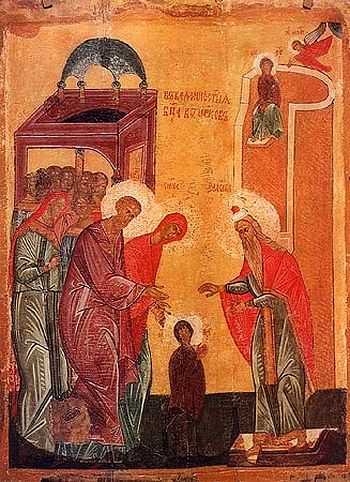
The Orthodox teaching on the The Entry of the Theotokos into the Temple as the heralding of the salvation of mankind is seen in the Icon of the Feast. The central theme of the icon is the Holy of Holies (1) in the Temple which is about to receive a blessing far superior to any of its former blessings. The priest Zacharias, the father of St. John the Baptist, receives Panagia at the gates of the Temple (3) and in this way prophesies that the Virgin Mary is the New Ark of the Covenant. Saints Joachim and Anna (4), accompanied by virgins of Jerusalem, carrying torches in procession, bring Panagia as a well-pleasing sacrifice. The Theotokos is brought to the gates and ascends to the Holy of Holies where she is cared for by angels (2). Notice that the young virgins do not have their heads covered but that the Theotokos has her head covered. Also the garments of the Mother of God resemble those of Saint Anna and not of the young virgins. The Theotokos, although a child, is already a perfected woman that has reached full spiritual maturity.  She who in body is but three years old, and yet in the spirit is full of years (Ode three of the Second Canon).

Temple Of The Foolish Rich Man – Homily by Father Phillip LeMasters

Have you ever thought about the similarities and differences between barns and temples? Usually when we think of barns, we think simply of places to house farm animals or to store crops.  We normally do not think of them as having much spiritual significance. The rich man in today’s gospel lesson thought of his barns only in terms of his business, which was so successful that he looked forward simply to relaxing, eating, drinking, and enjoying himself.  Unfortunately, he did so to the point of making his possessions an idol.  He was rich in things of the world, but poor towards God.  He was ultimately a fool, for he based his life on what was temporary and lost his own soul.  His barn became a temple only to himself. 

We live in a culture that constantly tempts us to follow this man’s bad example. More so than any previous generation, we are bombarded with advertising and other messages telling us that the good life is found in what we can buy. Whether it is cell phones, clothing, cars, houses, entertainment, food, or medicines, the message is the same: Happiness comes from buying the latest new product. During the weeks leading up to Christmas, this message is particularly strong. We do not have to become Scrooges, however. It is one thing to give reasonable gifts to our loved ones in celebration of the Savior’s birth, but it is quite another to turn this holy time of year into an idolatrous orgy of materialism that obscures the very reason for the season.

We are not really near Christmas yet, as Advent just began on November 15. Today, as we continue to celebrate the ForeFeast of the Entrance of the Theotokos into the Temple, we are reminded of the importance of preparing to receive Christ at His birth. Instead of looking for fulfillment in barns and the money they produce, we should follow her into the temple. Sts. Joachim and Anna took their young daughter to the temple in Jerusalem, where she grew up in prayer and purity in preparation to become the living temple of God when she consented to the message of the Archangel Gabriel to become the mother of the God-Man Jesus Christ. The Theotokos was not prepared for her uniquely glorious role by a life focused on making as much money as possible, acquiring the most fashionable and expensive products, or simply pleasing herself. No, she became unbelievably rich toward God by focusing on the one thing needful, by a life focused on hearing the word of God and keeping it.

In ways appropriate to our own life circumstances, God calls each of us to do the same thing. And before we start making excuses, we need to recognize that what St. Paul wrote to the Ephesians applies to us also: “[Y]ou are no longer strangers and sojourners, but…fellow citizens with the saints and members of the household of God, built upon the foundation of the apostles and prophets, Christ Jesus Himself being the cornerstone, in Whom the whole structure is joined together and grows into a holy temple in the Lord; in Whom you also are built into it for a dwelling place of God in the Spirit.” In other words, to be a Christian is to be a temple, for the Holy Spirit dwells in us both personally and collectively. The only way to become a better temple is to follow the example of the Theotokos in deliberate, intentional practices that make us rich toward God, that open ourselves to the healing and transformation of our souls that Christ has brought to the world. We must participate personally in His holiness if we want to welcome Him anew into our lives at Christmas.

The rich fool became wealthy by investing himself entirely in his business to the neglect of everything else. In contrast, the Theotokos invested herself so fully in the Lord that she was able to fulfill the most exalted, blessed, and difficult calling of all time as the Virgin Mother of the Savior. In order for us to follow her example by becoming better temples of Christ, we also have to invest ourselves in holiness. The hard truth is that holiness does not happen by accident, especially in a culture that worships at the altar of pleasure, power, and possessions. So much in our world shapes us every day a bit more like the rich fool in our gospel lesson, regardless of how much or how little money we have. Many of us are addicted to electronic screens on phones, computers, and televisions. What we see and hear through virtually all forms of entertainment encourages us to think and act as though our horizons extend no further than a barn. In other words, the measure of our lives becomes what we possess, what we can buy, and whatever pleasure or distraction we can find on our own terms with food, drink, sex, or anything else. We think of ourselves as isolated individuals free to seek happiness however it suits us. No wonder that there is so much divorce, abortion, sexual immorality, and disregard for the poor, sick, and aged in our society. Investing our lives in these ways is a form of idolatry, of offering ourselves to false gods that can neither save nor satisfy us. The barn of the rich fool was also a temple, a pagan temple in which he basically worshiped himself. If we are not careful, we will become just like him by laying up treasures for ourselves according to the dominant standards of our culture and shut ourselves out of the new life that Christ has brought to the world.

We cannot control the larger trends of our society, but we can control what we do each day. During this Nativity Fast, no matter the circumstances of our lives, we can all take steps to live more faithfully as members of God’s household, built on the foundation of the apostles and prophets, with Jesus Christ as the cornerstone. In other words, we can intentionally reject corrupting influences and live in ways that serve our calling to become better living temples of the Lord. Yes, we can stop obsessing about our barns and enter into the temple of the one true God.

The first step is to set aside time for prayer. If we do not pray every day, we should not be surprised that it is hard to pray in Church or that we find only frustration in trying to resist temptation or to know God’s peace in our lives.  We also need to read the Bible.  If we fill our minds with everything but the Holy Scriptures and the lives of the Saints, we should not be surprised that worry, fear, and unholy thoughts dominate us.  Fasting is also crucial.  If we do not fast or otherwise practice self-denial, we should not be surprised when self-centered desires for pleasure routinely get the better of us and make us their slaves.  We should also share with the poor.  If we do not give generously of our time and resources to others in need, we should not be surprised when selfishness alienates us from God, our neighbors, and even our loved ones. This is also a time for humble confession and repentance.   If we refuse to acknowledge and turn from our  sins, we should not be surprised when we are overcome by guilt and fall into despair about leading a faithful life.  No, the Theotokos did not wander into the temple by accident and we will not follow her into a life of holiness unless we intentionally reorient ourselves toward Him.

None of us will do that perfectly, but we must all take the steps we are capable of taking in order to turn our barns into temples. Remember that the infant Christ was born in a barn, which by virtue of His presence became a temple. The same will be true of our distracted, broken lives when—with the fear of God and faith and love—we open ourselves to the One Who comes to save us at Christmas. The Theotokos prepared to receive the Savior by attending to the one thing needful, to hearing and keeping His word. In the world as we know it, that takes deliberate effort, but it remains the only way to be rich toward God. And that is why Christ is born at Christmas, to bring us into His blessed, holy, and divine life which is more marvelous than anything we can possibly imagine. As the Lord said, “He who has ears to hear, let him hear.”