Nativity Fast Class #3 – Repentance Through Thanksgiving

We’re going to break away from our focus on the ‘Victory Of The Cross’ this Thanksgiving week. As you may know, Cynthia Oquendo’s son Wilder will be baptized Sunday morning beginning at 9:30am. I’d like us to attend this important sacrament so we’ll make this an abbreviated class. Further, we’re likely to have lots of folks who are out of town this holiday weekend.

My topic for this class is repentance through thanksgiving. We’ll be using an extract from Chapter 2 of the book “The Engraving of Christ in Man’s Heart” written by Archimandrite Zacharias as our source material. As we enter Thanksgiving week, I thought it might be useful to explore thanksgiving as a means of repentance. Many of us may elevate repentance to this difficult place that we intend to move towards but we can’t seem to find a way to get started. I think the prescription of using gratitude and thanks as a means of practicing repentance can help us begin today on this journey of repentance. Archimandrite Zacharias is alive and a monk at the Monastery of St. John the Baptist in Essex, England. He is a frequent visitor to the U.S. and a disciple of St. Sophrony who was his spiritual father.

We’ll address these three questions in the class:

  • How can thanksgiving help us overcome our pride?
  • How can thanksgiving help us overcome our despair?
  • How is thanksgiving practiced in the Divine Liturgy

You can also access the fuller contents of this extract by clicking here.

How can thanksgiving help us overcome our pride?

The way of thanksgiving heals us from the passion of pride, and strengthens us against the temptation to despair. Thanksgiving and gratitude equal humility, which can be inferred from the word of the Apostle Paul: ‘Now we have received, not the (proud) spirit of the world, but the (humble) spirit which is of God; that we might (gratefully) know the things that are freely given to us of God.’ 15 It is important, consequently, to remember that the blessing and the grace of God increase within us through humility and particularly through thanksgiving. Holy Scripture, both Old and New, confirms this saying, ‘God resisteth the proud, but giveth grace unto the humble’. 16 When we enter the grace of thanksgiving, we acquire the right kind of godly zeal, which befits the children of God.

How can thanksgiving help us overcome our despair?

Those who thank God never fall into despair and their heart is never empty of His consolation. This is illustrated by the example of a Christian man who once made a confession that he wanted to commit suicide because there was nothing but pain in his life. His spiritual father responded by asking him if there was anything good in his life, if, for instance, he was breathing and alive at that moment. His reply was positive, after which his spiritual father told him, ‘Start thanking God for the breath He gives you, for your physical life, and then for anything else God reveals that you have received as a gift from Him.’ The man started to thank God that he could breathe and that he was alive, and began to feel stronger within. Then he thanked God for knowing His Name, and that he received consolation from prayer in His Holy Name. Finally, his thanksgiving was so sincere and fervent, that he completely forgot about his despair and thoughts of suicide, and escaped this demonic temptation. 

According to the teaching of the Holy Fathers, there is no greater virtue in the sight of God, than the giving of thanks while going through ill-health, persecution, injustice, or rejection. It pleases God when we are in pain and say, ‘Glory to Thee O God! I thank Thee, Lord, for all that Thou hast done for me.’ When guards were dragging Saint John Chrysostom into exile, sick, much afflicted, and maltreated, they passed by a church. The Saint asked them to let him stay for a while in front of the Holy Altar, on which he leaned and said to God, ‘Glory be to Thee, O Lord, for everything’, and at that moment he committed his holy soul into the hands of God. When our life is in danger, there is no attitude more pleasing to God than thanksgiving. If in that moment of pain, we cling to God with our mind and say to Him, ‘I thank Thee Lord, for everything. Neither death, nor any other sorrow can separate me from Thee, for Thou art He that doth overcome death’, then this proves that our faith has become stronger than the death which threatens us. This is a great feat in the sight of God which carries us over to the other shore. In other words, it leads us into a dynamic life, into the blessed communion of all the Saints, into an everlasting doxology and thanksgiving to God throughout all ages in His Kingdom.

The Divine Liturgy is a great means given to us of fighting the passion of despondency, so that we can overcome the spiritual death which preys upon our life. In the Liturgy we learn to do what the Apostle Paul describes in his Epistle to the Philippians, that is, first to offer up mighty thanksgiving to God, and then humbly, with shame because of our spiritual weakness, to make our petitions for all that we need of Him. 17 This is well pleasing to God, so He gives His grace, and gradually light and the feeling of His presence increases in the heart. This small light shines more and more until it breaks forth into a perfect day in our heart, 18 as the Prophet Solomon says, and Christ dwells in our heart by faith. 19

How is thanksgiving practiced in the Divine Liturgy?

In the Divine Liturgy, we are taught to give perfect thanks to the almighty and beloved God in a manner worthy of Him. The Divine Liturgy is the Cross and the Resurrection at the same time, because the Body and the Blood of the Lord which we receive contain the same grace and the same blessing which His Body had after the Resurrection, when He ascended into heaven. The Divine Liturgy is the expression of our gratitude for the Passion, the Cross and the Resurrection of the Lord. This is why in the heart of the Liturgy we hear, ‘Take, eat; this is my Body.’ ‘This is the Body’, the Lord says, ‘which I offered, lifted up upon the Cross, led into the grave and raised up into the heavens resurrected; but I also left this Body on the earth on the night of the Last Supper so that you may partake in it and in all the grace which accompanies it, because in it dwells the fulness of Divinity.’ And then he continues, ‘Drink ye all of it; this is my Blood. The Blood which I shed on the Cross as a ransom for the sins, and for the salvation of the whole world.’ Therefore, when we repeat these words at every Liturgy, it is as if we are saying to Him, ‘To Thee, O Lord, is due all thanksgiving, all glory, every blessing, for Thou hast offered Thy Body and Thy Blood as nourishment for us so that we may be saved and live for all eternity.’ Of course, in heaven and on earth, there is no other matter or vision that occupies the souls of the Saints, than Christ’s saving sacrifice. The study of God’s indescribable love towards us strengthens the souls of the righteous to remain always in an everlasting doxology of joy, thanksgiving, and love worthy of God, Who is holy and good. 

The Apostle Paul writes, ‘For every creature of God is good, and nothing to be refused, if it be received with thanksgiving.’ 20 Everything in our life is sanctified if we receive it with gratitude. When we offer thanksgiving to God, all things, every object and every creature, become a means of salvation for us. God’s words are, ‘Take, eat…, drink ye all of it; this is my Blood.’ The Divine Liturgy is founded on these words and then follows the prayer that God may come and fill everything with the Holy Spirit, just as He fulfilled these great and saving mysteries which remain forever. In response, at the end of the Liturgy we can chant a new and triumphal hymn, ‘We have seen the true Light. We have received the heavenly Spirit. We have found the true faith. We worship the undivided Trinity; for the same hath saved us.’ This is the ‘new song’ of the children of God, which they chant every day out of gratitude and love. 21 Such is the zeal and inspiration of Christians who have been born again through the Divine Liturgy. 

In order for the children of God, who represent the Cherubim and Seraphim at the Divine Liturgy, not to ‘draw back’, 22 their thanksgiving must be replete and offered with ever increasing tension: ‘We thank Thee for all whereof we know and whereof we know not; for benefits both manifest and hid which Thou hast wrought upon us.’ 23 Of course, the things that God has done for us which we cannot see are greater in number, because the eyes of our soul are not open and enlightened. Yet we believe in what we are taught by the Church and in the prayer of the Divine Liturgy. This is why the Liturgy has such warmth; it is a flame of thanksgiving and gratitude. In the central hymn of the Divine Liturgy we chant, ‘We hymn Thee, we bless Thee, we give thanks unto Thee, O Lord, and we pray unto Thee, our God.’ Three verbs of thanksgiving and glory and one of entreaty are used here, because God the Saviour has already accomplished everything for us; He has given us all that we need for our soul to remain united with His Spirit, and for us to enter His never-ending blessedness. The only thing that is left is for our body to become incorrupt, and this He will grant us in the age to come, where we will be like the Angels of God in His Kingdom, as the Lord said to the Sadducees. 24 

Despite all this, we must not forget that our participation in the abundance of life which the Lord offers us in the Liturgy, depends not only upon how much we have prepared in our ‘closet’ 25 the day before, but every day as well. Our whole life ought to be a single preparation to present ourselves worthily before God in His house, and to thank Him for what we owe Him with all our heart, and in a manner befitting Him. The Apostle Paul says that we are all members of the Body of Christ. 26 When we graft a wild olive it grows into a cultivated olive. The Church does the same through baptism; it grafts us onto the Body of Christ. In order for us, however, to be living members of the Body, each one must preserve the gift received from God. The Apostle Paul says that, ‘Every man hath his proper gift of God’. 27 Each member has his unique gift, which he must cultivate in order to continue as a living member of this Body. Our preparation before the Liturgy is our cultivation of the gift God gave us to become a Christian. One way of preparing is by praying on our own for a period of time before the Liturgy, and then going to Church with our heart full of warmth, faith, love, hope, in expectation of the Lord’s mercy, and full of spiritual dispositions. That is an offering we bring to God and the Church, a gift to the assembly of the brethren who have gathered together in the temple.

Footnotes

1 Rom. 8: 7. 2 Jas. 4: 4. 3 1 Cor. 15: 32. 4 Cf. Matt. 6: 21 5 1 Thess. 4: 13. 6 John 17: 3. 7 Eps. 3: 12. 8 Cf. Job 7: 17-18. 9 Rom. 8: 32. 10 Eph. 1: 4. 11 Saint Maximus the Confessor, ‘Various Texts on Theology, the Divine Economy, and Virtue and Vice’ in The Philokalia, trans. and ed. G. E. H. Palmer, Philip Sherrard, Kallistos Ware (London & Boston: Faber & Faber, 1995), Vol. 2, 3: 29, p. 216. 12 See Prayer of the Great Blessing of the Waters, ‘Thou hast poured forth the air that living things may breathe’. 13 Luke 17: 10. 14 Cf. 2 Cor. 7: 1. 15 See 1 Cor. 2: 12. 16 Cf. Prov. 3: 34 (LXX); Jas. 4: 6; 1 Pet. 5: 5. 17 Phil. 4: 6. 18 Cf. Prov. 4: 18. 19 Eph. 3: 17. 20 1 Tim. 4: 4-5. 21 Ps. 33: 3. 22 Heb. 10: 39. 23 Anaphora, Liturgy of Saint John Chrysostom and Saint Basil. 24 Matt. 22: 30. 25 Matt. 6: 6. 26 1 Cor. 12: 27. 27 1 Cor. 7: 7. 28 Lity of Theophany. 29 

Repentance Through Thanksgiving – The Engraving Of Christ In Man’s Heart (From Chapter 2) By Archimandrite Zacharias Zacharou

As we enter Thanksgiving week, I thought it might be useful to explore thanksgiving as a means of repentance. Many of us may elevate repentance to this difficult place that we intend to move towards but we can’t seem to find a way to get started. I think the prescription of using gratitude and thanks as a means of practicing repentance can help us begin today on this journey of repentance. Archimandrite Zacharias is alive and a monk at the Monastery of St. John the Baptist in Essex, England. He is a frequent visitor to the U.S. and a disciple of St. Sophrony who was his spiritual father. I hope you find this article a great way of combining repentance and Thanksgiving …adding substance and meaning to this holiday – Bruce M.

What theory and which thoughts contribute to this greatest miracle known to the created world, namely, the union of the heart of man with the Spirit of God?

We are given this theory in Holy Scripture, where we learn that from the excess of His goodness, God formed man’s heart in a unique way, and it was the target of His visitation from evening until morning and from morning until evening. 8 It was made to be suitable for and capable of receiving its Creator when He would come into the world for the salvation of all. In order to take care of man and make him in the image of His Son, that is, a god according to grace, He conceived such a great plan for him, that He even ‘spared not His own Son’ 9 in order to fulfil it. Certainly, if man occupied the Mind of God ‘before the foundation of the world’, 10 then he must indeed be sublime in his origin and his destination, and extraordinary in the potential hidden in his nature which is made in the image of God.

This theory inspires faith which is activated by love and gratitude. Through thanksgiving to God for His merciful providence, the believer is enriched with spiritual gifts. We receive grace in proportion to the gratitude we show. As the great Saint Maximus says, God measures out His gifts to men according to the gratitude with which they receive them. 11 Thus we enter the blessed fulness of God’s grace: the greater the gratitude and glory we offer Him, the more abundant is the measure of His gifts to us. By thanksgiving, man acquires a hypostasis in the sight of God and his life has value in eternity, so that in the day of His glorious coming he will be able to stand in His unshakeable presence.

Moreover, with the gifts that he has, the believer enters into the communion of the gifts of the other members of the Body of Christ, the Saints and all of the Lord’s elect upon earth. In this rich assembly of grace, which the believer enters through thanksgiving and gratitude, he forgets about the smaller gifts he has received, and reaches out to a greater fulness of love and perfection, hungry and thirsty for the gift of God. Anyone who thanks God is a stranger to despondency, yet is overcome by a blessed sadness, because he cannot thank God for all His benefits in a manner worthy of Him, even for every breath of air which He pours out upon the face of the earth. 12 Consequently, thanksgiving such as this, leads to true repentance of which there is no end in this life. Then we understand why, in His Gospel, the Lord places self-condemnation arising from gratitude above all the commandments, deeming that we are useless and unworthy even when we have fulfilled all His commandments. ‘So likewise ye, when ye shall have done all those things which are commanded you, say, we are unprofitable servants: we have done that which was our duty to do.’ 13 Such a spirit preserves divine grace fervent in the lives of the faithful, and this leads to inspiration that saves, by sending away deathly despondency and giving strength daily to ‘perfect holiness in the fear of God’. 14

The way of thanksgiving heals us from the passion of pride, and strengthens us against the temptation to despair. Thanksgiving and gratitude equal humility, which can be inferred from the word of the Apostle Paul: ‘Now we have received, not the (proud) spirit of the world, but the (humble) spirit which is of God; that we might (gratefully) know the things that are freely given to us of God.’ 15 It is important, consequently, to remember that the blessing and the grace of God increase within us through humility and particularly through thanksgiving. Holy Scripture, both Old and New, confirms this saying, ‘God resisteth the proud, but giveth grace unto the humble’. 16 When we enter the grace of thanksgiving, we acquire the right kind of godly zeal, which befits the children of God.

Those who thank God never fall into despair and their heart is never empty of His consolation. This is illustrated by the example of a Christian man who once made a confession that he wanted to commit suicide because there was nothing but pain in his life. His spiritual father responded by asking him if there was anything good in his life, if, for instance, he was breathing and alive at that moment. His reply was positive, after which his spiritual father told him, ‘Start thanking God for the breath He gives you, for your physical life, and then for anything else God reveals that you have received as a gift from Him.’ The man started to thank God that he could breathe and that he was alive, and began to feel stronger within. Then he thanked God for knowing His Name, and that he received consolation from prayer in His Holy Name. Finally, his thanksgiving was so sincere and fervent, that he completely forgot about his despair and thoughts of suicide, and escaped this demonic temptation.

According to the teaching of the Holy Fathers, there is no greater virtue in the sight of God, than the giving of thanks while going through ill-health, persecution, injustice, or rejection. It pleases God when we are in pain and say, ‘Glory to Thee O God! I thank Thee, Lord, for all that Thou hast done for me.’ When guards were dragging Saint John Chrysostom into exile, sick, much afflicted, and maltreated, they passed by a church. The Saint asked them to let him stay for a while in front of the Holy Altar, on which he leaned and said to God, ‘Glory be to Thee, O Lord, for everything’, and at that moment he committed his holy soul into the hands of God. When our life is in danger, there is no attitude more pleasing to God than thanksgiving. If in that moment of pain, we cling to God with our mind and say to Him, ‘I thank Thee Lord, for everything. Neither death, nor any other sorrow can separate me from Thee, for Thou art He that doth overcome death’, then this proves that our faith has become stronger than the death which threatens us. This is a great feat in the sight of God which carries us over to the other shore. In other words, it leads us into a dynamic life, into the blessed communion of all the Saints, into an everlasting doxology and thanksgiving to God throughout all ages in His Kingdom.

The Divine Liturgy is a great means given to us of fighting the passion of despondency, so that we can overcome the spiritual death which preys upon our life. In the Liturgy we learn to do what the Apostle Paul describes in his Epistle to the Philippians, that is, first to offer up mighty thanksgiving to God, and then humbly, with shame because of our spiritual weakness, to make our petitions for all that we need of Him. 17 This is well pleasing to God, so He gives His grace, and gradually light and the feeling of His presence increases in the heart. This small light shines more and more until it breaks forth into a perfect day in our heart, 18 as the Prophet Solomon says, and Christ dwells in our heart by faith. 19

In the Divine Liturgy, we are taught to give perfect thanks to the almighty and beloved God in a manner worthy of Him. The Divine Liturgy is the Cross and the Resurrection at the same time, because the Body and the Blood of the Lord which we receive contain the same grace and the same blessing which His Body had after the Resurrection, when He ascended into heaven. The Divine Liturgy is the expression of our gratitude for the Passion, the Cross and the Resurrection of the Lord. This is why in the heart of the Liturgy we hear, ‘Take, eat; this is my Body.’ ‘This is the Body’, the Lord says, ‘which I offered, lifted up upon the Cross, led into the grave and raised up into the heavens resurrected; but I also left this Body on the earth on the night of the Last Supper so that you may partake in it and in all the grace which accompanies it, because in it dwells the fulness of Divinity.’ And then he continues, ‘Drink ye all of it; this is my Blood. The Blood which I shed on the Cross as a ransom for the sins, and for the salvation of the whole world.’ Therefore, when we repeat these words at every Liturgy, it is as if we are saying to Him, ‘To Thee, O Lord, is due all thanksgiving, all glory, every blessing, for Thou hast offered Thy Body and Thy Blood as nourishment for us so that we may be saved and live for all eternity.’ Of course, in heaven and on earth, there is no other matter or vision that occupies the souls of the Saints, than Christ’s saving sacrifice. The study of God’s indescribable love towards us strengthens the souls of the righteous to remain always in an everlasting doxology of joy, thanksgiving, and love worthy of God, Who is holy and good.

The Apostle Paul writes, ‘For every creature of God is good, and nothing to be refused, if it be received with thanksgiving.’ 20 Everything in our life is sanctified if we receive it with gratitude. When we offer thanksgiving to God, all things, every object and every creature, become a means of salvation for us. God’s words are, ‘Take, eat…, drink ye all of it; this is my Blood.’ The Divine Liturgy is founded on these words and then follows the prayer that God may come and fill everything with the Holy Spirit, just as He fulfilled these great and saving mysteries which remain forever. In response, at the end of the Liturgy we can chant a new and triumphal hymn, ‘We have seen the true Light. We have received the heavenly Spirit. We have found the true faith. We worship the undivided Trinity; for the same hath saved us.’ This is the ‘new song’ of the children of God, which they chant every day out of gratitude and love. 21 Such is the zeal and inspiration of Christians who have been born again through the Divine Liturgy.

In order for the children of God, who represent the Cherubim and Seraphim at the Divine Liturgy, not to ‘draw back’, 22 their thanksgiving must be replete and offered with ever increasing tension: ‘We thank Thee for all whereof we know and whereof we know not; for benefits both manifest and hid which Thou hast wrought upon us.’ 23 Of course, the things that God has done for us which we cannot see are greater in number, because the eyes of our soul are not open and enlightened. Yet we believe in what we are taught by the Church and in the prayer of the Divine Liturgy. This is why the Liturgy has such warmth; it is a flame of thanksgiving and gratitude. In the central hymn of the Divine Liturgy we chant, ‘We hymn Thee, we bless Thee, we give thanks unto Thee, O Lord, and we pray unto Thee, our God.’ Three verbs of thanksgiving and glory and one of entreaty are used here, because God the Saviour has already accomplished everything for us; He has given us all that we need for our soul to remain united with His Spirit, and for us to enter His never-ending blessedness. The only thing that is left is for our body to become incorrupt, and this He will grant us in the age to come, where we will be like the Angels of God in His Kingdom, as the Lord said to the Sadducees. 24

Despite all this, we must not forget that our participation in the abundance of life which the Lord offers us in the Liturgy, depends not only upon how much we have prepared in our ‘closet’ 25 the day before, but every day as well. Our whole life ought to be a single preparation to present ourselves worthily before God in His house, and to thank Him for what we owe Him with all our heart, and in a manner befitting Him. The Apostle Paul says that we are all members of the Body of Christ. 26 When we graft a wild olive it grows into a cultivated olive. The Church does the same through baptism; it grafts us onto the Body of Christ. In order for us, however, to be living members of the Body, each one must preserve the gift received from God. The Apostle Paul says that, ‘Every man hath his proper gift of God’. 27 Each member has his unique gift, which he must cultivate in order to continue as a living member of this Body. Our preparation before the Liturgy is our cultivation of the gift God gave us to become a Christian. One way of preparing is by praying on our own for a period of time before the Liturgy, and then going to Church with our heart full of warmth, faith, love, hope, in expectation of the Lord’s mercy, and full of spiritual dispositions. That is an offering we bring to God and the Church, a gift to the assembly of the brethren who have gathered together in the temple.

The gift that we cultivate when we are alone unites us with the Body of Christ. It leads us into the communion of all the other gifts of the members of Christ’s Body, the Saints in heaven, and also of His elect upon earth so that in truth we become rich. In monasteries, monks also have their daily prayer rule, which they do not consider to be a burden. On the contrary, it is an honour and privilege given to them to help them enter the communion of the grace of God, the communion of the gifts of the brethren who are their fellow strugglers.

Consequently, the more we cultivate our gift when we are alone, the more we shall be prepared when we come to church, to enter this blessed communion of gifts, the blessed communion of those who possess gifts, the blessed communion of the grace of God. For the grace of God stablishes the Church, who, like a mother, helps and inspires the faithful with her prayers and Liturgies, which create an upward impetus, while the Saints, who are the glorified members of the Body of Christ, pull them up with their prayers and intercessions. This is the meaning of the Church: a helpful push from below and a saving pull from above.

Those who offer a ‘sacrifice of love’ in their preparation for the Liturgy, come to the temple bearing gifts for God, which bring inspiration and impart joy, peace and grace to the other brethren. The greater and more attentive our preparation, the purer and stronger will our entry be into the family, that is, the communion of God. In one of the hymns of Theophany, it is written, ‘Where the King is present, there His army also goes.’ 28 That is to say, where Christ is, the King of heaven and earth, there are the orders of the heavenly spirits: His All Holy Mother, the Saints, the Archangels and Angels, and also all the Christians who have received the gift of the Holy Spirit and struggle for their perfection in all the places of His dominion.

By contrast, when we go to the Divine Liturgy without having prepared, we are not being fair to God and our brethren, because we do not have any gifts in our heart to offer God and with which to enter into this marvellous communion with the other members who do come bearing gifts.

Depending on how much they have prepared for the service, those who come to church maintain the warmth of their heart, so that they bear gifts for God and their brethren. We do not mean simply material gifts, like the goats and lambs which the Hebrews brought to God as offerings. Now they bring their heart, full of the warmth of faith, full of the light of God’s word from constant study of the Gospel, and full of the strength which the mystery of God produces in their soul. The hope and expectation they bear within, incites the faithful to exclaim and say to God, ‘Thine own, of Thine own, we offer unto Thee in all and for all’. 29 In other words, these things that are Yours, from the things You have given, when You provided everything we need to live and to be saved, we offer them to You, according to the commandment You have given us. And He receives their gifts, bread and wine, things which are insignificant but which become precious, because the congregation have placed in them all their faith, repentance, love, hope, their expectation in the Holy of Holies, and finally their whole life and humility. The Lord then accepts them, blesses them, and transforms them into His Body and Blood. That is, He also adds to them all the power and grace which were in His Body after the Resurrection and gives them back to us saying, ‘The holy things unto the holy.’ 30 This is the voice of God to His people. If the faithful have placed all their life in the gifts, they will succeed in exchanging them. In return they will receive all God’s life, all His grace, all His blessing, in short, the fulness of salvation.

In order for the door of the grace of God to open again, first of all we must thank Him ‘unto the end’ for all that He has given us until now. In this, we take heed to the words of the Lord, ‘If ye have not been faithful in that which is another man’s, who shall give you that which is your own?’ 31 In other words, man cannot receive a greater fulness of God’s grace if he has not first responded with a gratitude befitting God for all the changes of ‘the right hand of the most High’ in his life up to the present. 32

Thanksgiving, therefore, is the zeal which the children of God ought to possess. It is so pleasing to God, that the great Apostle Paul urges us first to give thanks to God for everything and only then to present our petitions to the Lord, ‘Be careful for nothing; but in every thing by prayer and supplication with thanksgiving let your requests be made known unto God,’ 33 and ‘In every thing give thanks: for this is the will of God in Christ Jesus concerning you.’ 34

In such a blessed communion of grace, we find true and dynamic divine inspiration which allows no rest on earth, but goes from faith to more perfect faith; from hope to confidence in the Living Jesus Who raises even the dead; from love to a greater fulness of love; and from a single light to the perfect day of His Kingdom that knows no eventide, wherein we will find the eternal rest of our souls with ‘all His Saints’ 35 and the ‘spirits of just men made perfect’. 36

Footnotes: 1 Rom. 8: 7. 2 Jas. 4: 4. 3 1 Cor. 15: 32. 4 Cf. Matt. 6: 21 5 1 Thess. 4: 13. 6 John 17: 3. 7 Eps. 3: 12. 8 Cf. Job 7: 17-18. 9 Rom. 8: 32. 10 Eph. 1: 4. 11 Saint Maximus the Confessor, ‘Various Texts on Theology, the Divine Economy, and Virtue and Vice’ in The Philokalia, trans. and ed. G. E. H. Palmer, Philip Sherrard, Kallistos Ware (London & Boston: Faber & Faber, 1995), Vol. 2, 3: 29, p. 216. 12 See Prayer of the Great Blessing of the Waters, ‘Thou hast poured forth the air that living things may breathe’. 13 Luke 17: 10. 14 Cf. 2 Cor. 7: 1. 15 See 1 Cor. 2: 12. 16 Cf. Prov. 3: 34 (LXX); Jas. 4: 6; 1 Pet. 5: 5. 17 Phil. 4: 6. 18 Cf. Prov. 4: 18. 19 Eph. 3: 17. 20 1 Tim. 4: 4-5. 21 Ps. 33: 3. 22 Heb. 10: 39. 23 Anaphora, Liturgy of Saint John Chrysostom and Saint Basil. 24 Matt. 22: 30. 25 Matt. 6: 6. 26 1 Cor. 12: 27. 27 1 Cor. 7: 7. 28 Lity of Theophany. 29 

Born To Set Us Free From Our Infirmities

December 4, 2021 · Fr. Philip LeMasters

Galatians 5:22-6:2; Luke 13:10-17

When Jesus Christ was teaching in a synagogue on the Sabbath, he saw a woman who was bent over and could not straighten up. She had been that way for eighteen years. Imagine how her life had changed due to her disability, how frustrating that chronic illness had to be, especially in a time before modern medicine and physical therapy. The Lord said to her, “Woman, you are loosed from your infirmity.” When He laid hands on her, she was healed. When the woman stood up straight again, she glorified God.

As was often the case when the Savior healed on the Sabbath day, there were those standing around just waiting to criticize Him for working on the day of rest.  He responded to them by noting that people do what is necessary to take care of their animals on the Sabbath.  “So ought not this woman, being a daughter of Abraham, whom Satan has bound for eighteen years, be loosed from this bond on the Sabbath?”  The force of His point was so clear that those self-righteous hypocrites were put to shame and the people rejoiced.

In these weeks of the Nativity Fast, we pray, fast, give to the needy, and confess and turn away from our sins as we prepare to celebrate the wonderful news of the Incarnation of the Son of God, of our Lord’s birth at Christmas for the salvation of the world. Today’s gospel text provides a beautiful image of what Jesus Christ has done for us by becoming a human being by uniting divinity and humanity in His own Person.  These weeks of preparation give us all the opportunity to gain the spiritual clarity to see ourselves in that poor woman bent over and bound with chronic, debilitating infirmity.

Though we often do our best to hide it, we are all too well acquainted with illness, pain, and death.  We face chronic challenges of various kinds from which we cannot deliver ourselves or our loved ones. We have diseases of soul, of personality, of behavior, and of relationships that cripple us, that keep us from acting, thinking, and speaking with the joyful freedom of the children of God.  We are all bent over and crippled in profound ways in relation to the Lord, our neighbors, and even ourselves.  We have all fallen short of fulfilling God’s gracious purposes for us, as has every generation since Adam and Eve.

Joachim and Anna knew all about long-term frustration and pain, for like Abraham and Sarah they were childless into their old age.  God heard their prayers, however, and gave them Mary, who would in turn give birth to the Savior Who came to liberate us all from sin and death.  We celebrate in the coming week the feast of St. Anna’s conception of the Theotokos, which foreshadows the coming of the Lord to loose us from the infirmities that hinder our participation even now in the joyful life of the Kingdom.

The story of the Old Testament unfolded through the family of Abraham, who was told by God that he would be the father of a large, blessed family.   Some think of life after death as being accomplished through ongoing generations of children and grandchildren, not by victory over death itself.  If God’s blessings extended no further than the grave, however, then no one would ever be loosed from bondage to the wages of sin, which is death itself. Only a Savior Who is truly divine and human could enter fully into the fatal consequences of our corruption and then rise victorious over them, making it possible for us to participate in the eternal life of the heavenly kingdom.

The history of the Hebrews was preparatory for the coming of the Christ, the Messiah in Whom God’s promises are fulfilled and extended to all who have faith in the Savior, regardless of their ethnic or national heritage.  Christ did not come to promote one nation over another or to set up an earthly kingdom of any kind, but to fulfill our original calling as those created in the image and likeness of God.  He unites divinity and humanity in Himself and makes it possible for us to share in the eternal life of the Holy Trinity as distinct, unique persons who become radiant with the divine glory by grace. God breaks the laws of nature, at least as we know them in our world of corruption, in order to save us, enabling elderly women like Sarah and Anna to conceive and bear children and a young virgin named Mary to become the mother of His Son, Who Himself rose from the dead after three days in the tomb.  He is born at Christmas to work our liberation, to break the bonds of death, and to heal the brokenness of our life in this world of corruption.

The Lord did not treat the woman in today’s reading according to her physical condition as simply an impersonal bundle of disease, even as St. Anna’s fate was not defined by barrenness.  Instead, He revealed her true identity as a beloved person, a daughter of Abraham, by enabling her to stand up straight for the first time in years.   On that particular Sabbath day, Jesus Christ treated her as a unique, cherished child of God who was not created for slavery to a wretched existence of pain, disease, and despair, but for blessing, health, and joy.  She glorified God for this deliverance from bondage, for this restoration of freedom, as did those who saw the miracle.

The good news of Christmas is that the Savior is born to do the same for us all, to set us free from captivity to the decay, corruption, and weakness that have taken root in our souls. He comes to deliver us from being defined by our infirmities so that we can leave behind our bondage and enter into the joyous freedom of the children of God.  He comes to restore us as living icons who manifest His glory and salvation as the unique persons He created us to be.

Our salvation is a process of becoming more fully our true ourselves by embracing Christ’s healing of the human person.  There is no limit to the unique beauty of our souls other than those we impose by our own refusal to unite ourselves to Him in holiness.  The more we share by grace in the life of the Holy Trinity, the more we will see that the process of our fulfillment in God is eternal.  Since our fundamental calling is to become like God in holiness, we become more truly ourselves whenever we turn away from slavery to sin and corruption in order to embrace more fully the new life that Christ has brought to the world.

Most people today probably do not think of Advent and Christmas in relation to liberation from our bondage to sin and death.  More typically, we distort them into opportunities to strengthen our addiction to the love of money and possessions and to excess in food and drink.  Such self-centered indulgence is really nothing but bondage to ourselves, which can easily leave us so weak spiritually that we will never be able to straighten ourselves up.  That is not surprising because, as God’s children, we were not created to find our fulfillment in the passing things of creation or in satisfying self-centered desires for bodily pleasure.  That is why we must resist the cultural temptation to become so busy with shopping, planning, and partying this time of year that we end up ignoring the profound spiritual gravity of our Lord’s Incarnation.  He is born to restore us to the full dignity of His sons and daughters, to make us personal participants in the blessing and joy of the heavenly kingdom.  He comes to loose us all from slavery to sin and death.

In the remaining weeks of the Nativity Fast, let us follow St. Paul’s advice to acquire “the fruit of the Spirit…love, joy, peace, longsuffering, kindness, goodness, faith, meekness, [and] self-control.” Let us use this season to crucify “the flesh with the passions and the lusts” as we are loosed from the debilitating corruptions of sin by the mercy of the God-Man born for our salvation. As we pray, fast, give to the needy, and confess and repent of our sins this Advent, let us do so with the joyful hope of the woman who could finally stand up straight after eighteen years. For the Savior is born to deliver us from bondage in all its forms. It is time to rise up with Him into the blessed life of holiness He comes to share with us, for we have already had more than enough of pain and infirmity. As daughters and sons of Abraham by faith, let us embrace the healing that is ours in Jesus Christ.

What Does The Entrance Into The Temple Of The Mother Of God Mean For Us & Our Salvation

By Father Panagiotes Carras

The oikonomia of our salvation began with the very creation of the world. It is not by chance that the fourth Gospel does not commence with a genealogy of our Lord but takes us back to the very beginning.  All things from the beginning to the end, from the alpha to the omega are part of God’soikonomia for our salvation, God’s providential ordering of our salvation. Man was created that he may participate in the Divinity of his Creator by first participat­ing in his own perfection.  We are taught by the Fathers that man was created for perfection. Adam was offered perfection but fell victim to the guile of the serpent.  God’s plan could not be frustrated and the Lord prepared the world for another Adam who would rescue the offspring of the first Adam.

St. Paul tells us that Adam is a type of the future Adam (Romans 5: 14). All Christians are des­cendants of both the first Adam and the last Adam. From the first we inherited death, from the last we inherited life. (1 Corinthians 15: 45-50). It is this Apostolic teaching of the two Adams which was developed by the Fathers and formed the nucleus of the Church’s teaching on the salvation of mankind.

Mankind, which had its beginning in the first Adam, had to be given a new beginning. A new Adam was needed to become the Head of the New Humanity, the Head of the body, the Church, which is His body (Ephesians 1:22-23). However, just as in the creation of the Old Humanity, mankind was given the freedom to choose sonship; similarly in the creation of the New Humanity, mankind was granted the opportunity to choose. The first Adam was from the earth, a man of dust, the second is from Heaven (1 Corinthians 15: 47). The first could choose sin because he was not yet perfect, the second Adam, our Lord Jesus Christ, being God by nature, was totally alien to sin. It is because God’s oikonomia required a member of the human race who was able to prove himself free from every sin that the time had fully come (Galatians 4:4) for God to send forth His Son, since mankind was able to bring forth the All-Holy Virgin.

This is precisely why Theotokos is the key-word of the Christological teaching of the fourth Ecumen­ical Council or as St. John of Damascus says, This name contains the whole mystery of the Oikonomia(On the Orthodox Faith, 3, 12). It is for this reason that the traditional Orthodox icon of the Mother of God is an icon of the Incarnation, the Virgin is always with the Child.

The Church’s teaching of the Theotokos is an ex­tension of what is believed concerning the person of Christ. The Son of God was born of a woman and in this case the Mother is not just a mere physical instrument but an active participant who has found favour with God (Luke 1, 30). The faith of the Church is aptly expressed in the words of Nicholas Cabasilas in his Homily on the Annunciation: The incarnation was not only the work of the Father and of His Power and His Spirit, it was also the work of the will and the faith of the Virgin (On the Annunciation, 4).

It is the teaching of the Church, attested to from the earliest date, that the Virgin Mother of the In­carnate Lord had found favour with God (Luke 1:30) and that she was chosen and ordained to particip­ate in the Mystery of the Incarnation, in the Oikonomia of Salvation. The ancient Church understood the typo­logical relationship between the first Adam and the last Adam, and by extension it was able to see that the first Eve prefigured the second Eve. We find that as early as the Second Century St. Justin and St. Irenaeus had a developed teaching of the Theotokos as the second Eve who through her obedience re­medied the disobedience of the first Eve. And so the knot of Eve’s disobedience received its unloosing through the obedience of Mary; for what Eve, a virgin, bound by unbelief, that, Mary, a Virgin, unloosed by faith (Against Heresies, III, 22, 4.) Mary… by yield­ing obedience, became the cause of salvation, both to herself and the whole human race. (Against Heresies, III, 22, 4). Mary alone cooperating with the economy (Against Heresies, III, 21, 7).

The Church has proclaimed this great Mystery of our salvation not only through the teaching of the Fathers but also through the festal celebration of the acts which worked our salvation, chief of which is the Holy Resurrection of our Lord. On the 21st of Novem­ber the Church celebrates the Feast of the Entry of the Theotokos into the Temple. It is at this time that the faithful chant Today is the prelude of God’s Good-Will and the heralding of the salvation of mankind. (Dismissal Hymn).

Throughout the whole service the hymns proclaim the exalted place which the Entry has in the history of Salvation. The Entry marks the closing of the Old Covenant, whereas the Annunciation marks the beginn­ing of the New. With the Entry the most Holy Virgin is passing from the Old Covenant to the New, and this transition in the person of the Mother of God shows us how the New Covenant is the fulfillment of the Old.

Like other human beings the Holy Virgin was born under the law of original sin but the sinful heritage of the fall had no mastery over her. She was without sin under the universal sovereignty of sin, pure from every seduction and yet part of a humanity enslaved by the devil. This is the victory which the Feast of the Entry joyfully celebrates. St. Photius praises the Holy Virgin as the great and God-carved ornament of human kind” who ” made her whole soul a holy shrine of meekness… never allowing any of her wares as much as to touch for a moment the brine of evil. (On the Annunciation, 4). This theme con­stantly appears in the hymns of the Feast of the EntryThy Miracle, 0 Pure Theotokos, transcends the power of words; for I comprehend that thine is a body transcending description, not receptive to the flow of sin. (Third Magnification of the ninth Ode). Ni­cholas Cabasilas expanded this teaching and dealt with it extensively in his Homily on the Birth of the Theo­tokos where we read: The Virgin remained from the beginning to the end free from every evil because of her vigilant attention, firm will, and magnitude of wisdom. (Chapter 15).

The sinlessness and purity of the Theotokos along with the fact that the Lord was preparing Her to be­come His chamber overshadowed the sanctity of the Old Testament temple. The All-Pure Virgin is allowed to enter the Holy of Holies precisely because she is to become the living temple of God. St. Tarasios in his Homily of the Entry has Saint Anne exclaiming:Re­ceive Zacharias, the pure tabernacle; receive 0 priest, the immaculate chamber of the Word … have her dwell in the temple made by hands, she who has be­come a living temple of the Word (Migne, 98:1489). Zacharias in turn speaks to the Virgin, You are the loosing of the curse of Adam, you are the payment of the debt of Eveand he continues to recall all the types and prophecies of the Old Testament which refer to the Theotokos. (Migne, 98:1492-93).

In the Minea of St. Dimitry of Rostov we read, Thus with the honor and glory not only of men, but also of angels, the most Immaculate Maiden was led into the temple of the Lord. And it was meet: for if the ark of the Old Testament, bearing manna in itself, which served only as a prototype of the Most Holy Virgin, was carried into the temple with great honor, with the assembling of all Israel, then with how much greater honor, with the assembling of angels and men, had to take place the entry into the temple of that same living ark, which had manna — Christ — in it, the Most Blessed Virgin, fore-ordained to be the Mother of God.

The Feast of the Entry celebrates the sanctity of the All-Holy Virgin and glorifies the Lord who placed her in the inaccessible Holies like some treasure of God’s, to be used in due time (even as came to pass) for the enrichment of, and as an ornament transcend­ing, as well as common to, all the world.(St. Gregory Palamas, Homily on the Entry, IX).

Teachings From the Service of the Feast

In the Orthodox Church services we participate in the saving events of the Oikonomia of Salvation. This is why, during these services we hear the word Today quite often. This is why in the first Sticheron of the  Lord I have Cried  begins, Come let us faithful dance for joy on this day. The second Sticheron begins with In the temple of the Law today is the living temple.  During Vespers, Matins and the Divine Liturgy we enter into the Mystery of the Entry of the Theotokos. When we enter into the Mystery we are not simple witnesses as the maidens who accompanied theTheotokos but rather participants in the eternal mystery.  

The first two Old Testament readings of Vespers speak of the Divine establishment of the Tabernacle and the Temple (Exodus 40:1-5, 9-10, 34-35 and IIIKings 8:1, 3-4, 6-7, 9, 10-11). The third reading, taken from the Prophecy to Prophet Ezekiel ( Ezekiel 43:27-44:4) speaks of the Theotokos as the living Temple of God.  

During the Divine Liturgy, in the reading of the Epistle of Saint Paul to the Hebrews (9:1-7), we are taught that all things which were done in the Temple of the Old Testament were a Prophecy of what would be fulfilled by our Saviour. In the Gospel of Saint Luke (10:38-42, 11:27-28), which is read at every Feast of the Mother of God, we hear: Blessed is the womb that bare thee, and the paps which thou hast sucked. We are reminded to glorify our Lord and bless His mother, who brought us our salvation.

Icon of the Feast

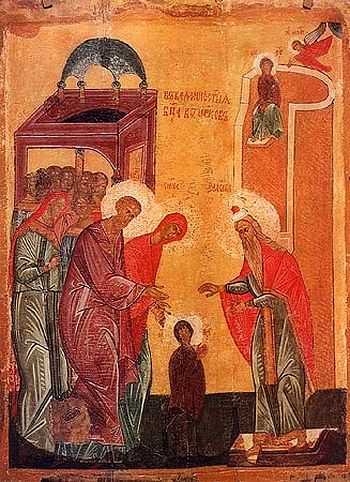
The Orthodox teaching on the The Entry of the Theotokos into the Temple as the heralding of the salvation of mankind is seen in the Icon of the Feast. The central theme of the icon is the Holy of Holies (1) in the Temple which is about to receive a blessing far superior to any of its former blessings. The priest Zacharias, the father of St. John the Baptist, receives Panagia at the gates of the Temple (3) and in this way prophesies that the Virgin Mary is the New Ark of the Covenant. Saints Joachim and Anna (4), accompanied by virgins of Jerusalem, carrying torches in procession, bring Panagia as a well-pleasing sacrifice. The Theotokos is brought to the gates and ascends to the Holy of Holies where she is cared for by angels (2). Notice that the young virgins do not have their heads covered but that the Theotokos has her head covered. Also the garments of the Mother of God resemble those of Saint Anna and not of the young virgins. The Theotokos, although a child, is already a perfected woman that has reached full spiritual maturity.  She who in body is but three years old, and yet in the spirit is full of years (Ode three of the Second Canon).

Great Lent And The Mystery of the Cross & Resurrection – Short Reflection

By Archimandrite Zacharias from his book ’At The Doors of Holy Lent’

Great Lent is a taste of death in the Name of God, for the sake of our reconciliation with Him, for the sake of His commandment. The little death that that beast, our ego, endures through fasting, through voluntarily bearing shame in the mystery of confession, by shedding streams of wretched tears for our dire poverty and inability to render mighty love unto the Lord; this death places us on the path of Him Who said: ‘I am the first and the last: I am He that liveth, and was dead; and, behold, I am alive for evermore.’(Rev 1:17-18). This begets in the heart the faith that, ‘If we be dead with Christ, we believe that we shall also live with Him: Knowing that Christ being raised from the dead dieth no more; death hath no more dominion over Him.’ (Rom 6:8-9). Then on the night of the Resurrection, we sing with boldness the hymn: ‘Yesterday, O Christ, I was buried with Thee and today I rise again with Thy rising. Yesterday I was crucified with Thee: do Thou Thyself glorify me, O Saviour, in thy kingdom.’ Our minor taste of death leavens in the heart and, upon hearing the good news of the Resurrection of Christ, it becomes an explosion of joy, initiating us into the mystery of His descent into hell and ascension above the Heavens.

The Church is preoccupied with only one matter: the Cross and Resurrection of Christ. Saint Paul was consumed by the desire to set forth before his disciples the image of Jesus Christ, ‘and Him crucified’ (1 Cor 2:2). In other words, his concern was to impart to them the knowledge of the mystery of the Cross and Resurrection of Christ, knowing that whosoever walks the way of the Cross will also enter into the presence of the Risen Lord. The Church institutes as a commandment that we should go through this period with spiritual tension for the renewal of our life. She travails to see her children assimilated through obedience into the mystery of the Cross and Resurrection of Christ.

Hopko on the Cross of Christ

This is the article I read partially this morning in class. I had posted it to the wrong website. I think it’s powerful in exploring the fullness of the Cross and its paradox that continually asks us to face what is ‘not of this world’.

An excerpt from a commencement address at St. Vladimir’s Seminary in 2007, given by Fr. Thomas Hopko. It is deeply worthy of conversation.

…I can tell you that being loved by God, and loving Him in return, is the greatest joy given to creatures, and that without it there is no real and lasting happiness for humanity.

And I can also tell you, alas, that such loving is always a violent, brutal and bloody affair.

The God who is merciful and gracious, longsuffering, and abounding in steadfast love and faithfulness, who gives us his divine life and peace and joy forever, is first of all the Divine Lover who wounds His beloved, and then hides from her, hoping to be sought and found. He is the Father who chastens and disciplines His children. He is the Vinekeeper who cuts and prunes His vines so that they bear much fruit. He is the Jeweler who burns His gold in His divine fire so that it would be purged of all impurities. And He is the Potter who continually smashes and refashions and re-bakes His muddy clay so that it can be the earthen vessel that He wants it to be, capable of bearing His own transcendent grace and power and glory and peace.

…I learned that all of these terrible teachings of the Holy Scriptures and the saints are real and true. And so I became convinced that God’s Gospel in His Son Jesus is really and truly God’s final act on earth. It is the act in which God’s Word is now not simply inscribed in letters on pages of parchment, but is personally incarnate as a human being in his own human body and blood. And so I became convinced of the truth of all truths: that the ultimate revelation of God as Love and the ultimate revelation of humanity’s love for God, are to be found in the bloody corpse of a dead Jew, hanging on a cross between two criminals, outside the walls of Jerusalem, executed at the hands of Gentiles, by the instigation of his own people’s leaders, in the most painful, cursed, shameful and wretched death that a human being — and especially a Jew – can possibly die.

So to the measure that we are honest and faithful, and try to keep God’s commandments, and repent for our failures and sins, we come to know, and to know ever more clearly and deeply as time goes by, what we have learned here at St. Vladimir’s. We come to know by experience that the Word of God (ho logos tou theou) is always and necessarily the word of the Cross (ho logos tou stavrou). And — in language befitting a commencement ceremony at an Orthodox graduate school of theology — we come to see that true theologia is always stavrologia. And real orthodoxia is always paradoxia. And that there is no theosis without kenosis.

Theology is stavrology and Orthodoxy is paradoxy: the almighty God reveals Himself as an infinitely humble, totally self-emptying and absolutely ruthless and relentless lover of sinners. And men and women made in His image and likeness must be the same. Thus we come to see that as there is no resurrection without crucifixion, there is also no sanctification without suffering, no glorification without humiliation; no deification without degradation; and no life without death. We learn, in a word, the truth of the early Christian hymn recorded in Holy Scripture:

If we have died with him, we shall also live with him;
if we endure with him, we shall also reign with him;
if we deny him, he will also deny us;
if we are faithless, he remains faithful – for he cannot deny himself. (2Tim 2.11-13)

According to the Gospel, therefore, those who wish to be wise are constrained to be fools. Those who would be great become small. Those who would be first put themselves last. Those who rule, serve as slaves. Those who would be rich make themselves poor. Those who want to be strong become weak. And those who long to find and fulfill themselves as persons deny and empty themselves for the sake of the Gospel. And, finally, and most important of all, those who want really to live have really to die. They voluntarily die, in truth and in love, to everyone and everything that is not God and of God.

And so, once again, if we have learned anything at all in our theological education, spiritual formation and pastoral service, we have learned to beware, and to be wary, of all contentment, consolation and comfort before our co-crucifixion in love with Christ. We have learned that though we can know about God through formal theological education, we can only come to know God by taking up our daily crosses with patient endurance in love with Jesus. And we can only do this by faith and grace through the Holy Spirit’s abiding power.

What does the Annunciation teach us about a grateful heart?

This week our Lenten journey is now about to intersect with Friday’s Feast of the Annunciation. I will be posting articles this week about the many and varied lessons the Annunciation holds for us.

Today’s article I find very, very hopeful. Some of you may remember the very well known Thanksgiving homily delivered by Father Alexander Schmemann just a few days before his death in 1983. It was unusual in that he chose to write it down; something that was not at all his usual custom. Perhaps, it was very important for him to express very precisely his thoughts in what became his last homily. Below are the powerful words of this homily. I love to meditate on the first line when I’m feeling particularly discouraged but each line has a fullness and resonance that speaks to me.

Everyone capable of thanksgiving is capable of salvation and eternal joy.

Thank You, O Lord, for having accepted this Eucharist, which we offered to the Holy Trinity, Father, Son and Holy Spirit, and which filled our hearts with the joy, peace and righteousness of the Holy Spirit.

Thank You, O Lord, for having revealed Yourself unto us and given us the foretaste of Your Kingdom.

Thank You, O Lord, for having united us to one another in serving You and Your Holy Church.

Thank You, O Lord, for having helped us to overcome all difficulties, tensions, passions, temptations and restored peace, mutual love and joy in sharing the communion of the Holy Spirit.

Thank You, O Lord, for the sufferings You bestowed upon us, for they are purifying us from selfishness and reminding us of the “one thing needed;” Your eternal Kingdom.

Thank You, O Lord, for having given us this country where we are free to worship You.

Thank You, O Lord, for this school, where the name of God is proclaimed.

Thank You, O Lord, for our families: husbands, wives and, especially, children who teach us how to celebrate Your holy Name in joy, movement and holy noise.

Thank You, O Lord, for everyone and everything.

Great are You, O Lord, and marvelous are Your deeds, and no word is sufficient to celebrate Your miracles.

Lord, it is good to be here! Amen!

https://www.oca.org/reflections/fr-alexander-schmemann/thank-you-o-lord

I’m also reminded of the phrase we sing in our first response in the Anaphora. The phrase ‘a sacrifice of praise’ is taken directly from multiple Psalms.

I think ‘sacrifice of praise’ describes beautifully this eucharistic exchange that Father Schmemann describes as what ’we offered to the Holy Trinity, Father, Son and Holy Spirit’. And that miraculously, our praise opens our hearts to be filled ‘with the joy, peace and righteousness of the Holy Spirit.’

So, today’s article reminds us of the importance of sacrificing whatever else we may be tempted to be doing right now and praising God. We see the Annunciation as uniting creation and Creator with this same foundation of praise and thanksgiving that Father Schmemann so beautifully described.

My Soul Magnifies the Lord”

By Father Thomas J. Paris

Do You Want to Know a Secret?

I have a secret that I would like to share with you. One might call it “an open” secret, but many people have stumbled because they ignored the truths in this secret. They have led sad, unfulfilled and many times wasted lives because they didn’t implement the wisdom hidden in this secret.

Here’s the secret. Hush; bend your ear close so that you will hear clearly. The secret of a happy, joy-filled life is a grateful heart. Without a heart filled with gratitude there is never a possibility of a life of happiness.

As we celebrate the Annunciation, we remember the earth-shaking news that God is taking on flesh. The Second Person of the Trinity, the Son of God, is going to enter the world as one of His creatures, to unite Himself with us, so that we can ultimately be united with God the Father.

It is a day that stumps the imagination. How? Why? Could God really do something like this? Could He actually become man and still remain God? What does that do to us? How does it change our future, yours and mine?

“My Soul Magnifies the Lord and my spirit has rejoiced in God my Savior.” (Luke 1:46,47) is a paean gushing forth from a heart filled to overflowing with gratitude. It is the opening lines of the Magnificat sung by The Panagia, the Mother of God after hearing the following words from her cousin Elizabeth:

“Blessed are you among women, and blessed is the fruit of your womb, but why is this granted to me, that the mother of my Lord should come to me?” (Luke 1:42)

The young teenage woman was truly overwhelmed by the message brought to her by the Archangel Gabriel. “How can this be, since I do not know a man?” The Archangel’s reply was both comforting and yet overwhelming. “For, with God nothing will be impossible.”

And Mary’s response was the culmination of humankind’s long effort to accomplish. Mary on behalf of all humans gives the one response that is needed from all of us. Yes Lord, I want to serve you. I do accept your offer of love. Change me so that I can be a clean vessel carrying you within me. Let the miracle of your birth in time transform mortals into timelessness.

Mary’s song of bursting praise is the manifestation of a heart filled with gratitude and thanksgiving. As we learn from the Orthodox Study Bible Mary knew her Scripture. The Bible was her inspiration and guide. “My soul magnifies the Lord” was a hymn first offered by Hannah who in her advanced years uttered this inspired prayer (1 Samuel 2:1-10). It was prayed by expectant Jewish mothers for centuries.

Her words echo thanksgiving and gratitude:

“He has regarded the lowly state of His maidservant; For behold, henceforth all generations will call me blessed. For He who is mighty has done great things for me, and holy is His name. And His mercy is on those who fear Him from generation to generation.”

Now this was not the only response that Mary could have given to the announcement from the Archangel and the words of Elizabeth.

She could have said, “Thanks, but no thanks. I really don’t want to be a spectacle carrying a child under these strange circumstances. I don’t need all that pressure on me to try to live up to some high standard that will curtail my activities, restrain my play, exercise program and entertainment. I don’t have time to raise a child. I don’t have the financial means, for I am so over my head in debt already. I didn’t ask for this honor. Give it to someone else. Why is it always me who is given the difficult problems? How come Miss ‘so and so’ gets off so easy and I am the one saddled with a child. I have so much more to experience in life before I need to take on the responsibilities of motherhood? Why poor me! “

Yes Mary could have responded in this or some other negative way, but thankfully she didn’t. She knew intuitively that a life of complaining, dissatisfaction, resentment, jealousy, grumbling and lament never brings happiness. Nor does resignation or indifference.

Happiness comes not when we reluctantly accept a new situation, a burdensome challenge or difficult responsibility, but when we embrace it and thank God for the opportunity to grow. Mary did not simply resign herself to her fate. She saw God acting, God loving, God offering, and she whole-heartedly embraced the new reality and burst into a song of praise and thanksgiving. She found true happiness in a life filled with gratitude.

Mary, the Theotokos, remains a model for all generations. She is the “Canon” the Rule or Measure by which all of us are to gauge our lives. She said Yes to God’s offer of love. She gratefully worshipped and thanked Him. May we be wise enough to do the same.