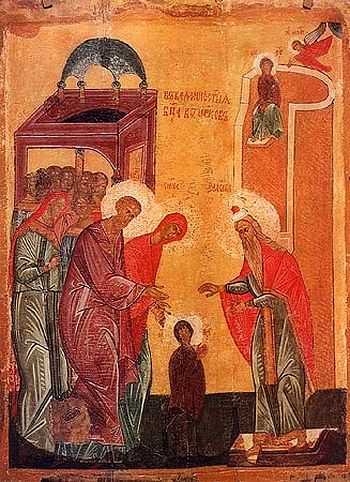
What Does The Entrance Into The Temple Of The Mother Of God Mean For Us & Our Salvation

By Father Panagiotes Carras

The oikonomia of our salvation began with the very creation of the world. It is not by chance that the fourth Gospel does not commence with a genealogy of our Lord but takes us back to the very beginning.  All things from the beginning to the end, from the alpha to the omega are part of God’soikonomia for our salvation, God’s providential ordering of our salvation. Man was created that he may participate in the Divinity of his Creator by first participat­ing in his own perfection.  We are taught by the Fathers that man was created for perfection. Adam was offered perfection but fell victim to the guile of the serpent.  God’s plan could not be frustrated and the Lord prepared the world for another Adam who would rescue the offspring of the first Adam.

St. Paul tells us that Adam is a type of the future Adam (Romans 5: 14). All Christians are des­cendants of both the first Adam and the last Adam. From the first we inherited death, from the last we inherited life. (1 Corinthians 15: 45-50). It is this Apostolic teaching of the two Adams which was developed by the Fathers and formed the nucleus of the Church’s teaching on the salvation of mankind.

Mankind, which had its beginning in the first Adam, had to be given a new beginning. A new Adam was needed to become the Head of the New Humanity, the Head of the body, the Church, which is His body (Ephesians 1:22-23). However, just as in the creation of the Old Humanity, mankind was given the freedom to choose sonship; similarly in the creation of the New Humanity, mankind was granted the opportunity to choose. The first Adam was from the earth, a man of dust, the second is from Heaven (1 Corinthians 15: 47). The first could choose sin because he was not yet perfect, the second Adam, our Lord Jesus Christ, being God by nature, was totally alien to sin. It is because God’s oikonomia required a member of the human race who was able to prove himself free from every sin that the time had fully come (Galatians 4:4) for God to send forth His Son, since mankind was able to bring forth the All-Holy Virgin.

This is precisely why Theotokos is the key-word of the Christological teaching of the fourth Ecumen­ical Council or as St. John of Damascus says, This name contains the whole mystery of the Oikonomia(On the Orthodox Faith, 3, 12). It is for this reason that the traditional Orthodox icon of the Mother of God is an icon of the Incarnation, the Virgin is always with the Child.

The Church’s teaching of the Theotokos is an ex­tension of what is believed concerning the person of Christ. The Son of God was born of a woman and in this case the Mother is not just a mere physical instrument but an active participant who has found favour with God (Luke 1, 30). The faith of the Church is aptly expressed in the words of Nicholas Cabasilas in his Homily on the Annunciation: The incarnation was not only the work of the Father and of His Power and His Spirit, it was also the work of the will and the faith of the Virgin (On the Annunciation, 4).

It is the teaching of the Church, attested to from the earliest date, that the Virgin Mother of the In­carnate Lord had found favour with God (Luke 1:30) and that she was chosen and ordained to particip­ate in the Mystery of the Incarnation, in the Oikonomia of Salvation. The ancient Church understood the typo­logical relationship between the first Adam and the last Adam, and by extension it was able to see that the first Eve prefigured the second Eve. We find that as early as the Second Century St. Justin and St. Irenaeus had a developed teaching of the Theotokos as the second Eve who through her obedience re­medied the disobedience of the first Eve. And so the knot of Eve’s disobedience received its unloosing through the obedience of Mary; for what Eve, a virgin, bound by unbelief, that, Mary, a Virgin, unloosed by faith (Against Heresies, III, 22, 4.) Mary… by yield­ing obedience, became the cause of salvation, both to herself and the whole human race. (Against Heresies, III, 22, 4). Mary alone cooperating with the economy (Against Heresies, III, 21, 7).

The Church has proclaimed this great Mystery of our salvation not only through the teaching of the Fathers but also through the festal celebration of the acts which worked our salvation, chief of which is the Holy Resurrection of our Lord. On the 21st of Novem­ber the Church celebrates the Feast of the Entry of the Theotokos into the Temple. It is at this time that the faithful chant Today is the prelude of God’s Good-Will and the heralding of the salvation of mankind. (Dismissal Hymn).

Throughout the whole service the hymns proclaim the exalted place which the Entry has in the history of Salvation. The Entry marks the closing of the Old Covenant, whereas the Annunciation marks the beginn­ing of the New. With the Entry the most Holy Virgin is passing from the Old Covenant to the New, and this transition in the person of the Mother of God shows us how the New Covenant is the fulfillment of the Old.

Like other human beings the Holy Virgin was born under the law of original sin but the sinful heritage of the fall had no mastery over her. She was without sin under the universal sovereignty of sin, pure from every seduction and yet part of a humanity enslaved by the devil. This is the victory which the Feast of the Entry joyfully celebrates. St. Photius praises the Holy Virgin as the great and God-carved ornament of human kind” who ” made her whole soul a holy shrine of meekness… never allowing any of her wares as much as to touch for a moment the brine of evil. (On the Annunciation, 4). This theme con­stantly appears in the hymns of the Feast of the EntryThy Miracle, 0 Pure Theotokos, transcends the power of words; for I comprehend that thine is a body transcending description, not receptive to the flow of sin. (Third Magnification of the ninth Ode). Ni­cholas Cabasilas expanded this teaching and dealt with it extensively in his Homily on the Birth of the Theo­tokos where we read: The Virgin remained from the beginning to the end free from every evil because of her vigilant attention, firm will, and magnitude of wisdom. (Chapter 15).

The sinlessness and purity of the Theotokos along with the fact that the Lord was preparing Her to be­come His chamber overshadowed the sanctity of the Old Testament temple. The All-Pure Virgin is allowed to enter the Holy of Holies precisely because she is to become the living temple of God. St. Tarasios in his Homily of the Entry has Saint Anne exclaiming:Re­ceive Zacharias, the pure tabernacle; receive 0 priest, the immaculate chamber of the Word … have her dwell in the temple made by hands, she who has be­come a living temple of the Word (Migne, 98:1489). Zacharias in turn speaks to the Virgin, You are the loosing of the curse of Adam, you are the payment of the debt of Eveand he continues to recall all the types and prophecies of the Old Testament which refer to the Theotokos. (Migne, 98:1492-93).

In the Minea of St. Dimitry of Rostov we read, Thus with the honor and glory not only of men, but also of angels, the most Immaculate Maiden was led into the temple of the Lord. And it was meet: for if the ark of the Old Testament, bearing manna in itself, which served only as a prototype of the Most Holy Virgin, was carried into the temple with great honor, with the assembling of all Israel, then with how much greater honor, with the assembling of angels and men, had to take place the entry into the temple of that same living ark, which had manna — Christ — in it, the Most Blessed Virgin, fore-ordained to be the Mother of God.

The Feast of the Entry celebrates the sanctity of the All-Holy Virgin and glorifies the Lord who placed her in the inaccessible Holies like some treasure of God’s, to be used in due time (even as came to pass) for the enrichment of, and as an ornament transcend­ing, as well as common to, all the world.(St. Gregory Palamas, Homily on the Entry, IX).

Teachings From the Service of the Feast

In the Orthodox Church services we participate in the saving events of the Oikonomia of Salvation. This is why, during these services we hear the word Today quite often. This is why in the first Sticheron of the  Lord I have Cried  begins, Come let us faithful dance for joy on this day. The second Sticheron begins with In the temple of the Law today is the living temple.  During Vespers, Matins and the Divine Liturgy we enter into the Mystery of the Entry of the Theotokos. When we enter into the Mystery we are not simple witnesses as the maidens who accompanied theTheotokos but rather participants in the eternal mystery.  

The first two Old Testament readings of Vespers speak of the Divine establishment of the Tabernacle and the Temple (Exodus 40:1-5, 9-10, 34-35 and IIIKings 8:1, 3-4, 6-7, 9, 10-11). The third reading, taken from the Prophecy to Prophet Ezekiel ( Ezekiel 43:27-44:4) speaks of the Theotokos as the living Temple of God.  

During the Divine Liturgy, in the reading of the Epistle of Saint Paul to the Hebrews (9:1-7), we are taught that all things which were done in the Temple of the Old Testament were a Prophecy of what would be fulfilled by our Saviour. In the Gospel of Saint Luke (10:38-42, 11:27-28), which is read at every Feast of the Mother of God, we hear: Blessed is the womb that bare thee, and the paps which thou hast sucked. We are reminded to glorify our Lord and bless His mother, who brought us our salvation.

Icon of the Feast

The Orthodox teaching on the The Entry of the Theotokos into the Temple as the heralding of the salvation of mankind is seen in the Icon of the Feast. The central theme of the icon is the Holy of Holies (1) in the Temple which is about to receive a blessing far superior to any of its former blessings. The priest Zacharias, the father of St. John the Baptist, receives Panagia at the gates of the Temple (3) and in this way prophesies that the Virgin Mary is the New Ark of the Covenant. Saints Joachim and Anna (4), accompanied by virgins of Jerusalem, carrying torches in procession, bring Panagia as a well-pleasing sacrifice. The Theotokos is brought to the gates and ascends to the Holy of Holies where she is cared for by angels (2). Notice that the young virgins do not have their heads covered but that the Theotokos has her head covered. Also the garments of the Mother of God resemble those of Saint Anna and not of the young virgins. The Theotokos, although a child, is already a perfected woman that has reached full spiritual maturity.  She who in body is but three years old, and yet in the spirit is full of years (Ode three of the Second Canon).

Temple Of The Foolish Rich Man – Homily by Father Phillip LeMasters

Have you ever thought about the similarities and differences between barns and temples? Usually when we think of barns, we think simply of places to house farm animals or to store crops.  We normally do not think of them as having much spiritual significance. The rich man in today’s gospel lesson thought of his barns only in terms of his business, which was so successful that he looked forward simply to relaxing, eating, drinking, and enjoying himself.  Unfortunately, he did so to the point of making his possessions an idol.  He was rich in things of the world, but poor towards God.  He was ultimately a fool, for he based his life on what was temporary and lost his own soul.  His barn became a temple only to himself. 

We live in a culture that constantly tempts us to follow this man’s bad example. More so than any previous generation, we are bombarded with advertising and other messages telling us that the good life is found in what we can buy. Whether it is cell phones, clothing, cars, houses, entertainment, food, or medicines, the message is the same: Happiness comes from buying the latest new product. During the weeks leading up to Christmas, this message is particularly strong. We do not have to become Scrooges, however. It is one thing to give reasonable gifts to our loved ones in celebration of the Savior’s birth, but it is quite another to turn this holy time of year into an idolatrous orgy of materialism that obscures the very reason for the season.

We are not really near Christmas yet, as Advent just began on November 15. Today, as we continue to celebrate the ForeFeast of the Entrance of the Theotokos into the Temple, we are reminded of the importance of preparing to receive Christ at His birth. Instead of looking for fulfillment in barns and the money they produce, we should follow her into the temple. Sts. Joachim and Anna took their young daughter to the temple in Jerusalem, where she grew up in prayer and purity in preparation to become the living temple of God when she consented to the message of the Archangel Gabriel to become the mother of the God-Man Jesus Christ. The Theotokos was not prepared for her uniquely glorious role by a life focused on making as much money as possible, acquiring the most fashionable and expensive products, or simply pleasing herself. No, she became unbelievably rich toward God by focusing on the one thing needful, by a life focused on hearing the word of God and keeping it.

In ways appropriate to our own life circumstances, God calls each of us to do the same thing. And before we start making excuses, we need to recognize that what St. Paul wrote to the Ephesians applies to us also: “[Y]ou are no longer strangers and sojourners, but…fellow citizens with the saints and members of the household of God, built upon the foundation of the apostles and prophets, Christ Jesus Himself being the cornerstone, in Whom the whole structure is joined together and grows into a holy temple in the Lord; in Whom you also are built into it for a dwelling place of God in the Spirit.” In other words, to be a Christian is to be a temple, for the Holy Spirit dwells in us both personally and collectively. The only way to become a better temple is to follow the example of the Theotokos in deliberate, intentional practices that make us rich toward God, that open ourselves to the healing and transformation of our souls that Christ has brought to the world. We must participate personally in His holiness if we want to welcome Him anew into our lives at Christmas.

The rich fool became wealthy by investing himself entirely in his business to the neglect of everything else. In contrast, the Theotokos invested herself so fully in the Lord that she was able to fulfill the most exalted, blessed, and difficult calling of all time as the Virgin Mother of the Savior. In order for us to follow her example by becoming better temples of Christ, we also have to invest ourselves in holiness. The hard truth is that holiness does not happen by accident, especially in a culture that worships at the altar of pleasure, power, and possessions. So much in our world shapes us every day a bit more like the rich fool in our gospel lesson, regardless of how much or how little money we have. Many of us are addicted to electronic screens on phones, computers, and televisions. What we see and hear through virtually all forms of entertainment encourages us to think and act as though our horizons extend no further than a barn. In other words, the measure of our lives becomes what we possess, what we can buy, and whatever pleasure or distraction we can find on our own terms with food, drink, sex, or anything else. We think of ourselves as isolated individuals free to seek happiness however it suits us. No wonder that there is so much divorce, abortion, sexual immorality, and disregard for the poor, sick, and aged in our society. Investing our lives in these ways is a form of idolatry, of offering ourselves to false gods that can neither save nor satisfy us. The barn of the rich fool was also a temple, a pagan temple in which he basically worshiped himself. If we are not careful, we will become just like him by laying up treasures for ourselves according to the dominant standards of our culture and shut ourselves out of the new life that Christ has brought to the world.

We cannot control the larger trends of our society, but we can control what we do each day. During this Nativity Fast, no matter the circumstances of our lives, we can all take steps to live more faithfully as members of God’s household, built on the foundation of the apostles and prophets, with Jesus Christ as the cornerstone. In other words, we can intentionally reject corrupting influences and live in ways that serve our calling to become better living temples of the Lord. Yes, we can stop obsessing about our barns and enter into the temple of the one true God.

The first step is to set aside time for prayer. If we do not pray every day, we should not be surprised that it is hard to pray in Church or that we find only frustration in trying to resist temptation or to know God’s peace in our lives.  We also need to read the Bible.  If we fill our minds with everything but the Holy Scriptures and the lives of the Saints, we should not be surprised that worry, fear, and unholy thoughts dominate us.  Fasting is also crucial.  If we do not fast or otherwise practice self-denial, we should not be surprised when self-centered desires for pleasure routinely get the better of us and make us their slaves.  We should also share with the poor.  If we do not give generously of our time and resources to others in need, we should not be surprised when selfishness alienates us from God, our neighbors, and even our loved ones. This is also a time for humble confession and repentance.   If we refuse to acknowledge and turn from our  sins, we should not be surprised when we are overcome by guilt and fall into despair about leading a faithful life.  No, the Theotokos did not wander into the temple by accident and we will not follow her into a life of holiness unless we intentionally reorient ourselves toward Him.

None of us will do that perfectly, but we must all take the steps we are capable of taking in order to turn our barns into temples. Remember that the infant Christ was born in a barn, which by virtue of His presence became a temple. The same will be true of our distracted, broken lives when—with the fear of God and faith and love—we open ourselves to the One Who comes to save us at Christmas. The Theotokos prepared to receive the Savior by attending to the one thing needful, to hearing and keeping His word. In the world as we know it, that takes deliberate effort, but it remains the only way to be rich toward God. And that is why Christ is born at Christmas, to bring us into His blessed, holy, and divine life which is more marvelous than anything we can possibly imagine. As the Lord said, “He who has ears to hear, let him hear.”

The Foolish Rich Man – Homily by Father Anthony Hughes November 2005

Planted in our hearts are possibilities, good and bad. It is possible for us to become unwholesome people filled with greed, pride, hatred, selfishness, insensitivity, intolerance, judgment, and cruelty. Or we can become people filled with love, peace, tolerance, compassion, joy. It is our decision which seeds take root and grow in us. What shall I nurture in my life? What shall I do with the time and talents that have been given me? The rich man in today’s Gospel, though evidently gifted, talented and intelligent chose unwisely.

The rich man transgressed in a number of different ways. Let’s examine three of them.

First, he ignored one of life’s greatest teachers: death. He seems to have forgotten death entirely. He was so busy worrying about accumulating more wealth that he did not envision an end to his life. He may not have thought of death, but he sure did fear it! The parable ends with God saying to him, “Fool! This night your soul will be required of you, then whose will those things be which you have provided?”

The saints of the Church often teach that we should keep death in our minds daily. People often call us crazy when we say that, but think about it for a moment. If we remember that we are going to die, it helps us to prioritize what we do with the time we have left. Thinking on our own mortality need not be morbid or depressing; instead it can help us appreciate life even more and live fuller and richer lives. It certainly causes us to think of God and the after-life. The remembrance of death encourages us to nurture good things in ourselves.

Here is a pithy saying, “All of us will surely die, but will any of us ever really live?” In order to really live we must not run from the remembrance of death.

Secondly, the rich man did not care for the poor. He had more than he needed and kept collecting even more, so much that he needed to build bigger barns. He forgot three important truths: every treasure in this life withers and fades, God gives in abundance so that we can share in abundance and, since all human beings are interconnected, the suffering of one equals the suffering of all.

Jesus tells us to “lay up treasures in heaven” that do not fade and can’t be stolen away. This we do by nurturing goodness in ourselves and sharing it with others. The truly rich are people who are rich in compassion even though they may have nothing in the bank. If we are well-off it is not for our benefit alone that God has blessed us. It is so that we can share even more with others and lay up treasure in heaven. Attachment to wealth, selfish hoarding during our short lives on this earth will impoverish us during our eternal life in the age to come.

Humanity is unity in diversity, one in essence just as we say about the Holy Trinity. Funny! We are indeed made in the image of God are we not? In fact, the truth of the essential unity of humanity is one reason why we Orthodox should be extremely concerned about social justice. Every hungry child is my child, every tortured prisoner is my brother, every mother dying of HIV/Aids in Africa is my mother, every wounded solider is my father, everyone suffering from injustice is my neighbor. Yes, it is our job to see to the needs of our neighbors and to do all we can to alleviate suffering. Like their Savior all true Christian disciples have “bleeding hearts”. After Cain killed his brother he asked God, “Am I my brother’s keeper.” The answer is yes.

St. Basil the Great has a famous quote for this foolish rich man and for us, “The bread which you do not use is the bread of the hungry, the garment hanging in your wardrobe is the garment of him who is naked, the shoes that you do not wear are the shoes of the one who is barefoot, the money that you keep locked away is the money of the poor, the acts of charity that you do not perform are so many injustices that you commit.” Sisters and brothers, we do not own anything. What we have belongs to God and to those who are in need. If we do not share, then we are no better than thieves.

God gives abundantly so that we can share abundantly. To those who give, God gives even more so that they can share even more. That is the truth of it.

Remember this wise saying, “All the happiness there is in the world comes from thinking about others, and all the suffering in the world comes from preoccupation with yourself.”

Lastly, the foolish rich man, by not remembering death and by hoarding his wealth and robbing the poor, failed to “lay up riches in heaven where neither rust nor moth destroys, where man cannot break in and steal.” Thus, he ignored God whose treasures are eternal. “Seek first the kingdom of God,” Jesus taught, but to do that we must stop trying to establish our own kingdoms here. Far from trying to ignore and escape death, Jesus teaches that we must embrace it, “Take up your cross and follow me.”

To save our lives we must lose them. To preserve our lives we must give them up. To become great we must become small. All that God teaches is contrary to conventional wisdom. As Christians we are therefore called to be compassionate revolutionaries, to subvert the normal order of things with the radical leaven of the kingdom of heaven.

The foolish rich man ran away from death and discovered himself racing into its arms. He stole from the poor by hoarding his wealth and found himself impoverished in eternity. He ignored God who alone had the power to give him what his heart truly desired – peace, security, eternal life – and ended up empty handed.

While we are able, while the light of day remains, let us learn from the foolish rich man, turn away from our own foolish ways and begin laying up treasures in heaven.

The Mystery of Holy Week – Father Stephen Freeman

Among the more pernicious ideas that inhabit our contemporary world is the notion that we are all isolated, independent, and alone. Even when we gather, we think of ourselves as but one among many. Among the most glaring exceptions to this form of thought, however, are sporting events. People attend a football game and declare when it is finished, “We won!” or “We lost!” We feel genuine joy at the first and sadness at the second. We do not say, “They won” (unless we mean the opposing side). This is not actually strange. Sport has, from its earliest beginnings, been a religious experience. That said, it is an experience that we fail to consider or understand. It is also a shallow, meaningless, religion.

The mystery of sport is that we have some sense not only watching, but participating in what takes place. The team’s victory is my victory. The emptiness of this mystery is that what is being “participated” in has no substance or true being. We feel robbed when a referee blows a call and the game ends with the wrong winner. At such a moment the emptiness of the game is revealed. It had no more meaning than a mistake.

This meditation on sport is a very vacuous way to get at the notion of true participation (of which it is but the least shadow). True participation lies at the heart of all worship and much else in our lives. A marriage, at its best, is a participation, a literal sharing in the life of the other. The language of Scripture describes a spouse as “bone of my bone and flesh of my flesh.” What each does affects the other, both for good and for ill. The same is true for other relationships to lesser extents. St. Silouan said, “My brother is my life.” This participation is the very nature of love itself. We are commanded to “love your neighbor as yourself.” There can be no other form of love.

Scripture describes the knowledge of God as a participation – it is a sharing in His life. God can never be the “object” of our love for He is not an object. Because knowledge of God is by participation, Christ can say, “This is eternal life, that they might know Thee… and Jesus Christ whom Thou hast sent.” (Jn. 17:3) This, of course, is a great frustration to atheists who claim that God does not exist because they cannot perceive Him as object. The emptiness of modern life presumes that there is no participation anywhere, only life as an object among objects. Little wonder that modernity thrives on violence (if people are objects, then we can do violence without damage to ourselves).

Participation in the Holy

Our modern mind-set has difficulties with the long, exhausting services of Orthodox Holy Week. Each of the services is something of a liturgical presentation of the significant events of that day that led up to the death and resurrection of Christ. They are also a “deep-dive” into the rich meanings, both in the events themselves, but also in hearts of all involved. But more than this, the services constitute a participation in the events themselves. Just as the Holy Eucharist is a “participation” in the Body and Blood of Christ (1Cor. 10:16), so the various services of the Church are a participation in that which they represent.

St. Paul writes, “I am crucified with Christ, nevertheless I live.” (Gal. 2:20) The death and resurrection of Christ are not simply events that we think about, things that happened long ago that we think of as significant. The crucifixion of Christ (to use but one example) is an event of eternal reality (as an extension of its historical character), as well. It is not just eternal, but reaches out and includes all things. It is a misunderstanding when Christians say that “Christ died for me,” without also saying, “Christ died in me, and I have died with Him.” St. Paul describes this as the very nature of Holy Baptism (Rom. 6:3).

The same mystical link that unites the sacrament of Holy Baptism and the death of Christ, is also found in the sacrament of the Holy Eucharist, and is the mystery that unites us to Him in all of the services. Worship has a sacramental character at all times.

In Holy Week, we do not make an extra effort merely to engage in liturgical excess. We extend that which is contained in the Liturgy of every Sunday morning across the days of an entire week that we might concentrate our souls on every detail of that most holy sacrifice, and in that concentration, allow ourselves to become aware of the grace given to us in that holy union. The services are long because the days of that week were long. We exhaust ourselves because He was exhausted. At its deepest moment, Christ Himself asked if it were possible for all of this to happen some other way. Our own doubts and hesitations are thus sanctified, and participate in the agony of the Garden. St. Paul gives voice to our hearts in our longing for participation in Christ:

“…that I may know Him and the power of His resurrection, and the fellowship [lit. “communion”]of His sufferings, being conformed to His death, if, by any means, I may attain to the resurrection from the dead.” (Phil 3:10-11)

Christ gives Himself for us that He might give Himself in us. We give ourselves to Him, that we might be with Him: crucified, buried, risen. It is our inheritance in the Kingdom.

Good strength in the events of this week!

Great Lent And The Mystery of the Cross & Resurrection – Short Reflection

By Archimandrite Zacharias from his book ’At The Doors of Holy Lent’

Great Lent is a taste of death in the Name of God, for the sake of our reconciliation with Him, for the sake of His commandment. The little death that that beast, our ego, endures through fasting, through voluntarily bearing shame in the mystery of confession, by shedding streams of wretched tears for our dire poverty and inability to render mighty love unto the Lord; this death places us on the path of Him Who said: ‘I am the first and the last: I am He that liveth, and was dead; and, behold, I am alive for evermore.’(Rev 1:17-18). This begets in the heart the faith that, ‘If we be dead with Christ, we believe that we shall also live with Him: Knowing that Christ being raised from the dead dieth no more; death hath no more dominion over Him.’ (Rom 6:8-9). Then on the night of the Resurrection, we sing with boldness the hymn: ‘Yesterday, O Christ, I was buried with Thee and today I rise again with Thy rising. Yesterday I was crucified with Thee: do Thou Thyself glorify me, O Saviour, in thy kingdom.’ Our minor taste of death leavens in the heart and, upon hearing the good news of the Resurrection of Christ, it becomes an explosion of joy, initiating us into the mystery of His descent into hell and ascension above the Heavens.

The Church is preoccupied with only one matter: the Cross and Resurrection of Christ. Saint Paul was consumed by the desire to set forth before his disciples the image of Jesus Christ, ‘and Him crucified’ (1 Cor 2:2). In other words, his concern was to impart to them the knowledge of the mystery of the Cross and Resurrection of Christ, knowing that whosoever walks the way of the Cross will also enter into the presence of the Risen Lord. The Church institutes as a commandment that we should go through this period with spiritual tension for the renewal of our life. She travails to see her children assimilated through obedience into the mystery of the Cross and Resurrection of Christ.

Putting All of the Fifth Week of Lent Together – Father Thomas Hopko

At the end of the fifth week of Great Lent, and very particularly on the fifth Sunday, the Orthodox Church has all of its members and faithful Christians contemplating a very beloved and well-known person in Christian history for ancient Christians, and that is a woman named Mary of Egypt. On the matins of the Thursday of the fifth week, there is a penitential canon of St. Andrew of Crete that is read. That particular service, which is a long type of penitential vigil, is often called in Orthodox popular piety “the vigil of Mary of Egypt.” It’s kind of an identification with Mary. In Slavonic, it’s called Marii bodrstvovaniye, the standing with Mary in penance before God. Indeed, in that canon, with all the penitential verses, there are verses that ask Mary of Egypt to intercede for us, to pray for us, as part of the penitential canon. St. Andrew of Crete, the author, is also asked, but particularly Mary of Egypt.

On this Sunday, it’s again kind of a paradox in Orthodox worship, because the focus is now all on Christ. You have that great celebration of the Theotokos with the Akathist on Saturday, and then you enter into the Lord’s Day, and you hear the gospel about Christ going up to Jerusalem and entering into his glory through his suffering. Then even on that Sunday also in the epistle reading, we’ll hear again about how Christ enters into the holy of holies in heaven, not of creation, the sanctuary of God, securing for us an eternal redemption, and that he’s led to offer his blood on the cross through the eternal Holy Spirit where he offers himself without blemish to God and we are encouraged to purify our consciences from dead works in order to serve the living God.

So we are focusing on Christ, but then, with that, you have this whole Sunday when on the one hand you have these marvelous hymns about the resurrection and the victory of Christ on that Sunday, and then you hear even more about this Mary of Egypt. And it’s a kind of a juxtaposition. It’s almost as if the Holy Spirit and God Almighty wants us to keep these two things together. As we focus on Christ and his victory and go up with him to Jerusalem, then we know that this is for everyone and that it is for the worst of sinners. Nobody is excluded, and you can never forget that when you think of Mary of Egypt.

Who was this Mary? It’s interesting that on that Thursday matins with that canon the entire Life of Mary of Egypt is read in church.

…Orthodox Christians in this ancient tradition are called to contemplate that Mary, to remember her. And what’s the point? What’s the point? Oh, there are probably so many, and maybe the points are different for every single person who hears that story, but there’s two points that are for sure. One is that, no matter how sinful we are, the Lord God Almighty forgives us. The other point is that repentance is not just an emotion. It’s not just some kind of magical act. When we repent, we have to purge out of ourselves all of the garbage and filth and slime that’s in us. We have to go through a purgation process before we can be illumined and deified. All that is evil in us has to go: it’s got to be scrubbed away; it’s got to be cut out by the word of God that’s a two-edged sword that cuts the bones and marrows, the sinews, as it says in [the] letter to the Hebrews, the heart of people.

Penance is a work. It is a work. It’s made possible by faith and grace, but it is the result of faith and grace. We know God, we believe in him, we accept his grace, and then that grace purifies us, but it’s not automatic. I can’t resist saying—maybe I shouldn’t on the radio—about how one of my friends would say, “We believe in God the Father, Creator of heaven and earth; and the Son, the Lord Jesus Christ; and the Holy Spirit. We don’t believe in the Magician, the Mechanic, and the Fairy Godmother.” God is not a fairy godmother. He’s not a magician. He’s not a mechanic. There has to be a synergia between us and God. We have to accept that grace that cleanses us, that heals us, that power, and it’s got to happen, and it takes time. It takes time, it takes effort, it takes perseverance to the end. How often Jesus said, “Those who persevere to the end will be saved.” He says, “In hypomone, in patient endurance you will win your life,” and that repentance is a process; it’s not a momentary act.

Yes, Mary had her conversion experience. Yes, she knew the grace and the love of God at that moment, at that Holy Sepulcher. Yes, she knew that she was saved when she was allowed to enter and to venerate the tomb of Christ and receive the precious gifts of his broken body and spilled blood for the forgiveness of her sins, for the healing of her soul and her body and her passions and emotions and for the attaining of everlasting life. Yeah, that moment took place, and there are many such moments often in people’s lives. But then there is the result of that moment: the ongoing life in conformity to that moment. That’s what we see also in Mary of Egypt.

When I was the dean of St. Vladimir’s and the pastor of the chapel, and of course I was there for 30-some years, I always loved that fifth week of Lent. We had a practice at the seminary chapel that was, for me, at least, incredibly significant and marvelous. This is what it was: We would have those penitential services: the Presanctified on Wednesday with all those prostrations and those 24 additional penitential hymns—“O Lord, before I perish utterly, before I perish to the end, do thou save me, O Lord.” We would sing that canon of Andrew with Mary and keep that vigil on that Thursday. Honestly, we cut it down a bit. We were not monks and monastics there; we had our schedule to live, but we did it. We did it, yes. And then we sang the entire Akathist Hymn the next day, with all that marvelous celebration and veneration of the Theotokos with everything we could possibly think of put into our mouth to celebration the incarnation of the Son of God through her.

And when we sang that Akathist Hymn, we had a quite large icon of the Theotokos, Mother of God, with the Child, and we had it set in the middle of the church, and it was surrounded by flowers. It was decorated by beautiful flowers, and we would stand in front of that icon of the Theotokos, Mary, Mother of God. The deacons would be incensing and the whole church would be singing this marvelous Akathistos Hymn with all those wonderful words. Then we would celebration the Incarnation and Mary on that Saturday in the morning.

And then, on Saturday evening when we would come for the vespers and the matins and the Divine Liturgy of the fifth Sunday of Lent, in that same frame of flowers, on that same stand, the same analoy, in the middle of our same church, would be another icon: an icon of another Mary. Because we would remove the icon of the Theotokos and Child, and in that very same frame of flowers, on that very same stand, in the middle of our very same chapel, we would see Mary of Egypt. What a contrast that was! What an amazing thing it was, that on Saturday we’re glorifying and venerating the incarnation of the Son of God through the All-pure Virgin, of whom is more holy? The most holiest of mere human beings, Christ’s mother, Mary, holding in her arms the Holy One of God, Jesus Christ, our Savior and Lord, the Messiah of Israel, the Savior of the world. Holiness! Holiness like you cannot imagine! was in that icon in those flowers and in those songs.

And then in the same building, on the same stand, in the same flowers—was Mary of Egypt. And our icon showed her emaciated, sun-burnt, her hair frizzly white, and her face totally beautiful, and even similar to the face of the Theotokos in the iconography. Totally beautiful. And we knew that a nymphomaniac, sexually addicted harlot and even-worse-than-a-harlot human enters the same radiance and the same glory as the Mother of Christ and of all believers. Like Mary, she herself became more honorable than cherubim, more glorious than seraphim, because in Christ everyone who’s saved has that particular glory. We all are enthroned with Christ over all the angels—the twelve apostles sit on twelve thrones, judging the angels, it says in Scripture. We really are deified and enter into the glory of God. That is why Christ was born of a Virgin, and that’s why we venerate his mother so magnificently.

But on this day we know that the worst, the lowliest, the filthiest, the most addicted, the most impassioned, the most possessed, by faith and grace through that same Christ, by the intercessions of his mother and all the saints, can enter into that same glory. And Mary of Egypt tells us that. She shows us that. And then she begins herself to intercede for us poor sinners. Maybe some of us listening are sex-addicted ourselves and nymphos and whatever, controlled and on computers, looking at porno and whatever—but there’s hope for us. There’s hope for us. Mary of Egypt proves there’s hope for us.

But it’s not magic, it’s not mechanical; God is not a fairy godmother. There must be faith, grace accepted and lived out, and that purgation that leads to illumination that leads to glorification, leads to deification—can be ours. If it can be Mary of Egypt’s, then it can be ours. And how wonderful it was to go to church on Saturday of the fifth week and stand in front of that flower-decorated icon of the Theotokos and Child, and to come back again that same night and the next day and to see, in that same place, Mary of Egypt.

Why is the Great Canon done in its entirety in the 5th week of Lent

Remember to check out the Great Canon Resource Page as you prepare

By Fr. Sergei V. Bulgakov

At Matins on this day the Canon of St. Andrew of Crete is read in its entirety once a year, which was read in four parts on the first four days of the first week, and the Life of St. Mary of Egypt is read after the Sessional Hymn (Kathisma). According to this feature of the Thursday Matins it is called either the St. Andrew of Crete or the St. Mary of Egypt Thursday. 

In the Canon are collected and stated, all the exhortations to fasting and repentance, and the Holy Church repeats it now in its fullness to inspire us new strength for the successful end to Lent. “Since”, it is said in the Synaxarion, “the Holy Forty Day Lent is drawing near the end so that men should not become lazy, or more carelessly disposed to the spiritual efforts, or give up their abstinence altogether,” that this Great Canon is offered. It is “so long, and so well-composed, as to be sufficient to soften even the hardest soul, and to rouse it to resumption of the good, if only it is sung with a contrite heart and proper attention”. And the Church Typikon (Ustav) orders the Great Canon to be read and chanted slowly and “with a contrite heart and voice, making three prostrations at each Troparion”. 

For the same purpose of abstinence and strength, and attention to repentance is the reading of the Life of the Venerable Mary of Egypt. According to an explanation of the same Synaxarion, the Life of the Venerable Mary also “manifests infinite compunction and gives much encouragement to the fallen and sinners”, representing itself to us as a paradigm of true repentance, and an example of the unutterable mercy of God. It serves as the continuation of the Canon of St. Andrew of Crete and a transition to the order of the following Sunday. Reading the Canon of St. Andrew and Mary of Egypt on the Thursday of the Fifth Week was established from the time of the Sixth Ecumenical Council.

Kontakion in Plagal of the Second Tone

My soul, my soul, arise. Why are you sleeping? The end is approaching, and you will be confounded. Awake, therefore, that you may be spared by Christ God, Who is everywhere present and fills all things.

Finding ‘God With Us’

I love this short article. It’s powerful in waking us up to what Archbishop Kallistos Ware describes as being ’conscious of our dependance on God’. It’s also helpful in relating our cross to His as we venerate the Cross this week. It’s helpful for me to remain clear about what we are doing and why we are doing it as we now now enter the home stretch of our Lenten journey together.

God With Us – By Father Stephen Freeman

Popular New Age thought postulates that everyone has a “god within.” It’s a pleasant way of saying that we’re all special while making “god” to be rather banal. But there is a clear teaching of classical Christianity regarding Christ-within-us, and it is essential to the Orthodox way of life.

We should not understand our relationship with God to be an “external” matter, as if we were one individual and God another. Our union with God, birthed in us at Holy Baptism, is far more profound.

“He who is joined to the Lord is one spirit with Him.” (1Co 6:17)

God does not “help” us in the manner of encouraging us or simply arranging for things to work out. Rather, He is in us, working in union with our work. The mystery of ascesis (the practice of prayer, fasting, self-denial, etc.) only makes true sense in this context. Those who look at Orthodoxy from the outside often accuse us of practicing “works-righteousness,” meaning that we believe we can earn favor with God by doing good works. This is utterly false. God’s good favor is His gift and cannot be earned.

However, the Orthodox life is similar to the life of Christ Himself.

“Truly, I say to you, the Son can do nothing of Himself, but what He sees the Father do; for whatever He does, the Son also does in like manner.  (Joh 5:19)

and

“Truly, I say to you, he who believes in Me, the works that I do he will do also; and greater works than these he will do, because I go to My Father. (Joh 14:12)

The “works” that a Christian does, are properly done in union with Christ, such that the works are not those of an individual, but of our common life with and in Christ. When we fast, it is Christ who fasts in us. When we pray, it is Christ who prays in us. When we give alms it is Christ who gives alms in us.

And we should understand that Christ-in-us longs to fast. Christ-in-us longs to pray. Christ-in-us longs to show mercy. The disciplines of the Church are not a prescription for behaving ourselves or a map of moral perfection. Rather, the commandments of Christ (as manifest in the life of the Church) are themselves a description, an icon of Christ Himself.

 Jesus answered and said to him, “If anyone loves Me, he will keep My word; and My Father will love him, and We will come to him and make Our home with him.” (Joh 14:2)

Dumitru Staniloae notes:

At the beginning Christ is, so to speak, buried in the commandments and in us, in the measure in which we are committed to them, by His power which is in us. By this collaboration we gain the virtues as living traits; they reflect the image of the Lord, and Christ is raised even brighter from under these veils. (Orthodox Spirituality)

This way of “union” is the very heart of Orthodox faith and practice. Sadly, much of Christianity has created an “extrinsic” view of our relationship with God and the path of salvation. In this, God is seen as exterior to our life, our relationship with Him being analogous to the individualized contractual relationships of modern culture. As such the Christian relationship with God is reduced to psychology and morality.

It is reduced to psychology in that the concern is shifted to God’s “attitude” towards us. The psychologized atonement concerns itself with God’s wrath. It is reduced to morality in that our behavior is no more than our private efforts to conform to an external set of rules and norms. We are considered “good” or “bad” based on our performance, but without regard to the nature of that performance. St. Paul says that “whatsoever is not of faith is sin.” Only our lives-lived-in-union-with-Christ have the nature of true salvation, true humanity. This is the proper meaning of being “saved by grace.”

…for it is God who works in you both to will and to do for Hisgood pleasure. (Phi 2:13)

and

You are of God, little children, and have overcome them, because He who is in you is greater than he who is in the world. (1Jo 4:4)

and

To them, God willed to make known what are the riches of the glory of this mystery among the Gentiles: which is Christ in you, the hope of glory. (Col 1:27)

There is a second part of this mystery (Christ in us) that presses its importance upon us. This is the suffering of Christ within us. Fr. Staniloae writes:

Jesus takes part in all our sufferings, making them easier. He helps us with our struggle against temptations and sin; He strives with us in our quest for virtues: He uncovers our true nature from under the leaves of sin. St. Maximus comments: Until the end of the world He always suffers with us, secretly, because of His goodness according to [and in proportion to] the suffering found in each one.

The Cross recapitulates the suffering and sin of humanity, but it extends throughout the life and experience of all people. It is the foundation of Christ’s statement: “Inasmuch as you did it [did it not] unto the least of these my brethren, you did it [did it not] unto me.

The hypostatic union of the person of Christ extends into the life of every person. There is something of a perichoresis or coinherence in our daily relationship with Christ.

And if one member suffers, all the members suffer with it; or if one member is honored, all the members rejoice with it. (1Co 12:26)

This must be given  the strongest possible reading. If any one of us suffers, Christ suffers. There is no specific human suffering to which Christ is alien.

It is the moment-by-moment pressing into this commonality (koinonia) that is the foundation of Christian existence. It is the point of Baptism (buried with Him). It is the point of the Eucharist (“whosoever eats my flesh and drinks my blood abides in me, and I in him”). It is the point of every action and thought.

It is the life of grace.

Surrender Ourselves To God’s Grace – Archimandrite Aimilianos

In our class Sunday we discussed distractions and how difficult it can be to remain focused during these longer, more intense services we experience during Lent. I thought this article was full of wisdom and pragmatic guidance that might be useful to us as we approach the mid-point of the Fast which occurs next Wednesday. The focus of the article is on the Divine Liturgy. It’s an excerpt from the outstanding book ’The Way of the Spirit’ by Archimandrite Aimilianos. It’s a useful next step as we get in touch with our sense of exile that he described in this earlier article . It’s also a good followup to the article we read about ’finding our true selves in Christ’.

Chapter 2 – On The State That Jesus Confers

My beloved children, how marvelous was today’s Gospel lesson! It’s one we’ve heard many times and experience continuously, especially during the celebration of the Divine Liturgy. As we journey through the desert of life, it is only natural that our thirst should draw us to the Liturgy, because the Divine Liturgy is a sumptuous table set in the open air, such as that which the Lord has spread before us today.

What did we hear in the Gospel? Jesus gathered the people together. Why? Because the Apostles told Him they have nothing to eat (cf. Mk 6.36; Mt 14.15). Thousands of people, who had come from every town to see Jesus (Mk 6.33), would have gone hungry, and so the Lord had them sit down in groups on the ground (Mk 6.40), in order to satisfy their souls. They had gone forth into the wilderness to see Jesus, and He gathered them all together (cf. Mk 6.35; Mt 14.15).

The Divine Liturgy, my beloved, is precisely this going forth; it is a movement from one place to another, which we enact continuously. It is also a sitting down in the open in order to eat. It is, first of all, a kind of exodus. But from where? The people mentioned in the Gospel went forth from their towns and villages (Mk 6.33; Mt 14.13), but we come forth from ourselves, as well as from the places in which we live. We leave one kind of place, and come to another, which is different from the one we left. And who among us, upon entering a church, does not sense that there is something special here? Who does not know that to come here means to leave all else behind? And this can be seen by the fact that, if an inappropriate thought enters our mind while we’re here, we immediately want to dismiss it. And even if we’re unable to, we recognize it as something foreign, something that has intruded into the space of our soul, something that has slipped past our guard and entered into us.

We enter the church, then, when we go forth from ourselves in power, in substance, and in truth, leaving behind all our sins, our inclinations, and our aspirations. To enter the church means to leave outside all those things that make up our life in the world. That which exists is God (cf. Ex 3.14), but that which is ours, and which alone belongs to us, is our sin, our self will, and our desire. Apart from God, the self is something non-existent, even though it is, and remains, the creation of His hands, the breath of His first blessing (cf. Gen 2.7).

When we enter the church, we leave behind, not simply the things we see, but even the things for which we hope, because the latter in particular occupy a central place in our lives. Even though the things we hope for are not currently in our hands, we live as if they already were, feeling them intensely, as if we could run our fingers through them, lay hold of them, and possess them. In general, the intensity of our feelings about such things assumes the character of an actual experience, and we must leave that behind, along with all that we see. 2

And what we “see” is everything we encounter in the course of the day: things seen by the eyes of the body as well as those of the soul—which are much more perceptive. The things we “see” are all the things we experience, which stir us up, unsettle us, occupy our minds, give us pleasure, and lift our spirits. When our eyes fall upon them, they elevate us, but only to a place within the visible world: never beyond it.

In leaving behind everything we see, we come forth from that which constitutes our place of exile. This is the new exodus undertaken by the children of God every time they assemble and unite themselves to Christ in the sacred space of the church.

Having left everything behind, where do we find ourselves? In the open air, as befits people close to God (Wis 16.9; cf. Lk 21.31). 3

Why do I say in the open air? Because, looking around the church, we feel that we’re standing in heaven, and heaven cannot be considered a closed space. 4 And this is why Christ chose the desert as a place for prayer: precisely because its endless expanses and tremendous openness symbolize heaven itself. The desert, moreover, stands in contrast to the world: it contains no worldly pleasure, it gives you no earthly delight, and it offers you no fleshly repose. Heaven is something like that.

It follows, then, that no one can live in the desert if he’s still seeking to satisfy his own desires, if he is still anxious to realize his own hopes. You ask God to satisfy your desires, and, when He doesn’t, you think He’s turning a deaf ear. You ask God to realize your hopes, and to your dismay they remain elusive. You ask God to deepen your religious feelings, only to discover that He keeps Himself at a distance. Why? Because in reality those things are only about you, and not God, and thus they constitute the closed space in which you are confined; they are the place out of which God wants to lead you. Now, however, we find ourselves in the open air like that crowd of thousands, people close to God, close to the Lord. As for me, I’m blind, but I’m here too. I’m paralyzed, but nevertheless I’m here. I have no wings, I’m confined to the earth, but I’m here too, close to God.

What does it mean to be close to God? Think for a moment: can you be close to an icon and not be moved to venerate it? Can you be close to a fire and not be warmed? Can you be close to the light and not be illumined? Of course not. How, then, can you be close to God and not become godlike? How can you stretch out on God’s open spaces and not be raised up to the heights of His grandeur?

It follows, then, that after our exit from the world, we find ourselves close to God. We do not, however, find ourselves before the face of God (cf. Ex 33.11). Why? Because, for the most part, the eyes of our soul and body (which are both earthly) do not see God: they only seek Him. In the darkness broken by the brazen lamps, we seek Him, but we do not see Him. And that is the tragedy of human existence: we see everything except that which truly exists. All creation, which had a beginning and which will come to an end, falls under our gaze, which means we see things that, in reality, have no independent existence. 5 The tragic figure of man does not see that which alone truly exists: the One Who Is (cf. Ex 3.14), and Who is always with us.

That is what it means to be close to God. And when we enter into the open spaces of the church, we immediately experience a particular feeling, a feeling which confirms for us that here, in this place, our Helper is at hand. He is invisible, but you feel Him, as if He were rushing toward you, as if you could hear the sound of His breathing. He is your Helper, the One Who can deliver you, Who can redeem you, Who alone can satisfy your insatiable soul, which is forever being gnawed by hunger. You are close to God, and God is invisibly present. But, you may ask, where is He? Who can see Him?

If you wish to see God, my beloved children, there’s only one thing to do: go to church filled with longing to see His face, filled with divine and heavenly desire to be able, somehow, to feel the presence of your Helper and Defender. When you do this, your soul will experience an initially strange feeling: it is God touching your heart. And what will the heart do in response? Will it laugh and rejoice? No. It will be filled with a blessed, godly grief, and begin to weep and lament. In the presence of the Lord, you’ll feel your heart—which is like a useless sack—filling to the brim with the sense of its own emptiness and thereby overflowing with tears. And these tears will be its secret cry, saying:

“Where are You, Lord? Have mercy on me.” “Where are You, Lord?” That is the heart’s first cry. But it immediately realizes that it’s not able to see God, and that, if it did, it would lose its life (cf. Ex 33.20). Correcting its mistake, it continues: “Grant me Your mercy, You are my mercy, Yours is mercy, I am Yours, and You alone can have mercy upon me; You alone can bring me up from the pit of tribulation, from the depths of Your absence and my absence—Your absence from me, and mine from Your own spiritual life.”

When the soul begins to cry—and it cries to God, my beloved, very easily indeed, because God, in a sense, is the soul’s only surviving relative, and what could be more natural than that it should seek Him, and that it should cry when it realizes that it cannot see Him? When you allow your soul to cry, when you reject everything that cuts off the flow of your tears, then you’ll have a feeling of much greater intimacy with God. You’ll understand that now someone else governs your life. You’ll sense that now someone else has grasped the tiller, someone else has taken hold of the wheel (indeed of your own hands) and is now directly guiding you Himself. You become someone guided by the grace of God.

We are guided by God’s grace, to which you can surrender yourself in all confidence. Indeed, it is impossible for you to do the slightest thing without it. Consider the glory of the stars, the magnificence of the heavens, and the wonders of the earth: none of these can give you anything at all. The only thing that can fashion a new heart within you (cf. Ezek 11.19), rendering the old one utterly useless, is the power of God’s grace.

The Annunciation & Our Conciliar Salvation

By Father Stephen Freeman

I consider it both a strange mystery and a settled matter of the faith that God prefers not to do things alone. Repeatedly, He acts in a manner that involves the actions of others when, it would seem, He could have acted alone.

Why would God reveal His Word to the world through the agency of men? Why would He bother to use writing? Why not simply communicate directly with people? Why speak to Moses in a burning bush? Why did the Incarnation involve Mary? Could He not have simply become man, whole, complete, adult, in a single moment?

Such questions could be multiplied ad infinitum. But at every turn, what we know of God involves others as well. We may rightly conclude that such a means of acting pleases Him.

This Friday is the Feast of the Annunciation when the Church celebrates the Incarnation of Christ at word of the angel Gabriel to the Virgin Mary. An Orthodox hymn on the feast says:

The manner of His emptying cannot be known;
the manner of His conception is beyond speech.
An Angel ministers at the miracle; a virginal womb receives the Son;
the Holy Spirit is sent down; the Father on high is well pleased,
and according to their common counsel, a reconciliation is brought to pass
in which and through which we are saved.

“According to their common counsel” is a rich phrase describing this conciliar action of God.

At the same time that this conciliar mode of action seems obvious to Orthodoxy, it is frequently denied or diminished by others. There is a fear in some Christian quarters that were we to admit that God shared His action with any other, our salvation would be a matter of our own works and not the sovereign act of God. It is feared that a conciliar mode of action shares the glory of God with mere mortals.

It is true. This understanding shares the glory of God with mere mortals. But, interestingly, St. Paul says that man is the “image and glory of God” (1 Cor. 11:7). Apparently, we were brought into existence in order to have such a share.

The failure to understand this and the effort to re-invent the Christian story with diminished roles for angels and saints, or Christians themselves, comes very close to setting forth a different gospel altogether.

The Word became flesh of the Virgin Mary. The flesh of the Virgin is also the flesh that is nailed to the Cross (when her soul was itself mysteriously pierced). The flesh which we eat in the Eucharist is also the flesh of the Virgin – for there is no flesh of God that is not the flesh of the Virgin.

And it does no good to protest that the Word merely “took flesh” of the Virgin. For Adam cried out concerning Eve, “This is truly bone of my bone and flesh of my flesh.” And St. Paul noted concerning the wife of a man that a man should love her, “For no one ever yet hated his own flesh.”

I puzzle at how Christians who understand that it is wrong for a woman to say, “It’s my body and I can do with it what I want,” when she is carrying a child, can at the same time treat the Mother of God as though she had merely lent her womb to God for a period of time.

God’s conciliar action in our salvation is so thoroughly established that it involves our will, our soul, our flesh and bones. He includes bread and wine in our salvation so that the fruit of this garden might become the fruit of life. Everything around you is for your salvation and has its share.

This is not only true in the Incarnation, but continues to be true for every saving effort in our lives. We cannot save ourselves, of course, for that, too, would be denying the conciliar action of God.

There is a saying among the fathers, “If anyone falls, he falls alone, but no one can be saved alone.” But I think we cannot even say that we fall alone – for the one who falls is equally bone of my bone and flesh of my flesh. Christ does not distance Himself from the one who falls, but unites Himself with him so completely that He endures the consequence of our fall, entering death and hell to bring us back alive.

The Church is nothing other than the conciliar salvation of God, bone of His bone and flesh of His flesh – His body. We are being saved together whether we will admit it or not. Those who study and quote the Bible are themselves handling documents that were written, copied and preserved by others. It is a conciliar document.

The Orthodox way of life urges us to embrace the fullness of our conciliar being. In sacraments and saints in worship and wonder we live within the cloud of witnesses and share the common struggle.

For this reason let us unite our song with Gabriel’s,
crying aloud to the Virgin:
“Rejoice, O Lady full of grace, the Lord is with you!
From you is our salvation, Christ our God,
Who, by assuming our nature, has led us back to Himself.
Humbly pray to Him for the salvation of our souls!”