By Father Thomas Hopko from Volume II (The Church Year) in the OCA Faith Series
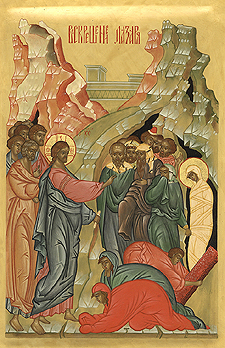
The week following the Sunday of Saint Mary of Egypt is called Palm or Branch Week. At the Tuesday services of this week the Church recalls that Jesus’ friend Lazarus has died and that the Lord is going to raise him from the dead (Jn 11). As the days continue toward Saturday, the Church, in its hymns and verses, continues to follow Christ towards Bethany to the tomb of Lazarus. On Friday evening, the eve of the celebration of the Resurrection of Lazarus, the “great and saving forty days” of Great Lent are formally brought to an end:
Having accomplished the forty days for the benefit of our souls, we pray to Thee, O Lover of Man, that we may see the holy week of Thy passion, that in it we may glorify Thy greatness and Thine unspeakable plan of salvation for our sake
Vespers Hymn
Lazarus Saturday is a paschal celebration. It is the only time in the entire Church Year that the resurrectional service of Sunday is celebrated on another day. At the liturgy of Lazarus Saturday, the Church glorifies Christ as “the Resurrection and the Life” who, by raising Lazarus, has confirmed the universal resurrection of mankind even before His own suffering and death.
By raising Lazarus from the dead before Thy passion, Thou didst confirm the universal resurrection, O Christ God! Like the children with the branches of victory, we cry out to Thee, O Vanquisher of Death: Hosanna in the highest! Blessed is he that comes in the name of the Lord! (Troparion).
Christ —the Joy, the Truth and the Light of All, the Life of the world and its Resurrection—has appeared in his goodness to those on earth. He has become the Image of our Resurrection, granting divine forgiveness to all (Kontakion).
At the Divine Liturgy of Lazarus Saturday the baptismal verse from Galatians: As many as have been baptized into Christ have put on Christ (Gal 3.27) replaces the Thrice-holy Hymn thus indicating the resurrectional character of the celebration, and the fact that Lazarus Saturday was once among the few great baptismal days in the Orthodox Church Year.
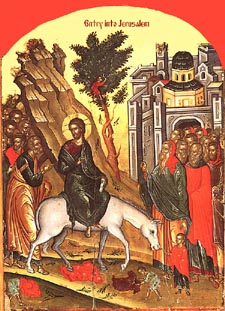
Because of the resurrection of Lazarus from the dead, Christ was hailed by the masses as the long-expected Messiah-King of Israel. Thus, in fulfillment of the prophecies of the Old Testament, He entered Jerusalem, the City of the King, riding on the colt of an ass (Zech 9.9; Jn 12.12). The crowds greeted Him with branches in their hands and called out to Him with shouts of praise: Hosanna! Blessed is He who comes in the name of the Lord! The Son of David! The King of Israel! Because of this glorification by the people, the priests and scribes were finally driven “to destroy Him, to put Him to death” (Lk 19.47; Jn 11.53, 12.10).
The feast of Christ’s triumphal Entry into Jerusalem, Palm Sunday, is one of the twelve major feasts of the Church. The services of this Sunday follow directly from those of Lazarus Saturday. The church building continues to be vested in resurrectional splendor, filled with hymns which continually repeat the Hosanna offered to Christ as the Messiah-King who comes in the name of God the Father for the salvation of the world.
The main troparion of Palm Sunday is the same one sung on Lazarus Saturday. It is sung at all of the services, and is used at the Divine Liturgy as the third antiphon which follows the other special psalm verses which are sung as the liturgical antiphons in the place of those normally used. The second troparion of the feast, as well as the kontakion and the other verses and hymns, all continue to glorify Christ’s triumphal manifestation “six days before the Passover” when he will give himself at the Supper and on the Cross for the life of the world.
Today the grace of the Holy Spirit has gathered us together. Let us all take up Thy cross and say: Blessed is he who comes in the name of the Lord. Hosanna in the highest! (First Verse of Vespers).
When we were buried with Thee in baptism, O Christ God, we were made worthy of eternal life by Thy resurrection. Now we praise Thee and sing: Hosanna in the highest! Blessed is he that comes in the name of the Lord! (Second Troparion).
Sitting on Thy throne in heaven, and carried on a foal on earth, O Christ God, accept the praise of angels and the songs of children who sing: BIessed is he who comes to recall Adam! (Kontakion).
At the vigil of the feast of Palm Sunday the prophecies of the Old Testament about the Messiah-King are read together with the Gospel accounts of the entry of Christ into Jerusalem. At Matins branches are blessed which the people carry throughout the celebration as the sign of their own glorification of Jesus as Saviour and King. These branches are usually palms, or, in the Slavic churches, pussy willows which came to be customary because of their availability and their early blossoming in the springtime.
As the people carry their branches and sing their songs to the Lord on Palm Sunday, they are judged together with the Jerusalem crowd. For it was the very same voices which cried Hosanna to Christ, which, a few days later, cried Crucify Him! Thus in the liturgy of the Church the lives of men continue to be judged as they hail Christ with the “branches of victory” and enter together with Him into the days of His “voluntary passion.”
The paschal season of the Church is preceded by the season of Great Lent, which is itself preceded by its own liturgical preparation. The first sign of the approach of Great Lent comes five Sundays before its beginning. On this Sunday the Gospel reading is about Zacchaeus the tax-collector. It tells how Christ brought salvation to the sinful man and how his life was greatly changed simply because he “sought to see who Jesus was” (Lk 19.3). The desire and effort to see Jesus begins the entire movement through lent towards Easter. It is the first movement of salvation.
The following Sunday is that of the Publican and the Pharisee. The focus here is on the two men who went to the Temple to pray—one a pharisee who was a very decent and righteous man of religion, the other a publican who was a truly sinful tax-collector who was cheating the people. The first, although genuinely righteous, boasted before God and was condemned, according to Christ. The second, although genuinely sinful, begged for mercy, received it, and was justified by God (Lk 18.9). The meditation here is that we have neither the religious piety of the pharisee nor the repentance of the publican by which alone we can be saved. We are called to see ourselves as we really are in the light of Christ’s teaching, and to beg for mercy.
The next Sunday in the preparation for Great Lent is the Sunday of the Prodigal Son. Hearing the parable of Christ about God’s loving forgiveness, we are called to “come to ourselves” as did the prodigal son, to see ourselves as being “in a far country” far from the Father’s house, and to make the movement of return to God. We are given every assurance by the Master that the Father will receive us with joy and gladness. We must only “arise and go,” confessing our selfinflicted and sinful separation from that “home” where we truly belong (Lk 15.11–24).
The next Sunday is called Meatfare Sunday since it is officially the last day before Easter for eating meat. It commemorates Christ’s parable of the Last Judgment (Mt 25.31–46). We are reminded this day that it is not enough for us to see Jesus, to see ourselves as we are, and to come home to God as his prodigal sons. We must also be his sons by following Christ, his only-begotten divine Son, and by seeing Christ in every man and by serving Christ through them. Our salvation and final judgment will depend upon our deeds, not merely on our intentions or even on the mercies of God devoid of our own personal cooperation and obedience.
. . . for I was hungry and you gave Me food, I was thirsty and you gave Me drink, I was a stranger and you took Me in, I was naked and you clothed Me, I was sick and in prison and you visited Me. For truly I say to you, if you did it to one of the least of these my brothers, you did it to Me (Mt 25).
We are saved not merely by prayer and fasting, not by “religious exercises” alone. We are saved by serving Christ through his people, the goal toward which all piety and prayer is ultimately directed.
Finally, on the eve of Great Lent, the day called Cheesefare Sunday and Forgiveness Sunday, we sing of Adam’s exile from paradise. We identify ourselves with Adam, lamenting our loss of the beauty, dignity and delight of our original creation, mourning our corruption in sin. We also hear on this day the Lord’s teaching about fasting and forgiveness, and we enter the season of the fast forgiving one another so that God will forgive us.
If you forgive men their trespasses, your heavenly Father will forgive you; but if you do not forgive men their trespasses, neither will your heavenly Father forgive you your trespasses (Mt 6.14–18).

 St John’s Adult Education