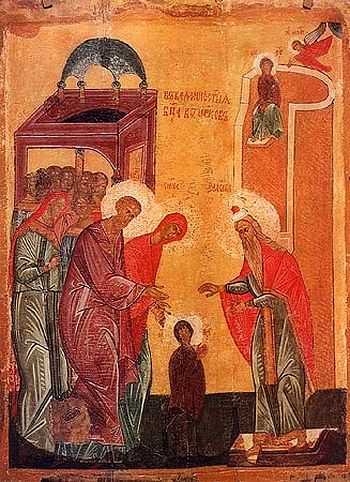
What Does The Entrance Into The Temple Of The Mother Of God Mean For Us & Our Salvation

By Father Panagiotes Carras

The oikonomia of our salvation began with the very creation of the world. It is not by chance that the fourth Gospel does not commence with a genealogy of our Lord but takes us back to the very beginning.  All things from the beginning to the end, from the alpha to the omega are part of God’soikonomia for our salvation, God’s providential ordering of our salvation. Man was created that he may participate in the Divinity of his Creator by first participat­ing in his own perfection.  We are taught by the Fathers that man was created for perfection. Adam was offered perfection but fell victim to the guile of the serpent.  God’s plan could not be frustrated and the Lord prepared the world for another Adam who would rescue the offspring of the first Adam.

St. Paul tells us that Adam is a type of the future Adam (Romans 5: 14). All Christians are des­cendants of both the first Adam and the last Adam. From the first we inherited death, from the last we inherited life. (1 Corinthians 15: 45-50). It is this Apostolic teaching of the two Adams which was developed by the Fathers and formed the nucleus of the Church’s teaching on the salvation of mankind.

Mankind, which had its beginning in the first Adam, had to be given a new beginning. A new Adam was needed to become the Head of the New Humanity, the Head of the body, the Church, which is His body (Ephesians 1:22-23). However, just as in the creation of the Old Humanity, mankind was given the freedom to choose sonship; similarly in the creation of the New Humanity, mankind was granted the opportunity to choose. The first Adam was from the earth, a man of dust, the second is from Heaven (1 Corinthians 15: 47). The first could choose sin because he was not yet perfect, the second Adam, our Lord Jesus Christ, being God by nature, was totally alien to sin. It is because God’s oikonomia required a member of the human race who was able to prove himself free from every sin that the time had fully come (Galatians 4:4) for God to send forth His Son, since mankind was able to bring forth the All-Holy Virgin.

This is precisely why Theotokos is the key-word of the Christological teaching of the fourth Ecumen­ical Council or as St. John of Damascus says, This name contains the whole mystery of the Oikonomia(On the Orthodox Faith, 3, 12). It is for this reason that the traditional Orthodox icon of the Mother of God is an icon of the Incarnation, the Virgin is always with the Child.

The Church’s teaching of the Theotokos is an ex­tension of what is believed concerning the person of Christ. The Son of God was born of a woman and in this case the Mother is not just a mere physical instrument but an active participant who has found favour with God (Luke 1, 30). The faith of the Church is aptly expressed in the words of Nicholas Cabasilas in his Homily on the Annunciation: The incarnation was not only the work of the Father and of His Power and His Spirit, it was also the work of the will and the faith of the Virgin (On the Annunciation, 4).

It is the teaching of the Church, attested to from the earliest date, that the Virgin Mother of the In­carnate Lord had found favour with God (Luke 1:30) and that she was chosen and ordained to particip­ate in the Mystery of the Incarnation, in the Oikonomia of Salvation. The ancient Church understood the typo­logical relationship between the first Adam and the last Adam, and by extension it was able to see that the first Eve prefigured the second Eve. We find that as early as the Second Century St. Justin and St. Irenaeus had a developed teaching of the Theotokos as the second Eve who through her obedience re­medied the disobedience of the first Eve. And so the knot of Eve’s disobedience received its unloosing through the obedience of Mary; for what Eve, a virgin, bound by unbelief, that, Mary, a Virgin, unloosed by faith (Against Heresies, III, 22, 4.) Mary… by yield­ing obedience, became the cause of salvation, both to herself and the whole human race. (Against Heresies, III, 22, 4). Mary alone cooperating with the economy (Against Heresies, III, 21, 7).

The Church has proclaimed this great Mystery of our salvation not only through the teaching of the Fathers but also through the festal celebration of the acts which worked our salvation, chief of which is the Holy Resurrection of our Lord. On the 21st of Novem­ber the Church celebrates the Feast of the Entry of the Theotokos into the Temple. It is at this time that the faithful chant Today is the prelude of God’s Good-Will and the heralding of the salvation of mankind. (Dismissal Hymn).

Throughout the whole service the hymns proclaim the exalted place which the Entry has in the history of Salvation. The Entry marks the closing of the Old Covenant, whereas the Annunciation marks the beginn­ing of the New. With the Entry the most Holy Virgin is passing from the Old Covenant to the New, and this transition in the person of the Mother of God shows us how the New Covenant is the fulfillment of the Old.

Like other human beings the Holy Virgin was born under the law of original sin but the sinful heritage of the fall had no mastery over her. She was without sin under the universal sovereignty of sin, pure from every seduction and yet part of a humanity enslaved by the devil. This is the victory which the Feast of the Entry joyfully celebrates. St. Photius praises the Holy Virgin as the great and God-carved ornament of human kind” who ” made her whole soul a holy shrine of meekness… never allowing any of her wares as much as to touch for a moment the brine of evil. (On the Annunciation, 4). This theme con­stantly appears in the hymns of the Feast of the EntryThy Miracle, 0 Pure Theotokos, transcends the power of words; for I comprehend that thine is a body transcending description, not receptive to the flow of sin. (Third Magnification of the ninth Ode). Ni­cholas Cabasilas expanded this teaching and dealt with it extensively in his Homily on the Birth of the Theo­tokos where we read: The Virgin remained from the beginning to the end free from every evil because of her vigilant attention, firm will, and magnitude of wisdom. (Chapter 15).

The sinlessness and purity of the Theotokos along with the fact that the Lord was preparing Her to be­come His chamber overshadowed the sanctity of the Old Testament temple. The All-Pure Virgin is allowed to enter the Holy of Holies precisely because she is to become the living temple of God. St. Tarasios in his Homily of the Entry has Saint Anne exclaiming:Re­ceive Zacharias, the pure tabernacle; receive 0 priest, the immaculate chamber of the Word … have her dwell in the temple made by hands, she who has be­come a living temple of the Word (Migne, 98:1489). Zacharias in turn speaks to the Virgin, You are the loosing of the curse of Adam, you are the payment of the debt of Eveand he continues to recall all the types and prophecies of the Old Testament which refer to the Theotokos. (Migne, 98:1492-93).

In the Minea of St. Dimitry of Rostov we read, Thus with the honor and glory not only of men, but also of angels, the most Immaculate Maiden was led into the temple of the Lord. And it was meet: for if the ark of the Old Testament, bearing manna in itself, which served only as a prototype of the Most Holy Virgin, was carried into the temple with great honor, with the assembling of all Israel, then with how much greater honor, with the assembling of angels and men, had to take place the entry into the temple of that same living ark, which had manna — Christ — in it, the Most Blessed Virgin, fore-ordained to be the Mother of God.

The Feast of the Entry celebrates the sanctity of the All-Holy Virgin and glorifies the Lord who placed her in the inaccessible Holies like some treasure of God’s, to be used in due time (even as came to pass) for the enrichment of, and as an ornament transcend­ing, as well as common to, all the world.(St. Gregory Palamas, Homily on the Entry, IX).

Teachings From the Service of the Feast

In the Orthodox Church services we participate in the saving events of the Oikonomia of Salvation. This is why, during these services we hear the word Today quite often. This is why in the first Sticheron of the  Lord I have Cried  begins, Come let us faithful dance for joy on this day. The second Sticheron begins with In the temple of the Law today is the living temple.  During Vespers, Matins and the Divine Liturgy we enter into the Mystery of the Entry of the Theotokos. When we enter into the Mystery we are not simple witnesses as the maidens who accompanied theTheotokos but rather participants in the eternal mystery.  

The first two Old Testament readings of Vespers speak of the Divine establishment of the Tabernacle and the Temple (Exodus 40:1-5, 9-10, 34-35 and IIIKings 8:1, 3-4, 6-7, 9, 10-11). The third reading, taken from the Prophecy to Prophet Ezekiel ( Ezekiel 43:27-44:4) speaks of the Theotokos as the living Temple of God.  

During the Divine Liturgy, in the reading of the Epistle of Saint Paul to the Hebrews (9:1-7), we are taught that all things which were done in the Temple of the Old Testament were a Prophecy of what would be fulfilled by our Saviour. In the Gospel of Saint Luke (10:38-42, 11:27-28), which is read at every Feast of the Mother of God, we hear: Blessed is the womb that bare thee, and the paps which thou hast sucked. We are reminded to glorify our Lord and bless His mother, who brought us our salvation.

Icon of the Feast

The Orthodox teaching on the The Entry of the Theotokos into the Temple as the heralding of the salvation of mankind is seen in the Icon of the Feast. The central theme of the icon is the Holy of Holies (1) in the Temple which is about to receive a blessing far superior to any of its former blessings. The priest Zacharias, the father of St. John the Baptist, receives Panagia at the gates of the Temple (3) and in this way prophesies that the Virgin Mary is the New Ark of the Covenant. Saints Joachim and Anna (4), accompanied by virgins of Jerusalem, carrying torches in procession, bring Panagia as a well-pleasing sacrifice. The Theotokos is brought to the gates and ascends to the Holy of Holies where she is cared for by angels (2). Notice that the young virgins do not have their heads covered but that the Theotokos has her head covered. Also the garments of the Mother of God resemble those of Saint Anna and not of the young virgins. The Theotokos, although a child, is already a perfected woman that has reached full spiritual maturity.  She who in body is but three years old, and yet in the spirit is full of years (Ode three of the Second Canon).

Temple Of The Foolish Rich Man – Homily by Father Phillip LeMasters

Have you ever thought about the similarities and differences between barns and temples? Usually when we think of barns, we think simply of places to house farm animals or to store crops.  We normally do not think of them as having much spiritual significance. The rich man in today’s gospel lesson thought of his barns only in terms of his business, which was so successful that he looked forward simply to relaxing, eating, drinking, and enjoying himself.  Unfortunately, he did so to the point of making his possessions an idol.  He was rich in things of the world, but poor towards God.  He was ultimately a fool, for he based his life on what was temporary and lost his own soul.  His barn became a temple only to himself. 

We live in a culture that constantly tempts us to follow this man’s bad example. More so than any previous generation, we are bombarded with advertising and other messages telling us that the good life is found in what we can buy. Whether it is cell phones, clothing, cars, houses, entertainment, food, or medicines, the message is the same: Happiness comes from buying the latest new product. During the weeks leading up to Christmas, this message is particularly strong. We do not have to become Scrooges, however. It is one thing to give reasonable gifts to our loved ones in celebration of the Savior’s birth, but it is quite another to turn this holy time of year into an idolatrous orgy of materialism that obscures the very reason for the season.

We are not really near Christmas yet, as Advent just began on November 15. Today, as we continue to celebrate the ForeFeast of the Entrance of the Theotokos into the Temple, we are reminded of the importance of preparing to receive Christ at His birth. Instead of looking for fulfillment in barns and the money they produce, we should follow her into the temple. Sts. Joachim and Anna took their young daughter to the temple in Jerusalem, where she grew up in prayer and purity in preparation to become the living temple of God when she consented to the message of the Archangel Gabriel to become the mother of the God-Man Jesus Christ. The Theotokos was not prepared for her uniquely glorious role by a life focused on making as much money as possible, acquiring the most fashionable and expensive products, or simply pleasing herself. No, she became unbelievably rich toward God by focusing on the one thing needful, by a life focused on hearing the word of God and keeping it.

In ways appropriate to our own life circumstances, God calls each of us to do the same thing. And before we start making excuses, we need to recognize that what St. Paul wrote to the Ephesians applies to us also: “[Y]ou are no longer strangers and sojourners, but…fellow citizens with the saints and members of the household of God, built upon the foundation of the apostles and prophets, Christ Jesus Himself being the cornerstone, in Whom the whole structure is joined together and grows into a holy temple in the Lord; in Whom you also are built into it for a dwelling place of God in the Spirit.” In other words, to be a Christian is to be a temple, for the Holy Spirit dwells in us both personally and collectively. The only way to become a better temple is to follow the example of the Theotokos in deliberate, intentional practices that make us rich toward God, that open ourselves to the healing and transformation of our souls that Christ has brought to the world. We must participate personally in His holiness if we want to welcome Him anew into our lives at Christmas.

The rich fool became wealthy by investing himself entirely in his business to the neglect of everything else. In contrast, the Theotokos invested herself so fully in the Lord that she was able to fulfill the most exalted, blessed, and difficult calling of all time as the Virgin Mother of the Savior. In order for us to follow her example by becoming better temples of Christ, we also have to invest ourselves in holiness. The hard truth is that holiness does not happen by accident, especially in a culture that worships at the altar of pleasure, power, and possessions. So much in our world shapes us every day a bit more like the rich fool in our gospel lesson, regardless of how much or how little money we have. Many of us are addicted to electronic screens on phones, computers, and televisions. What we see and hear through virtually all forms of entertainment encourages us to think and act as though our horizons extend no further than a barn. In other words, the measure of our lives becomes what we possess, what we can buy, and whatever pleasure or distraction we can find on our own terms with food, drink, sex, or anything else. We think of ourselves as isolated individuals free to seek happiness however it suits us. No wonder that there is so much divorce, abortion, sexual immorality, and disregard for the poor, sick, and aged in our society. Investing our lives in these ways is a form of idolatry, of offering ourselves to false gods that can neither save nor satisfy us. The barn of the rich fool was also a temple, a pagan temple in which he basically worshiped himself. If we are not careful, we will become just like him by laying up treasures for ourselves according to the dominant standards of our culture and shut ourselves out of the new life that Christ has brought to the world.

We cannot control the larger trends of our society, but we can control what we do each day. During this Nativity Fast, no matter the circumstances of our lives, we can all take steps to live more faithfully as members of God’s household, built on the foundation of the apostles and prophets, with Jesus Christ as the cornerstone. In other words, we can intentionally reject corrupting influences and live in ways that serve our calling to become better living temples of the Lord. Yes, we can stop obsessing about our barns and enter into the temple of the one true God.

The first step is to set aside time for prayer. If we do not pray every day, we should not be surprised that it is hard to pray in Church or that we find only frustration in trying to resist temptation or to know God’s peace in our lives.  We also need to read the Bible.  If we fill our minds with everything but the Holy Scriptures and the lives of the Saints, we should not be surprised that worry, fear, and unholy thoughts dominate us.  Fasting is also crucial.  If we do not fast or otherwise practice self-denial, we should not be surprised when self-centered desires for pleasure routinely get the better of us and make us their slaves.  We should also share with the poor.  If we do not give generously of our time and resources to others in need, we should not be surprised when selfishness alienates us from God, our neighbors, and even our loved ones. This is also a time for humble confession and repentance.   If we refuse to acknowledge and turn from our  sins, we should not be surprised when we are overcome by guilt and fall into despair about leading a faithful life.  No, the Theotokos did not wander into the temple by accident and we will not follow her into a life of holiness unless we intentionally reorient ourselves toward Him.

None of us will do that perfectly, but we must all take the steps we are capable of taking in order to turn our barns into temples. Remember that the infant Christ was born in a barn, which by virtue of His presence became a temple. The same will be true of our distracted, broken lives when—with the fear of God and faith and love—we open ourselves to the One Who comes to save us at Christmas. The Theotokos prepared to receive the Savior by attending to the one thing needful, to hearing and keeping His word. In the world as we know it, that takes deliberate effort, but it remains the only way to be rich toward God. And that is why Christ is born at Christmas, to bring us into His blessed, holy, and divine life which is more marvelous than anything we can possibly imagine. As the Lord said, “He who has ears to hear, let him hear.”

St. Symeon the New Theologian – His Lessons on Humility & Joyful Sorrow

This 11th century saint shed many tears in his life, and wrote much about the ’not of this world’ paradox of joyous tears. Below are a few of his quotes on humility and joyful sorrow. A common theme to many of these quotes is his experience of his own spiritual poverty in his journey to the wealth of what lies beyond in the mercy and grace of our Triune God. As Father Thomas Hopko would remind us “genuine humility means to see reality as it actually is in God”. You may also find this talk from our own Archbishop Alexander about the life of St. Symeon very interesting as he raises an awareness of his unique contributions to our faith.

“When the faithful man, who always pays strict attention to the commandments of God, performs all that the divine commandments enjoin and directs his mind toward their sublimity, that is, to a conduct and purity that are above reproach, he will discover his own limitations. He will find that he is weak and lacks the power to attain to the height of the commandments, indeed that he is very poor, that is, unworthy to receive God and give Him thanks and glory, since he has as yet failed to attain any good of his own. One who thus reasons with himself in the perception of his soul will indeed mourn with that sorrow which is truly most blessed, which will receive comfort and make the soul meek (cf. Matt. 5:5).”

He also writes:

“Let us long with all our soul for the things God commands us to embrace, spiritual poverty, which is humility; constant mourning by night and by day, from which there wells forth the joy of the soul and the hourly consolation for those who love God. By this means all who strive in truth succeed in attaining meekness. Those who hunger and thirst for righteousness and seek it at all times will obtain the kingdom of God, which ‘surpasses all human understanding’ (Phil. 4:7). Further, one becomes merciful, pure in heart, full of peace, a peacemaker, courageous in the face of trials (cf. Matt. 5:3-11). All this is the result of mourning day by day. It is also brought to pass that we will hate evil; it kindles in the soul that divine zeal which does not allow it to be ever at ease or to incline to evil deeds with evil men, but fills it with courage and strength to endure to the end against adversities.”

Elsewhere he writes: 

“The first effect of mourning in God is humility; but later it brings unspeakable joy and gladness. And around humility in God grows the hope of salvation. For the more a man feels with his whole soul that he is the most sinful of men, the more strongly hope and humility grow and blossom in his heart, and fill him with the conviction that, through humility, he will surely gain salvation.”

He also writes:

“Mourning has a twofold action: like water tears extinguish all the fire of the passions and wash the soul clean of their foulness; and, again, through the presence of the Holy Spirit, it is like fire bringing life, warming and inflaming the heart, and inciting it to love and desire God.”

Elsewhere he again writes:

“Where there is humility there is also the enlightenment of the Spirit. And where there is the enlightenment of the Spirit there is also the outpouring of the light of God, there is God in the wisdom and knowledge of His mysteries. Where these mysteries are to be found, there is the kingdom of heaven and the experience of the kingdom and the hidden treasures of the knowledge of God, which include the manifestation of the poverty of spirit. Where poverty of spirit is perceived, there also is the sorrow that is full of joy. There are the ever-flowing tears that purify the soul that love these things and cause it to be completely filled with light.”

Also:

“O tears, which flow from divine enlightenment and open heaven itself and assure me of divine consolation! Again and many times over I utter the same words out of delight and longing. Where there is abundance of tears, brethren, accompanied by true knowledge, there also shines the divine light. Where the light shines, there also all good gifts are bestowed and the seal of the Holy Spirit, from whom spring all the fruits of life, is implanted in the heart. Here also the fruit of gentleness is borne for Christ, as well as ‘peace, mercy, compassion, kindness, goodness, faith and self-control’ (Gal. 5:22-23). It is the source of the virtue of loving one’s enemies and praying for them (Matt. 5:44), of rejoicing in trials, of glorying in tribulations (Rom. 5:3), of looking on the faults of others as if they are one’s own and lamenting them, and of laying down one’s life for the brethren with eagerness even unto death.”

How to Say Yes to God: Homily for the Feast of the Annunciation

By Father Phillip LeMasters

Today we celebrate the very best example of how to live faithfully as a human being before God with the feast of the Annunciation.  When the Archangel Gabriel announced to the Virgin Mary that she was to become the Theotokos, she freely accepted this extraordinary calling when she said, “Behold, I am the handmaid of the Lord; let it be to me according to your word.”  When she offered herself to become the Living Temple of God, she played a crucial role in how the Savior would “deliver all those who through fear of death were subject to lifelong bondage.”  In opening her life without reservation to Christ, she made it possible for Him to “share in flesh and blood” and participate in our humanity so “that through death He might destroy him who has the power of death, that is, the devil.”

By conventional human standards, this teenage girl had no power or prominence at all.  No one in first-century Palestine would have been inclined to look to her as having a role in delivering them from anything.  But through her courage in accepting a calling that would impact every dimension of her life in ways that she could not possibly have fully understood, the Theotokos became a fierce warrior against evil because she broke the cycle of disobedience that went back to the rebellion of our first parents.  They chose satisfying their own self-centered desires over obeying the Lord and becoming more like Him in holiness.  She chose, instead, to say “yes” without reservation to the point of sharing her own flesh and blood with the Son of God, and of loving and serving Him throughout His earthly life, even as He hung on the Cross.   She is the New Eve through whom the Second Adam became one of us for our salvation.

In order for the Savior to be fully divine and fully human, He had to be born of a woman.  In order for Him to be the Great High Priest Who offered Himself fully on the Cross to conquer the power of death, the Messiah “had to be made like His brethren in every respect.”  The Theotokos’ offering of herself in free obedience made it possible for Him to do that.  Here we encounter the great mystery of divine-human cooperation or synergy, for God always respects our freedom as unique persons in responding to His will. God did not choose the Virgin Mary randomly, but prepared for her across the generations of the Hebrew people, culminating in the aged, barren couple of Joachim and Anna.  Like Abraham and Sarah before them, they did not conceive simply by their own youthful physical abilities, but after painful decades of childlessness due to the miraculous blessing of the Lord.  John the Baptist was born to Zechariah and Elizabeth in the same way.

These elderly parents of newborns bear witness that something very different from birth into a world dominated by the fear of death has arrived.  Now a new age of the fulfillment of God’s promises has dawned. It is fulfilled through a young girl’s amazing obedience, as the Savior becomes an unborn Child in her womb.  She conceived and gave birth without passion, without a husband, and in a way that preserved her virginity. In the Theotokos’ astounding offering of herself to the Lord, the brokenness and corruption of our humanity is unwound and undone.  This New Eve does not choose the satisfaction of her own desires over obedience to God, but opens every dimension of her being to share in His life.  Through her, the New Adam is born Who heals all the corruption of the first.

Remember, however, that neither our Savior nor the Theotokos is a conventional hero.  Instead of destroying His enemies through brute force, the Lord submitted to the ultimate humiliation of crucifixion, death, burial in a tomb, and descent to Hades in order to deliver us from captivity to fear of the grave and to bring us into the joy of eternal life.  He does not inflict suffering upon others, but takes it upon Himself purely for our sake.  The Theotokos was a young virgin, unmarried and of no particular importance in her society.  Her unwed pregnancy was scandalous and certainly not a path to a conventional life.   Eventually, she saw her Son and God condemned as a blasphemer and a traitor, and then nailed to the Cross.  Her purity and blessedness were surely hidden from the world and known only to those who had the eyes to see her Son as the Savior, not in spite of His Passion, but because of it.

We must use the spiritual disciplines of Lent to become more like the Theotokos in her complete obedience and receptivity to the Lord.  The Archangel announced her unique calling to which she said “yes.”  Through her, the Son of God united Himself with humanity.  Our calling, then, is to become like her in hearing and responding to God’s calling as we unite ourselves personally with Him.

If we believe the good news of this feast, then we may shut off no part of our lives from communion with Christ in holiness. His becoming the God-Man calls us to follow the example of the Theotokos in receiving Him in a fashion that transforms every dimension of our life into a sign of His salvation.  That is a tall order that we probably cannot image we would ever fulfill.  We likely cannot even begin to understand how that could be possible for people like us who are gravely weakened by our sins and the slaves of our self-centered desires.

By this point in Lent, we may have a clearer sense of how hard it is to open our lives to Christ through prayer, fasting, generosity, forgiveness, and repentance.  We undertake these practices so poorly and feebly, often gaining a stronger sense of our weakness than of peace, blessedness, and joy.  If we have embraced the season with integrity so far, Lent will have opened our eyes a bit to the true state of our souls; and if we are honest, there is much there that we do not like to see.  Though that may seem like bad news, it is actually exactly what we need.  For if we are to grow in personal union with the Lord, we have to get over any self-righteous illusions that would drown out the message we need to hear.  If we are to learn to say “Behold the handmaid of the Lord; let it be to me according to your word,” we must do so as the particular people we truly are.  If we try to relate to God with some kind of imaginary holiness or religiosity, we will do more harm than good to our souls. We may be able to fool ourselves, but we can never fool God.

Through the Theotokos’s response to the message of the Archangel, the Savior became one of us, uniting divinity and humanity in His own Person.  By His grace, He calls and enables each of us to find the healing of our souls by sharing in His blessed life.  As the Lenten journey continues with all its struggles, we have the opportunity to gain the spiritual strength to receive Him more fully as we grow into the unique persons He created us to be in His image and likeness.  Let us look to the Theotokos as our hero, our great example, of what happens when a humble, obedient person says “yes” to God from the depths of her soul.  There is no way other than becoming more like her to open ourselves to the victory over the fear of death that her Son accomplished through His Cross and glorious resurrection on the third day.

Glorifying What Is Not Of This World – The Kingdom Of God Through The Divine Sign Of The Cross In Our Hearts

By Father Sergius Bulgakov ; extracted from the book ‘Churchly Joy: Orthodox Devotions For the Church Year’

The power of God triumphs by means of itself, not by means of the power of this world. For the world, there is no power of God. The world does not see and does not know the power of God: it laughs at the power of God. But Christians know that the sign of God is powerlessness in the world — the Infant in the manger.

And there is no need to gild the manger, for a gilded manger is no longer Christ’s manger. There is no need for earthly defense, for such defense is superfluous for the Infant Christ. There is no need for earthly magnificence, for it is rejected by the King of Glory, the Infant in the manger.

But there is a need for the authentic revelation of the God of Love. There is a need for the image of all-forgiving meekness, praying for His enemies and tormenters. There is a need for the image of the way of the cross to Christ’s Kingdom, to defeat evil by the triumphant self-evidence of good. There is a need for the image of freedom from the world.

And powerless, we are powerful. In the kingdom of this world we desire to serve the Kingdom of God; we believe in, call, and await this Kingdom. For we have come to know the sign of the Infant in the manger.

Power in powerlessness, Triumph in humiliation. And let our heart be our manger, in which we bear the divine sign, the sign of the cross.

2nd Sunday of Lent Adult Education Class

This week the Church honors St. Gregory Palamas and his many important contributions to our faith. The theme I’d like us to focus on this week in the context of St. Gregory’s teaching is healing. Here is a quote from him that describes this process:

St. Gregory writes,

This bodily renewal is seen now through faith and hope rather than with our eyes, not being reality yet. The soul’s renewal, on the other hand, begins… with holy baptism through the remission of sins and is nourished and grows through righteousness in faith. The soul is continually renewed in the knowledge of God and the virtues associated with this knowledge, and will reach perfection in the future contemplation of God face to face. Now, however, it sees through a glass darkly.

An important aspect of ‘our part’ in this healing is in the keeping of the Lord’s commandments as we learn to rely and depend upon the gift of the Holy Spirit. St. Gregory continues:

For the Lord has promised to manifest Himself to the man who keeps [His commandments], a manifestation He calls His indwelling and that of the Father, saying, “If anyone loves Me, he will keep My word, and My Father will love him, and We will come to him and will make our abode wth him, and “I will manifest Myself to him.”

I’d like us to begin class this week with your observations on this second week of Lent. Next, I’d like us to read and reflect on the short homily from Father Phillip LeMaster entitled ’St. Gregory Palamas and the Healing of our Paralysis’. I’d then like us to read a short, very powerful reflection from C.S. Lewis that fits very nicely into this healing current of St. Gregory with an article entitled ‘Finding our True Selves in Christ’. I’d also like us to spend some time on prayer and use Archbishop Kallistos Ware’s very short article ’How Essential Is Prayer’.

I will print out the following articles for our class tomorrow:

Below are the other posts from this week that may also have value and relevance to our class and your Lenten journey:

On the subject of the Paralyzed Man – Homily by St. Gregory Palamas

Taken from The Homilies of St. Gregory Palamas Vol. 2, compiled by Christopher Veniamin. Homily 29 “On the subject of the Paralyzed Man who, according to Matthew the Evangelist, was healed in Capernaum. Also on Godly Sorrow”

The scribes and Pharisees, Greeks and Jews, are doubtful about the power and grace of Holy Baptism in which we believe, and ask, “Who can forgive sins?” (Mark 2:7). But we whose souls and bodies used to be paralyzed through sensual pleasures and passions, and incapable of doing anything good, hear the Lord saying to each of us, as to that paralyzed man, “Arise, take up thy bed, and go unto thy house” (Matt. 9:6). Strengthened by the grace and power of Holy Baptism within us, we become vigorous and active in virtue, and bring into subjection our mental and physical capabilities and those material things which ought to be subservient to them, but which formerly overpowered us. We then go wherever pleases God and ourselves and, as far as we can, move to our real home, the eternal heavenly mansions. Those who see us ordering our lives in this godly way, marvel and glorify God, Who has given such power and authority to those who believe in Him (cf. Matt. 9:8), that they have their citizenship in heaven while still living on earth. But when we sin after being baptized, although the grace and power of Baptism remain because of the Giver’s love for mankind, the soul’s health and purity depart.

That is why we who are sinners need to be sorrowful and downcast again over our former sins, and to prostrate ourselves anew in repentance, that we may hear once more in a mysterious fashion those words to the paralyzed man, “Son, be of good cheer”, receive forgiveness and have joy in exchange for our grief. For this kind of sorrow is that spiritual honey which we suck from the barren rock, according to the Scriptural allusion, “They sucked honey out of the rock” (Deut. 32: 13 LXX). As Paul says, “That Rock was Christ” (1 Cor. 10:4). Do not be surprised that I refer to sorrow as honey. This is what Paul meant when he said, “Godly sorrow worketh repentance to salvation not to be repented of (2 Cor. 7: 10). When someone with an injured tongue is offered honey, it seems to sting, but when his wounds are healed he realizes that honey is sweet. Similarly, when the fear of God touches perceptive souls through the preaching of the Gospel, it brings sorrow, as they are still covered in sin’s wounds. But once they have rid themselves of these through repentance, they receive the Gospel’s joy instead. As the Savior says, “Your sorrow shall be turned into joy” (John 16:20). Which sorrow? The sorrow the Lord’s disciples felt at being deprived of their Master and Teacher; the suffering Peter experienced when he denied Christ; the grief of every godly person who repents of his transgressions and his slothful lack of virtue. On falling into sins we should accuse only ourselves and no one else. When Adam broke the commandment, putting the blame on Eve did not help him, nor was it any use for her to accuse the serpent (Gen. 3:12-13). God put us in charge of ourselves, and our souls have been granted absolute authority over the passions, so nothing can prevail over us and force us.

This, then, is godly sorrow that brings salvation: to blame only ourselves, nobody else, for what we do wrong, to grieve over ourselves, and to be reconciled with God through confession of our sins and painful remorse over them.

Adam’s Lament – Saint Silouan of Mt Athos

St. Silouan is important Orthodox Saint of the 20th century canonized in 1987. His life was chronicled by his disciple Sophrony who himself was also recently canonized on November 27th 2019. Saint’s Sophrony’s book, “Wisdom From Mt. Athos; The Writings of St. Silouan 1866-1938’ contains a very powerful poem entitled ’Adam’s Lament’. This poem mystically captures the heart of both of this Sunday’s themes of the clarity and realism of ’Adam’s Exile from Paradise’ as well as the essential of reconciliation for repentance in ’Forgiveness Sunday’. It also poignantly relates Adam’s plight to our own. The hymns we’ve been singing in Pre-Lent of our exile in a foreign land (Psalm 137) and our desperate need for the “open doors of repentance’ really come alive in the context of this poem. The poem is further amplified by the fact that St. Silouan was barely literate and yet empowered by the Holy Spirit became such a prolific and inspiring writer.

Arvo Pärt is a world renown composer from Estonia who has found ways to incorporate his deep spiritual journey in Orthodoxy into his incredibly creative accomplishments in choral and symphonic composition. He was so impacted by St. Silouan’s poem ’Adam’s Lament’ that he made it into a composition that has been well received critically in the 21st century. You can hear it performed by the Canadian performing artists Soundstream below.

Here is what Avro said about this poem in the liner notes of the recording of ‘Adam’s Lament’. You can read a review of this here.

For the holy man Silouan of Mount Athos, the name Adam is like a collective term which comprises humankind in its entirety and each individual person alike, irrespective of time, epochs, social strata and confession. But who is this banished Adam? We could say that he is all of us who bear his legacy. And this “Total Adam” has been suffering and lamenting for thousands of years on earth. Adam himself, our primal father, foresaw the human tragedy and experienced it as his personal guilt. He has suffered all human cataclysms, unto the depths of despair.

Holy Silouan’s writings have great poetic, expressive power; their central message is Love – Love and Humility. All of his texts, everything he wanted to accomplish with his life was concerned with the issue of humility. Yet the true meaning of the term is difficult to apprehend – like marble, its beauty radiates from its depths.

Avro Pärt – ECM Recording Liner Notes
Adam’s Lament composed by Avro Pärt performed by Soundstreams in 2009

Adam’s Lament By St. Silouan the Athonite

Adam, father of all mankind, in paradise knew the sweetness of the love of God; and so when for his sin he was driven forth from the garden of Eden, and was widowed of the love of God, he suffered grievously and lamented with a great moan. And the whole desert rang with his lamentations, for his soul was racked as he thought, ‘I have distressed my beloved God’. He sorrowed less after paradise and the beauty thereof; for he sorrowed that he was bereft of the love of God, which insatiably, at every instant, draws the soul to Him.

In the same way the soul which has known God through the Holy Spirit, but has afterwards lost grace experiences the torment that Adam suffered. There is an aching and a deep regret in the soul that has grieved the beloved Lord.

Adam pined on earth, and wept bitterly, and the earth was not pleasing to him. He was heartsick for God, and this was his cry:

My soul wearies for the Lord, 
and I seek Him in tears.

How should I not seek Him?

When I was with Him my soul was glad and at rest, 
and the enemy could not come nigh me;

But now the spirit of evil has gained power over me, 
harassing and oppressing my soul,

So that I weary for the Lord even unto death,

And my spirit strains to God, 
and there is naught on earth can make me glad,

Nor can my soul take comfort in any thing, 
but longs once more to see the Lord, 
that her hunger may be appeased.

I cannot forget Him for a single moment, 
and my soul languishes after Him,

and from the multitude of my afflictions I lift up my voice and cry:

‘Have mercy upon me, O God. Have mercy on Thy fallen creature.’

Thus did Adam lament, and the tears steamed down his face on to his beard, on to the ground beneath his feet, and the whole desert heard the sound of his moaning. The beasts and the birds were hushed in grief; while Adam wept because peace and love were lost to all men on account of his sin.

Adam knew great grief when he was banished from paradise, but when he saw his son Abel slain by Cain his brother, Adam’s grief was even heavier. His soul was heavy, and he lamented and thought: 

Peoples and nations will descend from me, and multiply, and suffering will be their lot, and they will live in enmity and seek to slay one another.

And his sorrow stretched wide as the sea, and only the soul that has come to know the Lord and the magnitude of His love for us can understand.

I, too, have lost grace and call with Adam:

Be merciful unto me, O Lord! Bestow on me the spirit of humility and love.

O love of the Lord! He who has known Thee seeks Thee, tireless, day and night, crying with a loud voice: 

“I pine for Thee, O Lord, and seek Thee in tears. 

How should I not seek Thee?

Thou didst give me to know Thee by the Holy Spirit,

And in her knowing of God my soul is drawn to seek Thee in tears.”

Adam wept:

The desert cannot pleasure me; nor the high mountains, nor meadow nor forest, nor the singing of birds.

I have no pleasure in any thing.

My soul sorrows with a great sorrow:

I have grieved God.

And were the Lord to set me down in paradise again,

There, too, would I sorrow and weep – ‘O why did I grieve my beloved God?’

The soul of Adam fell sick when he was exiled from paradise, and many were the tears he shed in his distress. Likewise every soul that has known the Lord yearns for Him, and cries:

Where art Thou, O Lord? Where art Thou, my Light?

Why hast Thou hidden Thy face from me?

Long is it since my soul beheld Thee,

And she wearies after Thee and seeks Thee in tears.

Where is my Lord?

Why is it that my soul sees Him not?

What hinders Him from dwelling in me?

This hinders Him: Christ-like humility and love for my enemies art not in me.

God is love insaturable, love impossible to describe.

Adam walked the earth, weeping from his heart’s manifold ills, while the thoughts of his mind were on God; and when his body grew faint, and he could no longer shed tears, still his spirit burned with longing for God, for he could not forget paradise and the beauty thereof; but even more was it the power of His love which caused the soul of Adam to reach out towards God.

I write of thee, O Adam:

But thou art witness,
my feeble understanding cannot fathom thy longing after God, 

Nor how thou didst carry the burden of repentance.

O Adam, thou dost see how I, thy child, suffer here on earth.

Small is the fire within me, and the flame of my love flickers low.

O Adam, sing unto us the song of the Lord,

That my soul may rejoice in the Lord

And be moved to praise and glorify Him
as the Cherubim and Seraphim praise Him in the heavens

And all the hosts of heavenly angels
sing to Him the thrice-holy hymn.

O Adam, our father, sing unto us the Lord’s song,

That the whole earth may hear

And all thy sons may lift their minds to God
and delight in the strains of the heavenly anthem,

And forget their sorrows on earth.

The Holy Spirit is love and sweetness for the soul, mind and body. And those who have come to know God by the Holy Spirit stretch upward day and night, insatiable, to the living God, for the love of God is very sweet. But when the soul loses grace her tears flow as she seeks the Holy Spirit anew.

But the man who has not known God through the Holy Spirit cannot seek Him with tears, and his soul is ever harrowed by the passions; his mind is on earthly things. Contemplation is not for him, and he cannot come to know Jesus Christ. Jesus Christ is made known through the Holy Spirit.

Adam knew God in paradise, and after his fall sought Him in tears.

O Adam, our father, tell us, thy sons, of the Lord.

Thy soul didst know God on earth,

Knew paradise too, and the sweetness and gladness thereof,

And now thou livest in heaven and dost behold the glory of the Lord.

Tell of how our Lord is glorified for His sufferings.

Speak to us of the songs that are sung in heaven, how sweet they are,

For they are sung in the Holy Spirit.

Tell us of the glory of the Lord,
of His great mercy and how He loveth His creature.

Tell us of the Most Holy Mother of God,
how she is magnified in the heavens,

And the hymns that call her blessed.

Tell us how the Saints rejoice there, radiant with grace.

Tell us how they love the Lord,
and in what humility they stand before God.

O Adam, comfort and cheer our troubled souls.

Speak to us of the things thou dost behold in heaven.

Why art thou silent?

Lo, the whole earth is in travail.

Art thou so filled with the love of God that thou canst not think of us?

Or thou beholdest the Mother of God in glory,
and canst not tear thyself from the sight,

And wouldst not bestow a word of tenderness on us who sorrow,

That we might forget the affliction there on earth?

O Adam, our father,
thou dost see the wretchedness of thy sons on earth.
Why then art thou silent?

And Adam speaks:

My children, leave me in peace.

I cannot wrench myself from the love of God to speak with you.

My soul is wounded with love of the Lord and rejoices in His beauty.

How should I remember the earth?

Those who live before the Face of the Most High 
cannot think on earthly things.

O Adam, our father, thou hast forsaken us, thine orphans,
though misery is our portion here on earth.

Tell us what we may do to be pleasing to God?

Look upon thy children scattered over the face of the earth,
our minds scattered too.

Many have forgotten God.

They live in darkness and journey to the abysses of hell.

Trouble me not. I see the Mother of God in glory – 

How can I tear myself away to speak with you?

I see the holy Prophets and Apostles, 
and all they are in the likeness of our Lord Jesus Christ, Son of God.

I walk in the gardens of paradise, 
and everywhere behold the glory of the Lord.

For the Lord is in me and hath made me like unto Himself.

O Adam, yet we are they children!

Tell us in our tribulation how we may inherit paradise,

That we too, like thee, may behold the glory of the Lord.

Our souls long for the Lord,
while thou dost live in heaven and rejoice in the glory of the Lord.

We beseech thee – comfort us.

Why cry ye out to me, my children?

The Lord loveth you and hath given you commandments.

Be faithful to them, love one another, and ye shall find rest in God.

Let not an hour pass without ye repent of your transgressions, 

That ye may be ready to meet the Lord.

The Lord said: ‘I love them that love me, 
and glorify them that glorify me.’

O Adam, pray for us, thy children.
Our souls are sad from many sorrows.

O Adam, our father, thou dwellest in heaven
and dost behold the Lord seated in glory

On the right hand of God the Father.

Thou dost see the Cherubim and Seraphim and all the Saints

And thou dost hear celestial songs
whose sweetness maketh thy soul forgetful of the earth.

But we here on earth are sad, and e weary greatly after God.

There is little fire within us with which to love the Lord ardently.

Inspire us, what must we do to gain paradise?

Adam makes answer:

Leave me in peace, my children, for from sweetness of the love of God I cannot think about the earth.

O Adam, our souls are weary, and we are heavy-laden with sorrow.

Speak a word of comfort to us.

Sing to us from the songs thou hearest in heaven,

That the whole earth may hear and men forget their afflictions.

O Adam, we are very sad.

Leave me in peace. 
The time of my tribulation is past.

From the beauty of paradise and the sweetness of the Holy Spirit 
I can no longer be mindful of the earth.

But this I tell you:

The Lord loveth you, and do you live in love 
and be obedient to those in authority over you.

Humble your hearts, and the Spirit of God will live in you.

He cometh softly into the soul and giveth her peace,

And bearth wordless witness to salvation.

Sing to God in love and lowliness of Spirit, 
for the Lord rejoiceth therein.

O Adam, our father, what are we to do?

We sing but love and humility are not in us.

Repent before the Lord, and entreat of Him.

He loveth man and will give all things.

I too repented deeply and sorrowed much that I had grieved God,

And that peace and love were lost on earth because of my sin.

My tears ran down my face. 
My breast was wet with my tears, and the earth under my feet;

And the desert heard the sound of my moaning.

You cannot apprehend my sorrow, 
nor how I lamented for God and for paradise.

In paradise was I joyful and glad: 
the Spirit of God rejoiced me, and suffering was a strange to me.

But when I was driven forth from paradise 
cold and hunger began to torment me;

The beasts and the birds that were gentle and had loved me 
turned into wild things

And were afraid and ran from me.

Evil thoughts goaded me.

The sun and the wind scorched me.

The rain fell on me.

I was plagued by sickness and all the afflictions of the earth.

But I endured all things, trusting steadfastly in God.

Do ye, then, bear the travail of repentance.

Greet tribulation. Wear down your bodies. Humble yourselves

And love your enemies,

That the Holy Spirit may take up His abode in you,

And then shall ye know and attain the kingdom of heaven.

But come not nigh me:

Now from love of God 
have I forgotten the earth and all that therein is.

Forgotten even is the paradise I lost, 
for I behold the glory of the Lord

And the glory of the Saints 
whom the light of God’s countenance maketh radiant 
as the Lord Himself.

O Adam, sing unto us a heavenly song,

That the whole earth may hearken
and delight in the peace of love towards God.

We would hear those songs:

Sweet are they for they are sung in the Holy Spirit.

Adam lost the earthly paradise and sought it weeping. But the Lord through His love on the Cross gave Adam another paradise, fairer than the old – a paradise in heave where shines the Light of the Holy Trinity.

What shall we render unto the Lord for His love to us?

What is the meaning of Forgiveness Sunday?

By Father Alexander Schmemann

In the Orthodox Church, the last Sunday before Great Lent – the day on which, at Vespers, Lent is liturgically announced and inaugurated – is called Forgiveness Sunday.

On the morning of that Sunday, at the Divine Liturgy, we hear the words of Christ: 

“If you forgive men their trespasses, your heavenly Father will also forgive you, but if you forgive not men their trespasses, neither will your Father forgive your trespasses…”

Mark 6: 14-15

Then, after Vespers – after hearing the announcement of Lent in the Great Prokeimenon: “Turn not away Thy face from Thy child for I am afflicted! Hear me speedily! Draw near unto my soul and deliver it!” [and] after making our entrance into Lenten worship, with its special memories, with the prayer of St. Ephraim the Syrian, with its prostrations – we ask forgiveness from each other, we perform the rite of forgiveness and reconciliation. And as we approach each other with words of reconciliation, the choir intones the Paschal hymns, filling the church with the anticipation of Paschal joy.

What is the meaning of this rite? Why is it that the Church wants us to begin Lenten season with forgiveness and reconciliation? These questions are in order because for too many people, Lent means primarily, and almost exclusively, a change of diet, the compliance with ecclesiastical regulations concerning fasting. They understand fasting as an end in itself, as a “good deed” required by God and carrying in itself its merit and its reward. But, the Church spares no effort in revealing to us that fasting is but a means, one among many, towards a higher goal: the spiritual renewal of man, his return to God, true repentance and, therefore, true reconciliation. The Church spares no effort in warning us against a hypocritical and pharisaic fasting, against the reduction of religion to mere external obligations. As a Lenten hymn says: “In vain do you rejoice in no eating, O soul!  For you abstain from food, but from passions you are not purified.  If you persevere in sin, you will perform a useless fast.”

Now, forgiveness stands at the very center of Christian faith and of Christian life because Christianity itself is, above all, the religion of forgiveness. God forgives us, and His forgiveness is in Christ, His Son, Whom He sends to us, so that by sharing in His humanity we may share in His love and be truly reconciled with God. Indeed, Christianity has no other content but love. And it is primarily the renewal of that love, a return to it, a growth in it, that we seek in Great Lent, in fasting and prayer, in the entire spirit and the entire effort of that season. Thus, truly forgiveness is both the beginning of, and the proper condition for the Lenten season.

One may ask, however: Why should I perform this rite when I have no “enemies”? Why should I ask forgiveness from people who have done nothing to me, and whom I hardly know? To ask these questions is to misunderstand the Orthodox teaching concerning forgiveness. It is true, that open enmity, personal hatred, real animosity may be absent from our life, though if we experience them, it may be easier for us to repent, for these feelings openly contradict Divine commandments. But, the Church reveals to us that there are much subtler ways of offending Divine Love. These are indifference, selfishness, lack of interest in other people, of any real concern for them—in short, that wall which we usually erect around ourselves, thinking that by being “polite” and “friendly” we fulfill God’s commandments. The rite of forgiveness is so important precisely because it makes us realize – be it only for one minute – that our entire relationship to other men is wrong, makes us experience that encounter of one child of God with another, of one person created by God with another, makes us feel that mutual “recognition” which is so terribly lacking in our cold and dehumanized world.

On that unique day, listening to the joyful Paschal hymns, we are called to make a spiritual discovery: to taste of another mode of life and relationship with people, of life whose essence is love. We can discover that always and everywhere Christ, the Divine Love Himself, stands in the midst of us, transforming our mutual alienation into brotherhood. As l advance towards the other, as the other comes to me – we begin to realize that it is Christ Who brings us together by His love for both of us.

And because we make this discovery – and because this discovery is that of the Kingdom of God itself: the Kingdom of Peace and Love, of reconciliation with God and, in Him, with all that exists – we hear the hymns of that Feast, which once a year, “opens to us the doors of Paradise.”

We know why we shall fast and pray, what we shall seek during the long Lenten pilgrimage. Forgiveness Sunday: the day on which we acquire the power to make our fasting – true fasting; our effort – true effort; our reconciliation with God – true reconciliation.

Why is the ’Prayer of St. Ephraim’ our Lenten Prayer?

By Father Alexander Schmemann

Of all lenten hymns and prayers, one short prayer can be termed the lenten prayer. Tradition ascribes it to one of the great teachers of spiritual life – St. Ephraim the Syrian. Here is its text:

O Lord and Master of my life! Take from me the spirit of sloth, faint-heartedness, lust of power, and idle talk.  But give rather the spirit of  chastity, humility, patience, and love to Thy servant. Yea, O Lord and King! Grant me to see my own errors and not to judge my brother; For Thou art blessed unto ages of ages. Amen

This prayer is read twice at the end of each lenten service Monday through Friday (not on Saturdays and Sundays for, as we shall see later, the services of these days do not follow the lenten pattern). At the first reading, a prostration follows each of the three petitions. Then we all bow twelve times saying: “O God, cleanse me a sinner.” The entire prayer is repeated with one final prostration at the end.

Why does this short and simple prayer occupy such an important position in the entire lenten worship? Because it enumerates in a unique way all the “negative” and “positive” elements of repentance and constitutes, so to speak, a “check list” for our individual lenten effort. This effort is aimed first at our liberation from some fundamental spiritual diseases which shape our life and make it virtually impossible for us even to start turning ourselves to God. 

The basic disease is sloth. It is that strange laziness and passivity of our entire being which always pushes us “down” rather than “up” — which constantly convinces us that no change is possible and therefore desirable. It is in fact a deeply rooted cynicism which to every spiritual challenge responds “what for?” and makes our life one tremendous spiritual waste. It is the root of all sin because it poisons the spiritual energy at its very source. 

The result of  sloth is faint-heartedness. It is the state of despondency which all spiritual Fathers considered the greatest danger for the soul. Despondency is the impossibility for man to see anything good or positive; it is the reduction of everything to negativism and pessimism. It is truly a demonic power in us because the Devil is fundamentally a liar. He lies to man about God and about the world; he fills life with darkness and negation. Despondency is the suicide of the soul because when man is possessed by it he is absolutely unable to see the light and to desire it.

Lust of power! Strange as it may seem, it is precisely sloth and despondency that fill our life with lust of power. By vitiating the entire attitude toward life and making it meaningless and empty, they force us to seek compensation in, a radically wrong attitude toward other persons. If my life is not oriented toward God, not aimed at eternal values, it will inevitably become selfish and selfcentered and this means that all other beings will become means of my own self-satisfaction. If God is not the Lord and Master of my life, then I become my own lord and master — the absolute center of my own world, and I begin to evaluate everything in terms of my needs, my ideas, my desires, and my judgments. The lust of power is thus a fundamental depravity in my relationship to other beings, a search for their subordination to me. It is not necessarily expressed in the actual urge to command and to dominate “others.” It may result as well in indifference, contempt, lack of interest, consideration, and respect. It is indeed sloth and despondency directed this time at others; it completes spiritual suicide with spiritual murder.

Finally, idle talk. Of all created beings, man alone has been endowed with the gift of speech. All Fathers see in it the very “seal” of the Divine Image in man because God Himself is revealed as Word (John, 1:1). But being the supreme gift, it is by the same token the supreme danger. Being the very expression of man, the means of his self-fulfillment, it is for this very reason the means of his fall and self-destruction, of betrayal and sin. The word saves and the word kills; the word inspires and the word poisons. The word is the means of Truth and it is the means of demonic Lie. Having an ultimate positive power, it has therefore a tremendous negative power. It truly creates positively or negatively. When deviated from its divine origin and purpose, the word becomes idle. It “enforces” sloth, despondency, and lust of power, and transforms life into hell. It becomes the very power of sin.

These four above are thus the negative “objects” of repentance. They are the obstacles to be removed. But God alone can remove them. Hence, the first part of the lenten prayer; this cry from the bottom of human helplessness. Then the prayer moves to the positive aims of repentance which also are four.

Chastity! If one does not reduce this term, as is so often and erroneously done, only to its sexual connotations, it is understood as the positive counterpart of sloth. The exact and full translation of the Greek sofrosini and the Russian tselomudryie ought to be whole-mindedness. Sloth is, first of all, dissipation, the brokenness of our vision and energy, the inability to see the whole. Its opposite then is precisely wholeness. If we usually mean by chastity the virtue opposed to sexual depravity, it is because the broken character of our existence is nowhere better manifested than in sexual lust — the alienation of the body from the life and control of the spirit. Christ restores wholeness in us and He does so by restoring in us the true scale of values by leading us back to God.

The first and wonderful fruit of this wholeness or chastity is humility. We already spoke of it. It is above everything else the victory of truth in us, the elimination of all lies in which we usually live. Humility alone is capable of truth, of seeing and accepting things as they are and therefore of seeing God’s majesty and goodness and love in everything. This is why we are told that God gives grace to the humble and resists the proud.

Chastity and humility are naturally followed by patience. The “natural” or “fallen” man is impatient, for being blind to himself he is quick to judge and to condemn others. Having but a broken, incomplete, and distorted knowledge of everything, he measures all things by his tastes and his ideas. Being indifferent to everyone except himself, he wants life to be successful right here and now. Patience, however, is truly a divine virtue. God is patient not because He is “indulgent,” but because He sees the depth of all that exists, because the inner reality of things, which in our blindness we do not see, is open to Him. The closer we come to God, the more patient we grow and the more we reflect that infinite respect for all beings which is the proper quality of God.

Finally, the crown and fruit of all virtues, of all growth and effort, is love — that love which, as we have already said, can be given by God alone-the gift which is the goal of all spiritual preparation and practice.

All this is summarized and brought together in the concluding petition of the lenten prayer in which we ask “to see my own errors and not to judge my brother.” For ultimately there is but one danger: pride. Pride is the source of evil, and all evil is pride. Yet it is not enough for me to see my own errors, for even this apparent virtue can be turned into pride. Spiritual writings are full of warnings against the subtle forms of pseudo-piety which, in reality, under the cover of humility and self-accusation can lead to a truly demonic pride. But when we “see our own errors” and “do not judge our brothers,” when, in other terms, chastity, humility, patience, and love are but one in us, then and only then the ultimate enemy–pride–will be destroyed in us.

After each petition of the prayer we make a prostration. Prostrations are not limited to the Prayer of St. Ephrem but constitute one of the distinctive characteristics of the entire lenten worship. Here, however, their meaning is disclosed best of all. In the long and difficult effort of spiritual recovery, the Church does not separate the soul from the body. The whole man has fallen away from God; the whole man is to be restored, the whole man is to return. The catastrophe of sin lies precisely in the victory of the flesh — the animal, the irrational, the lust in us — over the spiritual and the divine. But the body is glorious; the body is holy, so holy that God Himself “became flesh.”

Salvation and repentance then are not contempt for the body or neglect of it, but restoration of the body to its real function as the expression and the life of spirit, as the temple of the priceless human soul. Christian asceticism is a fight, not against but for the body. For this reason, the whole man – soul and body  – repents. The body participates in the prayer of the soul just as the soul prays through and in the body. Prostrations, the “psycho-somatic” sign of repentance and humility, of adoration and obedience, are thus the lenten rite par excellence.