
Nativity Class #6 – The Cross Of Righteous Suffering – Victory Of The Cross By St. Dumitru Stăniloae

In our final Nativity class as we draw close to the birth of Christ, it is good for us to remember how even Christ’s birth reflects this cross of the righteous suffering. Perhaps you, like me, might be tempted to believe that if I’m trying to do the right thing with God … why is this so hard … why wasn’t there room at the inn … why did even finding a place to lay His head become a struggle? So often my life in Christ is complicated by the doubts of my expectations and desires. And, if I’m honest, placing myself on His throne … playing God by imposing my will … instead of accepting His and trusting that as I participate in His will I deepen an experience of God He desires that unites me to Him and reflects His Goodness. Perhaps in the final class, we need to be reminded of the question of the condition of my heart and St. Dumitru’s explanation of God’s purpose for us:

The fathers emphasized the goodness of God as the motive behind creation … God created all things in order that they might share in his Love, that is, full communion with God … the Good, as scripture testifies, produced everything and is the ultimately perfect Cause… God created the world for the sake of humanity, that the world be led towards the purpose of full communion with Him … only humans in a conscious way can rejoice more and more in the love of God and become God’s partners … The world serves this movement of raising ourselves to our ultimate meaning of achieving our fullness in communion with the personal God. All things impose on us a responsibility before God and before the world itself, and it is by the exercise of this responsibility that we increase in our communion with God and with our fellow human beings.

The Experience of God – Vol 2: The World: Creation & Deification (p.17-18) By Dumitru Staniloae

There is a transcendent mystery to our life in Christ .. one that forces us out of the comfort zone of our own understanding. And our life in Christ will reflect this cross if we live it with the daily willingness he is very clear will be presented to us:

If anyone desires to come after Me, let him deny himself, and take up his cross daily, and follow me 

Luke 9:23

Let’s have St. Dumitru use the life of Job to help us more deeply understand this cross of righteous suffering from his booklet ‘Victory of the Cross’ we’ve studied through Nativity.


In the end it is God alone who can explain the sufferings of the righteous, and he does it through the many questions which he asks Job, all of which draw Job’s attention to the Giver of gifts. God in effect says to Job, ‘All my gifts are wonderful, but the intention of their wonder is to reveal the infinite wisdom and greatness of the one who gives them all’.

Then Job answered the Lord and said: I know that thou canst do everything, and that no thought can be withheld from thee … I have uttered that I understood not; things too wonderful for me, which I knew not … I have heard of thee by the hearing of the ear; but now mine eye seeth thee. Wherefore I abhor myself, and repent in dust and ashes.

Job 42: 1-3; 5-6

This means to say that up until this moment Job had always thought of God in much the same terms in which others had spoken of him; now he begins to understand God himself, beyond all his gifts, the Giver of everything. In order to gain this supreme treasure he had for a while to lose all his possessions. He lost the respect of others, he lost his health, his wealth—all things—in order to see God in all his greatness and wisdom and marvellous nature. In losing all things he did not doubt God and thus he came to see the apophatic, inexpressible character of God who is beyond all human understanding. He saw God in a higher way than is possible merely through his gifts. He saw him immediately through his suffering.

The believer continually needs to make abstraction of the things of this world, needs to put the things of this world into brackets of forgetfulness, in order to think of God who is above all human understanding. But sometimes it is necessary that God himself should intervene in order to throw into relief the little value of the things of this world in comparison with God, their transitory, passing nature in contrast to the eternity of God, in order to show us more clearly God’s infinite transcendence of his gifts and his ineffable presence with us. In such cases it seems to us that God himself abandons us. This is because sometimes we become so attached to things that we can no longer see God. Sometimes we make so close a link between God and the things which he gives, that we identify God with these things and totally forget God in himself, and then if God no longer shows his interest in us by giving us gifts it seems to us that he has abandoned us. For this reason the cross often seems to us a sign of our being abandoned by God. But it can also happen that God does really withdraw himself from our vision in order to prove and strengthen the tenacity of our love for him. Even our Lord Jesus Christ on the cross had this feeling of complete abandonment by God. But even the Lord Jesus never weakened in his love for God.

In reality, God never abandons us in whatever situation we find ourselves. It is possible that he may disappear for a time, for a moment, from our horizon, from our understanding. But the God whom we habitually think of in terms of creation will then appear to us in the true greatness of his glory which is indefinable and inexpressible in human thoughts and words. This is why in the Song of Songs it is said that sometimes God hides himself, and then again reveals himself in a higher and more glorious way:

By night on my bed I sought him whom my soul loveth; I sought him, but I found him not. I will rise now, and go about the city in the streets, and in the broad ways I will seek him whom my soul loveth; I sought him, but I found him not. The watchmen that go about the city found me, to whom I said: Saw ye him whom my soul loveth? It was but a little that I passed from them, but I found him whom my soul loveth. I held him, and would not let him go, until I had brought him into my mother’s house and into the chamber of her who conceived me. (Song of Songs 3: 1- 4)

It is only then that we enter into a relationship with God which is truly personal, a relationship which is above all created things. This relationship with God is one no longer dominated by material images. Our ideas about things and about the gifts which God gives altogether disappear in the light of God himself. Thus purified we give ourselves wholly to God; and we are raised into the dialogue of love exclusively with him. Then we feel that God is infinitely greater than all his gifts and all his creatures, and that in this relationship with him we are raised to a different spiritual level at which we regain in him all that we had lost.

The Christian who has the love of God in him and who thus has love for every person—that love which is an imperishable and inexhaustible reality—feels a greater joy than all the joys which the things of this world can procure, a greater joy than his own existence lived as an isolated individual could ever give him. This is the fact which the righteous discover in their suffering. This cross is given to a man in order that he himself may come to discover God at another level, at an apophatic depth, but also in order to show to other men that there are those who can be attached to God in this way even when all their possessions are taken from them, and even when God himself seems to disappear from their view.

The Cross as the Mystery of Love

The mystery of the cross of the just is the mystery of love between men as eternal persons, the mystery of love for God, and also of the love which above all things must be affirmed amongst men. Truly to love a person means to love them for themselves even when they no longer give us anything, when they no longer seem to have goodwill towards us, even when they seem to show us an incomprehensible coldness or hostility which is altogether contrary to the goodness which they showed to us earlier, even when it seems that the other person has abandoned us even to death. For if we remain firm in our love towards others despite their incomprehensible hardness towards us, we make a true proof of love, of the love which we have for them. This is the love which God himself forms in us and which does indeed raise us from death. When love confronts even death, then it conquers death itself.

He who accepts the death which God gives, with the declaration of love on his lips, gives a supreme proof of a love which will never fail, a love which is given to the person himself and not to his gifts. It is in this supreme love for God that we find the mystery of the cross which is carried by the just, of whom God has given the perfect example in the person of Jesus Christ, and in the earthly suffering which he underwent for the love of God. The Son of God in becoming man accepted the cross first of all to show his love for men, despite their hatred and incomprehension of him which were to be the cause of his death in this world. But then by his death on the cross he has given us the example of a man in whom love for God has resisted to the end, even to being given up to death.

…The world has value only in so far as through it we see and receive the revelations and the energies of the person of God who in himself, in his essence, cannot be described, but whose energies are already at work in all creation and will be fully revealed in the transfigured world of the age to come. Until the last day God is at work in this world, leading it towards its resurrection, above all by means of the cross.

Thus the cross is the sign and the means of the salvation of the world. All the world is a gift of God, and by the cross all the world has to be transcended in God. Only in Christ is this meaning of the cross fully revealed. In the cross of Christ the salvation of the world is founded, and the salvation of the whole cosmos, because by the cross the tendency of the whole cosmos to transcend itself in God is accomplished. One cannot conceive of a world which is not saved, a world which would always remain in suffering, enclosed in itself, a world in which the cross would not fully fulfil the destiny of the world. Suffering would have no meaning at all unless it was leading the world towards its salvation in God. The hell of an eternal suffering is no longer ‘a world’, properly speaking, but simply fragments detached from the world without meaning and without solidarity amongst themselves, shadowy, phantasmagoric fragments of the world. In hell suffering is eternal and would finally swallow up the gift. In the kingdom of God the world has been transfigured by the cross through which God himself is finally revealed and glorified.
Father Gabe’s Rich Young Ruler Homily December 1st 2024 Audio & Transcript

Father Gabe’s Rich Young Ruler Homily 12-1-2024

So, we all try really, really hard to avoid the uncomfortable truth of this story.

So, in the interest of time, let’s get right to it.

This story is not simply a diatribe against having wealth. We are all wealthy. Some of us with money, most of us not with money. But with something, we all have wealth. St. John Chrysostom, the Golden Mouth, tells us that giving away possessions is the least of Christ’s instructions in this passage. Indeed, for some people, giving up all their possessions is actually a great relief and would not actually be all that difficult for them.

The true message of this story cuts much deeper. So, that message is this.

Every single one of us, without exception, possesses something or some things that we value more highly than the kingdom of heaven. Things for which we would be willing to abandon God. And by abandoning God, I don’t mean that we become open enemies of God. But rather that we willingly choose something or someone else, something or someone other than God, with which or with whom to become unified.

If we were in the place of the rich young ruler and Jesus asked us to give away or give up X in order to draw closer to Him, we too would walk away sorrowfully, but willingly.

God does not want to see us make this horrible trade.

So, this story is begging us for our own sakes to figure out what X is in each of our lives. So, this thing or things, this could be people, places, goals, expectations, pursuits of respect, honor, glory. This certainly happens within the church as well.  This will be different for each one of us, and they may likely shift over time.

I remember myself, my earliest thing that I wouldn’t give up to follow God, was to be famous in a band. It was going to happen. I know it doesn’t happen to most people, but it was going to happen for me. My intentions were pure. I just wanted to make beautiful music. No, no; I wanted to be famous. I wanted to have glory. Riches would come along with that. And I wasn’t willing to give that up until it became very clear that this was not going to happen.

So, I then started a company and tried to make all of those same things happen through the company. And it did, sort of. And then God makes that seem hollow and fleeting.

And oftentimes we have to go through it. We have to learn the hard way. The things that we think we should unify ourselves with will actually destroy us. And usually it takes them destroying us in some way for us to realize that God asked us to trade up long ago.

And so at its core, this gospel is a good, true fatherly exhortation to wisely spend our limited time and energy in the pursuit of true freedom.

God is here leading us to become like He is, to become completely unbound by anything, completely free and completely happy. This prospect terrifies most of us because it means becoming an entirely different creature, which is not an easy process. It’s a really big deal.

And thus God is very, very patient with us.

But be that as it may be, out of true love, God always keeps this transformative task directly before us. We must find the courage which without His help is impossible. We must find the courage to let go of the things that we would trade for the Kingdom of Heaven. To let go of the corruptible things that we would choose to unify with instead of unifying with God.

We have to remember, if we choose to unify with that which corrupts and decays, then we also corrupt and decay. Simple math. If we choose to unify with that which is eternal and divine, then we too become eternal and divine.

This is the cross. And crosses really hurt. But they bring us into union with God. This is salvation.

In the name of the Father, Son, and the Holy Spirit.

Nativity Fast Class #3 – Repentance Through Thanksgiving

We’re going to break away from our focus on the ‘Victory Of The Cross’ this Thanksgiving week. As you may know, Cynthia Oquendo’s son Wilder will be baptized Sunday morning beginning at 9:30am. I’d like us to attend this important sacrament so we’ll make this an abbreviated class. Further, we’re likely to have lots of folks who are out of town this holiday weekend.

My topic for this class is repentance through thanksgiving. We’ll be using an extract from Chapter 2 of the book “The Engraving of Christ in Man’s Heart” written by Archimandrite Zacharias as our source material. As we enter Thanksgiving week, I thought it might be useful to explore thanksgiving as a means of repentance. Many of us may elevate repentance to this difficult place that we intend to move towards but we can’t seem to find a way to get started. I think the prescription of using gratitude and thanks as a means of practicing repentance can help us begin today on this journey of repentance. Archimandrite Zacharias is alive and a monk at the Monastery of St. John the Baptist in Essex, England. He is a frequent visitor to the U.S. and a disciple of St. Sophrony who was his spiritual father.

We’ll address these three questions in the class:

  • How can thanksgiving help us overcome our pride?
  • How can thanksgiving help us overcome our despair?
  • How is thanksgiving practiced in the Divine Liturgy

You can also access the fuller contents of this extract by clicking here.

How can thanksgiving help us overcome our pride?

The way of thanksgiving heals us from the passion of pride, and strengthens us against the temptation to despair. Thanksgiving and gratitude equal humility, which can be inferred from the word of the Apostle Paul: ‘Now we have received, not the (proud) spirit of the world, but the (humble) spirit which is of God; that we might (gratefully) know the things that are freely given to us of God.’ 15 It is important, consequently, to remember that the blessing and the grace of God increase within us through humility and particularly through thanksgiving. Holy Scripture, both Old and New, confirms this saying, ‘God resisteth the proud, but giveth grace unto the humble’. 16 When we enter the grace of thanksgiving, we acquire the right kind of godly zeal, which befits the children of God.

How can thanksgiving help us overcome our despair?

Those who thank God never fall into despair and their heart is never empty of His consolation. This is illustrated by the example of a Christian man who once made a confession that he wanted to commit suicide because there was nothing but pain in his life. His spiritual father responded by asking him if there was anything good in his life, if, for instance, he was breathing and alive at that moment. His reply was positive, after which his spiritual father told him, ‘Start thanking God for the breath He gives you, for your physical life, and then for anything else God reveals that you have received as a gift from Him.’ The man started to thank God that he could breathe and that he was alive, and began to feel stronger within. Then he thanked God for knowing His Name, and that he received consolation from prayer in His Holy Name. Finally, his thanksgiving was so sincere and fervent, that he completely forgot about his despair and thoughts of suicide, and escaped this demonic temptation. 

According to the teaching of the Holy Fathers, there is no greater virtue in the sight of God, than the giving of thanks while going through ill-health, persecution, injustice, or rejection. It pleases God when we are in pain and say, ‘Glory to Thee O God! I thank Thee, Lord, for all that Thou hast done for me.’ When guards were dragging Saint John Chrysostom into exile, sick, much afflicted, and maltreated, they passed by a church. The Saint asked them to let him stay for a while in front of the Holy Altar, on which he leaned and said to God, ‘Glory be to Thee, O Lord, for everything’, and at that moment he committed his holy soul into the hands of God. When our life is in danger, there is no attitude more pleasing to God than thanksgiving. If in that moment of pain, we cling to God with our mind and say to Him, ‘I thank Thee Lord, for everything. Neither death, nor any other sorrow can separate me from Thee, for Thou art He that doth overcome death’, then this proves that our faith has become stronger than the death which threatens us. This is a great feat in the sight of God which carries us over to the other shore. In other words, it leads us into a dynamic life, into the blessed communion of all the Saints, into an everlasting doxology and thanksgiving to God throughout all ages in His Kingdom.

The Divine Liturgy is a great means given to us of fighting the passion of despondency, so that we can overcome the spiritual death which preys upon our life. In the Liturgy we learn to do what the Apostle Paul describes in his Epistle to the Philippians, that is, first to offer up mighty thanksgiving to God, and then humbly, with shame because of our spiritual weakness, to make our petitions for all that we need of Him. 17 This is well pleasing to God, so He gives His grace, and gradually light and the feeling of His presence increases in the heart. This small light shines more and more until it breaks forth into a perfect day in our heart, 18 as the Prophet Solomon says, and Christ dwells in our heart by faith. 19

How is thanksgiving practiced in the Divine Liturgy?

In the Divine Liturgy, we are taught to give perfect thanks to the almighty and beloved God in a manner worthy of Him. The Divine Liturgy is the Cross and the Resurrection at the same time, because the Body and the Blood of the Lord which we receive contain the same grace and the same blessing which His Body had after the Resurrection, when He ascended into heaven. The Divine Liturgy is the expression of our gratitude for the Passion, the Cross and the Resurrection of the Lord. This is why in the heart of the Liturgy we hear, ‘Take, eat; this is my Body.’ ‘This is the Body’, the Lord says, ‘which I offered, lifted up upon the Cross, led into the grave and raised up into the heavens resurrected; but I also left this Body on the earth on the night of the Last Supper so that you may partake in it and in all the grace which accompanies it, because in it dwells the fulness of Divinity.’ And then he continues, ‘Drink ye all of it; this is my Blood. The Blood which I shed on the Cross as a ransom for the sins, and for the salvation of the whole world.’ Therefore, when we repeat these words at every Liturgy, it is as if we are saying to Him, ‘To Thee, O Lord, is due all thanksgiving, all glory, every blessing, for Thou hast offered Thy Body and Thy Blood as nourishment for us so that we may be saved and live for all eternity.’ Of course, in heaven and on earth, there is no other matter or vision that occupies the souls of the Saints, than Christ’s saving sacrifice. The study of God’s indescribable love towards us strengthens the souls of the righteous to remain always in an everlasting doxology of joy, thanksgiving, and love worthy of God, Who is holy and good. 

The Apostle Paul writes, ‘For every creature of God is good, and nothing to be refused, if it be received with thanksgiving.’ 20 Everything in our life is sanctified if we receive it with gratitude. When we offer thanksgiving to God, all things, every object and every creature, become a means of salvation for us. God’s words are, ‘Take, eat…, drink ye all of it; this is my Blood.’ The Divine Liturgy is founded on these words and then follows the prayer that God may come and fill everything with the Holy Spirit, just as He fulfilled these great and saving mysteries which remain forever. In response, at the end of the Liturgy we can chant a new and triumphal hymn, ‘We have seen the true Light. We have received the heavenly Spirit. We have found the true faith. We worship the undivided Trinity; for the same hath saved us.’ This is the ‘new song’ of the children of God, which they chant every day out of gratitude and love. 21 Such is the zeal and inspiration of Christians who have been born again through the Divine Liturgy. 

In order for the children of God, who represent the Cherubim and Seraphim at the Divine Liturgy, not to ‘draw back’, 22 their thanksgiving must be replete and offered with ever increasing tension: ‘We thank Thee for all whereof we know and whereof we know not; for benefits both manifest and hid which Thou hast wrought upon us.’ 23 Of course, the things that God has done for us which we cannot see are greater in number, because the eyes of our soul are not open and enlightened. Yet we believe in what we are taught by the Church and in the prayer of the Divine Liturgy. This is why the Liturgy has such warmth; it is a flame of thanksgiving and gratitude. In the central hymn of the Divine Liturgy we chant, ‘We hymn Thee, we bless Thee, we give thanks unto Thee, O Lord, and we pray unto Thee, our God.’ Three verbs of thanksgiving and glory and one of entreaty are used here, because God the Saviour has already accomplished everything for us; He has given us all that we need for our soul to remain united with His Spirit, and for us to enter His never-ending blessedness. The only thing that is left is for our body to become incorrupt, and this He will grant us in the age to come, where we will be like the Angels of God in His Kingdom, as the Lord said to the Sadducees. 24 

Despite all this, we must not forget that our participation in the abundance of life which the Lord offers us in the Liturgy, depends not only upon how much we have prepared in our ‘closet’ 25 the day before, but every day as well. Our whole life ought to be a single preparation to present ourselves worthily before God in His house, and to thank Him for what we owe Him with all our heart, and in a manner befitting Him. The Apostle Paul says that we are all members of the Body of Christ. 26 When we graft a wild olive it grows into a cultivated olive. The Church does the same through baptism; it grafts us onto the Body of Christ. In order for us, however, to be living members of the Body, each one must preserve the gift received from God. The Apostle Paul says that, ‘Every man hath his proper gift of God’. 27 Each member has his unique gift, which he must cultivate in order to continue as a living member of this Body. Our preparation before the Liturgy is our cultivation of the gift God gave us to become a Christian. One way of preparing is by praying on our own for a period of time before the Liturgy, and then going to Church with our heart full of warmth, faith, love, hope, in expectation of the Lord’s mercy, and full of spiritual dispositions. That is an offering we bring to God and the Church, a gift to the assembly of the brethren who have gathered together in the temple.

Footnotes

1 Rom. 8: 7. 2 Jas. 4: 4. 3 1 Cor. 15: 32. 4 Cf. Matt. 6: 21 5 1 Thess. 4: 13. 6 John 17: 3. 7 Eps. 3: 12. 8 Cf. Job 7: 17-18. 9 Rom. 8: 32. 10 Eph. 1: 4. 11 Saint Maximus the Confessor, ‘Various Texts on Theology, the Divine Economy, and Virtue and Vice’ in The Philokalia, trans. and ed. G. E. H. Palmer, Philip Sherrard, Kallistos Ware (London & Boston: Faber & Faber, 1995), Vol. 2, 3: 29, p. 216. 12 See Prayer of the Great Blessing of the Waters, ‘Thou hast poured forth the air that living things may breathe’. 13 Luke 17: 10. 14 Cf. 2 Cor. 7: 1. 15 See 1 Cor. 2: 12. 16 Cf. Prov. 3: 34 (LXX); Jas. 4: 6; 1 Pet. 5: 5. 17 Phil. 4: 6. 18 Cf. Prov. 4: 18. 19 Eph. 3: 17. 20 1 Tim. 4: 4-5. 21 Ps. 33: 3. 22 Heb. 10: 39. 23 Anaphora, Liturgy of Saint John Chrysostom and Saint Basil. 24 Matt. 22: 30. 25 Matt. 6: 6. 26 1 Cor. 12: 27. 27 1 Cor. 7: 7. 28 Lity of Theophany. 29 

Repentance Through Thanksgiving – The Engraving Of Christ In Man’s Heart (From Chapter 2) By Archimandrite Zacharias Zacharou

As we enter Thanksgiving week, I thought it might be useful to explore thanksgiving as a means of repentance. Many of us may elevate repentance to this difficult place that we intend to move towards but we can’t seem to find a way to get started. I think the prescription of using gratitude and thanks as a means of practicing repentance can help us begin today on this journey of repentance. Archimandrite Zacharias is alive and a monk at the Monastery of St. John the Baptist in Essex, England. He is a frequent visitor to the U.S. and a disciple of St. Sophrony who was his spiritual father. I hope you find this article a great way of combining repentance and Thanksgiving …adding substance and meaning to this holiday – Bruce M.

What theory and which thoughts contribute to this greatest miracle known to the created world, namely, the union of the heart of man with the Spirit of God?

We are given this theory in Holy Scripture, where we learn that from the excess of His goodness, God formed man’s heart in a unique way, and it was the target of His visitation from evening until morning and from morning until evening. 8 It was made to be suitable for and capable of receiving its Creator when He would come into the world for the salvation of all. In order to take care of man and make him in the image of His Son, that is, a god according to grace, He conceived such a great plan for him, that He even ‘spared not His own Son’ 9 in order to fulfil it. Certainly, if man occupied the Mind of God ‘before the foundation of the world’, 10 then he must indeed be sublime in his origin and his destination, and extraordinary in the potential hidden in his nature which is made in the image of God.

This theory inspires faith which is activated by love and gratitude. Through thanksgiving to God for His merciful providence, the believer is enriched with spiritual gifts. We receive grace in proportion to the gratitude we show. As the great Saint Maximus says, God measures out His gifts to men according to the gratitude with which they receive them. 11 Thus we enter the blessed fulness of God’s grace: the greater the gratitude and glory we offer Him, the more abundant is the measure of His gifts to us. By thanksgiving, man acquires a hypostasis in the sight of God and his life has value in eternity, so that in the day of His glorious coming he will be able to stand in His unshakeable presence.

Moreover, with the gifts that he has, the believer enters into the communion of the gifts of the other members of the Body of Christ, the Saints and all of the Lord’s elect upon earth. In this rich assembly of grace, which the believer enters through thanksgiving and gratitude, he forgets about the smaller gifts he has received, and reaches out to a greater fulness of love and perfection, hungry and thirsty for the gift of God. Anyone who thanks God is a stranger to despondency, yet is overcome by a blessed sadness, because he cannot thank God for all His benefits in a manner worthy of Him, even for every breath of air which He pours out upon the face of the earth. 12 Consequently, thanksgiving such as this, leads to true repentance of which there is no end in this life. Then we understand why, in His Gospel, the Lord places self-condemnation arising from gratitude above all the commandments, deeming that we are useless and unworthy even when we have fulfilled all His commandments. ‘So likewise ye, when ye shall have done all those things which are commanded you, say, we are unprofitable servants: we have done that which was our duty to do.’ 13 Such a spirit preserves divine grace fervent in the lives of the faithful, and this leads to inspiration that saves, by sending away deathly despondency and giving strength daily to ‘perfect holiness in the fear of God’. 14

The way of thanksgiving heals us from the passion of pride, and strengthens us against the temptation to despair. Thanksgiving and gratitude equal humility, which can be inferred from the word of the Apostle Paul: ‘Now we have received, not the (proud) spirit of the world, but the (humble) spirit which is of God; that we might (gratefully) know the things that are freely given to us of God.’ 15 It is important, consequently, to remember that the blessing and the grace of God increase within us through humility and particularly through thanksgiving. Holy Scripture, both Old and New, confirms this saying, ‘God resisteth the proud, but giveth grace unto the humble’. 16 When we enter the grace of thanksgiving, we acquire the right kind of godly zeal, which befits the children of God.

Those who thank God never fall into despair and their heart is never empty of His consolation. This is illustrated by the example of a Christian man who once made a confession that he wanted to commit suicide because there was nothing but pain in his life. His spiritual father responded by asking him if there was anything good in his life, if, for instance, he was breathing and alive at that moment. His reply was positive, after which his spiritual father told him, ‘Start thanking God for the breath He gives you, for your physical life, and then for anything else God reveals that you have received as a gift from Him.’ The man started to thank God that he could breathe and that he was alive, and began to feel stronger within. Then he thanked God for knowing His Name, and that he received consolation from prayer in His Holy Name. Finally, his thanksgiving was so sincere and fervent, that he completely forgot about his despair and thoughts of suicide, and escaped this demonic temptation.

According to the teaching of the Holy Fathers, there is no greater virtue in the sight of God, than the giving of thanks while going through ill-health, persecution, injustice, or rejection. It pleases God when we are in pain and say, ‘Glory to Thee O God! I thank Thee, Lord, for all that Thou hast done for me.’ When guards were dragging Saint John Chrysostom into exile, sick, much afflicted, and maltreated, they passed by a church. The Saint asked them to let him stay for a while in front of the Holy Altar, on which he leaned and said to God, ‘Glory be to Thee, O Lord, for everything’, and at that moment he committed his holy soul into the hands of God. When our life is in danger, there is no attitude more pleasing to God than thanksgiving. If in that moment of pain, we cling to God with our mind and say to Him, ‘I thank Thee Lord, for everything. Neither death, nor any other sorrow can separate me from Thee, for Thou art He that doth overcome death’, then this proves that our faith has become stronger than the death which threatens us. This is a great feat in the sight of God which carries us over to the other shore. In other words, it leads us into a dynamic life, into the blessed communion of all the Saints, into an everlasting doxology and thanksgiving to God throughout all ages in His Kingdom.

The Divine Liturgy is a great means given to us of fighting the passion of despondency, so that we can overcome the spiritual death which preys upon our life. In the Liturgy we learn to do what the Apostle Paul describes in his Epistle to the Philippians, that is, first to offer up mighty thanksgiving to God, and then humbly, with shame because of our spiritual weakness, to make our petitions for all that we need of Him. 17 This is well pleasing to God, so He gives His grace, and gradually light and the feeling of His presence increases in the heart. This small light shines more and more until it breaks forth into a perfect day in our heart, 18 as the Prophet Solomon says, and Christ dwells in our heart by faith. 19

In the Divine Liturgy, we are taught to give perfect thanks to the almighty and beloved God in a manner worthy of Him. The Divine Liturgy is the Cross and the Resurrection at the same time, because the Body and the Blood of the Lord which we receive contain the same grace and the same blessing which His Body had after the Resurrection, when He ascended into heaven. The Divine Liturgy is the expression of our gratitude for the Passion, the Cross and the Resurrection of the Lord. This is why in the heart of the Liturgy we hear, ‘Take, eat; this is my Body.’ ‘This is the Body’, the Lord says, ‘which I offered, lifted up upon the Cross, led into the grave and raised up into the heavens resurrected; but I also left this Body on the earth on the night of the Last Supper so that you may partake in it and in all the grace which accompanies it, because in it dwells the fulness of Divinity.’ And then he continues, ‘Drink ye all of it; this is my Blood. The Blood which I shed on the Cross as a ransom for the sins, and for the salvation of the whole world.’ Therefore, when we repeat these words at every Liturgy, it is as if we are saying to Him, ‘To Thee, O Lord, is due all thanksgiving, all glory, every blessing, for Thou hast offered Thy Body and Thy Blood as nourishment for us so that we may be saved and live for all eternity.’ Of course, in heaven and on earth, there is no other matter or vision that occupies the souls of the Saints, than Christ’s saving sacrifice. The study of God’s indescribable love towards us strengthens the souls of the righteous to remain always in an everlasting doxology of joy, thanksgiving, and love worthy of God, Who is holy and good.

The Apostle Paul writes, ‘For every creature of God is good, and nothing to be refused, if it be received with thanksgiving.’ 20 Everything in our life is sanctified if we receive it with gratitude. When we offer thanksgiving to God, all things, every object and every creature, become a means of salvation for us. God’s words are, ‘Take, eat…, drink ye all of it; this is my Blood.’ The Divine Liturgy is founded on these words and then follows the prayer that God may come and fill everything with the Holy Spirit, just as He fulfilled these great and saving mysteries which remain forever. In response, at the end of the Liturgy we can chant a new and triumphal hymn, ‘We have seen the true Light. We have received the heavenly Spirit. We have found the true faith. We worship the undivided Trinity; for the same hath saved us.’ This is the ‘new song’ of the children of God, which they chant every day out of gratitude and love. 21 Such is the zeal and inspiration of Christians who have been born again through the Divine Liturgy.

In order for the children of God, who represent the Cherubim and Seraphim at the Divine Liturgy, not to ‘draw back’, 22 their thanksgiving must be replete and offered with ever increasing tension: ‘We thank Thee for all whereof we know and whereof we know not; for benefits both manifest and hid which Thou hast wrought upon us.’ 23 Of course, the things that God has done for us which we cannot see are greater in number, because the eyes of our soul are not open and enlightened. Yet we believe in what we are taught by the Church and in the prayer of the Divine Liturgy. This is why the Liturgy has such warmth; it is a flame of thanksgiving and gratitude. In the central hymn of the Divine Liturgy we chant, ‘We hymn Thee, we bless Thee, we give thanks unto Thee, O Lord, and we pray unto Thee, our God.’ Three verbs of thanksgiving and glory and one of entreaty are used here, because God the Saviour has already accomplished everything for us; He has given us all that we need for our soul to remain united with His Spirit, and for us to enter His never-ending blessedness. The only thing that is left is for our body to become incorrupt, and this He will grant us in the age to come, where we will be like the Angels of God in His Kingdom, as the Lord said to the Sadducees. 24

Despite all this, we must not forget that our participation in the abundance of life which the Lord offers us in the Liturgy, depends not only upon how much we have prepared in our ‘closet’ 25 the day before, but every day as well. Our whole life ought to be a single preparation to present ourselves worthily before God in His house, and to thank Him for what we owe Him with all our heart, and in a manner befitting Him. The Apostle Paul says that we are all members of the Body of Christ. 26 When we graft a wild olive it grows into a cultivated olive. The Church does the same through baptism; it grafts us onto the Body of Christ. In order for us, however, to be living members of the Body, each one must preserve the gift received from God. The Apostle Paul says that, ‘Every man hath his proper gift of God’. 27 Each member has his unique gift, which he must cultivate in order to continue as a living member of this Body. Our preparation before the Liturgy is our cultivation of the gift God gave us to become a Christian. One way of preparing is by praying on our own for a period of time before the Liturgy, and then going to Church with our heart full of warmth, faith, love, hope, in expectation of the Lord’s mercy, and full of spiritual dispositions. That is an offering we bring to God and the Church, a gift to the assembly of the brethren who have gathered together in the temple.

The gift that we cultivate when we are alone unites us with the Body of Christ. It leads us into the communion of all the other gifts of the members of Christ’s Body, the Saints in heaven, and also of His elect upon earth so that in truth we become rich. In monasteries, monks also have their daily prayer rule, which they do not consider to be a burden. On the contrary, it is an honour and privilege given to them to help them enter the communion of the grace of God, the communion of the gifts of the brethren who are their fellow strugglers.

Consequently, the more we cultivate our gift when we are alone, the more we shall be prepared when we come to church, to enter this blessed communion of gifts, the blessed communion of those who possess gifts, the blessed communion of the grace of God. For the grace of God stablishes the Church, who, like a mother, helps and inspires the faithful with her prayers and Liturgies, which create an upward impetus, while the Saints, who are the glorified members of the Body of Christ, pull them up with their prayers and intercessions. This is the meaning of the Church: a helpful push from below and a saving pull from above.

Those who offer a ‘sacrifice of love’ in their preparation for the Liturgy, come to the temple bearing gifts for God, which bring inspiration and impart joy, peace and grace to the other brethren. The greater and more attentive our preparation, the purer and stronger will our entry be into the family, that is, the communion of God. In one of the hymns of Theophany, it is written, ‘Where the King is present, there His army also goes.’ 28 That is to say, where Christ is, the King of heaven and earth, there are the orders of the heavenly spirits: His All Holy Mother, the Saints, the Archangels and Angels, and also all the Christians who have received the gift of the Holy Spirit and struggle for their perfection in all the places of His dominion.

By contrast, when we go to the Divine Liturgy without having prepared, we are not being fair to God and our brethren, because we do not have any gifts in our heart to offer God and with which to enter into this marvellous communion with the other members who do come bearing gifts.

Depending on how much they have prepared for the service, those who come to church maintain the warmth of their heart, so that they bear gifts for God and their brethren. We do not mean simply material gifts, like the goats and lambs which the Hebrews brought to God as offerings. Now they bring their heart, full of the warmth of faith, full of the light of God’s word from constant study of the Gospel, and full of the strength which the mystery of God produces in their soul. The hope and expectation they bear within, incites the faithful to exclaim and say to God, ‘Thine own, of Thine own, we offer unto Thee in all and for all’. 29 In other words, these things that are Yours, from the things You have given, when You provided everything we need to live and to be saved, we offer them to You, according to the commandment You have given us. And He receives their gifts, bread and wine, things which are insignificant but which become precious, because the congregation have placed in them all their faith, repentance, love, hope, their expectation in the Holy of Holies, and finally their whole life and humility. The Lord then accepts them, blesses them, and transforms them into His Body and Blood. That is, He also adds to them all the power and grace which were in His Body after the Resurrection and gives them back to us saying, ‘The holy things unto the holy.’ 30 This is the voice of God to His people. If the faithful have placed all their life in the gifts, they will succeed in exchanging them. In return they will receive all God’s life, all His grace, all His blessing, in short, the fulness of salvation.

In order for the door of the grace of God to open again, first of all we must thank Him ‘unto the end’ for all that He has given us until now. In this, we take heed to the words of the Lord, ‘If ye have not been faithful in that which is another man’s, who shall give you that which is your own?’ 31 In other words, man cannot receive a greater fulness of God’s grace if he has not first responded with a gratitude befitting God for all the changes of ‘the right hand of the most High’ in his life up to the present. 32

Thanksgiving, therefore, is the zeal which the children of God ought to possess. It is so pleasing to God, that the great Apostle Paul urges us first to give thanks to God for everything and only then to present our petitions to the Lord, ‘Be careful for nothing; but in every thing by prayer and supplication with thanksgiving let your requests be made known unto God,’ 33 and ‘In every thing give thanks: for this is the will of God in Christ Jesus concerning you.’ 34

In such a blessed communion of grace, we find true and dynamic divine inspiration which allows no rest on earth, but goes from faith to more perfect faith; from hope to confidence in the Living Jesus Who raises even the dead; from love to a greater fulness of love; and from a single light to the perfect day of His Kingdom that knows no eventide, wherein we will find the eternal rest of our souls with ‘all His Saints’ 35 and the ‘spirits of just men made perfect’. 36

Footnotes: 1 Rom. 8: 7. 2 Jas. 4: 4. 3 1 Cor. 15: 32. 4 Cf. Matt. 6: 21 5 1 Thess. 4: 13. 6 John 17: 3. 7 Eps. 3: 12. 8 Cf. Job 7: 17-18. 9 Rom. 8: 32. 10 Eph. 1: 4. 11 Saint Maximus the Confessor, ‘Various Texts on Theology, the Divine Economy, and Virtue and Vice’ in The Philokalia, trans. and ed. G. E. H. Palmer, Philip Sherrard, Kallistos Ware (London & Boston: Faber & Faber, 1995), Vol. 2, 3: 29, p. 216. 12 See Prayer of the Great Blessing of the Waters, ‘Thou hast poured forth the air that living things may breathe’. 13 Luke 17: 10. 14 Cf. 2 Cor. 7: 1. 15 See 1 Cor. 2: 12. 16 Cf. Prov. 3: 34 (LXX); Jas. 4: 6; 1 Pet. 5: 5. 17 Phil. 4: 6. 18 Cf. Prov. 4: 18. 19 Eph. 3: 17. 20 1 Tim. 4: 4-5. 21 Ps. 33: 3. 22 Heb. 10: 39. 23 Anaphora, Liturgy of Saint John Chrysostom and Saint Basil. 24 Matt. 22: 30. 25 Matt. 6: 6. 26 1 Cor. 12: 27. 27 1 Cor. 7: 7. 28 Lity of Theophany. 29 

The Cross and God’s Revelation of Its Meaning – Victory Of The Cross By Father Dumitru Stăniloae

This is a 2nd extract from a powerful booklet entitled ‘The Victory Of The Cross’ written by the well known 20th century Romanian Orthodox priest and scholar Father Dumitru Stăniloae. You can find the 1st extract from his booklet here.


In the end it is God alone who can explain the sufferings of the righteous, and he does it through the many questions which he asks Job, all of which draw Job’s attention to the Giver of gifts. God in effect says to Job, ‘All my gifts are wonderful, but the intention of their wonder is to reveal the infinite wisdom and greatness of the one who gives them all’.

Then Job answered the Lord and said: I know that thou canst do everything, and that no thought can be withheld from thee … I have uttered that I understood not; things too wonderful for me, which I knew not … I have heard of thee by the hearing of the ear; but now mine eye seeth thee. Wherefore I abhor myself, and repent in dust and ashes.

Job 42: 1-3; 5-6

This means to say that up until this moment Job had always thought of God in much the same terms in which others had spoken of him; now he begins to understand God himself, beyond all his gifts, the Giver of everything. In order to gain this supreme treasure he had for a while to lose all his possessions. He lost the respect of others, he lost his health, his wealth—all things—in order to see God in all his greatness and wisdom and marvellous nature. In losing all things he did not doubt God and thus he came to see the apophatic, inexpressible character of God who is beyond all human understanding. He saw God in a higher way than is possible merely through his gifts. He saw him immediately through his suffering.

The believer continually needs to make abstraction of the things of this world, needs to put the things of this world into brackets of forgetfulness, in order to think of God who is above all human understanding. But sometimes it is necessary that God himself should intervene in order to throw into relief the little value of the things of this world in comparison with God, their transitory, passing nature in contrast to the eternity of God, in order to show us more clearly God’s infinite transcendence of his gifts and his ineffable presence with us. In such cases it seems to us that God himself abandons us. This is because sometimes we become so attached to things that we can no longer see God. Sometimes we make so close a link between God and the things which he gives, that we identify God with these things and totally forget God in himself, and then if God no longer shows his interest in us by giving us gifts it seems to us that he has abandoned us. For this reason the cross often seems to us a sign of our being abandoned by God. But it can also happen that God does really withdraw himself from our vision in order to prove and strengthen the tenacity of our love for him. Even our Lord Jesus Christ on the cross had this feeling of complete abandonment by God. But even the Lord Jesus never weakened in his love for God.

In reality, God never abandons us in whatever situation we find ourselves. It is possible that he may disappear for a time, for a moment, from our horizon, from our understanding. But the God whom we habitually think of in terms of creation will then appear to us in the true greatness of his glory which is indefinable and inexpressible in human thoughts and words. This is why in the Song of Songs it is said that sometimes God hides himself, and then again reveals himself in a higher and more glorious way:

By night on my bed I sought him whom my soul loveth; I sought him, but I found him not. I will rise now, and go about the city in the streets, and in the broad ways I will seek him whom my soul loveth; I sought him, but I found him not. The watchmen that go about the city found me, to whom I said: Saw ye him whom my soul loveth? It was but a little that I passed from them, but I found him whom my soul loveth. I held him, and would not let him go, until I had brought him into my mother’s house and into the chamber of her who conceived me. (Song of Songs 3: 1- 4)

It is only then that we enter into a relationship with God which is truly personal, a relationship which is above all created things. This relationship with God is one no longer dominated by material images. Our ideas about things and about the gifts which God gives altogether disappear in the light of God himself. Thus purified we give ourselves wholly to God; and we are raised into the dialogue of love exclusively with him. Then we feel that God is infinitely greater than all his gifts and all his creatures, and that in this relationship with him we are raised to a different spiritual level at which we regain in him all that we had lost.

The Christian who has the love of God in him and who thus has love for every person—that love which is an imperishable and inexhaustible reality—feels a greater joy than all the joys which the things of this world can procure, a greater joy than his own existence lived as an isolated individual could ever give him. This is the fact which the righteous discover in their suffering. This cross is given to a man in order that he himself may come to discover God at another level, at an apophatic depth, but also in order to show to other men that there are those who can be attached to God in this way even when all their possessions are taken from them, and even when God himself seems to disappear from their view.

The Cross as the Mystery of Love

The mystery of the cross of the just is the mystery of love between men as eternal persons, the mystery of love for God, and also of the love which above all things must be affirmed amongst men. Truly to love a person means to love them for themselves even when they no longer give us anything, when they no longer seem to have goodwill towards us, even when they seem to show us an incomprehensible coldness or hostility which is altogether contrary to the goodness which they showed to us earlier, even when it seems that the other person has abandoned us even to death. For if we remain firm in our love towards others despite their incomprehensible hardness towards us, we make a true proof of love, of the love which we have for them. This is the love which God himself forms in us and which does indeed raise us from death. When love confronts even death, then it conquers death itself.

He who accepts the death which God gives, with the declaration of love on his lips, gives a supreme proof of a love which will never fail, a love which is given to the person himself and not to his gifts. It is in this supreme love for God that we find the mystery of the cross which is carried by the just, of whom God has given the perfect example in the person of Jesus Christ, and in the earthly suffering which he underwent for the love of God. The Son of God in becoming man accepted the cross first of all to show his love for men, despite their hatred and incomprehension of him which were to be the cause of his death in this world. But then by his death on the cross he has given us the example of a man in whom love for God has resisted to the end, even to being given up to death.

In the case of Job we do not have this picture of a love for God which continues even to death, but we feel that this love could have been there unalterable to the end in Job. All the same, in the beginning Job did not understand the reason for his sufferings which in the end were to be a proof of his love for God. It is Christ who first saw the supreme and absolute value of the cross as a proof of love both of God and of men, love of a worth beyond all else. None the less, Job is the type of Christ, and his second and greater fortune is a type or symbol of the resurrection which the just man who accepts death from God will receive in the end.

Love which does not go so far as the love of Job went or, more clearly, as far as the love of Jesus Christ, is not true love but only conditional, a love conditional on things, that is to say a love of oneself and not a true love of others. It does not reveal the true, infinitely greater worth of persons than of any other created things or the eternal basis of their worth in the personal reality of God. In true love a man should transcend himself, go beyond himself, and the supreme act of this transcendence is fulfilled in love for God, who is the Transcendent One.

It is is doubtless true and right that persons reveal their love for one another by their gifts, and this is also true in God’s relationship with men. In this sense we cannot think of the cross without the world as God’s gift. But on the other side we cannot think of the world without the cross. The cross makes this world transparent for God. The cross shows that the world is God’s gift, and as such is a lower and lesser reality than God himself. The cross is the sign of God as a person who is above all his gifts. But it is also the sign of a perfect relationship between God and man. In this sense the cross is specially the sign of the Son of Man in whom this relationship has been perfectly realised. The cross is the sign of the Son of God become man, the sign which he prints on the world by his solidarity with the world.

Without the cross man would be in danger of considering this world as the ultimate reality. Without the cross he would no longer see the world as God’s gift. Without the cross the Son of God incarnate would have simply confirmed the image of the world as it is now as the final reality, and strictly speaking he could have been neither God nor God incarnate. The cross completes the fragmentary meaning of this world which has meaning when it is seen as a gift which has its value, but only a relative and not an absolute value. The cross reveals the destiny of the world as it is drawn towards its transfiguration in God by Christ. For this reason at the end of this stage of the world this sign, ‘the sign of the Son of Man’, will be revealed in the heavens above all the world, as a light, as a meaning, as a destiny which illumines the whole history of man (Matt. 24: 30).

In this way the cross prophetically points to the eschatological, the final destiny of the world. For this reason we associate the sign of the cross with the Holy Trinity, with the Kingdom of God. This is the reason why in the Orthodox Liturgy the cross is printed on the loaf which is used in the Eucharist, bread being at once the sign of God’s gift and of man’s work, the existential expression of the whole of man’s life in this world offered to God. With this sign of the cross the Church blesses, and before all their actions Christians make the sign of the cross in order to dedicate them to God. With this sign the priest blesses the water of Baptism, and also the holy water with which he sprinkles the house, the fields and the whole world in which the Christian lives and works—all is covered with the sign of the cross.

The world has value only in so far as through it we see and receive the revelations and the energies of the person of God who in himself, in his essence, cannot be described, but whose energies are already at work in all creation and will be fully revealed in the transfigured world of the age to come. Until the last day God is at work in this world, leading it towards its resurrection, above all by means of the cross.

Thus the cross is the sign and the means of the salvation of the world. All the world is a gift of God, and by the cross all the world has to be transcended in God. Only in Christ is this meaning of the cross fully revealed. In the cross of Christ the salvation of the world is founded, and the salvation of the whole cosmos, because by the cross the tendency of the whole cosmos to transcend itself in God is accomplished. One cannot conceive of a world which is not saved, a world which would always remain in suffering, enclosed in itself, a world in which the cross would not fully fulfil the destiny of the world. Suffering would have no meaning at all unless it was leading the world towards its salvation in God. The hell of an eternal suffering is no longer ‘a world’, properly speaking, but simply fragments detached from the world without meaning and without solidarity amongst themselves, shadowy, phantasmagoric fragments of the world. In hell suffering is eternal and would finally swallow up the gift. In the kingdom of God the world has been transfigured by the cross through which God himself is finally revealed and glorified.

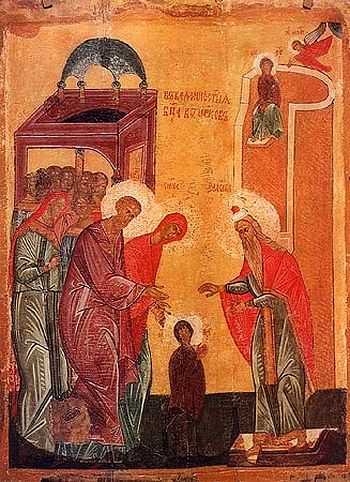
What Does The Entrance Into The Temple Of The Mother Of God Mean For Us & Our Salvation

By Father Panagiotes Carras

The oikonomia of our salvation began with the very creation of the world. It is not by chance that the fourth Gospel does not commence with a genealogy of our Lord but takes us back to the very beginning.  All things from the beginning to the end, from the alpha to the omega are part of God’soikonomia for our salvation, God’s providential ordering of our salvation. Man was created that he may participate in the Divinity of his Creator by first participat­ing in his own perfection.  We are taught by the Fathers that man was created for perfection. Adam was offered perfection but fell victim to the guile of the serpent.  God’s plan could not be frustrated and the Lord prepared the world for another Adam who would rescue the offspring of the first Adam.

St. Paul tells us that Adam is a type of the future Adam (Romans 5: 14). All Christians are des­cendants of both the first Adam and the last Adam. From the first we inherited death, from the last we inherited life. (1 Corinthians 15: 45-50). It is this Apostolic teaching of the two Adams which was developed by the Fathers and formed the nucleus of the Church’s teaching on the salvation of mankind.

Mankind, which had its beginning in the first Adam, had to be given a new beginning. A new Adam was needed to become the Head of the New Humanity, the Head of the body, the Church, which is His body (Ephesians 1:22-23). However, just as in the creation of the Old Humanity, mankind was given the freedom to choose sonship; similarly in the creation of the New Humanity, mankind was granted the opportunity to choose. The first Adam was from the earth, a man of dust, the second is from Heaven (1 Corinthians 15: 47). The first could choose sin because he was not yet perfect, the second Adam, our Lord Jesus Christ, being God by nature, was totally alien to sin. It is because God’s oikonomia required a member of the human race who was able to prove himself free from every sin that the time had fully come (Galatians 4:4) for God to send forth His Son, since mankind was able to bring forth the All-Holy Virgin.

This is precisely why Theotokos is the key-word of the Christological teaching of the fourth Ecumen­ical Council or as St. John of Damascus says, This name contains the whole mystery of the Oikonomia(On the Orthodox Faith, 3, 12). It is for this reason that the traditional Orthodox icon of the Mother of God is an icon of the Incarnation, the Virgin is always with the Child.

The Church’s teaching of the Theotokos is an ex­tension of what is believed concerning the person of Christ. The Son of God was born of a woman and in this case the Mother is not just a mere physical instrument but an active participant who has found favour with God (Luke 1, 30). The faith of the Church is aptly expressed in the words of Nicholas Cabasilas in his Homily on the Annunciation: The incarnation was not only the work of the Father and of His Power and His Spirit, it was also the work of the will and the faith of the Virgin (On the Annunciation, 4).

It is the teaching of the Church, attested to from the earliest date, that the Virgin Mother of the In­carnate Lord had found favour with God (Luke 1:30) and that she was chosen and ordained to particip­ate in the Mystery of the Incarnation, in the Oikonomia of Salvation. The ancient Church understood the typo­logical relationship between the first Adam and the last Adam, and by extension it was able to see that the first Eve prefigured the second Eve. We find that as early as the Second Century St. Justin and St. Irenaeus had a developed teaching of the Theotokos as the second Eve who through her obedience re­medied the disobedience of the first Eve. And so the knot of Eve’s disobedience received its unloosing through the obedience of Mary; for what Eve, a virgin, bound by unbelief, that, Mary, a Virgin, unloosed by faith (Against Heresies, III, 22, 4.) Mary… by yield­ing obedience, became the cause of salvation, both to herself and the whole human race. (Against Heresies, III, 22, 4). Mary alone cooperating with the economy (Against Heresies, III, 21, 7).

The Church has proclaimed this great Mystery of our salvation not only through the teaching of the Fathers but also through the festal celebration of the acts which worked our salvation, chief of which is the Holy Resurrection of our Lord. On the 21st of Novem­ber the Church celebrates the Feast of the Entry of the Theotokos into the Temple. It is at this time that the faithful chant Today is the prelude of God’s Good-Will and the heralding of the salvation of mankind. (Dismissal Hymn).

Throughout the whole service the hymns proclaim the exalted place which the Entry has in the history of Salvation. The Entry marks the closing of the Old Covenant, whereas the Annunciation marks the beginn­ing of the New. With the Entry the most Holy Virgin is passing from the Old Covenant to the New, and this transition in the person of the Mother of God shows us how the New Covenant is the fulfillment of the Old.

Like other human beings the Holy Virgin was born under the law of original sin but the sinful heritage of the fall had no mastery over her. She was without sin under the universal sovereignty of sin, pure from every seduction and yet part of a humanity enslaved by the devil. This is the victory which the Feast of the Entry joyfully celebrates. St. Photius praises the Holy Virgin as the great and God-carved ornament of human kind” who ” made her whole soul a holy shrine of meekness… never allowing any of her wares as much as to touch for a moment the brine of evil. (On the Annunciation, 4). This theme con­stantly appears in the hymns of the Feast of the EntryThy Miracle, 0 Pure Theotokos, transcends the power of words; for I comprehend that thine is a body transcending description, not receptive to the flow of sin. (Third Magnification of the ninth Ode). Ni­cholas Cabasilas expanded this teaching and dealt with it extensively in his Homily on the Birth of the Theo­tokos where we read: The Virgin remained from the beginning to the end free from every evil because of her vigilant attention, firm will, and magnitude of wisdom. (Chapter 15).

The sinlessness and purity of the Theotokos along with the fact that the Lord was preparing Her to be­come His chamber overshadowed the sanctity of the Old Testament temple. The All-Pure Virgin is allowed to enter the Holy of Holies precisely because she is to become the living temple of God. St. Tarasios in his Homily of the Entry has Saint Anne exclaiming:Re­ceive Zacharias, the pure tabernacle; receive 0 priest, the immaculate chamber of the Word … have her dwell in the temple made by hands, she who has be­come a living temple of the Word (Migne, 98:1489). Zacharias in turn speaks to the Virgin, You are the loosing of the curse of Adam, you are the payment of the debt of Eveand he continues to recall all the types and prophecies of the Old Testament which refer to the Theotokos. (Migne, 98:1492-93).

In the Minea of St. Dimitry of Rostov we read, Thus with the honor and glory not only of men, but also of angels, the most Immaculate Maiden was led into the temple of the Lord. And it was meet: for if the ark of the Old Testament, bearing manna in itself, which served only as a prototype of the Most Holy Virgin, was carried into the temple with great honor, with the assembling of all Israel, then with how much greater honor, with the assembling of angels and men, had to take place the entry into the temple of that same living ark, which had manna — Christ — in it, the Most Blessed Virgin, fore-ordained to be the Mother of God.

The Feast of the Entry celebrates the sanctity of the All-Holy Virgin and glorifies the Lord who placed her in the inaccessible Holies like some treasure of God’s, to be used in due time (even as came to pass) for the enrichment of, and as an ornament transcend­ing, as well as common to, all the world.(St. Gregory Palamas, Homily on the Entry, IX).

Teachings From the Service of the Feast

In the Orthodox Church services we participate in the saving events of the Oikonomia of Salvation. This is why, during these services we hear the word Today quite often. This is why in the first Sticheron of the  Lord I have Cried  begins, Come let us faithful dance for joy on this day. The second Sticheron begins with In the temple of the Law today is the living temple.  During Vespers, Matins and the Divine Liturgy we enter into the Mystery of the Entry of the Theotokos. When we enter into the Mystery we are not simple witnesses as the maidens who accompanied theTheotokos but rather participants in the eternal mystery.  

The first two Old Testament readings of Vespers speak of the Divine establishment of the Tabernacle and the Temple (Exodus 40:1-5, 9-10, 34-35 and IIIKings 8:1, 3-4, 6-7, 9, 10-11). The third reading, taken from the Prophecy to Prophet Ezekiel ( Ezekiel 43:27-44:4) speaks of the Theotokos as the living Temple of God.  

During the Divine Liturgy, in the reading of the Epistle of Saint Paul to the Hebrews (9:1-7), we are taught that all things which were done in the Temple of the Old Testament were a Prophecy of what would be fulfilled by our Saviour. In the Gospel of Saint Luke (10:38-42, 11:27-28), which is read at every Feast of the Mother of God, we hear: Blessed is the womb that bare thee, and the paps which thou hast sucked. We are reminded to glorify our Lord and bless His mother, who brought us our salvation.

Icon of the Feast

The Orthodox teaching on the The Entry of the Theotokos into the Temple as the heralding of the salvation of mankind is seen in the Icon of the Feast. The central theme of the icon is the Holy of Holies (1) in the Temple which is about to receive a blessing far superior to any of its former blessings. The priest Zacharias, the father of St. John the Baptist, receives Panagia at the gates of the Temple (3) and in this way prophesies that the Virgin Mary is the New Ark of the Covenant. Saints Joachim and Anna (4), accompanied by virgins of Jerusalem, carrying torches in procession, bring Panagia as a well-pleasing sacrifice. The Theotokos is brought to the gates and ascends to the Holy of Holies where she is cared for by angels (2). Notice that the young virgins do not have their heads covered but that the Theotokos has her head covered. Also the garments of the Mother of God resemble those of Saint Anna and not of the young virgins. The Theotokos, although a child, is already a perfected woman that has reached full spiritual maturity.  She who in body is but three years old, and yet in the spirit is full of years (Ode three of the Second Canon).

Putting All of the Fifth Week of Lent Together – Father Thomas Hopko

At the end of the fifth week of Great Lent, and very particularly on the fifth Sunday, the Orthodox Church has all of its members and faithful Christians contemplating a very beloved and well-known person in Christian history for ancient Christians, and that is a woman named Mary of Egypt. On the matins of the Thursday of the fifth week, there is a penitential canon of St. Andrew of Crete that is read. That particular service, which is a long type of penitential vigil, is often called in Orthodox popular piety “the vigil of Mary of Egypt.” It’s kind of an identification with Mary. In Slavonic, it’s called Marii bodrstvovaniye, the standing with Mary in penance before God. Indeed, in that canon, with all the penitential verses, there are verses that ask Mary of Egypt to intercede for us, to pray for us, as part of the penitential canon. St. Andrew of Crete, the author, is also asked, but particularly Mary of Egypt.

On this Sunday, it’s again kind of a paradox in Orthodox worship, because the focus is now all on Christ. You have that great celebration of the Theotokos with the Akathist on Saturday, and then you enter into the Lord’s Day, and you hear the gospel about Christ going up to Jerusalem and entering into his glory through his suffering. Then even on that Sunday also in the epistle reading, we’ll hear again about how Christ enters into the holy of holies in heaven, not of creation, the sanctuary of God, securing for us an eternal redemption, and that he’s led to offer his blood on the cross through the eternal Holy Spirit where he offers himself without blemish to God and we are encouraged to purify our consciences from dead works in order to serve the living God.

So we are focusing on Christ, but then, with that, you have this whole Sunday when on the one hand you have these marvelous hymns about the resurrection and the victory of Christ on that Sunday, and then you hear even more about this Mary of Egypt. And it’s a kind of a juxtaposition. It’s almost as if the Holy Spirit and God Almighty wants us to keep these two things together. As we focus on Christ and his victory and go up with him to Jerusalem, then we know that this is for everyone and that it is for the worst of sinners. Nobody is excluded, and you can never forget that when you think of Mary of Egypt.

Who was this Mary? It’s interesting that on that Thursday matins with that canon the entire Life of Mary of Egypt is read in church.

…Orthodox Christians in this ancient tradition are called to contemplate that Mary, to remember her. And what’s the point? What’s the point? Oh, there are probably so many, and maybe the points are different for every single person who hears that story, but there’s two points that are for sure. One is that, no matter how sinful we are, the Lord God Almighty forgives us. The other point is that repentance is not just an emotion. It’s not just some kind of magical act. When we repent, we have to purge out of ourselves all of the garbage and filth and slime that’s in us. We have to go through a purgation process before we can be illumined and deified. All that is evil in us has to go: it’s got to be scrubbed away; it’s got to be cut out by the word of God that’s a two-edged sword that cuts the bones and marrows, the sinews, as it says in [the] letter to the Hebrews, the heart of people.

Penance is a work. It is a work. It’s made possible by faith and grace, but it is the result of faith and grace. We know God, we believe in him, we accept his grace, and then that grace purifies us, but it’s not automatic. I can’t resist saying—maybe I shouldn’t on the radio—about how one of my friends would say, “We believe in God the Father, Creator of heaven and earth; and the Son, the Lord Jesus Christ; and the Holy Spirit. We don’t believe in the Magician, the Mechanic, and the Fairy Godmother.” God is not a fairy godmother. He’s not a magician. He’s not a mechanic. There has to be a synergia between us and God. We have to accept that grace that cleanses us, that heals us, that power, and it’s got to happen, and it takes time. It takes time, it takes effort, it takes perseverance to the end. How often Jesus said, “Those who persevere to the end will be saved.” He says, “In hypomone, in patient endurance you will win your life,” and that repentance is a process; it’s not a momentary act.

Yes, Mary had her conversion experience. Yes, she knew the grace and the love of God at that moment, at that Holy Sepulcher. Yes, she knew that she was saved when she was allowed to enter and to venerate the tomb of Christ and receive the precious gifts of his broken body and spilled blood for the forgiveness of her sins, for the healing of her soul and her body and her passions and emotions and for the attaining of everlasting life. Yeah, that moment took place, and there are many such moments often in people’s lives. But then there is the result of that moment: the ongoing life in conformity to that moment. That’s what we see also in Mary of Egypt.

When I was the dean of St. Vladimir’s and the pastor of the chapel, and of course I was there for 30-some years, I always loved that fifth week of Lent. We had a practice at the seminary chapel that was, for me, at least, incredibly significant and marvelous. This is what it was: We would have those penitential services: the Presanctified on Wednesday with all those prostrations and those 24 additional penitential hymns—“O Lord, before I perish utterly, before I perish to the end, do thou save me, O Lord.” We would sing that canon of Andrew with Mary and keep that vigil on that Thursday. Honestly, we cut it down a bit. We were not monks and monastics there; we had our schedule to live, but we did it. We did it, yes. And then we sang the entire Akathist Hymn the next day, with all that marvelous celebration and veneration of the Theotokos with everything we could possibly think of put into our mouth to celebration the incarnation of the Son of God through her.

And when we sang that Akathist Hymn, we had a quite large icon of the Theotokos, Mother of God, with the Child, and we had it set in the middle of the church, and it was surrounded by flowers. It was decorated by beautiful flowers, and we would stand in front of that icon of the Theotokos, Mary, Mother of God. The deacons would be incensing and the whole church would be singing this marvelous Akathistos Hymn with all those wonderful words. Then we would celebration the Incarnation and Mary on that Saturday in the morning.

And then, on Saturday evening when we would come for the vespers and the matins and the Divine Liturgy of the fifth Sunday of Lent, in that same frame of flowers, on that same stand, the same analoy, in the middle of our same church, would be another icon: an icon of another Mary. Because we would remove the icon of the Theotokos and Child, and in that very same frame of flowers, on that very same stand, in the middle of our very same chapel, we would see Mary of Egypt. What a contrast that was! What an amazing thing it was, that on Saturday we’re glorifying and venerating the incarnation of the Son of God through the All-pure Virgin, of whom is more holy? The most holiest of mere human beings, Christ’s mother, Mary, holding in her arms the Holy One of God, Jesus Christ, our Savior and Lord, the Messiah of Israel, the Savior of the world. Holiness! Holiness like you cannot imagine! was in that icon in those flowers and in those songs.

And then in the same building, on the same stand, in the same flowers—was Mary of Egypt. And our icon showed her emaciated, sun-burnt, her hair frizzly white, and her face totally beautiful, and even similar to the face of the Theotokos in the iconography. Totally beautiful. And we knew that a nymphomaniac, sexually addicted harlot and even-worse-than-a-harlot human enters the same radiance and the same glory as the Mother of Christ and of all believers. Like Mary, she herself became more honorable than cherubim, more glorious than seraphim, because in Christ everyone who’s saved has that particular glory. We all are enthroned with Christ over all the angels—the twelve apostles sit on twelve thrones, judging the angels, it says in Scripture. We really are deified and enter into the glory of God. That is why Christ was born of a Virgin, and that’s why we venerate his mother so magnificently.

But on this day we know that the worst, the lowliest, the filthiest, the most addicted, the most impassioned, the most possessed, by faith and grace through that same Christ, by the intercessions of his mother and all the saints, can enter into that same glory. And Mary of Egypt tells us that. She shows us that. And then she begins herself to intercede for us poor sinners. Maybe some of us listening are sex-addicted ourselves and nymphos and whatever, controlled and on computers, looking at porno and whatever—but there’s hope for us. There’s hope for us. Mary of Egypt proves there’s hope for us.

But it’s not magic, it’s not mechanical; God is not a fairy godmother. There must be faith, grace accepted and lived out, and that purgation that leads to illumination that leads to glorification, leads to deification—can be ours. If it can be Mary of Egypt’s, then it can be ours. And how wonderful it was to go to church on Saturday of the fifth week and stand in front of that flower-decorated icon of the Theotokos and Child, and to come back again that same night and the next day and to see, in that same place, Mary of Egypt.

4th Sunday of Lent – ‘Lord I Believe; Help My Unbelief’ Adult Education Class

This week we celebrated the mid-point of the Lenten fast. We’ve had the Cross out in the church and heard words that encourage us to enjoin ourselves to the Cross as the not of this world ’refuge of all men’.

The Cross is the haven of the storm-tossed, the guide and support of those that go astray, the glory of Christ, the power of the apostles and the prophets, the strength of God’s athletes, the refuge of all men. We see it set before us in this time of fasting and we venerate it.

Heal my brokenness, O King of all, crucified upon the Cross in thy surpassing love. Thy hands and feet were pierced with nails, Thy side was wounded with the spear, and Thou wast given vinegar and gall to drink, who art the joy of all men, their sweetness, glory and eternal redemption.

The Fast that brings us blessings has now reached its midmost point: it has helped us to receive God’s grace in the days that are past, and it will bring us further benefit in the days still to come. For by continuing in what is right we attain yet greater gifts. We therefore cry to Christ, the Giver of all good: O Thou who for our sakes hast fasted and endured the Cross, make us worthy to share uncondemned in Thy divine Passover. May we spend our lives in peace and rightly glorify Thee with the Father and the Spirit.

Triodion Matins/Vespers Wednesday/Friday 4th Week

This Sunday we venerate St. John Climacus and his great work ’The Ladder of Divine Ascent’. In our Vigil we’ll sing these powerful words that unite him to the Cross and as a guide for our own Lenten journeys.

O holy father John, through faith thou hast lifted up thy mind on wings to God; hating the restless confusion of this world, thou has taken up thy Cross; and following Him who sees all things, though has subjected thy rebellious body to His guidance through ascetic discipline, by the power of the Holy Spirit

O holy father John, truly hast though ever carried on thy lips the praises of the Lord, and with great wisdom has thou studied the words of Holy Scripture that teach us how to practice the ascetic life. So hast thou gained the riches of grace, and thou has become blessed, overthrowing all the purposes of the ungodly.

Triodion Vespers 4th Sunday of Lent

During this week’s class time, I’d like us to focus on the Gospel reading (Mark 9: 17-31) for today and the humility and honesty of the appeal ’Lord I believe, help my unbelief’. I’d also like us to do a deep dive into the Prayer of St. Ephraim and what lessons it has for us as we now enter the second half of our Lenten journey.

I’ll print the following articles for our class Sunday:

During the week, I posted some additional articles that you may find relevant and useful as we prepare for class:

Finding ‘God With Us’

I love this short article. It’s powerful in waking us up to what Archbishop Kallistos Ware describes as being ’conscious of our dependance on God’. It’s also helpful in relating our cross to His as we venerate the Cross this week. It’s helpful for me to remain clear about what we are doing and why we are doing it as we now now enter the home stretch of our Lenten journey together.

God With Us – By Father Stephen Freeman

Popular New Age thought postulates that everyone has a “god within.” It’s a pleasant way of saying that we’re all special while making “god” to be rather banal. But there is a clear teaching of classical Christianity regarding Christ-within-us, and it is essential to the Orthodox way of life.

We should not understand our relationship with God to be an “external” matter, as if we were one individual and God another. Our union with God, birthed in us at Holy Baptism, is far more profound.

“He who is joined to the Lord is one spirit with Him.” (1Co 6:17)

God does not “help” us in the manner of encouraging us or simply arranging for things to work out. Rather, He is in us, working in union with our work. The mystery of ascesis (the practice of prayer, fasting, self-denial, etc.) only makes true sense in this context. Those who look at Orthodoxy from the outside often accuse us of practicing “works-righteousness,” meaning that we believe we can earn favor with God by doing good works. This is utterly false. God’s good favor is His gift and cannot be earned.

However, the Orthodox life is similar to the life of Christ Himself.

“Truly, I say to you, the Son can do nothing of Himself, but what He sees the Father do; for whatever He does, the Son also does in like manner.  (Joh 5:19)

and

“Truly, I say to you, he who believes in Me, the works that I do he will do also; and greater works than these he will do, because I go to My Father. (Joh 14:12)

The “works” that a Christian does, are properly done in union with Christ, such that the works are not those of an individual, but of our common life with and in Christ. When we fast, it is Christ who fasts in us. When we pray, it is Christ who prays in us. When we give alms it is Christ who gives alms in us.

And we should understand that Christ-in-us longs to fast. Christ-in-us longs to pray. Christ-in-us longs to show mercy. The disciplines of the Church are not a prescription for behaving ourselves or a map of moral perfection. Rather, the commandments of Christ (as manifest in the life of the Church) are themselves a description, an icon of Christ Himself.

 Jesus answered and said to him, “If anyone loves Me, he will keep My word; and My Father will love him, and We will come to him and make Our home with him.” (Joh 14:2)

Dumitru Staniloae notes:

At the beginning Christ is, so to speak, buried in the commandments and in us, in the measure in which we are committed to them, by His power which is in us. By this collaboration we gain the virtues as living traits; they reflect the image of the Lord, and Christ is raised even brighter from under these veils. (Orthodox Spirituality)

This way of “union” is the very heart of Orthodox faith and practice. Sadly, much of Christianity has created an “extrinsic” view of our relationship with God and the path of salvation. In this, God is seen as exterior to our life, our relationship with Him being analogous to the individualized contractual relationships of modern culture. As such the Christian relationship with God is reduced to psychology and morality.

It is reduced to psychology in that the concern is shifted to God’s “attitude” towards us. The psychologized atonement concerns itself with God’s wrath. It is reduced to morality in that our behavior is no more than our private efforts to conform to an external set of rules and norms. We are considered “good” or “bad” based on our performance, but without regard to the nature of that performance. St. Paul says that “whatsoever is not of faith is sin.” Only our lives-lived-in-union-with-Christ have the nature of true salvation, true humanity. This is the proper meaning of being “saved by grace.”

…for it is God who works in you both to will and to do for Hisgood pleasure. (Phi 2:13)

and

You are of God, little children, and have overcome them, because He who is in you is greater than he who is in the world. (1Jo 4:4)

and

To them, God willed to make known what are the riches of the glory of this mystery among the Gentiles: which is Christ in you, the hope of glory. (Col 1:27)

There is a second part of this mystery (Christ in us) that presses its importance upon us. This is the suffering of Christ within us. Fr. Staniloae writes:

Jesus takes part in all our sufferings, making them easier. He helps us with our struggle against temptations and sin; He strives with us in our quest for virtues: He uncovers our true nature from under the leaves of sin. St. Maximus comments: Until the end of the world He always suffers with us, secretly, because of His goodness according to [and in proportion to] the suffering found in each one.

The Cross recapitulates the suffering and sin of humanity, but it extends throughout the life and experience of all people. It is the foundation of Christ’s statement: “Inasmuch as you did it [did it not] unto the least of these my brethren, you did it [did it not] unto me.

The hypostatic union of the person of Christ extends into the life of every person. There is something of a perichoresis or coinherence in our daily relationship with Christ.

And if one member suffers, all the members suffer with it; or if one member is honored, all the members rejoice with it. (1Co 12:26)

This must be given  the strongest possible reading. If any one of us suffers, Christ suffers. There is no specific human suffering to which Christ is alien.

It is the moment-by-moment pressing into this commonality (koinonia) that is the foundation of Christian existence. It is the point of Baptism (buried with Him). It is the point of the Eucharist (“whosoever eats my flesh and drinks my blood abides in me, and I in him”). It is the point of every action and thought.

It is the life of grace.

The Annunciation & Our Conciliar Salvation

By Father Stephen Freeman

I consider it both a strange mystery and a settled matter of the faith that God prefers not to do things alone. Repeatedly, He acts in a manner that involves the actions of others when, it would seem, He could have acted alone.

Why would God reveal His Word to the world through the agency of men? Why would He bother to use writing? Why not simply communicate directly with people? Why speak to Moses in a burning bush? Why did the Incarnation involve Mary? Could He not have simply become man, whole, complete, adult, in a single moment?

Such questions could be multiplied ad infinitum. But at every turn, what we know of God involves others as well. We may rightly conclude that such a means of acting pleases Him.

This Friday is the Feast of the Annunciation when the Church celebrates the Incarnation of Christ at word of the angel Gabriel to the Virgin Mary. An Orthodox hymn on the feast says:

The manner of His emptying cannot be known;
the manner of His conception is beyond speech.
An Angel ministers at the miracle; a virginal womb receives the Son;
the Holy Spirit is sent down; the Father on high is well pleased,
and according to their common counsel, a reconciliation is brought to pass
in which and through which we are saved.

“According to their common counsel” is a rich phrase describing this conciliar action of God.

At the same time that this conciliar mode of action seems obvious to Orthodoxy, it is frequently denied or diminished by others. There is a fear in some Christian quarters that were we to admit that God shared His action with any other, our salvation would be a matter of our own works and not the sovereign act of God. It is feared that a conciliar mode of action shares the glory of God with mere mortals.

It is true. This understanding shares the glory of God with mere mortals. But, interestingly, St. Paul says that man is the “image and glory of God” (1 Cor. 11:7). Apparently, we were brought into existence in order to have such a share.

The failure to understand this and the effort to re-invent the Christian story with diminished roles for angels and saints, or Christians themselves, comes very close to setting forth a different gospel altogether.

The Word became flesh of the Virgin Mary. The flesh of the Virgin is also the flesh that is nailed to the Cross (when her soul was itself mysteriously pierced). The flesh which we eat in the Eucharist is also the flesh of the Virgin – for there is no flesh of God that is not the flesh of the Virgin.

And it does no good to protest that the Word merely “took flesh” of the Virgin. For Adam cried out concerning Eve, “This is truly bone of my bone and flesh of my flesh.” And St. Paul noted concerning the wife of a man that a man should love her, “For no one ever yet hated his own flesh.”

I puzzle at how Christians who understand that it is wrong for a woman to say, “It’s my body and I can do with it what I want,” when she is carrying a child, can at the same time treat the Mother of God as though she had merely lent her womb to God for a period of time.

God’s conciliar action in our salvation is so thoroughly established that it involves our will, our soul, our flesh and bones. He includes bread and wine in our salvation so that the fruit of this garden might become the fruit of life. Everything around you is for your salvation and has its share.

This is not only true in the Incarnation, but continues to be true for every saving effort in our lives. We cannot save ourselves, of course, for that, too, would be denying the conciliar action of God.

There is a saying among the fathers, “If anyone falls, he falls alone, but no one can be saved alone.” But I think we cannot even say that we fall alone – for the one who falls is equally bone of my bone and flesh of my flesh. Christ does not distance Himself from the one who falls, but unites Himself with him so completely that He endures the consequence of our fall, entering death and hell to bring us back alive.

The Church is nothing other than the conciliar salvation of God, bone of His bone and flesh of His flesh – His body. We are being saved together whether we will admit it or not. Those who study and quote the Bible are themselves handling documents that were written, copied and preserved by others. It is a conciliar document.

The Orthodox way of life urges us to embrace the fullness of our conciliar being. In sacraments and saints in worship and wonder we live within the cloud of witnesses and share the common struggle.

For this reason let us unite our song with Gabriel’s,
crying aloud to the Virgin:
“Rejoice, O Lady full of grace, the Lord is with you!
From you is our salvation, Christ our God,
Who, by assuming our nature, has led us back to Himself.
Humbly pray to Him for the salvation of our souls!”