Sunday of the Last Judgment – Homily by Archpriest Symeon Lev

We know that Christians should avoid vainglory, conceit, and the tacit expectation of rewards of grace during Lent. However, even the most careful and unceasing self-control does not always lead to the desired results. Protecting oneself from hidden vainglory during Lent is by no means easy. This is where Christian good deeds – when one really takes on human grief – can be of help. After all, when we move away from ourselves by coming into contact with concrete human trouble and misfortune, by sharing in someone’s oppressive grief, our own concerns fade into the background, silent and diminished. One person grieves because of frequent colds, while another dreams of learning to walk without crutches. When we see real grief right in front of us we begin to experience a burning shame not only for our own petty vainglory, but also for our prosperity: just recently we thought it defective and dared complain about our lot. 

The Holy Church of Christ insists that we perform good deeds during the time of Great Lent, inasmuch as our acts of mercy not only relieve other people’s plights, making their lives easier and brighter, but they turn the struggler’s attention from himself to others, thereby quietly freeing him from his egotistical self. The wave of love that arises in us when we share in the misfortunes of others fills us with Divine life, animating and inspiring us while driving the passions far away, thereby cleansing us from their harmful and troublesome effects. 

Why is the subject of good deeds so tightly interwoven in the Gospel with that of the end of the world and the Second Coming of Christ? After all, it would seem that the call to mercy is not especially inspiring when we are simultaneously being reminded that the earth and all deeds therein shall be consumed.

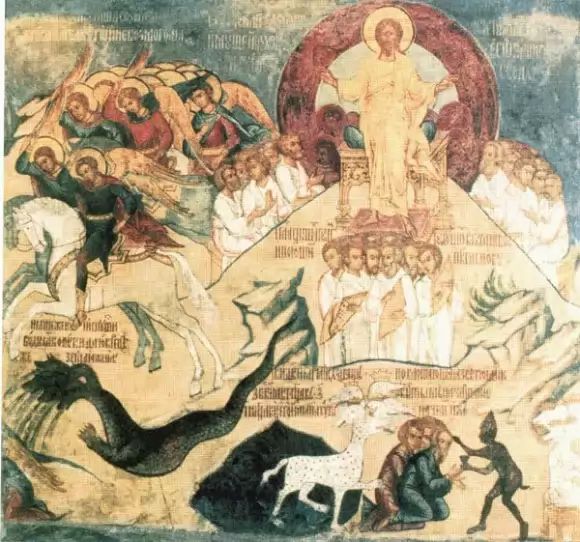
Icon of the Last Judgment. Seventeenth century. 

The fact is that even good deeds, as with all other Christian actions, have their dangers. From the example of the Pharisee and the elder son in the parable of the Prodigal Son we have already seen how religious effort can take on an ungodly character that alienates man from God’s love. The same thing can happen with good deeds. If a Christian immerses himself in them to the point of completely forgetting the primary goal of human existence, then it is unlikely he will do himself any good. Good deeds themselves, if one forgets the memory of death, can acquire the character of an activity that is excited, chaotic, and scattered. 

When the Jewish woman poured precious myrrh onto the head of Jesus, certain of the disciples said among themselves: Why was this waste of ointment made? For it might have been sold… and have been given to the poor (Mark 14:4-5). The indignant disciples probably expected the Savior to endorse their feelings. Christ, however, comes to the defense of this “squanderer”: why trouble ye her? she hath wrought a good work on Me. For ye have the poor with you always, and whensoever ye will ye may do them good: but Me ye have not always (Mark 14:6-7). 

With these words the Savior warns His followers that the work of keeping oneself in the truth of the Gospel is of utmost importance and, moreover, that this does not yield in importance to Christian good deeds; in some cases it even surpasses them. Indeed, Christ tells us that our eternal fate depends entirely and wholly on deeds of mercy. By including this call to mercy in the general discourse on the Second Coming, however, the Gospel establishes the proportionality and consistency of every part of the Christian activity that makes up our salvation. As such, if we will always have in mind the Second Coming and the Dread Judgment, but all the while become so absorbed in the expectation of the end that we lose sight of concrete deeds of mercy, we will most likely not acquire that love without which no one can see God. Yet if we give ourselves over enthusiastically to deeds of love while forgetting about the fleeting and vain nature of all that takes place on earth and the memory of death, then our good deeds will take on an emotional rather than spiritual character and not bring us any closer to God.

In Ecclesiastes we read: To every thing there is a season, and a time to every purpose under the heaven… a time to keep silence… A time to love (3:1-8). A time of silence – a time of solitude and standing noetically before God’s Judgment – is no less essential to Christianity than the active and continuous performance of good deeds. This silence not only returns us from the superficial life around us back to our own depths, but also reminds us of the finite nature of everything that takes place on earth, thereby purifying our love from emotional exaltation.

Therefore, from the publican’s repentance to deeds of love and mercy; from good deeds to the memory of death; and from the memory of death back to repentance and prayer, we must make our journey toward the joyful and bright days of Christ’s Resurrection. The Gospel readings during these preparatory weeks show us the direction we are to follow in our Lenten journey: they are like road signs showing us the way to the Heavenly Jerusalem, to the Lord’s eternal and unceasing Pascha.

Key Triodion Quotes / Messages from Sunday of Prodigal Son

In the Matins service for the Sunday of the Prodigal Son, we see how our actions and attitudes have exiled us far from the Love of our Father. We also see how the repentance of the prodigal is received by our merciful Father. The connections between the Prodigal Son, Publican and wise thief are powerful reminders of how crucial it is that we see ourselves with clarity not with a pride that rejects the glory of the Lover of mankind. The pride of how we apply human justice to reject the grace of God seems to be a crucial lesson the elder son has to teach. Our inclination to elevate our judgement above God’s is a common manifestation of pride we see illustrated with the Pharisee last week and now the elder son this week. Perhaps, like me, you can see how my judgements of ‘how it should be’ can separate me from the reality that ’He is everyone present and fillest all things’ … if I have eyes of faith to see.

I have been enslaved to foreign strangers, exiled in the land of corruption, and I am filled with shame. But returning now, O merciful One, I cry to Thee: “I have sinned”.

Utterly beside myself, I have clung insanely to the sins suggested to me by the passions. But do Thou accept me, O Christ, as the Prodigal.

I have wasted in riotous living the riches which the Father hath given me, and am now filled with shame and enslaved to fruitless thoughts. Wherefore I cry unto Thee: “O Lover of mankind be compassionate unto me and save me”.

In hunger I find myself deprived of every blessing, and exiled from Thee O all-good one, be compassionate to me who now return unto Thee,  and save me O Christ, who doth praise Thy love for mankind.

Foolishly have I fled from Thy glory, O Father, * in wickedness wasting the wealth that Thou hast given me. * Wherefore with the voice of the Prodigal I cry unto Thee: * “I have sinned before Thee, O compassionate Father. ** Accept me who repent, and make me as one of Thy hired servants”.

Ikos: Every day our Savior doth teach us with His own voice: let us therefore hearken to the Scriptures concerning the Prodigal who once again became wise, and with faith let us emulate the good example of his repentance. With humbleness of heart let us cry out to Him Who knoweth the hidden things of all: “We have sinned against Thee, O compassionate Father, and can never be worthy to be called Thy children as we were before. But since Thou art by nature the Lover of mankind, accept me and make me as one of Thy hired servants”.

Behold, O Christ, the affliction of my heart; behold my turning back; behold my tears, O Savior, and despise me not. But for the sake of Thy compassion embrace me also once again, that, with the multitude of the saved, I may with thanksgiving sing the praises of Thy mercy.

Like the thief I cry to Thee, “Remember me.” and like the Publican, with eyes cast down to earth, I beat my breast saying, “Be merciful.” Like the Prodigal O compassionate One, deliver me from every evil, O King of all, that I may sing the praises of Thy boundless compassion.

O Good One, I have departed far from Thee, * but forsake me not, neither reject me from Thy Kingdom. * The evil enemy hath stripped me and taken all of my wealth; * I have squandered, like the Prodigal, the good gifts given to my soul. * But now I have arisen and returned, and to Thee I cry aloud: * “Make me as one of Thy hired servants. * For, for my sake on the Cross Thou didst stretch out Thy sinless hands, * to snatch me from the evil beast * and to clothe me once again in my first raiment ** for Thou alone art plenteous in mercy.

Ruled by corrupting thoughts, I am full of darkness and separated far from Thee, and have lost all care for myself, O compassionate One. Therefore save me as I fall down before Thee in repentance

Matins Service Sunday of the Prodigal Son

What does the elder son in the Prodigal Son parable have to teach us?

The theme of exile and how it relates to both sons is crucial and often overlooked. Archimandrite Zacharias (Zacharou) in his book ’At the Doors of Holy Lent’ does a powerful deep dive into how much the elder son has to teach us about the condition of our hearts, how distant our hearts may be from God, and our need for repentance. I think this article is a very good compliment to the article entitled ’Exile of Both Sons’ by Father Robert Aida.

At The Doors of Holy Lent – Archimandrite Zacharias

The elder son may have been a child of the Father, but his heart was not with Him. He lived in his Father’s house enjoying His wealth, but he had not given his heart to Him. He had put his confidence in external works and he never worked on his heart. Therefore, he could not enter the house and join the feast for the return of his brother. He speaks about his brother with no compassion as if he were a stranger. In his dialogue with the Father, without even naming him, he resentfully refers to him with the words, ‘this your son’. 

The firstborn son had wasted his life, turning it into the formal fulfilment of his duty, instead of increasing it and enriching it as an offering of love. If he had nurtured tender love for the Father, he would not have condemned any of His acts, but would have followed His slightest desire as something holy and sacred. 

The elder son represents first the Pharisees, who justified themselves in all things and would have preferred to see a sinner be destroyed rather than forgiven. They put their confidence in their rights and considered themselves to be the elect of God. They thought they knew His law and that they were not transgressing His commandments. On the other hand, blinded as they were by pride, they were not only unable to recognise the Son of God in the Person of the meek and lowly Jesus, but they also confronted Him as a criminal. They condemned Him and in the end they even killed Him. 

This son also represents a number of Christians, who live a comfortable life, performing external pious works and taking for granted their own salvation. Yet, for created and sinful man to enter the heavenly banquet, it is not enough to pay a visit to the church, light a candle, listen to the beautiful chanting and then leave. An ontological transformation must occur in his heart and man must develop an inner relationship of love with his Father ‘which is in heaven’. And since through His incarnation, Christ has become the most known among the three Persons of the Holy Trinity, He is our Father, brother and Saviour, He is all things. Through the invocation of His Name, the heart is changed and cultivated. 

‘Therefore came his father out, and intreated him.’ God humbles Himself before man and condescends to his weaknesses, so as to sustain and care for every soul in His goodness, and receive them in His Kingdom. The Father not only hastened to comfort the prodigal son, but also came out to console his other son who protested at being treated unjustly. 

‘And he answering said to his father, Lo, these many years do I serve thee, neither transgressed I at any time thy commandment: and yet thou never gavest me a kid, that I might make merry with my friends. But as soon as this thy son was come, which hath devoured thy living with harlots, thou hast killed for him the fatted calf. And he said unto him, Son, thou art ever with me, and all that I have is thine. It was meet that we should make merry, and be glad: for this thy brother was dead, and is alive again; and was lost, and is found.’ 

The elder son had fallen prey to the illusion that he had never broken any commandment, his heart was far from his Father. The eyes of his soul were not open to discern the repentance of his brother and the change in his soul. Instead, he only judged his external actions, and though he lacked accurate knowledge of them, he enumerated them. His words contained wilfulness, envy and harshness. The elder son is the personification of human justice, who considers that God is obliged to him and resists His will. If he had given his heart to the Father without reserve, he would have found the trust to take part in the feast with no need to ask for details. He would have rejoiced with the joy of his Father. The man who repents and returns to God is not concerned about anything except His justice and wisdom, which he unquestioningly accepts in times of both sorrow and joy. 

When the Lord appeared after the Resurrection to the disciples at the lake of Gennesaret, He restored Peter as the chief of the apostles with His threefold question: ‘Dost thou love me?’, and then foretold him his martyrdom. Peter turned to John and asked Christ puzzled: ‘What shall this man do?’ The Lord then gave him another great lesson through the words: ‘If I will that he tarry till I come, what is that to thee? follow thou me.’ 37 Our eyes must not wander around to see what the others do, how they react, what they say. Our gaze must remain fixed on the Lord, Who will lead us to the haven of salvation, if we follow Him. 

‘Son, thou art ever with me, and all that I have is thine.’ When we convince God that we love Him as our Father, He gives us all His life. He gives to all the same commandments and the same promises. The knowledge of His love and of His thirst to impart to us by grace all that belongs to Him by nature, floods the soul with gratitude and leaves no room in the heart for the hideous passion of envy. 

The word of the Father, ‘All that I have is thine,’ is fearful. If God Himself is mindful of all things and makes us partakers of His eternal treasure, then we cannot lack anything. His Light shines for all and is not diminished when it illumines not only us but also our brethren. It is like the flame of the candle, which remains the same, even if it ignites millions of other candles. In every portion of His Body and Blood, He gives us the entire wealth of His gifts. The Lord gives us all things, but we also have a great debt: to follow Him and consider the salvation of our brother and of the whole world as our own concern and joy. Then, all the abundance of gifts that sprang from the coming of the Paraclete, the Holy Spirit, will become our own. 

The Light proceeding from the Father gives us the ‘light of the knowledge of the glory of God in the face of Jesus Christ’ 38… The image of the only begotten Son of one substance with the Father, the Logos, kindles a strong desire in us to become like Him in all things… We suffer but in a hitherto-unknown way… We shrink into ourselves, knowing ourselves for what we are, while at the same time God comes forward to embrace us like the father of the prodigal son. Fear and trembling depart from us, giving place to wonder at God. He clothes us in rich garments. He adorns us with great gifts, the noblest of which is all-embracing love. Our initial suffering of repentance is transformed into the joy and sweetness of love which now takes a new form–compassion for every creature deprived of divine Light. 39 

The Lord Jesus Christ Who overcame the world, is a Living God, always present among us. He reigns unto all ages. If we surrender our whole heart to Him with trust and cultivate a relationship of love, humility and thanksgiving with Him, nothing will be able to make us waver. Through the continual and painful struggle of our repentance, we will leave behind our old sins. We will make a new beginning to return to the house of the Father and our life will be blessed and renewed. When the end of time will come, this relationship with the Lord will continue, but on another level, stronger, more perfect, indescribable.

What do I truly treasure?

Our actions, attitudes, and awareness have a lot to teach us about what we honestly treasure in the depths of our hearts. I find this article by Father Stephen Freeman entitled ’The Treasures of the Heart’ very helpful as I enter this Pre-Lenten period and desire to see more clearly, with God’s help, the truth of what lies within me. I’ve created a slightly shortened extract of the full article below. I hope this may help you reflect and gain some clarity about this important question that we can ask and perhaps even answer right now today.

The Treasures of the Heart – Father Stephen Freeman

A good man out of the good treasure of his heart brings forth good; and an evil man out of the evil treasure of his heart brings forth evil. For out of the abundance of the heart his mouth speaks. 

Matthew 12:34-35

Christ’s teaching on the heart points to it as the very center of our life. He does not describe it as inherently good or inherently bad. It is inherently central. It is that place in the core of our existence from which all words and actions flow. And so Christ tells us simply that if the treasure of our heart is good – it will be evidenced by the good things we say and do – and, conversely, if the treasure of our heart is evil – it, too, will be evidenced by the evil things we say and do. What we should take from this is the realization that we are daily laying up treasure (good or evil) in the heart.

I recently gave some thought to St. Macarius’ saying on the treasures of the heart – that we find dragons and lions, poisonous beasts, etc., and that we find God, the angels, the life and the kingdom, the heavenly cities and the treasuries of grace. My thoughts stayed with his imagery as I walked myself through the day. It was obvious that over the course of the day I myself added to the treasures of my heart – and to some extent – others added to that treasure as well.

One image that came to me was travel on our busy freeways. In East Tennessee it seems that our interstate highway system is in a constant state of “under construction.” At times traffic is heavy, too fast, and frightening (especially if you add in cell-phone usage and the like as we zip along at freeway speeds). The image that came to mind was of cars barreling down the highway with dragons and lions and poisonous beasts pouring out the windows as travelers cursed one another on their daily commute. “Road rage” is a common phenomenon all across the nation. I wondered how we would react if we could actually see the “treasures” of our heart pouring out of our cars.

The same image could be applied across the whole of the day. For we are either bringing forth good out of the treasure of a good heart or pouring out dragons from the treasure of an evil heart.

There was an additional thought. The nature of the heart’s treasure is their inexhaustibility. When we pour forth our treasure we do not see its decrease. Quite the opposite – dragons begat dragons. And in the same way, every act of kindness of mercy does not diminish the kindness and mercy of our heart but multiplies them. Kindness begats kindness.

And so it is that over the course of every day we not only nurture the treasure of our own heart (for good or ill), we also add, or attempt to add, to the treasures of those around us. Some of the poisonous beasts that I find within my heart have been dwelling there a long time – placed there even when I was a child.

And so a significant question for all of us (daily) is: what treasure do I share with others?

Meditating on such imagery should also drive us deeper into repentance (not guilt, but repentance). What am I doing with the beasts that inhabit my heart? Frequent confession – telling the truth about the state of my heart is important. But equally important (perhaps more so) is the attention we should give to the good treasures that are so lacking. Every act of kindness and mercy, every effort towards forgiveness of everyone for everything, does not exhaust the heart but stores up good treasures in the presence of the good God. Avoiding evil is an effort not to do something. I always find that such efforts alone are very weak indeed. The man who is busy being kind cannot be busy being evil. One of the powers of goodness is that it actually has substance rather than absence. And so St. Paul exhorts us, “Overcome evil by doing good” (Romans 12:21).

Dragons depart ….