Preview Next Weekend – Lazarus Saturday and Palm Sunday

By Father Thomas Hopko from Volume II (The Church Year) in the OCA Faith Series

The week following the Sunday of Saint Mary of Egypt is called Palm or Branch Week. At the Tuesday services of this week the Church recalls that Jesus’ friend Lazarus has died and that the Lord is going to raise him from the dead (Jn 11). As the days continue toward Saturday, the Church, in its hymns and verses, continues to follow Christ towards Bethany to the tomb of Lazarus. On Friday evening, the eve of the celebration of the Resurrection of Lazarus, the “great and saving forty days” of Great Lent are formally brought to an end:

Having accomplished the forty days for the benefit of our souls, we pray to Thee, O Lover of Man, that we may see the holy week of Thy passion, that in it we may glorify Thy greatness and Thine unspeakable plan of salvation for our sake

Vespers Hymn
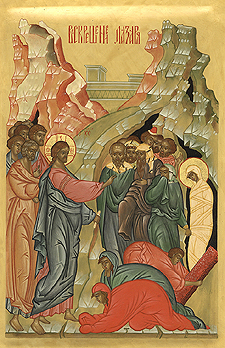
Lazarus

Lazarus Saturday is a paschal celebration. It is the only time in the entire Church Year that the resurrectional service of Sunday is celebrated on another day. At the liturgy of Lazarus Saturday, the Church glorifies Christ as “the Resurrection and the Life” who, by raising Lazarus, has confirmed the universal resurrection of mankind even before His own suffering and death.

By raising Lazarus from the dead before Thy passion, Thou didst confirm the universal resurrection, O Christ God! Like the children with the branches of victory, we cry out to Thee, O Vanquisher of Death: Hosanna in the highest! Blessed is he that comes in the name of the Lord! (Troparion).

Christ —the Joy, the Truth and the Light of All, the Life of the world and its Resurrection—has appeared in his goodness to those on earth. He has become the Image of our Resurrection, granting divine forgiveness to all (Kontakion).

At the Divine Liturgy of Lazarus Saturday the baptismal verse from Galatians: As many as have been baptized into Christ have put on Christ (Gal 3.27) replaces the Thrice-holy Hymn thus indicating the resurrectional character of the celebration, and the fact that Lazarus Saturday was once among the few great baptismal days in the Orthodox Church Year.

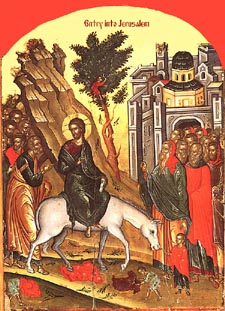
Because of the resurrection of Lazarus from the dead, Christ was hailed by the masses as the long-expected Messiah-King of Israel. Thus, in fulfillment of the prophecies of the Old Testament, He entered Jerusalem, the City of the King, riding on the colt of an ass (Zech 9.9; Jn 12.12). The crowds greeted Him with branches in their hands and called out to Him with shouts of praise: Hosanna! Blessed is He who comes in the name of the Lord! The Son of David! The King of Israel! Because of this glorification by the people, the priests and scribes were finally driven “to destroy Him, to put Him to death” (Lk 19.47; Jn 11.53, 12.10).

Palm Sunday

The feast of Christ’s triumphal Entry into Jerusalem, Palm Sunday, is one of the twelve major feasts of the Church. The services of this Sunday follow directly from those of Lazarus Saturday. The church building continues to be vested in resurrectional splendor, filled with hymns which continually repeat the Hosanna offered to Christ as the Messiah-King who comes in the name of God the Father for the salvation of the world.

The main troparion of Palm Sunday is the same one sung on Lazarus Saturday. It is sung at all of the services, and is used at the Divine Liturgy as the third antiphon which follows the other special psalm verses which are sung as the liturgical antiphons in the place of those normally used. The second troparion of the feast, as well as the kontakion and the other verses and hymns, all continue to glorify Christ’s triumphal manifestation “six days before the Passover” when he will give himself at the Supper and on the Cross for the life of the world.

Today the grace of the Holy Spirit has gathered us together. Let us all take up Thy cross and say: Blessed is he who comes in the name of the Lord. Hosanna in the highest! (First Verse of Vespers).

When we were buried with Thee in baptism, O Christ God, we were made worthy of eternal life by Thy resurrection. Now we praise Thee and sing: Hosanna in the highest! Blessed is he that comes in the name of the Lord! (Second Troparion).

Sitting on Thy throne in heaven, and carried on a foal on earth, O Christ God, accept the praise of angels and the songs of children who sing: BIessed is he who comes to recall Adam! (Kontakion).

At the vigil of the feast of Palm Sunday the prophecies of the Old Testament about the Messiah-King are read together with the Gospel accounts of the entry of Christ into Jerusalem. At Matins branches are blessed which the people carry throughout the celebration as the sign of their own glorification of Jesus as Saviour and King. These branches are usually palms, or, in the Slavic churches, pussy willows which came to be customary because of their availability and their early blossoming in the springtime.

As the people carry their branches and sing their songs to the Lord on Palm Sunday, they are judged together with the Jerusalem crowd. For it was the very same voices which cried Hosanna to Christ, which, a few days later, cried Crucify Him! Thus in the liturgy of the Church the lives of men continue to be judged as they hail Christ with the “branches of victory” and enter together with Him into the days of His “voluntary passion.”

2nd Sunday of Lent Adult Education Class

This week the Church honors St. Gregory Palamas and his many important contributions to our faith. The theme I’d like us to focus on this week in the context of St. Gregory’s teaching is healing. Here is a quote from him that describes this process:

St. Gregory writes,

This bodily renewal is seen now through faith and hope rather than with our eyes, not being reality yet. The soul’s renewal, on the other hand, begins… with holy baptism through the remission of sins and is nourished and grows through righteousness in faith. The soul is continually renewed in the knowledge of God and the virtues associated with this knowledge, and will reach perfection in the future contemplation of God face to face. Now, however, it sees through a glass darkly.

An important aspect of ‘our part’ in this healing is in the keeping of the Lord’s commandments as we learn to rely and depend upon the gift of the Holy Spirit. St. Gregory continues:

For the Lord has promised to manifest Himself to the man who keeps [His commandments], a manifestation He calls His indwelling and that of the Father, saying, “If anyone loves Me, he will keep My word, and My Father will love him, and We will come to him and will make our abode wth him, and “I will manifest Myself to him.”

I’d like us to begin class this week with your observations on this second week of Lent. Next, I’d like us to read and reflect on the short homily from Father Phillip LeMaster entitled ’St. Gregory Palamas and the Healing of our Paralysis’. I’d then like us to read a short, very powerful reflection from C.S. Lewis that fits very nicely into this healing current of St. Gregory with an article entitled ‘Finding our True Selves in Christ’. I’d also like us to spend some time on prayer and use Archbishop Kallistos Ware’s very short article ’How Essential Is Prayer’.

I will print out the following articles for our class tomorrow:

Below are the other posts from this week that may also have value and relevance to our class and your Lenten journey:

Triodion Reflections – Tuesday in the Second Week

In thine idleness my soul, why art though become a slave of sin? And in thy sickness, why dost thou not run to the Physician? Behold, now is the accepted time; behold, now is the true day of salvation. Rise up and wash thy face with tears of repentance, and make thy lamp burn brightly with the oil of good deeds, so that Christ our God may grant thee cleansing and great mercy.

Matins Aposticha Tuesday in Second Week

O Christ, Thou hast stretched out Thy sinless hands upon the Cross, gathering together the ends of the earth. Therefore I cry unto Thee: Gather together my scattered mind, taken captive by the passions; cleanse me in every part through abstinence, and make me a sharer in Thy sufferings.

The season of the Fast is one of gladness. In shining purity and unfeigned love, filled with the light of prayer and every virtue, with rejoicing let us cry aloud: Most Holy Cross of Christ, that has brought us life and joy, count us all worthy to venerate thee with pure hearts, and grant us forgiveness and great mercy.

Vespers Lord I have Cried Stichera Tuesday of Second Week

When Thou was crucified in the flesh, O Lord, Thou has crucified our fallen nature with Thyself; when Thy side was pierced by the spear, Thou has pierced the serpent that destroyed mankind. Nail my flesh with the fear of Thee and wound my soul with Thy love, that, gazing on Thy Passion, in abstinence I may pass through the appointed time of the Fast, governing not my stomach only, but all the other entrances of sin. Repenting over my past sins, may I offer Thee in sacrifice a humble spirit and a contrite heart. O deliver me from my offenses in Thy love for mankind.

Vespers Aposticha

Come To The Great Canon And Wake Up

Olivier Clément’s book ’The Song of Tears’ begins with this short, powerful chapter that compellingly illustrates how the Great Canon (like the Orthodox Funeral Service) helps awaken us to the reality of our lives. We so often suppress this reality in the busyness of our daily distractions. Awakening to ‘see the reality of our lives in God’ can help us identify these distortions. We are encouraged to embrace the ’mother of virtues’, humility in the Light of this reality. This chapter is full of references to the Great Canon that are italicized and referenced with a parenthesis noting which ode and the specific troparia/verse within that ode. So, the first reference (4:32) is the 4th ode verse 32 of the full version of the Great Canon done in the 5th week of Lent.

Awakening and the Fear of God – Chapter 1 ’The Song of Tears’ by Olivier Clément

Spiritual death, expressed as biological death, secretly eats away at our existence. Yet, by the very intensity of the anguish it provokes, it can set us on the path of awakening. The fickleness of time and the precariousness of an existence in which everything eludes us is something that is repeatedly emphasized by St Andrew of Crete in his Great Canon: The time of my life is short, filled with trouble and evil (4.32); The end draws near, my soul, the end draws near for the days of our life pass swiftly, as a dream, as a flower (4.11); My life is dead, it is petering out and my mind is wounded, my body has grown feeble, my spirit is sick, my speech has lost its power (9.10).

Thus we become aware of a fundamental emptiness and a sense of failure. St Andrew alludes several times to this background of anguish. Feelings of revulsion and yet a melancholic nostalgia take hold of us when we come to realize the hollowness of our preoccupations, the emptiness of the hustle and bustle and the many concerns and preoccupations in which we seek refuge so as to forget our finiteness. My days have vanished as the dream of one awaking (7.20); I speak boastfully, with boldness of heart, yet all to no purpose and in vain (4.33). That is to say, out of a laughable self-importance or, even more tritely, out of the dreary despondency that is so characteristic of our thoroughly nihilistic age. This is argia, the “sloth” or “idleness” spoken of in the prayer that is recited so frequently in Lent, the Prayer of St Ephraim: “O Lord and Master of my life, give me not a spirit of sloth . . .” Argia, say the ascetics of old, begets forgetfulness, one of the “giants” of sin: forgetfulness of God and thus of oneself and of the other in his mystery; forgetfulness of the truth about beings and things—a sort of sleepwalking filled with fantasies in which the soul, as it were, splinters, breaks up, splits into two. It is precisely this dipsychia, this double-mindedness that the Epistle of St James (1.8) describes as the major sin. In fragmenting, the soul falls prey to the demon whose name is Legion (Mk 5.9). The same night that falls perceptibly with the approach of death had long since begun to enshroud our life, rising from the cracks and the chaos: In night have I passed all my life; for the night of sin has covered me with darkness and thick mist (5.1). A layer of filth encrusts the soul, hardening the heart and rendering it heavy and insensitive: I have defiled my body, I have stained my spirit (392). We have a sense of foreboding that maleficent powers are on the look-out, and that in the shadows the Enemy lurks with his perverted intelligence. The Enemy—that deceiver, that beguiler, that separator: 1 Let me not become the possession and food of the enemy, we pray four times in Ode Four (4.32, 34, 35, 36).

Then, a first blessing is given: the “remembrance of death.” St John Climacus advises us — to make the constant thought of death our “spouse.” 2 In the sobering light of this “remembrance,” our conscience begins to awaken, regardless of our conditioning or our instinct for self-preservation. Solzhenitsyn3 has shown how the experience of the camps—where the remembrance of death was inescapable—can indeed awaken the conscience. I am convicted by the verdict of my own conscience, which is more compelling than all else in the world (4.14). For several of the Fathers—Dorotheus of Gaza, for example4—the conscience is like a divine spark. Thus man is judged from within, and with no possibility of appeal, by his own conscience. He then becomes aware not only that he “sits in darkness and the shadow of death” (Lk 1.79), but that in a certain sense he is in hell; for hell, as Origen said, is precisely the burning sensation caused by one’s own conscience. 5

There remains a certain persistent hunger. I am barren of the virtues of holiness; in my hunger I cry out (1.21). There remains a certain desire, though it has been disappointed for so long by the fantasies we have projected onto the wall of our finiteness. And so, the understanding and the heart begin to undergo change. This is the real meaning of metanoia, which is too often translated as “repentance” but which in fact signifies the transformation of our entire grasp of reality. We begin to shake off our torpor, our self-sufficiency, and that habit of perpetually justifying ourselves by condemning others. It is a return to one’s true self, which becomes a return to God and which manifests itself in confession: With boldness tell Christ of thy deeds and thoughts (4.12); Turn back, repent, uncover all that thou hast hidden. Say unto God, to whom all things are known: Thou alone knowest my secrets, O Savior; “have mercy on me,” as David sings, “according to thy mercy” (7.19).

As this awakening becomes more clearly defined, it brings with it a second blessing: the “fear of God.” This is an attitude that has become alien to many Christians today, probably because it happens to have been linked to a terrorist conception of God. Yet it is important to rediscover its deeper meaning, otherwise we risk remaining insensitive to the fundamental tone of the Great Canon. “The holy fathers place fear of God after faith in the order of virtue,” write Kallistos and Ignatius Xanthopoulos. 6 It is not fear that incites faith, as a terrorist approach to the mystery might well imply. Rather, it is faith that elicits fear—fear in the sense of a feeling of metaphysical dread or awe that wrests us from this world. One might mention here Heidegger’s analysis of angst in Being and Time. Angst, he argues, is caused by the awareness of our absorption into this world of futility, banality, and death. A world of “vanity,” says St Paul (Rom 8.20), in a sense that might be described not as ontological but as “non-ontological”: I have wasted the substance of my soul in riotous living (1.21). Angst causes man to distance himself from this world, sensing that “la vraie vie est ailleurs,” as Rimbaud puts it. 7 Yet such anxiety, when provoked simply by an intuition of nothingness, is insupportable; so man attempts to rid himself of it by exchanging it for various cares and fears. Always, adds Heidegger, a fear of something in the world, whereas angst proper is nothing other than our very awareness of being-in-the-world. It is noteworthy, he continues, that once such a feeling has passed, we are only too ready to say, “It was nothing”; for it was precisely this nothing that was causing us anxiety in the first place.

The “fear of God” takes up again this theme of fundamental angst, but now from within the perspective of our spiritual destiny. Thus the fear of identifying ourselves with the mortal way of the world, with the thirst for security whilst all escapes us, with the thirst for happiness whilst death stalks us—this fear now calls into question our spiritual responsibility. It is no longer a matter of simply discovering our closed finiteness, but an awareness of our sin as being a voluntary separation from God and neighbor, as a spiritual torpor, as entailing the risk that we might miss out on our eternal destiny: I have killed my conscience . . . making war upon the soul by my wicked actions (1.7).

It is a fear that implies the existence of a spiritual authority that transcends this world and before which man will be accountable for his destiny, or rather in the light of which his destiny will be judged and which can, from this point on, begin to judge itself. If men were orphans, alone in the world, if they did not have to render an account to anyone for their absorption into the world, their angst would be inexplicable. This outpouring of anguish—Give ear to the groaning of my soul (2.28)—only has meaning if said to Someone. It has no meaning unless it becomes “fear of God.” And whereas a fear of the world debilitates us and causes us to lose our footing more and more, the “fear of God,” born of a spiritual awakening and of faith, fortifies us, enables us to tear ourselves away from being captivated by “idols,” whether they be fears, passions, or cares. We begin to understand that letting ourselves be absorbed into the world results in our overlooking God. We begin to realize that we have stoned [our] body to death with [our] evil deeds, and killed [our] mind with [our] disordered longings (2.31) and that to care only for the outward adornment is to neglect that which is within—the tabernacle fashioned by God (2.19). Thus, between ourselves and the world, a certain distance is introduced. We can no longer bury ourselves in it because we now make sense of our destiny in a light that is not of this world. We understand that our being absorbed by the world risks compromising our eternal destiny, turning us away from God for ever. This fundamental angst that worries us points to a risk with everlasting consequences—the absence of God, hell. That the incarnate God has nevertheless come to seek us out, even in hell—that is something we shall discover later. We must first of all have a sense of what we have been saved from; or simply of the fact that we need to be saved!

I lie as an outcast before thy gate, O Savior. In my old age cast me not down empty into hell (1.13).

I have found myself stripped naked of God, of the eternal Kingdom and its joy, because of my sins (1.3).

Fear of God is the acceptance here and now of that krisis, that judgment by which, says St Symeon the New Theologian, we anticipate the Last Judgment and which enables us to pass beyond it: “In this present life when, through repentance, we enter freely into . . . the divine light, we find ourselves accused and under judgement; but, owing to the divine love and compassion the accusation and judgement is made in secret, in the depths of our soul, to purify us, that we may receive the pardon of our sins. . . . Those who in this life undergo such a judgement will have nothing to fear from another tribunal.” 8

In this way, say the Fathers—and the Great Canon as a whole progresses in this same direction—man passes little by little from impure fear to a fear that is pure. Impure fear is vanquished by humility, trust, and openness to the vastness of divine love. More exactly, it becomes this openness. On the other hand, as St Maximos the Confessor writes, “Fear that is pure . . . is always present even without remembrance of offences committed. Such fear will never cease to exist, because it is somehow rooted by God in creation and makes clear to everyone his awe-inspiring nature, which transcends all kingship and power.” 9

Notes

1Clément is alluding here to the etymology of the New Testament Greek term for the devil: dia-bolos.

2St John Climacus, The Ladder of Divine Ascent 3.15. Translation: Ladder of Divine Ascent, C. Luibheid and N. Russell, trans. (Mahwah, NJ: Paulist Press, 1982), 87. (Section numbers within the steps appear in the English translation published by Holy Transfiguration Monastery in Brookline, MA; these are found in many Greek and Russian texts, and are provided to allow readers to navigate other versions of the work more easily.—Ed.)

3See Olivier Clément’s 1974 book on Solzhenitsyn: The Spirit of Solzhenitsyn, S. Fawcett and P. Burns, trans. (London & New York: Search Press/ Barnes & Noble, 1976).

4See Dorotheos of Gaza, Discourses and Sayings, E. Wheeler, trans., Cistercian Studies 33 (Collegeville, MN: The Liturgical Press, 2008).

5See Origen, On First Principles 2.10.4.

6Callistus and Ignatius of Xanthopoulos, Directions to Hesychasts 1

7. Translation in Writings from the Philokalia on the Prayer of the Heart, E. Kadloubovsky and G. E. H. Palmer, trans. (London: Faber & Faber, 1951), 190. 7Though Clément must have been aware that what Rimbaud actually wrote in Une saison en enfer (1873) was “La vraie vie est absente,” the misquotation is so well known and so often used that he naturally preferred not to amend it. Moreover, it is admirably suited to the present context.

8Quoted in Vladimir Lossky, The Mystical Theology of the Eastern Church (Crestwood, NY: St Vladimir’s Seminary Press, 1997), 233–34.

9St Maximos the Confessor, Quaestiones ad Thalassium 10.5. Translation in On Difficulties in Sacred Scripture: The Responses to Thalassios, Maximos Constas, trans. (Washington DC: Catholic University of America Press, 2018), 118.

How Is The Humility of the Wise Thief and Harlot highlighted in the Great Canon

Olivier Clement has written a wonderful book entitled ’The Song of Tears’ entirely on the Great Canon. In Chapter 6 , he explores how the Great Canon promotes humility that he describes as ’the basis and crown of all virtues’. In the extract below from this chapter , you will find references to the Great Canon denoted with a parenthesis. The first number will indicate the ode or canticle that is involved and the second the specific troparia verse. This book is another reminder of the depth and majesty of this great work.

By Olivier Clement extracted from Chapter 6 Trust & Humility in ‘The Song of Tears’

It is with the good thief and the harlot that those Orthodox preparing to receive communion identify themselves, as the Prayers before Communion emphasize.

By becoming wholly a being of faith, existing only by his relationship with Christ, man frees himself from his various masks and his pride. He learns humility, which is the basis and crown of all virtue: I have passed my life in arrogance: make me humble and save me (4.4). The soul that is humble lives only by God’s mercy. The ladder of virtues is in fact a descent—a descent into humility, but then “he who humbles himself will be exalted” (Lk 18.14). A saint is simply a sinner who has become fully conscious of the fact, and who is thereby open to God’s grace. In the heroic days of desert asceticism, even the monks with the most abrupt of manners ended by recognizing that all that was needed was humility—in a way that heralds the “little way” of St Thérèse or St Silouan. Do not demand from me worthy fruits of repentance, for my strength has failed within me. Give me an ever-contrite heart and poverty of spirit, that I may offer these to thee as an acceptable sacrifice, O only Savior (9.33). In Step 5 of St John Climacus’ Ladder of Divine Ascent, there is the harrowing description of his visit to the separate monastery of serious penitents called “The Prison”—a voluntary gulag, as it were, for God. Yet it is noteworthy and significant that much later in his book (Step 25), he writes as follows: “In Scripture are the words, ‘I humbled myself, and the Lord hastened to rescue me’ (Ps 114.6); and these words are there instead of ‘I have fasted,’ ‘I have kept vigil,’ ‘I lay down on the bare earth.’”

The fact is that humility assimilates us to that of God himself, to his voluntary humiliation, his great kenosis of love: “Learn from me, for I am meek and lowly in heart” (Mt 11.29). The revelation of God’s own humility touches the proud heart of man, breaks it, and transforms it into a “heart of flesh” (Ezek 36.26). “Let us eagerly follow the ways of Jesus the Savior and his humility, if we desire to attain the everlasting tabernacle of joy and to dwell in the land of the living.” For trust and humility help us become poor in spirit, and it is those who possess nothing whom God can pervade with his joy. Take pity on me, as David sings, and restore to me thy joy (7.18).

Can reflecting on an individual ode (of the Great Canon) be useful?

Last night we had our first encounter of Lent with the Great Canon of St. Andrew. Let’s examine just one of the nine odes we heard in more depth. Specifically, let’s add the Biblical verses (both Old and New Testament) that support the troparia written by St. Andrew. We’ll just examine and reflect on the 2nd ode.

My hope is that this may strengthen the connection between what we’ve heard and its scriptural support in a way that deepens our acceptance and response to his continual call for repentance while also reminding us of God’s acceptance of us … when we approach Him with the truth of how dependent we are upon His mercy and Grace.

Clean Monday Night 2nd Canon – Great Canon of St. Andrew

He is my Helper and Protector, and has become my salvation. This is my God and I will glorify Him. My father’s God and I will exalt Him. For gloriously has He been glorified. (Exodus 15:2,1; Psalm 117:14)

The Lord is my strength and song, and he is become my salvation: he is my God, and I will prepare him an habitation; my father’s God, and I will exalt him

Exodus 15:2 , 1

The Lord is my strength and my song , and He is become my salvation

Psalm 117:14

Attend, O heaven, and I will speak; O earth, give ear to a voice repenting to God and singing praises to Him.


Attend to me, O God my Savior, with Thy merciful eye, and accept my fervent confession. (Proverbs 15:3; Psalm 33:15)

The eyes of the Lord are in every place, beholding the evil and the good.

Proverbs 15:3

The eyes of the Lord are upon the righteous, and His ears are opened unto their supplication.

Psalm 33:15


I have sinned above all men, I alone have sinned against Thee. But as God have compassion, O Savior, on Thy creature. (1 Tim. 1:15)

This is a faithful saying, and worthy of all acceptation, that Christ Jesus came into the world to save sinners; of whom I am chief.

1 Timothy 1:15


Having formed by my pleasure-loving desires the deformity of my passions, I have marred the beauty of my mind.


A storm of passions besets me, O compassionate Lord. But stretch out Thy hand to me too, as to Peter. (Matthew 14:31)

And immediately Jesus stretched forth his hand, and caught him, and said unto him, O thou of little faith, wherefore didst thou doubt?

Matthew 14:31


I have stained the coat of my flesh, and soiled what is in Thy image and likeness, O Savior.


I have darkened the beauty of my soul with passionate pleasures, and my whole mind I have reduced wholly to mud.


I have torn my first garment which the Creator wove for me in the beginning, and therefore I am lying naked. (Genesis 3:21)

Unto Adam also and to his wife did the LordGod make coats of skins, and clothed them

Genesis 3:21

I have put on a torn coat, which the serpent wove for me by argument, and I am ashamed. (Genesis 3:4-5)

And the serpent said unto the woman, Ye shall not surely die. For God doth know that in the day ye eat thereof, then your eyes shall be opened, and ye shall be as gods, knowing good and evil.

Genesis 3:4 – 5


The tears of the harlot, O merciful Lord, I too offer to Thee. Be merciful to me, O Savior, in Thy compassion. (Luke 7:38; 18:13)

She stood at his feet behind him weeping, and began to wash his feet with tears, and did wipe them with the hairs of her head, and kissed his feet, and anointed them with the ointment.

And the publican, standing afar off, would not lift up so much as his eyes unto heaven, but smote upon his breast, saying, God be merciful to me a sinner.

Luke 7:38 and Luke 18:13


I looked at the beauty of the tree, and my mind was seduced; and now I lie naked, and I am ashamed. (Genesis 3:7)

And the eyes of them both were opened, and they knew that they were naked; and they sewed fig leaves together, and made themselves aprons.

Genesis 3:7


All the demon-chiefs of the passions have plowed on my back, and long has their tyranny over me lasted. (Psalm 128:3)

The sinners wrought upon my back, they lengthened out their iniquity

Psalm 128:3


Adam’s Expulsion From Paradise & Forgiveness Sunday Adult Education Class

This week we face the challenge in the mirror of who Adam is for us and to us. The homilies and reflections I’ve chosen are ones that remind us of a theme we’ve been exploring before … that the judgments of ourselves, our neighbors and God get in the way of His mercy. And is there anything needed more today than His mercy?

Adam’s sin was certainly disobedience but these reflections suggest that his response to his disobedience … his dishonesty in not accepting the reality of his disobedience, his fear that he would be punished and his encounter with shame, his judgement that he should blame Eve and even blame God for giving him Eve , his decision to hide from God instead of to seek God out … that his response to protect what was false and hide from what was true is the ’condition of heart’ that lead Adam away from God. And so it is with us … with the prodigal in us, with the elder son in us, with the Pharisee in us … all real and undeniable in us … truly a mirror of who we are. Our Lenten preparation hopefully now leaves us in the place of humility that Father Thomas Hopko so beautifully describes as ’seeing reality as it is in God’ and with this humility as the ’mother of virtues’ we need as we begin our journey in Lent.

However, this Sunday also moves us from this mirror of our exile to a communal and very tangible expression of reconciliation and forgiveness. Father Alexander Schmemann once again provides us some very useful and practical guidance for why forgiveness is so essential to what we are about to begin in Lent on this Forgiveness Sunday.

This week , I’d also like us to discuss the Lenten ’Prayer of St. Ephraim’ and the wisdom of Archbishop’s Kailistos’s Ware guidance on fasting.

So our class readings this Sunday will include:

  1. How can the lesson of Adam help me accept my sinfulness before God; not justify it?
  2. What is the meaning of Forgiveness Sunday?
  3. Why is the ’Prayer of St. Ephraim’ our Lenten Prayer?
  4. Why do we fast? (Excerpted from Triodion)

Although we won’t have time to go further than these readings, this week a lot of supplemental information was shared that may be useful and relevant to where we find ourselves. These additional articles include:

What is the meaning of Forgiveness Sunday?

By Father Alexander Schmemann

In the Orthodox Church, the last Sunday before Great Lent – the day on which, at Vespers, Lent is liturgically announced and inaugurated – is called Forgiveness Sunday.

On the morning of that Sunday, at the Divine Liturgy, we hear the words of Christ: 

“If you forgive men their trespasses, your heavenly Father will also forgive you, but if you forgive not men their trespasses, neither will your Father forgive your trespasses…”

Mark 6: 14-15

Then, after Vespers – after hearing the announcement of Lent in the Great Prokeimenon: “Turn not away Thy face from Thy child for I am afflicted! Hear me speedily! Draw near unto my soul and deliver it!” [and] after making our entrance into Lenten worship, with its special memories, with the prayer of St. Ephraim the Syrian, with its prostrations – we ask forgiveness from each other, we perform the rite of forgiveness and reconciliation. And as we approach each other with words of reconciliation, the choir intones the Paschal hymns, filling the church with the anticipation of Paschal joy.

What is the meaning of this rite? Why is it that the Church wants us to begin Lenten season with forgiveness and reconciliation? These questions are in order because for too many people, Lent means primarily, and almost exclusively, a change of diet, the compliance with ecclesiastical regulations concerning fasting. They understand fasting as an end in itself, as a “good deed” required by God and carrying in itself its merit and its reward. But, the Church spares no effort in revealing to us that fasting is but a means, one among many, towards a higher goal: the spiritual renewal of man, his return to God, true repentance and, therefore, true reconciliation. The Church spares no effort in warning us against a hypocritical and pharisaic fasting, against the reduction of religion to mere external obligations. As a Lenten hymn says: “In vain do you rejoice in no eating, O soul!  For you abstain from food, but from passions you are not purified.  If you persevere in sin, you will perform a useless fast.”

Now, forgiveness stands at the very center of Christian faith and of Christian life because Christianity itself is, above all, the religion of forgiveness. God forgives us, and His forgiveness is in Christ, His Son, Whom He sends to us, so that by sharing in His humanity we may share in His love and be truly reconciled with God. Indeed, Christianity has no other content but love. And it is primarily the renewal of that love, a return to it, a growth in it, that we seek in Great Lent, in fasting and prayer, in the entire spirit and the entire effort of that season. Thus, truly forgiveness is both the beginning of, and the proper condition for the Lenten season.

One may ask, however: Why should I perform this rite when I have no “enemies”? Why should I ask forgiveness from people who have done nothing to me, and whom I hardly know? To ask these questions is to misunderstand the Orthodox teaching concerning forgiveness. It is true, that open enmity, personal hatred, real animosity may be absent from our life, though if we experience them, it may be easier for us to repent, for these feelings openly contradict Divine commandments. But, the Church reveals to us that there are much subtler ways of offending Divine Love. These are indifference, selfishness, lack of interest in other people, of any real concern for them—in short, that wall which we usually erect around ourselves, thinking that by being “polite” and “friendly” we fulfill God’s commandments. The rite of forgiveness is so important precisely because it makes us realize – be it only for one minute – that our entire relationship to other men is wrong, makes us experience that encounter of one child of God with another, of one person created by God with another, makes us feel that mutual “recognition” which is so terribly lacking in our cold and dehumanized world.

On that unique day, listening to the joyful Paschal hymns, we are called to make a spiritual discovery: to taste of another mode of life and relationship with people, of life whose essence is love. We can discover that always and everywhere Christ, the Divine Love Himself, stands in the midst of us, transforming our mutual alienation into brotherhood. As l advance towards the other, as the other comes to me – we begin to realize that it is Christ Who brings us together by His love for both of us.

And because we make this discovery – and because this discovery is that of the Kingdom of God itself: the Kingdom of Peace and Love, of reconciliation with God and, in Him, with all that exists – we hear the hymns of that Feast, which once a year, “opens to us the doors of Paradise.”

We know why we shall fast and pray, what we shall seek during the long Lenten pilgrimage. Forgiveness Sunday: the day on which we acquire the power to make our fasting – true fasting; our effort – true effort; our reconciliation with God – true reconciliation.

Triodion – Why do we fast? – Archbishop Kallistos Ware

The primary aim of fasting is to make us conscious of our dependence upon God. If practiced seriously, the Lenten abstinence from food – particularly in the opening days – involves a considerable measure of real hunger, and also a feeling of tiredness and physical exhaustion. The purpose of this is to lead us in turn to a sense of inward brokenness and contrition; to bring us, that is, to the point where we appreciate the full force of Christ’s statement, ‘Without Me you can do nothing’ (John 15: 5). If we always take our fill of food and drink, we easily grow over-confident in our own abilities, acquiring a false sense of autonomy and self-sufficiency. The observance of a physical fast undermines this sinful complacency. Stripping from us the specious assurance of the Pharisee – who fasted, it is true, but not in the right spirit – Lenten abstinence gives us the saving self dissatisfaction of the Publican (Luke I 8: 10-1 3). Such is the function of the hunger and the tiredness: to make us ‘poor in spirit’, aware of our helplessness and of our dependence on God’s aid.

Yet it would be misleading to speak only of this element of weariness and hunger. Abstinence leads, not merely-to this, but also to a sense of lightness, wakefulness, freedom and joy. Even if the fast proves debilitating at first, afterwards we find that it enables us to sleep less, to think more clearly, and to work more decisively. As many doctors acknowledge, periodical fasts contribute to bodily hygiene. While involving genuine self-denial, fasting does not seek to do violence to our body but rather to restore it to health and equilibrium. Most of us in the Western world habitually eat more than we need. Fasting liberates our body from the burden of excessive weight and makes it a willing partner in the task of prayer, alert and responsive to the voice of the Spirit.

It will be noted that in common Orthodox usage the words ‘fasting’ and ‘abstinence’ are employed interchangeably. Prior to the Second Vatican Council, the Roman Catholic Church made a clear distinction between the two terms: abstinence concerned the types of food eaten, irrespective of quantity, whereas fasting signified a limitation on the number of meals or on the amount of food that could be taken. Thus on certain days both abstinence and fasting were required; alternatively, the one might be prescribed but not the other. In the Orthodox Church a clear-cut distinction is not made between the two words. During Lent there is frequently a limitation on the number of meals eaten each day, 5 but when a meal is permitted there is no restriction on the amount of food allowed. The Fathers simply state, as a guiding principle, that we should never eat to satiety but always rise from the table feeling that we could have taken more and that we are now ready for prayer.

If it is important not to overlook the physical requirements of fasting, it is even more important not to overlook its inward significance. Fasting is not a mere matter of diet. It is moral as well as physical. True fasting is to be converted in heart and will; it is to return to God, to come home like the Prodigal to our Father’s house. In the words of St. John Chrysostom, it means ‘abstinence not only from food but from sins’. ‘The fast’, he insists, ‘should be kept not by the mouth alone but also by the eye, the ear, the feet, the hands and all the members of the body’: the eye must abstain from impure sights, the ear from malicious gossip, the hands from acts of injustice. 6 It is useless to fast from food, protests St. Basil, and yet to indulge in cruel criticism and slander: ‘You do not eat meat, but you devour your brother’ . 7 The same point is made in the Triodion, especially during the first week of Lent:

As we fast from food, let us abstain also from every passion. . .

Let us observe a fast acceptable and pleasing to the Lord.
True fasting is to put away all evil,
To control the tongue, to forbear from anger,
To abstain from lust, slander, falsehood and perjury.
If we renounce these things, then is our fasting true and acceptable to God.
Let us keep the Fast not only by refraining from food,
But by becoming strangers to all the bodily passions. 8

The inner significance of fasting is best summed up in the triad: prayer, fasting, almsgiving. Divorced from prayer and from the reception of the holy sacraments, unaccompanied by acts of compassion, our fasting becomes pharisaical or even demonic. It leads, not to contrition and joyfulness, but to pride, inward tension and irritability. The link between prayer and fasting is rightly indicated by Father Alexander Elchaninov. A critic of fasting says to him: ‘Our work suffers and we become irritable. . . . I have never seen servants [in pre-revolutionary Russia] so bad tempered as during the last days of Holy Week. Clearly, fasting has a very bad effect on the nerves.’ To this Father Alexander replies: ‘You are quite right. . . . If it is not accompanied by prayer and an increased spiritual life, it merely leads to a heightened state of irritability. It is natural that servants who took their fasting seriously and who were forced to work hard during Lent, while not being allowed to go to church, were angry and irritable.’ 9

Fasting, then, is valueless or even harmful when not combined with prayer. In the Gospels the devil is cast out, not by fasting alone, but by ‘prayer and fasting’ (Matt. 17: 21 ; Mark 9: 29); and of the early Christians it is said, not simply that they fasted, but that they ‘fasted and prayed’ (Acts 13: 3; compare 14: 23). In both the Old and the New Testament fasting is seen, not as an end in itself, but as an aid to more intense and living prayer, as a preparation for decisive action or for direct encounter with God. Thus our Lord’s forty-day fast in the wilderness was the immediate preparation for His public ministry (Matt. 4: 1-11). When Moses fasted on Mount Sinai (Exod. 34: 28) and Elijah on Mount Horeb (3 [1] Kgs. 19: 8-12), the fast was in both cases linked with a theophany. The same connection between fasting and the vision of God is evident in the case of St. Peter (Acts 10: 9-17). He ‘went up on the housetop to pray about the sixth hour, and he became very hungry and wanted to eat; and it was in this state that he fell into a trance and heard the divine voice. Such is always the purpose of ascetic fasting – to enable us, as the Triodion puts it, to ‘draw near to the mountain of prayer’. 10

Prayer and fasting should in their turn be accompanied by almsgiving – by love for others expressed in practical form, by works of compassion and forgiveness. Eight days before the opening of the Lenten fast, on the Sunday of the Last Judgment, the appointed Gospel is the Parable of the Sheep and the Goats (Matt. 25′: 31-46), reminding us that the criterion in the coming judgment will not be the strictness of our fasting but the amount of help that we have given to those in need. In the words of the Triodion:


Knowing the commandments of the Lord, let this be our way of life:
Let us feed the hungry, let us give the thirsty drink,
Let us clothe the naked, let us welcome strangers,
Let us visit those in prison and the sick.
Then the Judge of all the earth will say even to us:
‘Come, ye blessed of My Father, inherit the Kingdom prepared for you.’ 11

This stanza, it may be noted in passing, is a typical instance of the ‘evangelical’ character of the Orthodox service-books. In common with so many other texts in the Triodion, it is simply a paraphrase of the words of Holy Scripture. 12

It is no coincidence that on the very threshold of the Great Fast, at Vespers on the Sunday of Forgiveness, there is a special ceremony of mutual reconciliation: 13  for without love towards others there can be no genuine fast. And this love for others should not be limited to formal gestures or to sentimental feelings, but should issue in specific acts of almsgiving. Such was the firm conviction of the early Church. The second-century Shepherd of Hermas insists that the money saved through fasting is to be given to the widow, the orphan and the poor. 14 But almsgiving means more than this. It is to give not only our money but our time, not only what we have but what we are; it is to give a part of ourselves. When we hear the Triodion speak of almsgiving, the word should almost always be taken in this deeper sense. For the mere giving of money can often be a substitute and an evasion, a way of protecting ourselves from closer personal involvement with those in distress. On the other hand, to do nothing more than offer reassuring words of advice to someone crushed by urgent material anxieties is equally an evasion of our responsibilities (see Jas. 2: 16). Bearing in mind the unity already emphasized between man’s body and his soul, we seek to offer help on both the material and the spiritual levels at once.

‘When thou seest the naked, cover him; and hide not thyself from thine own flesh.’ The Eastern liturgical tradition, in common with that of the West, treats Isaiah 58: 3-8 as a basic Lenten text.


So we read in the Triodion:

While fasting with the body, brethren, let us also fast in spirit.
Let us loose every bond of iniquity;
Let us undo the knots of every contract made by violence;
Let us tear up all unjust agreements;
Let us give bread to the hungry
And welcome to our house the poor who have no roof to cover them,
That we may receive great mercy from Christ our God. 15

Always in our acts of abstinence we should keep in mind St. Paul’s admonition not to condemn others who fast less strictly: ‘Let not him who abstains pass judgment on him who eats’ (Rom. 14: 3). Equally, we remember Christ’s condemnation of outward display in prayer, fasting or almsgiving (Matt. 6: 1-18). Both these Scriptural passages are often recalled in the Triodion:

Consider well, my soul: dost thou fast? Then despise not thy neighbor.
Dost thou abstain from food? Condemn not thy brother.

Come, let us cleanse ourselves by almsgiving and acts of mercy to the poor,
Not sounding a trumpet or making a show of our charity.
Let not our left hand know what our right hand is doing;
Let not vainglory scatter the fruit of our almsgiving;
But in secret let us call on Him that knows all secrets:
Father, forgive us our trespasses, for Thou lovest mankind. 16

If we are to understand correctly the text of the Triodion and the spirituality that underlies it, there are five misconceptions about the Lenten fast against which we should guard. In the first place, the Lenten fast is not intended only for monks and nuns, but is enjoined on the whole Christian people. Nowhere do the Canons of the Ecumenical or Local Councils suggest that fasting is only for monks and not for the laity. By virtue of their Baptism, all Christians – whether married or under monastic vows – are Cross-bearers, following the same spiritual path. The exterior conditions in which they live out their Christianity display a wide variety, but in its inward essence the life is one. Just as the monk by his voluntary self-denial is seeking to affirm the intrinsic goodness and beauty of God’s creation, so also is each married Christian required to be in some measure an ascetic. The way of negation and the way of affirmation are interdependent, and every Christian is called to follow both ways at once.

In the second place, the Triodion should not be misconstrued in a Pelagian sense.If the Lenten texts are continually urging us to greater personal efforts, this should not be taken as implying that our progress depends solely upon the exertion of our own will. On the contrary, whatever we achieve in the Lenten fast is to be regarded as a free gift of grace from God. The Great Canon of St. Andrew of Crete leaves no doubt at all on this point:

I have no tears, no repentance, no compunction;
But as God do Thou Thyself, O Saviour, bestow them on me. 17

In the third place, our fasting should not be self-willed but obedient. When we fast, we should not try to invent special rules for ourselves, but we should follow as faithfully as possible the accepted pattern set before us by Holy Tradition. This accepted pattern, expressing as it does the collective conscience of the People of God, possesses a hidden wisdom and balance not to be found in ingenious austerities devised by our own fantasy. Where it seems that the traditional regulations are not applicable to our personal situation, we should seek the counsel of our spiritual father – not in order legalistically to secure a ‘dispensation’ from him, but in order humbly with his help to discover what is the will of God for us. Above all, if we desire for ourselves not some relaxation but some piece of additional strictness, we should not embark upon it without our spiritual father’s blessing. Such has been the practice since the early centuries of the Church’s life:

Abba Antony said: ‘I know of monks who fell after much labor and lapsed into madness, because they trusted in their own work and neglected the commandment that says: “Ask your father, and he will tell you.'” (Deut. 32: 7)


Again he said: ‘So far as possible, for every step that a monk takes, for every drop of water that he drinks in his cell, he should consult the gerontes, in case he makes some mistake in this.’ 18

These words apply not only to monks but also to lay people living in the ‘world’, even though the latter may be bound by a less strict obedience to their spiritual father. If proud and willful, our fasting assumes a diabolical character, bringing us closer not to God but to Satan. Because fasting renders us sensitive to the realities of the spiritual world, it can be dangerously ambivalent: for there are evil spirits as well as good.


In the fourth place, paradoxical though it may seem, the period of Lent is a time not of gloom but of joyfulness. It is true that fasting brings us to repentance and to grief for sin, but this penitent grief, in the vivid phrase of St. John Climacus, is a ‘joy-creating sorrow’ . 19 The Triodion deliberately mentions both tears and gladness in a single sentence:

Grant me tears falling as the rain from heaven,O Christ,
As I keep this joyful day of the Fast. 20

It is remarkable how frequently the themes of joy and light recur in the texts for the first day of Lent:


With joy let us enter upon the beginning of the Fast.
Let us not be of sad countenance. . . .
Let us joyfully begin the all-hallowed season of abstinence;
And let us shine with the bright radiance of the holy commandments. . . 
All mortal life is but one day, so it is said,
To those who labor with love.
There are forty days in the Fast;
Let us keep them all with joy. 21

The season of Lent, it should be noted, falls not in midwinter when the countryside is frozen and dead, but in spring when all things are returning to life. The English word ‘Lent’ originally had the meaning ‘springtime’; and in a text of fundamental importance the Triodion likewise describes the Great Fast as ‘springtime’:


The springtime of the Fast has dawned,
The flower of repentance has begun to open.
O brethren, let us cleanse ourselves from all impurity
And sing to the Giver of Light:
Glory be to Thee, who alone lovest mankind. 22

Lent signifies not winter but spring, not darkness but light, not death but renewed vitality. Certainly it has its somber aspect, with the repeated prostrations at the weekday services, with the dark vestments of the priest, with the hymns sung to a subdued chant, full of compunction. In the Christian Empire of Byzantium theatres were closed and public spectacles forbidden during Lent; 23 and even today weddings are forbidden in the seven weeks of the fast. 24 Yet these elements of austerity should not blind us to the fact that the fast is not a burden, not a punishment, but a gift of God’s grace:

Come,O ye people, and today let us accept
The grace of the Fast as a gift from God. 25

Fifthly and finally, our Lenten abstinence does not imply a rejection of God’s creation. As St. Paul insists, ‘Nothing is unclean in itself’ (Rom. 14: 14). All that God has made is ‘very good’ (Gen. I: 31): to fast is not to deny this intrinsic goodness but to reaffirm it. ‘To the pure all things are pure’ (Titus I: I S), and so at the Messianic banquet in the Kingdom of heaven there will be no need for fasting and ascetic self-denial. But, living as we do in a fallen world, and suffering as we do from the consequences of sin, both original and personal, we are not pure; and so we have need of fasting. Evil resides not in created things as such but in our attitude towards them, that is, in our will. The purpose of fasting, then, is not to repudiate the divine creation but to cleanse our will. During the fast we deny our bodily impulses – for example, our spontaneous appetite for food and drink – not because these impulses are in themselves evil, but because they have been disordered by sin and require to be purified through self-discipline. In this way, asceticism is a fight not against but for the body; the aim of fasting is to purge the body from alien defilement and to render it spiritual. By rejecting what is sinful in our will, we do not destroy the God-created body but restore it to its true balance and freedom. In Father Sergei Bulgakov’s phrase, we kill the flesh in order to acquire a body.

But in rendering the body spiritual, we do not thereby dematerialize it, depriving it of its character as a physical entity. The ‘spiritual’ is not to be equated with the non-material, neither is the ‘fleshly’ or carnal to be equated with the bodily. In St. Paul’s usage, ‘flesh’ denotes the totality of man, soul and body together, in so far as he is fallen and separated from God; and in the same way ‘spirit’ denotes the totality of man, soul and body together, in so far as he is redeemed and divinized by grace. 26 Thus the soul as well as the body can become carnal and fleshly, and the body as well as the soul can become spiritual. When St. Paul enumerates the ‘works of the flesh’ (Gal. 5: 19-21), he includes such things as sedition, heresy and envy, which involve the soul much more than the body. In making our body spiritual, then, the Lenten fast does not suppress the physical aspect of our human nature, but makes our materiality once more as God intended it to be.

This has been extracted from the full article that replicates what is in the Triodion.

Triodion – CheeseFare Week – Themes Preparing Us For Great Lent

Up to this point, the Triodion has only had messages for us on Sundays. This week it begins to expand itself into daily Matins and Vespers services. These Triodion daily services continue throughout Lent and Holy Week.

So, what are the key messages for this first day of daily Triodion services?

Monday’s Triodion messages fit into themes that look backwards at our Pre-Lenten preparation as well as forward to the upcoming Sunday of the Expulsion of Adam from Paradise and of course the Lenten Fast itself which begins a week from today on March 7th. Below are the key themes along with some quotes from Monday’s Daily Matins and Vespers Services.

1. Desire/Eagerness (Zacchaus)

The entranceway to divine repentance * hath been opened: * let us eagerly enter therein, * purified in body and observing abstinence * from food and the passions, * as obedient servants of Christ * who hath called the world into the heavenly Kingdom. * Let us offer unto the King of all * a tenth part of the whole year, ** that with love we may behold His Resurrection.

The bright forefeast of the time of abstinence, the bright threshold of the Fast hath appeared today, wherefore brethren, let us run the race with hope and great eagerness.

2. Humility/ God’s Mercy (Publican)

My way of life is shameful and bitter, but Thy mercy and compassion are immeasurable O Lover of mankind, wherefore I beseech Thee O Savior, grant unto me who doth sing Thy praises with love, time for repentance.

3. Repentance (Prodigal)

Having wasted my whole life living prodigally, I have been hired by bitter and wicked citizens; but O Christ who desireth that I turn back to Thy compassion, reject me not.

The beginning of compunction and repentance is to make a stranger of sin and abstain from passions. Therefore, let us hasten to cut off our wicked deeds.

Behold, the door of repentance hath already opened, O friends of God: come, let us make haste to enter therein, that Christ not close it and we be shut out as unworthy

4. Being Merciful & God’s Judgement (Last Judgement)

Behold, now is the season of repentance, the forefeast that prepareth us to enter the Fast. Awake, O my soul, and with a fervent heart be reconciled to thy God and Benefactor, and thus escape His just and truly fearful judgment

The time for repentance hath begun; be not heedless, O my soul. Give bread to the hungry, and pray unto the Lord every day and night and each hour, that He may save thee.

5. Expulsion of Adam from Paradise (Coming This Sunday)

By transgressing I have emulated our forefather Adam, and wretched as I am, I have been cast out from sweet joy. Therefore I fall down before Thee in repentance weeping: O Lord save me.

6. Lenten Fast & Fasting ( Our fast begins slowly this week and in high gear next)

At all times the Fast is profitable for those * who choose to observe it, * for the temptations of devils are rendered ineffective * against those who fast, * rather the protectors of our lives, the angels, * abide with us who with fortitude, ** cleanse ourselves by fasting.

With fasting let us hasten to wash away * the filth of our transgressions, * and by means of mercy and compassion to the poor, * let us enter the bridal chamber of the Bridegroom Christ, ** who hath bestowed upon us great mercy.

7. Preparation and Purifying Ourselves ( General throughout Pre-Lent and Lent)

Announcing that spring is upon us, the week of cleansing which prepareth us for the holy Fast, let us all now illumine our souls and bodies thereby

Standing before the entrance and gateway of the Fast, let us not begin it with reckless abandon and drunkenness, rather, let us eagerly enter with purity of thought, that we may worthily receive crowns of immortality and the fruit of our labors.