
Bookclub Suggestions & Resources
Weekly Suggested Materials, Discussion Questions, Reflection and Background Materials
This book consists primarily of 3 lectures which were transcribed into this book. Each of these lectures has some key themes that will hopefully make for good discussion as well as stimulate interest in the reading material.
Week 1 (Book Introduction/Theme of Lecture 1)
Book Review Suggestions
Read and highlight quickly the Preface, Forward, and Schemanun Siliuana’s background. If possible, begin reading Lecture 1 prior to your bookclub meeting.
Discussion Theme
The key theme of Lecture 1 is suffering. Rather than get directly into the Lecture 1 materials perhaps it would be helpful to begin the discussion around some of the crucial questions that are raised about suffering by Metropolitan Seraphim as he introduced Mother Siluana for this lecture.
Discussion Questions Suggestions
What should our spiritual response be as Orthodox Christians when we are confronted with the suffering of today’s world?
How do we deal with our own suffering … our weaknesses, traumas, sins, and the passions which fight within us … which enchain us, from which we find it so hard to break?
How is it possible that God, who is good, merciful and forgiving can allow the powers of the evil one to overwhelm or to defeat His powers, His Divine energies, which permeate the world and God’s creation?
Group Reflection
St. Nikolai Velimirovich, a great 20th century saint and the author of the Prologue of Ohrid had this reflection on February 5th:
The monks asked the great Abba Ischyrion: “What have we done?” “We have fulfilled the commandments of God,” Ischyrion replied. “And what will those do who come after us?” “They will do what we do, but only half as much.” “And those after them?” “Before the end of time, they will not keep the monastic rule, but such misfortunes and temptations will befall them that, through their patience during those assaults and temptations, they will prove themselves greater than us and our fathers in the Kingdom of God.”
Do you find this reflection hopeful … accurate ???
Further Week 1 Adult Education Resources on this theme of suffering
Victory of the Cross Part I – Worshipping the Gift Giver Not The Gifts
Victory of the Cross Part II – The Cross Of Our Relationships
How Do We Face The Cross Of Suffering Of Our Neighbors & Ourselves – Poem
Finding ‘God With Us’ – Father Stephen Freeman
Hopko On The Cross of Christ – Father Thomas Hopko
A suggestion for how to use these three lectures in the upcoming weekly bookclub meetings is shown below. Each week we will update this page with relevant discussion questions, reflection, and background materials
Week 2 (Lecture 1)
Discussion Questions Suggestions
Do you see Mother Siluanna’s statement below as helpful … what makes it helpful ?
“God, I don’t want to understand anything anymore! I want to know You and to love You!” and her experience that “prayer teaches you”.
How about this assertion from Mother Siluanna that helped her begin her spiritual journey in earnest … perhaps, a reminder of how important being honest with God is:
A God Who descends with His love to whatever is most corrupt in me, to whatever stinks in me! And I also heard that I, a human being, even though “I carry in myself the wounds of the sin”, I continue to be “the image of His glory”!
And perhaps this statement:
“I left myself in God’s hand because I wanted to see, to know what God’s providence meant” …”If I made a blunder, I wouldn’t get angry or worried, but I would say “now let me see You, God, what are You going to do?”
Group Reflection
St. Nikolai Velimirovich, a great 20th century saint and the author of the Prologue of Ohrid had this reflection on March 11th:
“Good works are accomplished not by our efforts alone, but by the power and will of God. Nevertheless, God demands effort on our part in conforming to His will.” These are the words of Saints Barsanuphius and John–few words, but much is said in them.
We are obliged to labor, cultivate and prepare every good thing, and if some good will take root, grow, and bring forth fruit, that is up to the power and will of God. We plow the furrows, and God sows–if He wills it. We cleanse the vessels of the Spirit, and God pours the Spirit into these vessels–if He wills it. He can do anything if He wills it. And He will do everything that answers to the highest wisdom and wholeness, that is, to His plan of man’s salvation. In interpreting the words of our Lord, Be ye therefore wise as serpents, and harmless as doves (Matthew 10:16), St. John Chrysostom writes that our Lord gave this commandment to His disciples that “they themselves should cooperate in some way, so that it will not appear that all effort is of grace alone and so that they will not think that they received the wreaths of glory for nothing.” And so, both of them are indispensable for our salvation: our effort and the power of God’s grace.
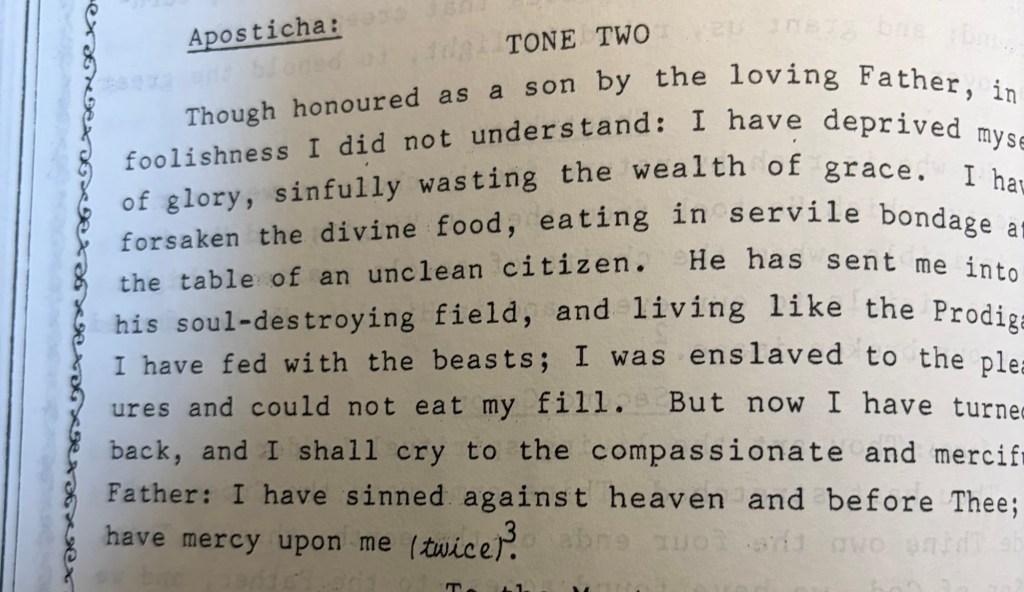
Perhaps another hopeful message from today’s , Wednesday of the 3rd week Tridion, Matins service reminds us that much of what we are doing in repentance is simply returning to our true Home where God welcomes and loves us … not because of what we’ve done or not done … because we are now Home with Him and Love is who He is
Week 3(Lecture 2)
See this article entitled ‘The Grace Of Our Powerlessness” for some materials to help you explore the theme of powerlessness from Lecture 2.
 St John’s Adult Education